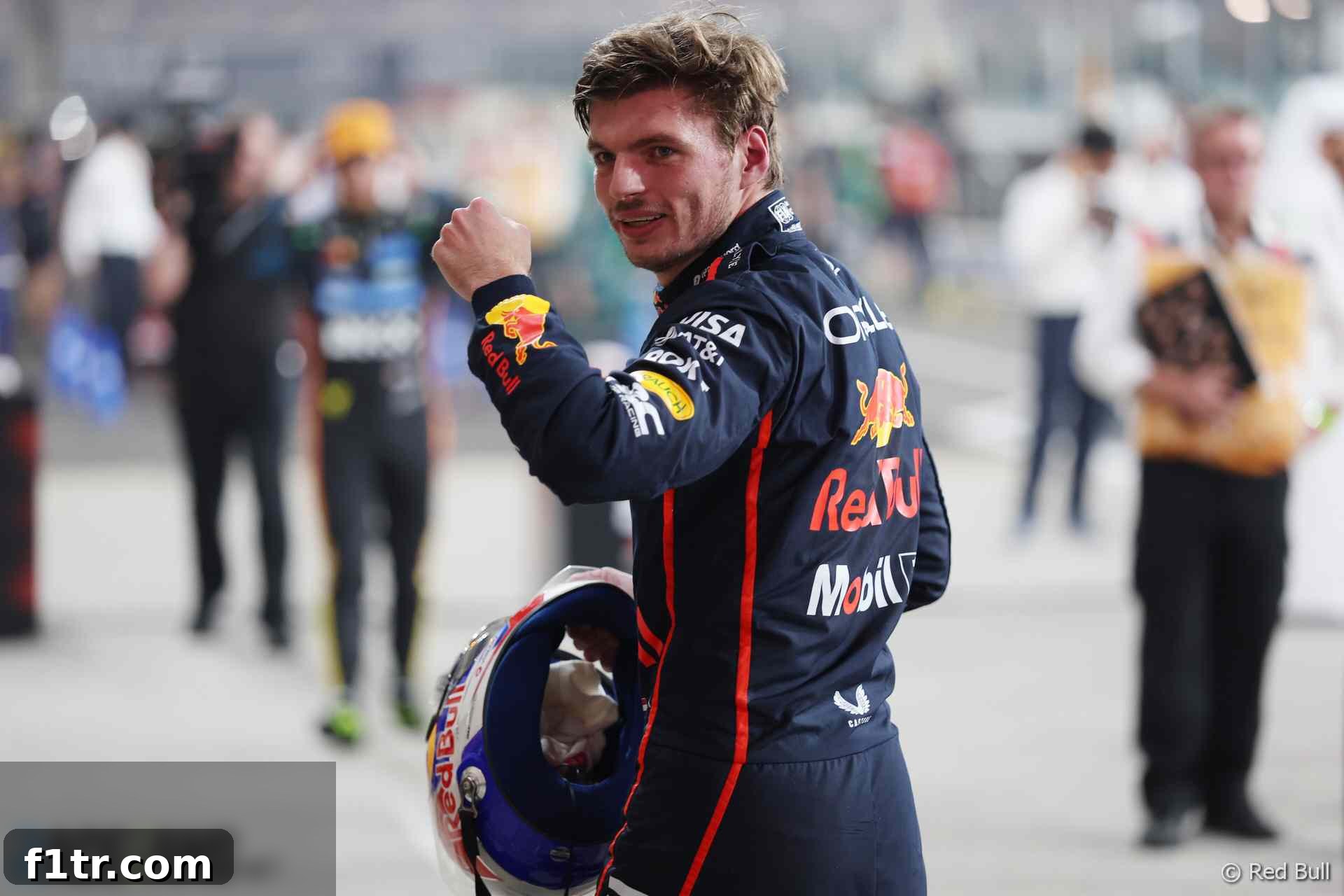
Max Verstappen, the formidable Red Bull driver, recently shed light on an intriguing moment during the critical qualifying session for the championship-deciding Abu Dhabi Grand Prix. He revealed his amusement upon learning of rival George Russell’s highly unusual request to receive a slipstream, or “tow,” from Verstappen during their final laps in Q3. This peculiar request, aimed at gaining a crucial aerodynamic advantage, highlights the intense strategic mind games and competitive spirit at the pinnacle of Formula 1 racing, especially when a world championship hangs in the balance.
The incident unfolded in the nail-biting Q3 session, where every millisecond counts. Mercedes driver George Russell, locked in a fierce battle for grid position, made a rather audacious suggestion to his race engineer, Marcus Dudley, over the team radio. Russell’s message was direct and unexpected: “Try and get me behind Verstappen on his in-lap, he’ll probably give me a tow.” This unusual plea immediately caught the attention of those listening, signaling a bold, if not desperate, strategic move from the Mercedes camp.
A “tow” or slipstream in Formula 1 is a significant aerodynamic advantage gained when one car closely follows another. The lead car punches a hole through the air, creating a zone of reduced air resistance behind it. A following car can then exploit this ‘hole’ to travel at a higher speed with less drag, often resulting in a gain of several tenths of a second per lap, which can be absolutely vital in qualifying. While often employed between teammates, particularly in Q1 or Q2 to help a driver advance, requesting one from a direct rival, especially in a championship decider, is virtually unheard of. It underscores the high-stakes environment and Russell’s determination to find any possible edge.
Unsurprisingly, Verstappen, focused on securing pole position for the season’s ultimate showdown, did not oblige Russell’s request for a slipstream. Red Bull’s lead driver was entirely concentrated on his own performance and the championship implications. However, Verstappen later confirmed that he was indeed aware of Russell’s optimistic suggestion, finding humor in the situation. “I saw, before I went out for the final run, that he said so,” Verstappen told Viaplay, adding with a chuckle, “It makes me laugh.” This reaction from Verstappen painted a clear picture: while appreciative of the audaciousness, helping a rival was never on the cards.
Russell eventually qualified fourth on the grid, placing him behind Verstappen and two of his championship rivals. The grid position itself was respectable, but it clearly wasn’t what Russell had hoped for, prompting his inventive, albeit ultimately futile, request. His motivation, as he later explained, stemmed from a broader strategic outlook concerning the championship scenario. Verstappen entered the race needing to secure a victory, with Lando Norris finishing outside the top three places, to clinch the coveted world title. Russell believed Mercedes could play a spoiler role, or at least get “in the mix,” if they could optimize their grid position.
Speaking to Channel 4, Russell elaborated on his thinking behind the unconventional request. “They need somebody in the mix,” he stated, referring to Red Bull and the championship permutations. “Realistically we didn’t quite have the pace today.” He went on to describe his radio message as “a subtle hint to the Red Bull pit wall to consider it.” It was, in essence, a strategic bluff, a psychological tactic aimed at nudging Red Bull into a potentially advantageous position for Mercedes, even if it meant attempting to elicit a reaction from a rival team. While the immediate objective of receiving a tow didn’t materialize, Russell concluded that fourth place was still “a good place to get involved tomorrow,” signifying his intention to be a factor in the race’s outcome.
The contrast between Russell’s unsuccessful, rival-dependent strategy and Verstappen’s effective, team-backed approach was stark. While Russell was hoping for an unlikely assist, Verstappen benefited from the unwavering support of his own teammate, Yuki Tsunoda. Tsunoda played a crucial role in Red Bull’s qualifying strategy, arranging to provide Verstappen with a tow on his first run in Q3. This is a classic example of intra-team cooperation, where one driver sacrifices their own lap or position to benefit the team’s primary contender, particularly when championship points are at stake.
Verstappen acknowledged the significant help provided by Tsunoda. “It helped, for sure,” he confirmed, recognizing the strategic importance of the slipstream. He expressed profound gratitude for his teammate’s dedication, stating, “He had to sacrifice one of his runs, so I’m of course very happy and thankful that he did that. He’s always been a great team player so I’m very thankful for that.” This highlights the strong bond and strategic alignment within the Red Bull Racing team, where individual ambitions are often aligned with the greater team objective, especially in a championship fight.
However, Verstappen’s pole position wasn’t solely reliant on teamwork. Demonstrating his exceptional skill and the raw pace of his Red Bull car, he managed to further improve his lap time on his final attempt in Q3, notably without Tsunoda’s assistance. This underscores his ability to extract every ounce of performance from the car under immense pressure. “But then I also knew in the final run if I wanted to find a little bit more, I had to really dig deep in the corners and luckily we could find a little bit extra,” Verstappen explained. This blend of strategic teamwork and individual brilliance ultimately secured him the crucial pole position, setting the stage perfectly for the championship decider.
The qualifying session for the Abu Dhabi Grand Prix was a microcosm of Formula 1 itself: a blend of high-speed action, intricate strategy, and intense psychological warfare. George Russell’s bold, if whimsical, request for a tow from Max Verstappen became a memorable footnote, demonstrating the lengths drivers and teams will go to gain an edge. It also emphasized the fundamental difference between seeking assistance from a teammate versus an opponent, especially in a season-defining moment. Verstappen’s response, a mix of amusement and focused determination, perfectly encapsulated the competitive ethos that defines the sport.
As the grid lined up for the championship-deciding race, the implications of these qualifying moments were profound. Russell’s P4 position meant he was strategically placed to potentially influence the outcome, fulfilling his promise to “get involved.” Meanwhile, Verstappen on pole, reinforced by solid teamwork and individual excellence, was in the strongest possible position to execute his championship bid. The dynamic interplay between these drivers and teams underscored the thrilling drama that makes Formula 1 a global spectacle, where every decision, every radio message, and every millisecond on track can alter the course of history.
This dramatic qualifying session served as a perfect prelude to what promised to be an unforgettable championship finale. The events leading up to the race highlighted the razor-thin margins in F1, where strategic gambles, team cohesion, and raw driving talent converge to determine success. As the tension mounted, fans worldwide anticipated a race where these elements would inevitably collide, deciding the ultimate victor of a fiercely contested season.
Stay Connected with RaceFans Insights
Never miss a moment of the action. Receive our latest stories directly in your inbox daily – no marketing, no ads, just pure F1 content. Subscribe now for exclusive updates and in-depth analysis.
Click here to subscribe to our daily newsletter and ensure you stay at the forefront of all Formula 1 news.
Explore More on the Abu Dhabi Grand Prix and Championship Battles:
Delve deeper into the tactical decisions, driver performances, and the unfolding drama that defined this pivotal race and the wider championship season. Understand how every strategic move, every qualifying lap, and every racing incident contributes to the legacy of Formula 1.