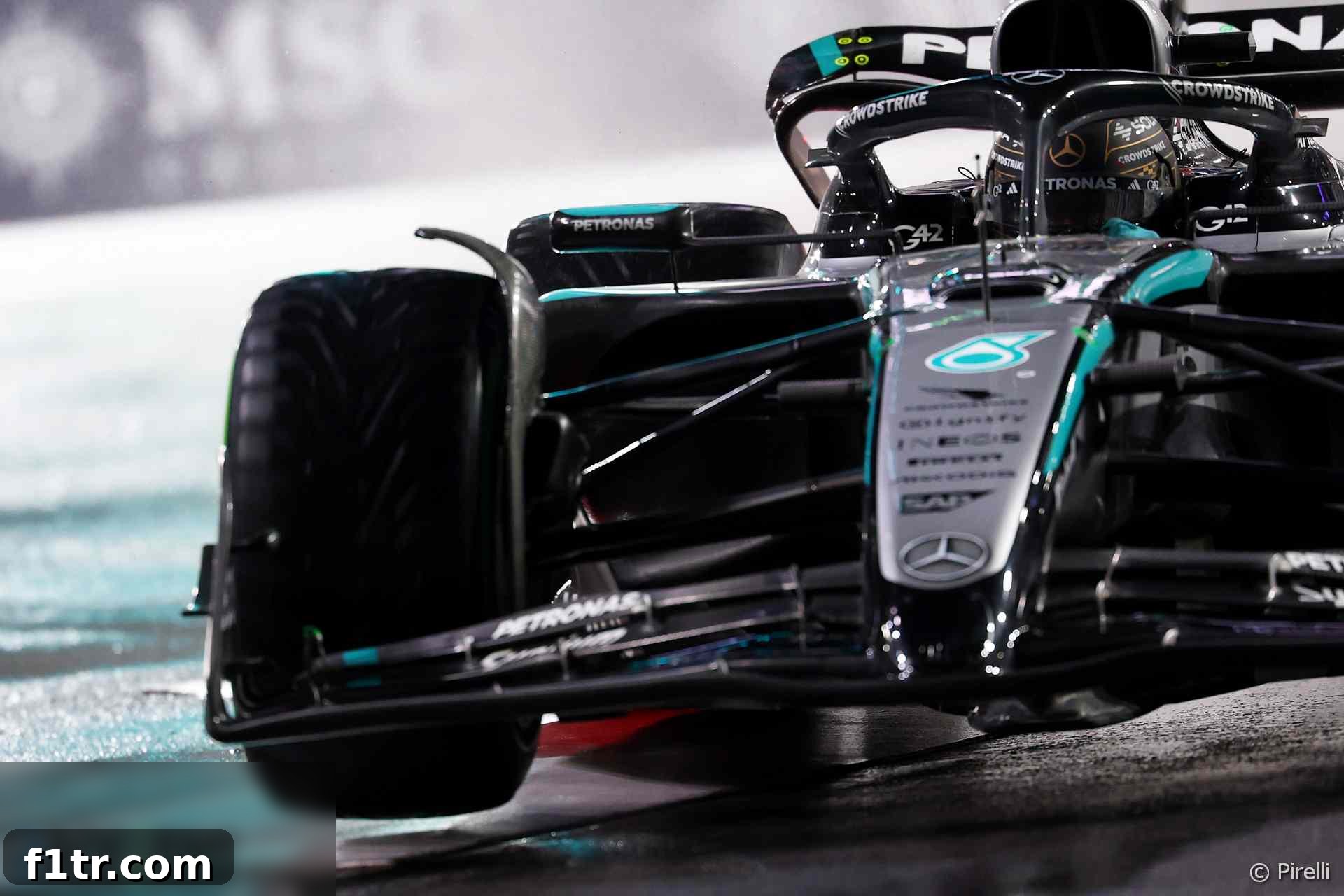
George Russell, a formidable talent in Formula 1, entered the Las Vegas Grand Prix qualifying session with palpable momentum, having showcased exceptional pace throughout the weekend. After confidently topping the final practice session, he carried this impressive form into the crucial qualifying stages, leading both Q1 and Q2. His performance suggested a genuine shot at securing pole position, a feat he had famously achieved in Las Vegas the previous year. The anticipation for a repeat performance was high, promising an exhilarating conclusion to Saturday’s on-track action under the dazzling lights of the Strip.
Advert | Become a Supporter & go ad-free
However, the final, decisive segment of qualifying, Q3, brought an unexpected and frustrating turn for the Mercedes driver. What began as a promising pursuit of pole position quickly unraveled due to a critical technical issue that emerged on his car. Russell revealed that he encountered a significant power steering problem during his crucial laps, an issue that severely hampered his ability to extract maximum performance from the W14 and ultimately left him in a respectable yet disappointing fourth place on the grid.
“I actually had some sort of steering issue,” Russell candidly shared with the official F1 channel after the session, his frustration evident. “The last three laps it felt like I completely lost power steering assistance. It was incredibly challenging to navigate the corners with any precision or speed, especially on a demanding street circuit like Las Vegas.” This sudden loss of essential driver aid transformed the already demanding track into an even greater test of skill and resilience, forcing Russell to battle his compromised machine rather than focusing solely on optimal lap times.
He further elaborated on the severity of the problem, stating, “I was really struggling to turn around the corners. It was a bizarre and unwelcome development. I don’t know what the exact issue was at the time, but it just didn’t come together in Q3 when Q1 and Q2 had been exceptionally solid and I felt genuinely competitive.” The stark contrast between his commanding early sessions and the struggle in Q3 painted a clear picture of a problem that arose suddenly and without warning, derailing what was shaping up to be a standout qualifying effort and leaving the British driver undeniably disappointed.
Initially, Russell was unsure about the precise nature of the malfunction. His immediate instinct was to inform his team to investigate the suspension, suggesting a potential mechanical failure from impact or component stress. Crucially, he confirmed that he had not made any contact with the circuit barriers, eliminating a common cause for such steering or suspension damage. This ruled out driver error as the origin, placing the onus squarely on a potential internal component failure within the car’s complex systems, specifically the power steering unit or its hydraulic counterparts, which are vital for a modern F1 car’s handling.
Despite the considerable setback and the clear frustration, Russell maintained a pragmatic outlook, expressing doubt that he would have claimed pole position even without the power steering issue. His assessment was rooted in a distinct change in the car’s behavior and his personal feeling behind the wheel as the track conditions evolved. “I don’t think we’d have been on pole ’cause I didn’t have a great feeling with the car on the intermediate tyres,” he confessed. He had been fastest in the initial two stages where all drivers utilized full wet weather tyres, but felt a noticeable dip in competitiveness and car balance once the switch to intermediates was made at the end of the session. While the power steering problem undeniably cost him performance, the underlying feeling with the car on the slicker intermediates already presented a challenge. “It was kind of quite annoying,” he concluded, highlighting the double blow of a less-than-ideal setup coupled with a critical mechanical failure during the most crucial part of qualifying.
The team’s engineering director, Andrew Shovlin, provided a more technical explanation of the events that unfolded in Q3, confirming Russell’s account of a debilitating power steering issue. Shovlin detailed how the problem was not an outright failure but rather an inconsistent delivery of assistance, which is arguably even more challenging for a driver to manage than a complete loss. “We had an issue with his power steering halfway through the session where it was providing inconsistent levels of assistance,” Shovlin explained. This intermittency meant Russell could never truly anticipate the level of steering input required, leading to unpredictability in cornering and massive instability, making precision driving nearly impossible at F1 speeds.
The engineering director also shed light on how this mechanical fault compounded other performance challenges, particularly impacting tyre management – a critical factor on the high-speed Las Vegas street circuit. “Fearing that the car wouldn’t make it to the finish of the session with any steering at all, George was forced to continue pushing hard on his penultimate lap,” Shovlin stated. This desperate attempt to bank a competitive time before a potential complete failure had an adverse effect on his tyre temperatures and structural integrity. “This aggressive push meant the tyres were already significantly overheated and past their optimal operating window when he began his final, most crucial attempt.” The delicate balance of tyre temperature and grip was compromised, further exacerbating the impact of the steering problem and preventing Russell from setting a representative lap time on his last chance.
Advert | Become a RaceFans supporter andgo ad-free
Russell’s Radio Messages: A Glimpse into the Q3 Drama
The intense pressure and unfolding crisis in Q3 were vividly captured through the real-time radio communications between George Russell, his dedicated race engineer Marcus Dudley, and team principal Toto Wolff. These exchanges offer a fascinating insight into the immediate diagnosis attempts and the growing frustration as the crucial final laps slipped away. The transcript reveals the raw, unfiltered dialogue as Russell battled his car while simultaneously trying to convey the complex technical issue to his team under immense pressure.
| Russell | (Approaching turn five) Check suspension. I feel something strange on the front end of the car, very unresponsive. |
| Dudley | Looks okay at the moment from our data, George. Nothing immediately apparent from the sensors. |
| Russell | I’ve got a problem on the front. It’s the steering. It’s really heavy at times, then suddenly light, very inconsistent. |
| Dudley | We still don’t see anything unusual in the telemetry data, George. Can you be more specific on the sensation? |
| Russell | There’s something not right. Check hydraulics, please. Just keep an eye on it, it’s definitely something there. It’s making the car incredibly difficult to place. |
| Dudley | Affirm. We’re monitoring all systems closely for any anomalies. So there’ll be one more lap remaining after this one. We’ll have strat two out of the final corner for optimal energy deployment. (Russell begins final lap) |
| Russell | (Russell finishes his final lap, palpable frustration in his voice) I don’t know what’s happened to the steering, something’s broken on the front end. I couldn’t drive it properly at all. |
| Dudley | Understood, George, understood. We’ll investigate thoroughly once you’re back in the garage. Don’t worry about it now. |
| Russell | Fuck. |
| Dudley | So Verstappen on pole position, approximately half a second ahead. Sorry, my mistake, it’s Norris on pole, about nine tenths to him. |
| Russell | Are we fourth, or where are we? What’s the final position? |
| Dudley | Still fourth, yes, P4. So Norris P1, Verstappen P2, and then Sainz P3. A strong result despite the issues you faced. |
| Dudley | George, did you make any contact with the wall at all or did you just feel… We need to confirm for our checks. |
| Russell | I didn’t, no. No contact whatsoever with any barriers. |
| Dudley | …something strange with the suspension? Copy? Just for clarity on our diagnostics. |
| Russell | I didn’t touch the wall. Initially I thought it was hydraulics, but it felt much more like a power steering failure, or at least a very inconsistent delivery of assistance. |
| Russell | Yeah, that’s a real shame after the pace we showed in Q1 and Q2. It was looking so good to challenge for the front row. |
| Dudley | Yeah, absolutely. But still a long way to go tomorrow, though. P4 is a strong starting position on this circuit, plenty of opportunities. |
| Russell | Yeah, for sure. We’ll fight hard from there. |
| Wolff | George, was the grip significantly worse for you on those intermediate tyres in Q3 compared to the earlier sessions on wets? |
| Russell | Yeah, I couldn’t get the car working as effectively as I could on the full wet tyre. And then on top of that, the last two laps I had that severe steering issue which complicated everything further. |
| Wolff | Good job to keep it on the road under those circumstances, George. Very well managed with such a critical fault. |
| Russell | Yeah, for sure. Race tomorrow is where it counts. We move on and focus on that now. |
The dialogue paints a vivid picture of a driver grappling with a critical mechanical failure while pushing to the absolute limit. Russell’s immediate thoughts turned to suspension and hydraulics, reflecting the severity of the feedback he was receiving through the steering wheel. The initial lack of corresponding telemetry data presented a challenge for the engineers, highlighting the nuanced and often unpredictable nature of intermittent technical glitches in high-performance machinery. Despite the profound disappointment, both Dudley and Wolff provided words of encouragement, shifting focus immediately to the race day and the opportunities that still lie ahead from a strong P4 starting position.
Starting from the second row of the grid in Las Vegas offers George Russell a decent platform for the Grand Prix, despite the frustrations of qualifying. The unique characteristics of the Las Vegas Street Circuit, with its exceptionally long straights and tight, technical corners, mean that overtaking opportunities will present themselves, particularly with the benefit of DRS zones. While the power steering issue undoubtedly robbed him of a potential front-row start, perhaps even pole, securing P4 demonstrates the underlying pace of the Mercedes W14 and Russell’s exceptional skill even when compromised. His ability to maintain control and push on despite the inconsistent steering assistance speaks volumes about his talent and mental fortitude, turning what could have been a disaster into a credible starting position.
The immediate challenge for Mercedes will now be to thoroughly diagnose and rectify the power steering problem ahead of the race. Ensuring the car is in perfect working order will be paramount for Russell to capitalize on his starting position and battle for significant points, or even a podium finish, in what is expected to be a high-octane race. The competitive nature of Formula 1 means every tenth of a second and every percentage of car performance is vital, and a repeat of the steering issue would be catastrophic. This qualifying setback, while disheartening, sets the stage for a compelling Sunday, where Russell will aim to prove his resilience and extract the maximum possible result for his team, turning a qualifying disappointment into a race day triumph under the dazzling Vegas lights.
Advert | Become a RaceFans supporter andgo ad-free
Miss nothing from RaceFans: Your Daily Dose of F1 News and Analysis
Get a daily email with all our latest stories – meticulously curated and delivered straight to your inbox. No marketing emails, no intrusive ads, just pure Formula 1 content. Sign up here to stay ahead of the curve:
More from the 2025 Las Vegas Grand Prix
Delve deeper into the thrills and spills of the Las Vegas Grand Prix with our extensive coverage. Explore more articles related to this spectacular event, including driver reactions, technical analyses, and race strategies:
- Losing win through strategy error “hurts more” than Las Vegas disqualification – Piastri
- FIA feels McLaren’s Las Vegas GP disqualification is “draconian”, claims Brown
- Why did McLaren’s messages to Norris and Piastri not mention plank problems?
- McLaren explain Las Vegas disqualifications – including their “counterproductive” reaction
- McLaren’s first double disqualification ended their second-longest points streak
Browse all 2025 Las Vegas Grand Prix articles