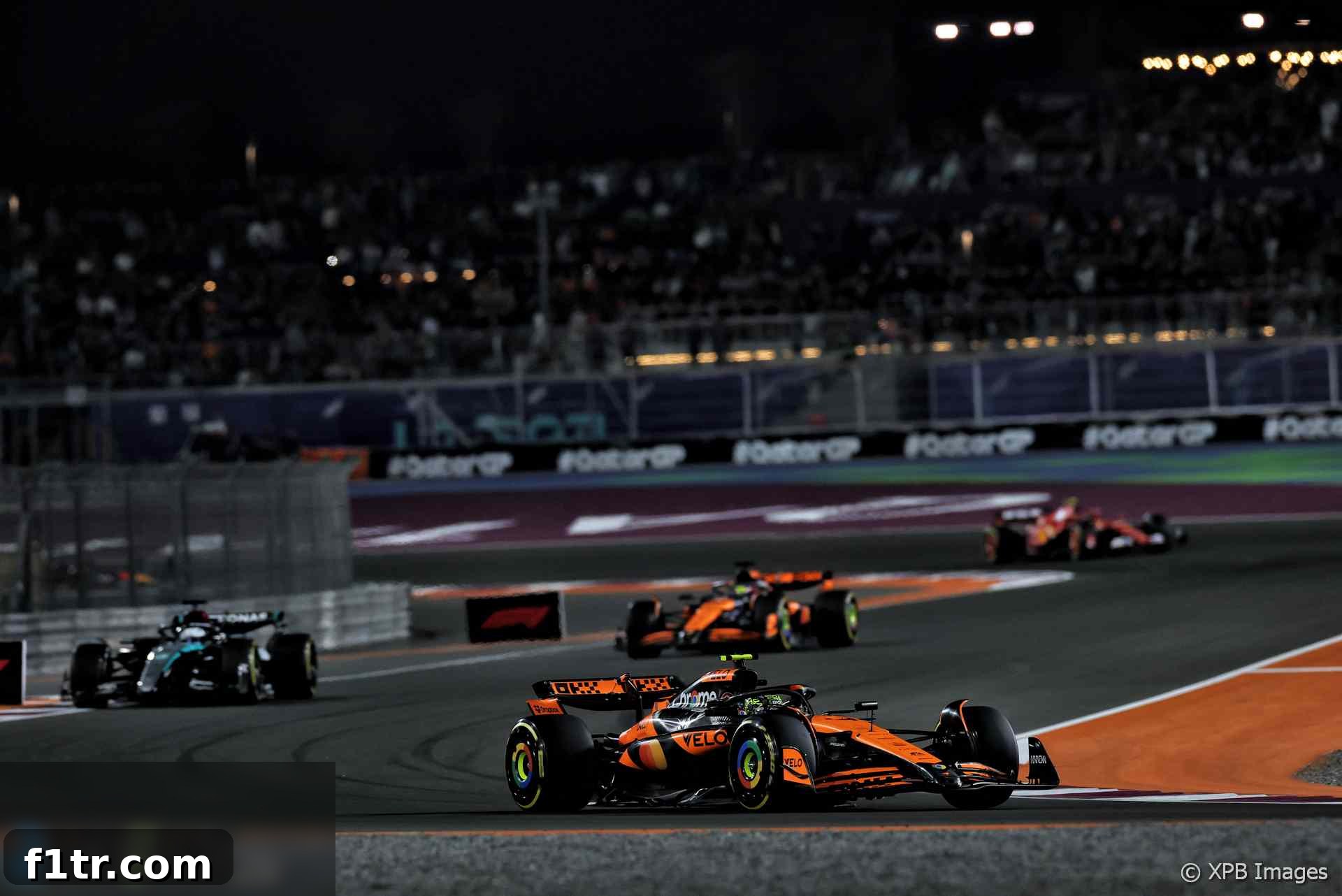
Lando Norris Receives Yellow Flag Penalty at Qatar GP: A Deep Dive into the Controversial Incident
The 2024 Qatar Grand Prix delivered high-octane drama and a moment of significant controversy involving McLaren’s rising star, Lando Norris. Despite showcasing formidable pace throughout the race, Norris found himself at the receiving end of a stringent penalty from the race stewards for failing to adequately slow down under double-waved yellow flags. This incident not only marred his individual performance but also carried weighty implications for the fiercely contested Constructors’ Championship between McLaren and Ferrari, adding another layer of intrigue to an already thrilling Formula 1 season. The decision sparked immediate discussion about driver awareness, the strict enforcement of safety regulations, and the fine margins that define success and failure at the pinnacle of motorsport.
The Incident Unfolds: Debris, Flags, and the Penalty
Advert | Become a Supporter & go ad-free
The pivotal moment occurred when a crucial piece of debris, later identified as a mirror from Alexander Albon’s car, detached and lay exposed on the pit straight as drivers approached Turn 1. This hazardous obstruction necessitated the deployment of double-waved yellow flags, a critical signal demanding drivers to significantly reduce speed and be prepared to stop. For his failure to comply with this vital safety directive, the McLaren driver was issued a 10-second stop-go penalty – one of the most severe sanctions available to the stewards. This type of penalty requires a driver to enter the pits, stop their car for the specified duration, and then rejoin the race, often costing them considerable track position and time. The severity underscores the paramount importance placed on adhering to yellow flag protocols in Formula 1.
Complicating matters, race control initially displayed yellow flags in response to the debris but then briefly withdrew them before reinstating them. This fluctuating signal might have contributed to the confusion, though it does not absolve a driver of their ultimate responsibility to observe trackside warnings. The presence of Albon’s mirror on the racing line for several laps prior to the penalty decision highlighted a potential delay in hazard removal, raising questions about race management procedures in such high-speed environments.
Norris’s Immediate Reaction and Honest Assessment
In the immediate aftermath of the penalty, a candid Lando Norris expressed genuine bewilderment regarding the infringement. Speaking to Sky Sports, he stated, “Honestly, I don’t know what I’ve done wrong at the minute under the yellow.” His comments painted a picture of a driver caught off guard, suggesting a possible failure in visual observation or communication rather than a deliberate disregard for safety protocols. He further elaborated, “I’m not an idiot. If I knew there was a yellow I would have slowed down. I don’t know if I missed it or just been dumb.” This raw admission reflects the intense focus required in an F1 cockpit, where split-second decisions and constant monitoring of multiple information streams are the norm.
Despite his initial confusion, Norris demonstrated maturity and an understanding of the sport’s unyielding rules. He quickly accepted the stewards’ decision, acknowledging the non-negotiable nature of safety regulations. “The rule is, if you don’t slow down in the yellow, that’s a penalty,” he confirmed. “So it’s a fair penalty.” This acknowledgement, even in the face of a personally costly error, highlighted his professionalism and respect for the regulations designed to protect all participants on track. It’s a testament to the discipline required in Formula 1, where personal feelings often must yield to the strict letter of the law for the collective good.
The Stewards’ Verdict: Unwavering Commitment to Safety
The official communication from the stewards left no room for ambiguity regarding the justification for the penalty. Their investigation, based on comprehensive data analysis, presented irrefutable evidence against Norris. The statement highlighted that “The telemetry and on-board audio clearly showed that the driver of car four [Norris] did not make any reduction in speed in the yellow sector.” This use of advanced telemetry data provides an objective measure of driver behavior, leaving little room for subjective interpretation. Furthermore, the stewards noted, “The double waved yellow flags and yellow lights were clearly visible to him,” indicating that both physical flag signals and electronic light panels around the circuit should have alerted the driver.
The stewards’ reasoning reiterated the fundamental principle underpinning such regulations: “Compliance with the yellow flag rules is paramount for the safety of all parties and this requirement is clearly noted in the first item of the race director’s event notes at every event.” This emphasis on safety is non-negotiable in Formula 1, where speeds are extreme and the risk of injury from debris or stationary cars is constant. Any lapse in adherence to these rules can have catastrophic consequences, which is why breaches are met with severe penalties like the one imposed on Norris. The ruling serves as a stark reminder to all drivers that vigilance under yellow flag conditions is not merely a suggestion but an absolute requirement, foundational to the integrity and safety of the sport.
Impact on the Constructors’ Championship and Norris’s Regret
At the time of his infringement, Lando Norris was running in a strong second position, poised to secure a significant points haul for McLaren. The 10-second stop-go penalty, however, drastically altered the outcome, pushing him down the order and ultimately denying McLaren crucial championship points. This directly benefited Ferrari, their closest rivals, who were able to reduce McLaren’s hard-earned lead in the Constructors’ Championship. The championship battle, now even tighter, was effectively pushed to the very last race of the season, intensifying the pressure on both teams and their drivers.
Norris openly expressed his profound disappointment in his performance and the repercussions for his team. “Of course it’s an opportunity missed, that’s quite obvious,” he lamented. He acknowledged the exceptional effort from his team, stating, “The team gave me a great car today, so I’m thankful for the team. Disappointed that I couldn’t have done a worse job than I did today and not give them the points they deserved so I’ve made the job of the team much harder than it needs to be.” His words reflect the immense pressure and responsibility drivers feel not just for their own results but for the collective success of their entire team, especially in a tight championship fight. The incident served as a painful reminder of how a single error can have far-reaching consequences in the high-stakes world of Formula 1.
In addition to the time penalty, the stewards also imposed three penalty points on Norris’s super licence. While these were his first penalty points within the current 12-month period, accumulating 12 points within this timeframe results in a race ban. This adds another layer of consequence to such infringements, pushing drivers to maintain impeccable records throughout the season and further emphasizing the gravity of yellow flag violations.
Understanding Yellow Flags: The Cornerstone of F1 Safety
The yellow flag system is one of the most critical safety mechanisms in Formula 1, designed to protect drivers, marshals, and spectators alike. When marshals or race control detect a hazard on or near the track – be it debris, a stalled car, or an accident – yellow flags are deployed. A single waved yellow flag signifies a hazard, requiring drivers to slow down, be prepared to change direction, and avoid overtaking. However, a double-waved yellow flag, as seen in Norris’s case, indicates a more severe hazard, such as a car on the track or marshals working nearby, and demands a significant speed reduction and the readiness to stop. In modern F1, these physical flags are augmented by electronic light panels around the circuit and dashboard displays in the cars, providing multiple layers of warning.
Beyond the simple yellow flag, Formula 1 employs other graduated safety measures, including the Virtual Safety Car (VSC) and the Safety Car. The VSC is activated for less severe incidents where cars can still safely drive at a reduced, pre-determined pace, maintaining gaps between competitors. The full Safety Car is deployed for more serious incidents requiring track clear-up or medical attention, neutralizing the race entirely by bunching up the field behind a safety vehicle. These systems are meticulously designed to manage varying levels of danger, but the fundamental responsibility for reacting to a yellow flag lies squarely with the individual driver, who must always prioritize safety over competitive gain. The incident involving Norris serves as a potent reminder that even a momentary lapse can have significant consequences, reinforcing the absolute necessity of driver vigilance at all times on track.
Advert | Become a RaceFans supporter andgo ad-free
Conclusion: Lessons Learned and Forward Focus
The Lando Norris yellow flag penalty at the Qatar Grand Prix stands as a significant moment, not just for the driver and McLaren, but for illustrating the unwavering commitment of Formula 1 to safety regulations. While Norris’s explanation suggested a failure of perception rather than intent, the objective evidence and the strict application of rules underscored that such errors cannot go unpunished. The incident significantly impacted McLaren’s championship aspirations, transforming a potential podium finish into a setback and ensuring the Constructors’ battle would reach a thrilling crescendo in the season’s final race.
As the Formula 1 season progresses, the Qatar penalty serves as a powerful reminder to all drivers: the yellow flag rules are sacrosanct. They are the bedrock of safety in a sport that constantly pushes the boundaries of speed and technology. For Norris, it was a harsh but ultimately fair lesson, which he openly accepted. The focus now shifts to the upcoming races, where McLaren, fueled by this experience, will undoubtedly be pushing harder than ever to secure every possible point and cap off a remarkable season with the Constructors’ title.
Miss nothing from RaceFans
Get a daily email with all our latest stories – and nothing else. No marketing, no ads. Sign up here:
2024 Qatar Grand Prix
- Horner ‘believes 100%’ Verstappen did not threaten to crash into Russell
- Russell and Verstappen cast new light on clash which triggered explosive row
- Hamilton’s puncture not caused by mirror debris – Mercedes
- Another start-to-finish win shows Qatar GP could be F1’s most processional race
- “Am I dead last now?” Unheard radio from Hamilton’s disastrous Qatar GP
Browse all 2024 Qatar Grand Prix articles