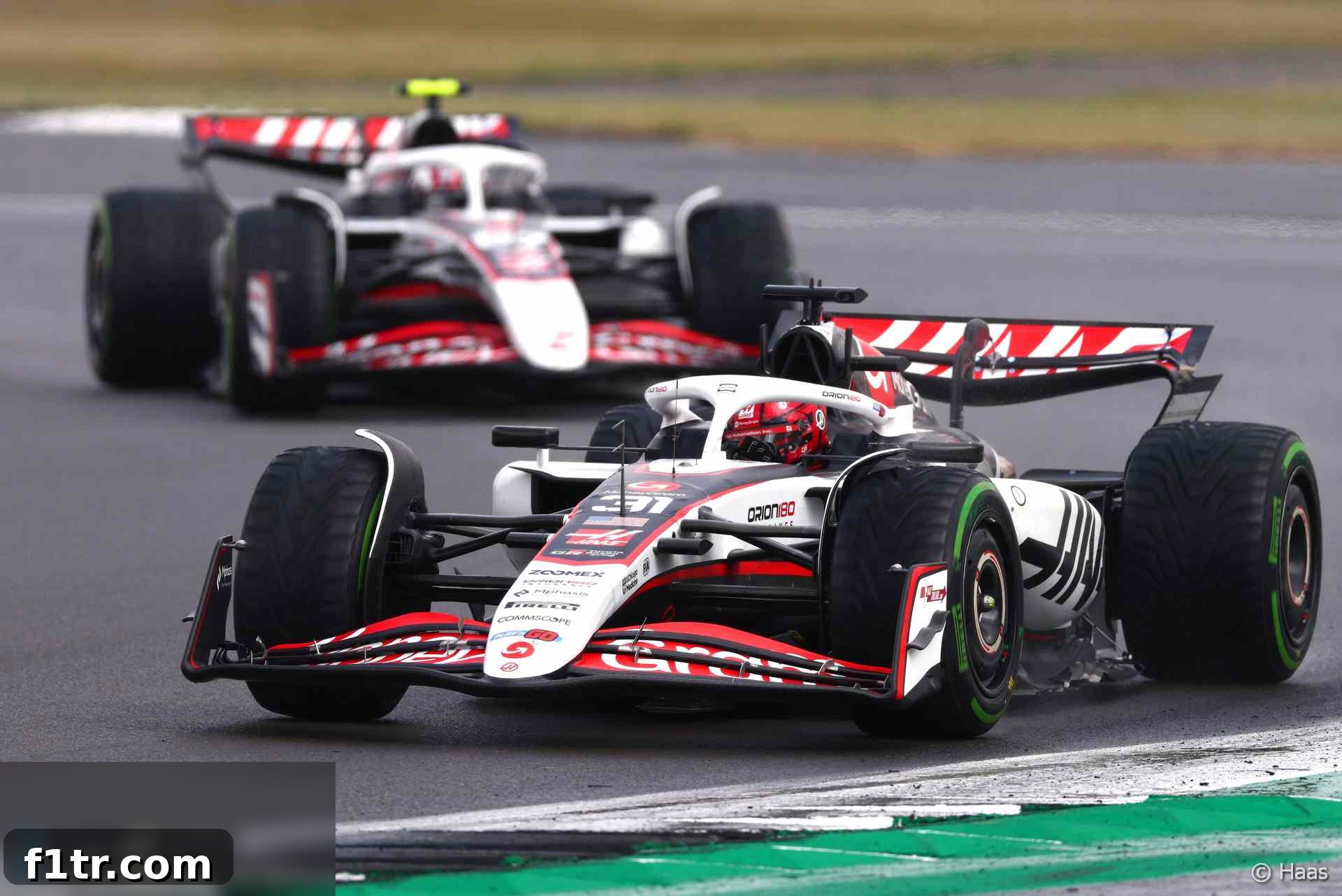
In the high-stakes world of Formula 1, where milliseconds define victory and defeat, an internal collision between teammates can be a catastrophic blow. Such was the case at Silverstone, where the Haas F1 team experienced a moment that encapsulated their weekend’s frustrations. Team Principal Ayao Komatsu, reflecting on the incident, accepted that neither of his drivers, Oliver Bearman nor Esteban Ocon, was primarily to blame for the contact that ultimately derailed their race. Yet, his candid assessment went deeper, pointing towards a systemic failure within the team to extract the maximum performance from their upgraded car throughout the entire Grand Prix weekend.
Haas’s Missed Opportunity at Silverstone: A Weekend Under Scrutiny
The British Grand Prix at Silverstone held significant promise for Haas. The team arrived with a much-anticipated upgrade package for their car, a crucial development aimed at improving their competitive edge in the fiercely contested midfield. Early signs were positive: Oliver Bearman, a rising talent, expertly navigated the challenges of qualifying to propel his Haas into Q3, initially securing an impressive seventh position on the grid. This was a remarkable achievement, showcasing the potential of the new upgrades and Bearman’s skill behind the wheel. However, the optimism was short-lived. A subsequent penalty relegated Bearman to 18th place, a harsh blow that stripped the team of a prime starting position.
Esteban Ocon, the team’s other experienced driver, also struggled to convert the car’s potential into a strong grid slot, qualifying 15th. The qualifying session, despite Bearman’s momentary brilliance, highlighted a lingering issue: the inability to consistently capitalize on opportunities and avoid setbacks. This initial struggle set the stage for a race day fraught with challenges.
The race itself saw both drivers finish outside the points, their efforts undone by the very collision that Komatsu addressed. His post-race comments were stark and uncompromising. “We executed a terrible race today,” Komatsu stated, his words reflecting the palpable disappointment within the team. “We have to be better.” This wasn’t merely a critique of the drivers or a single incident, but a broader indictment of the team’s overall execution. He emphasized that the upgrade had indeed provided them with “a strong car,” but lamented that they “didn’t do justice to the car or the team” during the Grand Prix weekend.
Komatsu’s call for improvement extended beyond the immediate race. “It’s not just today, as a whole we need to focus on how we get a clean weekend together,” he urged. This underlines a fundamental principle in Formula 1: success is not just about raw pace, but about consistent, error-free execution from Friday practice through to the checkered flag on Sunday. Starting from disadvantaged positions like P14 and P18, as was the case for Haas, inevitably forces drivers into desperate measures and higher-risk scenarios. The team principal’s message was clear: focus on “executing three clean days on a race weekend and getting the result that our car deserves.”
The Collision at Brooklands: A Moment of Shared Misfortune
The pivotal moment of Haas’s British Grand Prix unfolded at Brooklands, a challenging corner at the iconic Silverstone circuit. The conditions were treacherous, with parts of the track still damp, creating a narrow, elusive dry line that drivers fiercely competed for. Both Haas drivers found themselves embroiled in a battle with the Williams cars, a familiar midfield scrap where every position is hard-won. As they navigated the damp section, Oliver Bearman moved alongside Esteban Ocon, attempting an overtake. In a split second, the two Haas cars made contact, an incident that sent shockwaves through the garage and effectively ended their hopes of scoring points.
For any team principal, witnessing two of your own cars collide is a nightmare scenario. Komatsu articulated this sentiment perfectly: “Our drivers touching is the last thing that should happen.” However, his immediate reaction was not one of blame, but of thorough investigation. After reviewing the onboard footage from both cars and engaging in direct conversations with Bearman and Ocon, Komatsu concluded it was a “racing incident.” This assessment is crucial, distinguishing between deliberate aggression or gross negligence and an unavoidable consequence of competitive racing under difficult circumstances.
Komatsu delved deeper into the sequence of events leading up to the collision. He explained that the pit stop timings for their respective stops were strategically sound, with the leading car (Bearman at that point) pitting first. However, a subsequent off-track excursion by Bearman in a high-speed corner meant that when Ocon emerged from his pit stop, he was now ahead of his teammate. Bearman, having just pitted, found himself with hotter, more optimal tires compared to Ocon. This differential in tire temperature and grip presented an immediate opportunity for Bearman to attempt an overtake. While the attempt was rational given the circumstances, Komatsu reiterated, “we shouldn’t have been in that position to start with. It just shouldn’t happen.”
Komatsu also took the opportunity to praise his drivers’ professionalism. He noted that in previous instances where differing speeds or strategies necessitated a swap in track position, both drivers had demonstrated exemplary teamwork. “When they had different speeds or strategies, we’ve been swapping them over, and they’re complete team players – they don’t argue, and they do the job straight away.” This highlights the trust and respect within the team, making the collision even more regrettable. Despite the incident being deemed a racing one, Komatsu vowed, “we’ll make sure it doesn’t happen again,” emphasizing the need for learning and prevention.
Stewards’ Verdict: A Comprehensive Analysis of a Challenging Situation
The stewards, the independent arbiters of racing infractions, meticulously reviewed the incident. Their role is to assess driver conduct against established sporting regulations and guidelines, taking into account all relevant factors. Their decision echoed Komatsu’s assessment: neither driver was found to be solely responsible for the collision, and consequently, no penalty was issued.
The official stewards’ notes provided a detailed account: “In damp conditions, car 87 [Bearman] attempted to overtake car 31 [Ocon] on the inside at turn six and collided with car 31.” Crucially, both drivers corroborated the significant role of the track conditions. They informed the hearing that “the track conditions contributed significantly to the incident given that they were both driving on slicks on a damp track.” The inherent challenge of navigating a partially wet circuit on dry-weather tires, fighting for the narrow “dry line,” was a central theme in their testimony. As they both contended for this single car’s width of optimal grip, they inevitably converged, leading to the collision that saw both cars spin off track.
The drivers’ mutual assessment that it was a racing incident, with “no driver wholly or predominantly to blame,” significantly influenced the stewards’ final decision. While car 87 (Bearman) appeared to have a “legitimate claim to the corner at the apex under the Driver Guidelines,” the stewards took a holistic view. They carefully considered “the prevailing track conditions, the available grip, and the respective positions and dynamics of both cars at the time.” These complex factors painted a picture not of individual culpability, but of a confluence of challenging circumstances. The stewards concluded that “the collision was the result of a convergence of movement from both drivers under challenging circumstances, rather than any one driver being predominantly at fault.” Furthermore, they acknowledged that “the situation did not reasonably allow car 31 [Ocon] to take a significantly wider line to avoid the contact,” absolving him of significant blame for not being able to yield more space.
Ultimately, the stewards stated, “We were therefore unable to establish that one driver was wholly or predominantly to blame and agreed with the assessment of the drivers that this was an (unfortunate) racing incident. We accordingly took no further action.” This ruling underscores the complexity of racing incidents, particularly in marginal conditions, where the line between aggressive driving and unavoidable contact can be incredibly fine. It also highlights the importance of driver testimony and a comprehensive understanding of the racing environment in determining fault.
Lessons Learned and Future Outlook for Haas F1
The Silverstone collision, while officially deemed a racing incident, serves as a significant learning experience for the Haas F1 team. Beyond the immediate disappointment of missed points, such events carry broader implications for team dynamics, morale, and financial resources due to potential repair costs. For a team like Haas, operating with a more constrained budget compared to the sport’s giants, every lost opportunity for points and every dollar spent on repairs is amplified. The incident prompts a thorough internal review, not just of driver conduct, but of strategic decisions, communication protocols, and overall operational efficiency during race weekends. The pursuit of “a clean weekend” as articulated by Ayao Komatsu becomes paramount.
The stewards’ decision to impose no penalties, while validating the “racing incident” nature, does not absolve the team of the need to prevent such occurrences. It reinforces the importance of clear team orders, especially when drivers are on differing strategies or have a significant tire advantage, to manage track position without resorting to high-risk overtakes between teammates. The positive aspect remains the drivers’ “complete team players” attitude, which suggests that the incident will likely be addressed maturely and constructively internally rather than festering into animosity. The focus will now undoubtedly shift to ensuring such a scenario does not repeat, allowing Haas to fully exploit the potential of their upgraded car and consistently deliver the results it deserves in the competitive midfield battle.
What’s Your Take on the Haas Collision?
The debate around racing incidents is as old as motorsport itself. While the stewards ruled it an unfortunate racing incident with no single driver predominantly at fault, public opinion often offers varied perspectives. We invite you to consider the circumstances: the damp track, the fight for the dry line, the differing tire temperatures, and the inherent risks of wheel-to-wheel racing. Should either Oliver Bearman or Esteban Ocon have faced a penalty for their contact at Silverstone? Cast your vote and share your detailed thoughts in the comments section below.
Should Bearman or Ocon have been penalised for their collision?
- No opinion (8%)
- Strong penalty for Ocon (6%)
- Light penalty for Ocon (4%)
- No penalty for either driver (64%)
- Light penalty for Bearman (19%)
- Strong penalty for Bearman (0%)
Total Voters: 53
Please note: A RaceFans account is typically required to participate in polls. If you do not have one, you might need to register an account or read more about the registration process to access full interactive features. Once a poll is closed, only the final results are displayed.
Don’t Miss a Moment from RaceFans!
Stay updated with all the latest stories, news, and analyses from the world of Formula 1 and motorsport. Get a daily email with our newest content – no marketing, no ads, just pure racing insights straight to your inbox. Sign up here:
Explore More from the 2025 British Grand Prix
For more in-depth coverage, analysis, and news from this thrilling event, delve into our collection of articles related to the 2025 British Grand Prix:
- Tsunoda says the stewards have “not been nice to me” as penalty points mount up
- ‘I’ve considered Hulkenberg an exceptional talent for a very long time’ – Wheatley
- Alpine is now F1’s highest scoring last-placed team of all time: British GP stats
- Ferrari had no GPS data from Hamilton’s car throughout British Grand Prix
- “The risk for us is a Safety Car”: Why Norris’s win was in danger for six laps
Browse all 2025 British Grand Prix articles