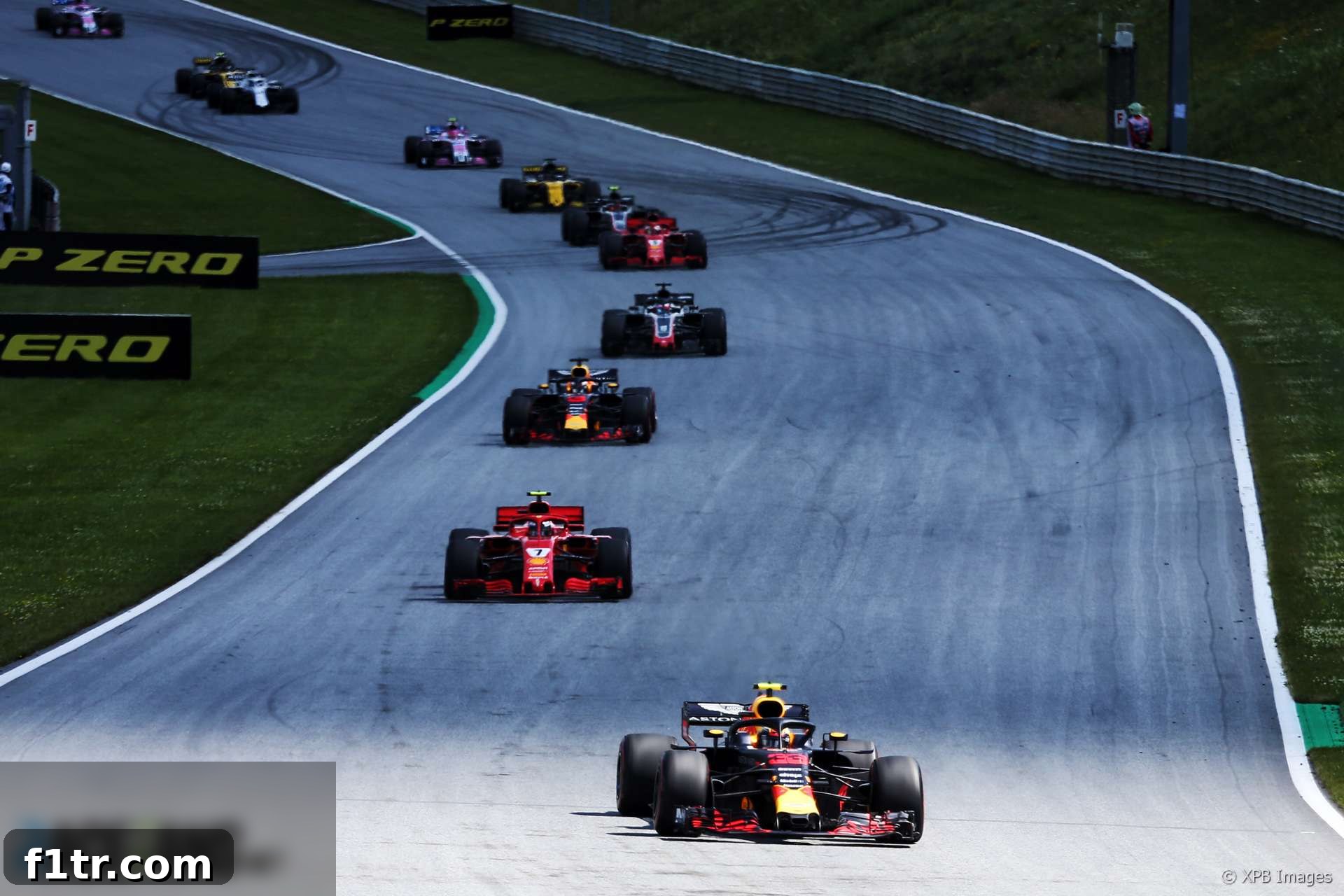
The 2018 Formula 1 season had, for many of its early races, been defined by a series of costly errors for Max Verstappen. These missteps often led to DNFs, significant loss of points, and on occasion, forfeited victory opportunities. Facing persistent scrutiny and repeated questions about his string of incidents, Verstappen fiercely defended his signature maximum-attack driving style, pushing back against critics who suggested he should temper his approach.
However, as the season progressed, a notable shift began. Verstappen systematically started to iron out these errors, a change that culminated spectacularly for both him and Red Bull Racing at their home race, the Austrian Grand Prix. This victory marked a significant turning point, not only validating Verstappen’s unwavering philosophy but also showcasing Red Bull’s potent capabilities on a day riddled with drama and strategic blunders from their rivals.
Mercedes’ Early Scramble and Ferrari’s Bold Move
Race day at the picturesque Red Bull Ring dawned with unexpectedly high temperatures, a factor that would profoundly influence tyre degradation and race strategy. Red Bull team principal Christian Horner light-heartedly credited team owner Dietrich Mateschitz for “turning the heater up,” hinting at the advantage the warmer conditions might provide his squad. As events unfolded, his prediction proved remarkably accurate.
On paper, Red Bull should not have been in contention for a win. Neither of their drivers had managed to out-qualify the dominant Mercedes or the formidable Ferraris. Mercedes had locked out the front row, with Ferrari occupying the second. It was only due to a three-place grid penalty for Sebastian Vettel – incurred for impeding Carlos Sainz Jnr in Q2 due to a communication lapse from his engineer – that Verstappen was elevated to the second row, directly ahead of the Ferrari ace. This was the first of several critical errors by other teams that would inadvertently swing circumstances in Verstappen’s favour.
As the lights went out, pole-sitter Valtteri Bottas, who had confidently remarked that “a driver needs to make a particularly poor start to be passed on the short run to Turn One,” ironically demonstrated this very scenario. From second on the grid, Lewis Hamilton made a sufficiently strong start to pull alongside his Mercedes teammate. However, it was third-placed Kimi Raikkonen, starting on softer compound tyres, who launched off the line with ferocious speed, boldly diving between the two Silver Arrows.
For a fleeting moment, the circuit held its breath, anticipating a potential repeat of the dramatic multi-car collision seen in Singapore the previous year. Yet, this time, all three drivers navigated the opening metres with professional precision, giving each other just enough room. Hamilton emerged at the front, leading Raikkonen up the hill, while Verstappen seized the opportunity to demote Bottas. Mercedes had been acutely aware of Ferrari’s superior traction out of Turn Three, so a collective sigh of relief must have swept through their garage when Raikkonen momentarily slithered wide at the corner, releasing Hamilton from immediate pressure.
This momentary lapse from Raikkonen presented Verstappen with a golden opportunity, allowing him a clear run down the inside of the Ferrari as they approached Turn Four. Raikkonen, perhaps overly focused on defending against the Red Bull, squeezed Verstappen onto the grass. In this intense battle, both drivers were momentarily distracted, creating a window for Bottas to serenely sweep around the pair, re-establishing a Mercedes one-two and seemingly restoring order to the race.
Having nearly gone from third to first, Raikkonen then slipped back to fourth when he turned into Turn Seven just as Verstappen was executing an incisive dive on his inside. The two cars made contact, prompting Raikkonen to back off, which allowed Verstappen to complete the move and claim third position, demonstrating his aggressive yet precise race craft.
Mercedes’ Strategic Meltdown Gifts Verstappen the Lead
As lap two commenced, the Mercedes pair appeared to be settling into their customary one-two formation, trailed closely by Verstappen, Raikkonen, and Daniel Ricciardo, who had impressively gained two positions on the chaotic opening lap. Vettel, hampered by his grid penalty, was initially stuck behind the quick Haas duo. However, demonstrating Ferrari’s raw pace, he dispatched them on consecutive laps and rapidly closed onto the tail of the leading quintet.
The soaring track temperatures posed a formidable challenge, making a conventional one-stop strategy exceptionally difficult. For the strategists, determining the absolute earliest a driver could pit and realistically run to the finish was paramount. The prospect of an early Safety Car or Virtual Safety Car (VSC) period loomed, presenting a potentially career-defining decision: should they capitalize on the immediate opportunity to pit, or risk staying out?
Towards the end of lap 10, Nico Hulkenberg reported a developing engine issue. His team urged him to pit, but he flashed past the pit lane entrance just as the warning was given. As thick plumes of smoke began to billow from his yellow Renault, Hulkenberg initially seemed to consider stopping alongside the pit wall, a move that would have instantly triggered a full Safety Car. Instead, he prudently pulled off into the Turn One run-off area, allowing race control to keep the race under green flag conditions.
However, just two laps later, the situation drastically changed, sparked by the most astonishing of reasons. One of the hitherto bulletproof Mercedes cars had ground to a halt. A catastrophic loss of hydraulic pressure forced Bottas to retire. Ironically, the subsequent Virtual Safety Car period, necessitated by his car’s recovery, would indirectly — and tragically — ruin the race for the other Mercedes.
Mercedes had already thrown away a potential win under VSC conditions earlier that year in Australia, miscalculating the gap Hamilton needed to hold over Vettel to prevent the Ferrari driver from pitting and rejoining ahead. This time, their error was more straightforward, yet equally devastating: they should have pitted Hamilton but failed to do so, hesitating for too long trying to ascertain whether a pit stop was necessary. This strategic paralysis proved fatal.
In stark contrast, Red Bull and Ferrari demonstrated decisive confidence. So certain were they that a VSC pit stop was the optimal approach, they brought both pairs of their drivers in, even enduring the minor delay of queuing them in the pit lane. Red Bull, in particular, seemed to thrive under this pressure, executing two of the four quickest complete pit stops of the entire race for Verstappen and Ricciardo, showcasing their operational brilliance.
Crucially, the VSC period was abruptly cancelled before Hamilton could even reach the pit entry. His window of opportunity to pit for fresh tyres, and thus save his race, was irrevocably lost. This catastrophic strategic misjudgment by Mercedes, a team renowned for its meticulous planning, effectively handed Max Verstappen the lead and the eventual victory, changing the complexion of the Grand Prix in an instant.
Red Bull’s Dominance on Scorching Tyres
Despite inheriting the lead, Verstappen still faced the arduous task of nursing his car home on a day where tyre life was extraordinarily critical. “Max knew the race was all about tyre conservation,” explained Christian Horner, highlighting that track temperatures were a full 10 to 12 degrees hotter than during the teams’ race simulations on Friday practice. This significant difference meant that previous data was largely irrelevant.
Horner further elaborated on the challenging conditions: “We’d seen in the support races [on Sunday] a couple of F2 guys getting into trouble with rear degradation. It was something we talked about during the race – that this might not be as easy a one-stop as we thought.” Red Bull’s engineering team had also worked tirelessly on the RB14s since Friday, significantly improving the car’s balance and performance. “It was clear that we were off the pace on Friday,” Horner admitted, “But Mercedes had no pace on us today. And also Ferrari we had covered as well. We looked six, seven tenths off on Friday. Good work from engineering to get the car back into a competitive window.”
Daniel Ricciardo provided a clear demonstration of the Red Bull’s newfound pace when he executed a superb overtake on Raikkonen to claim fourth position. Verstappen, witnessing the move on a trackside video screen, promptly relayed his excitement and appreciation to his team over the radio.
Red Bull also drew considerable encouragement from Ferrari’s perceived lack of pace. When Hamilton eventually made his long-overdue pit stop under green flag conditions, he surprisingly emerged ahead of Vettel. The Ferrari driver simply hadn’t been quick enough to build a sufficient gap to stay within Hamilton’s pit window, a further indication of the challenging conditions impacting everyone differently.
Vettel expressed his frustration over the radio, “I was aware that we were fighting him but I was of the opinion that we were ahead.” He later explained, “I didn’t expect it to be that close and to be on the back foot,” highlighting the unexpected strategic disadvantage he found himself in.
Hamilton’s Anguish and Mercedes’ Unraveling
However, the Ferrari driver’s displeasure paled in comparison to the utter anguish radiating from Hamilton. “What the hell was that?” he demanded over the radio, his voice laced with disbelief and fury. “How did we miss that?” he continued, the unspoken word ‘again’ hanging heavy in the air, hinting at the recurring strategic woes that plagued Mercedes that season.
In a rare and candid moment, Mercedes’ chief strategist James Vowles came on the radio not once, but twice, to reassure Hamilton that he was not responsible for the error. “I have thrown the win away today but you have the potential opportunity to get back up,” Vowles confessed at one point, taking full accountability for the strategic blunder, a testament to the immense pressure within the team.
Vowles also advised Hamilton to “just let the tyres cool,” recognizing that Hamilton’s aggressive pursuit of Raikkonen was placing immense strain on his tyres, leading to critical problems. As his front right tyre began to blister severely, Hamilton suddenly found himself not only losing ground to the Finn but also under intense attack from the second Ferrari of Sebastian Vettel.
Vettel, sensing an opportunity, pounced with characteristic aggression on the approach to Turn Three. Hamilton mounted a desperate, late defence, attempting to edge the Ferrari towards the grass, but it was too little, too late. Vettel expertly squeezed through, leaving Hamilton to rue another lost position. Capping Hamilton’s misery, the severe blistering on his tyres forced him into an unscheduled second pit stop, further plummeting him down the order.
This second stop dropped him behind his teammate Daniel Ricciardo, who himself was discovering the limits of his Red Bull’s tyres. Pushing hard to make passes was asking too much of the rubber on this exceptionally hot day. As Hamilton began to zero in, Ricciardo’s Red Bull started to emit ominous smoke, and soon after, his engine gave up. His third retirement of the year made for an utterly miserable 29th birthday present, a stark reminder of the fragile nature of Formula 1 machinery.
Astonishingly, Hamilton was joined in retirement nine laps later. In an almost unbelievable turn of events, the other hitherto bulletproof Mercedes also stopped, this time due to a critical loss of fuel pressure. This double retirement was a nightmare scenario for Mercedes, a team rarely plagued by reliability issues, and an outcome that dramatically reshaped the championship picture.
Moments before his retirement, Mercedes had advised Hamilton to turn down his engine, consoling him with the belief he would only lose a mere three points to Vettel. Instead, due to the unprecedented double DNF, he lost a staggering 15 points – and, critically, the lead of the world championship – to his rival, transforming a frustrating day into a catastrophic one.
Up at the front, Verstappen, free from the need to make overtakes, brilliantly managed his tyres. “We could see the start of blisters just starting to happen,” said Horner. “But he was able to manage that. He was very much in control, he was getting the information from the pit wall, he was using the tyres he had available to him.”
Following Ricciardo’s engine failure, Red Bull conservatively turned down Verstappen’s engine. However, the Ferraris, particularly Raikkonen, were relentlessly closing the gap. With five laps remaining, both Ferraris were within five seconds of the leader, putting immense pressure on Verstappen. Recognizing the threat, Red Bull cautiously allowed him to unleash more of the Renault power unit’s performance.
“[It was] a really very mature drive from him to make sure he’d got just enough left in the last five to 10 laps,” Horner added, praising his young driver’s composure. “I think Ferrari were better than us on tyre degradation today and we knew they’d come back at us at the end of the race. But he’d got enough in the tank to see off the challenge to the end,” Horner concluded, highlighting Verstappen’s masterful balance of speed and tyre conservation.
Haas’s Milestone Achievement and Alonso’s Masterclass
Behind the leaders, the rest of the field was ultimately lapped, led home by a sensational performance from the Haas pair. The American team, arguably the closest midfield outfit to the front-running pace all year, finally delivered on its immense potential in its 50th Grand Prix. Kevin Magnussen and Romain Grosjean secured a best-ever finish of fourth and fifth respectively, marking a significant milestone for the team.
Force India, with Sergio Perez on fresher tyres, briefly allowed him to attack the Haas VF-18s from behind his teammate Esteban Ocon. Perez got tantalizingly close before falling back. In a display of strict team orders, Force India then instructed him to return the position to Ocon, which he did, backing off by a considerable 10 seconds on the final lap, prioritizing team points over individual glory.
Fernando Alonso delivered another vintage performance, impressively navigating his McLaren to an eighth-place finish despite being forced to start from the pit lane. This unusual starting position was due to the team having to fit an old-specification front wing to his car after he damaged the new one in qualifying. Alonso made amends with a typically canny and intelligent drive, meticulously babying his tyres for lap after lap after his early pit stop, then expertly picking off his midfield rivals in the latter stages for a solid points haul, once again demonstrating his unparalleled race craft.
The Sauber pair, Marcus Ericsson and Charles Leclerc, filled the remaining points positions, completing a strong day for the Swiss team. Like their Force India counterparts, they also swapped positions on the final lap after Marcus Ericsson had been waved past Charles Leclerc earlier in the race, presumably to attack faster cars or on a different strategy. Leclerc, whose starting position was already compromised by a five-place grid penalty for a gearbox change, initially spoiled a good start by going off track while battling Pierre Gasly. “I just pushed like crazy, and even more after my error, to catch up and do a better job after it and it just worked out,” he said, reflecting on his determined recovery. This marked Leclerc’s fifth points score in six races, further fueling speculation linking him with a coveted Ferrari race seat in 2019.
A Resounding Home Victory and a Champion’s Vindication
The fifth running of the Austrian Grand Prix at the modernized Red Bull Ring since its return to the Formula 1 calendar finally produced a winner other than the dominant Mercedes-AMG Petronas F1 Team. More significantly, it delivered an overdue and emotionally charged home victory for Red Bull Racing on a circuit owned by their corporate parent. This win was not just about the trophy; it was a profound statement.
For Max Verstappen, this triumph served as a powerful vindication of the aggressive, no-holds-barred driving approach he had consistently sworn he would never alter, despite the earlier criticisms. “Sometimes you have difficult moments and then you try to work hard and you keep working hard even when it’s difficult and you overcome the situation,” he reflected, highlighting his resilience and mental fortitude.
Just as in the previous year, a massive contingent of passionate Verstappen fans, identifiable by their vibrant orange attire, had amassed at the Red Bull Ring, eager to witness their hero in action. In 2017, their hopes were dashed as Verstappen’s race ended prematurely at Turn One. This year, however, their unwavering support was rewarded with a masterful performance and a glorious victory.
Unreliability, tactical misjudgments, and driving errors – mistakes of one form or another ultimately paved the way for Max Verstappen’s triumph. Each of his formidable rivals could pinpoint at least one critical error, whether their own or their team’s, that explained why he ascended to the top step of the podium while they did not. The 2018 Austrian Grand Prix was a testament to Verstappen’s emerging maturity, Red Bull’s strategic acuity, and the unpredictable, unforgiving nature of Formula 1.
Quotes: Dieter Rencken
2018 Austrian Grand Prix Related Articles
- 2018 Austrian Grand Prix Star Performers
- Four wins, no poles: Verstappen equals an unusual record
- Top ten pictures from the 2018 Austrian Grand Prix
- Error-free Verstappen hands Red Bull a home win
- Why the Red Bull Ring showed Paul Ricard how to run a race
Browse all 2018 Austrian Grand Prix articles
Latest F1 Race Reviews
- Antonelli lucks in for second win and becomes youngest F1 championship leader
- Emotional Antonelli grabs first Formula 1 victory in Chinese Grand Prix
- Russell sees off Ferrari threat to lead Mercedes one-two in Melbourne
- Norris clinches F1 title by two points as Verstappen wins finale at Yas Marina
- McLaren strategy blunder in Losail hands Verstappen crucial win and shot at title
Read all F1 race reviews