The 2019 Formula 1 season concluded at the Yas Marina Circuit in Abu Dhabi, delivering a stark reminder of Lewis Hamilton’s and Mercedes’ undeniable dominance. The season finale felt eerily reminiscent of the season’s beginning, with the reigning champion asserting his authority and the Silver Arrows proving untouchable, leaving competitors like Ferrari and Red Bull in the role of determined, yet ultimately impotent, challengers.
Valtteri Bottas, Hamilton’s teammate, showcased the sheer pace of the Mercedes W10 despite a challenging start. Having incurred an engine change penalty stemming from a power unit failure in Brazil, Bottas was forced to start from the very back of the grid. While his title aspirations with Hamilton had evaporated two races prior, his performance in Abu Dhabi underscored his resilience and the car’s formidable capabilities.
Demonstrating a masterclass in recovery, Bottas carved his way through the field, ultimately finishing a remarkable fourth. This achievement was particularly impressive given the absence of any Safety Cars or significant delays for the front-runners, which typically aid charges from the back. His ascent served as a powerful testament to Mercedes’ overwhelming superiority, easily overtaking a host of rivals on a circuit where overtaking can be notoriously difficult.
Leclerc’s Pre-Race Drama and Early Charge
The race weekend was not without its controversies, particularly for Ferrari. Approximately 45 minutes before the lights went out, the FIA revealed a significant fuel discrepancy in Charles Leclerc’s car during a random pre-race check. Ferrari had declared almost five kilograms less fuel than what was actually in the car – a breach of technical regulations. With cars already preparing to head to the grid, the stewards postponed their deliberation until after the race.
In a strategic move to shield their driver from added pressure, Ferrari opted not to inform Leclerc of the impending investigation, allowing him to focus entirely on the upcoming Grand Prix. This decision seemingly paid dividends at the start. From third on the grid, Leclerc launched an aggressive attack, capitalizing on Max Verstappen’s slight error at Turn 7, where the Red Bull driver ran wide. Leclerc, leveraging the potent grunt of his Ferrari, surged into second place, while Lewis Hamilton began his customary task of building an unassailable lead from pole position.
Leclerc’s move was crucial not just for track position, but also for his personal battle with Verstappen. He needed to find 12 points to snatch third place in the drivers’ championship from the Dutchman. With both the constructors’ and drivers’ championships already decided, this specific contest for third marked one of the few remaining significant battles shaping the final standings.
Further down the order, another intense fight was unfolding for sixth place in the championship. Carlos Sainz Jnr and Pierre Gasly were tied on points before the race, with Alexander Albon also within striking distance. However, Gasly’s hopes took a severe blow on the opening lap when Lance Stroll, in a highly unfortunate incident, collided with him from behind. This contact sent Gasly’s front into Sergio Perez’s right-rear wheel, causing significant damage.
Stroll was incredibly fortunate to avoid inadvertently eliminating his own teammate in the process, while Gasly was left fuming at his rival’s driving standards as he limped back to the pits for a replacement front wing. Adding insult to injury, his team discovered broken screws in the nose assembly, further prolonging an already costly pit stop. This delay not only ruined Gasly’s race but also played a small part in Bottas’s rapid ascent, as he cleared the recovering Toro Rosso with ease.
Bottas continued his impressive charge, but his progress, and indeed that of many drivers, was hampered by an unusual technical problem: the Drag Reduction System (DRS) was deactivated. A data server crucial for transmitting information to the cars had failed, leading to the entire DRS system being switched off as a precautionary measure. This decision profoundly altered the dynamics of overtaking, favoring raw car performance over strategic DRS activation.
While Bottas’s Mercedes still possessed sufficient power to scythe through slower cars, others were significantly disadvantaged. Daniil Kvyat, piloting his Toro Rosso, vocalized his frustration. “I was stuck behind Kimi [Raikkonen] and I was much quicker actually,” he explained. “Maybe it helped [people] behind, but it didn’t help me because I was stuck behind also someone. It was very surprising. I was like ‘where is my DRS?’.”
Sebastian Vettel, who had opted for the soft compound tires at the start, also found his efforts to close on Verstappen stifled by the absence of DRS. After an initial probe of his rival’s defenses, Vettel’s soft tires began to fade quickly, forcing him to drop back from the Red Bull.
Ferrari’s Strategy and Mercedes’ Control
By lap 11, Leclerc had fallen six seconds adrift of Hamilton, with Verstappen closing in, just over two seconds behind him. Vettel was nearly five seconds further back from his teammate, and Alexander Albon trailed Vettel by another five seconds. It was clear Vettel’s soft tires were giving up, signaling an imminent pit stop.
Leclerc, harboring ambitious hopes of challenging for a win, expressed a desire for an early pit stop, aiming to provoke a reaction from Mercedes. In response, Ferrari brought both their cars into the pits together on lap 12 for a ‘stacked’ stop. However, the execution was far from flawless. While Leclerc was in and out efficiently, Vettel suffered a significant delay of approximately four seconds on the jacks. This critical time loss cost him the chance to emerge ahead of the Renaults.
Red Bull, quick to observe Ferrari’s strategic misstep and Vettel’s pit stop woes, brought Albon in on the very next lap. His stop was clean, though not exceptionally fast, and crucially, it wasn’t quite enough to bring him out ahead of Vettel. This proved to be a rare strategic miscalculation from Red Bull. Albon had been lapping quicker than the Renaults on his medium tires before pitting and might have successfully overcut Vettel had he extended his stint by a few more laps.
Mercedes, meanwhile, remained unperturbed by Leclerc’s early pit stop. Confident in Hamilton’s pace and tire management, they elected to keep their world champion out on track. Leclerc’s Ferrari only demonstrated a faster pace than Hamilton for the first three laps after his pit stop before predictably beginning to fall back from the race leader once again. It became abundantly clear that no one was going to pose a serious threat to Hamilton’s dominant performance that day.
Verstappen Reclaims Second Despite Issues
The leading contenders maintained a relatively consistent pace until Verstappen made his way to the pits on lap 26. Although his stop was executed cleanly, his return to the track was immediately marred by an unexpected turbo lag problem. Despite repeated instructions from his team for switch changes and adjustments, the issue persisted throughout the remainder of the race. This unexpected technical glitch added another layer of challenge to Verstappen’s already demanding race.
Remarkably, the turbo lag was not severe enough to prevent Verstappen from eventually passing Leclerc with relative ease. This overtake was significantly aided by the re-enablement of DRS on lap 18. Its return brought an end to a brief but thoroughly enjoyable period of racing without the often-criticized “motorway passes” that DRS has facilitated over the preceding nine years. The period of deactivated DRS had forced drivers to rely purely on car performance and skill, leading to more organic and hard-fought overtakes.
Antonio Giovinazzi, in particular, had reason to be grateful for the temporary deactivation of DRS. His superb lunge past Lance Stroll at Turn 7 was a testament to his car control and timing. Had DRS been active at that moment, Stroll could have very easily reversed the move on the long straights that followed, negating Giovinazzi’s brilliant effort. The reintroduction of DRS, while common, undeniably altered the dynamic of the race once more.
Following Verstappen’s assertive move, Leclerc dropped back quickly. Ferrari reacted by bringing him in for a second pit stop, once again on the same lap as Vettel. This double-stack strategy brought the rapidly recovering Bottas within striking distance of Leclerc towards the end of the race. However, despite his relentless pursuit, the Mercedes driver ultimately ran out of laps to challenge the Ferrari for the final podium position, settling for a commendable fourth.
Vettel, after his second stop, managed to pick off Albon for fifth place on the penultimate lap, securing valuable points for Ferrari. Yet, neither Vettel nor Albon could have anticipated finishing the race behind the number 77 Mercedes of Bottas, highlighting the extraordinary recovery drive of the Finn.
Sainz Grabs Sixth in Championship
Behind the front-runners, the battle for the top midfield positions provided some much-needed late-race drama, injecting excitement into what had largely been a processional race at the front. This excitement, however, was somewhat tainted by the knowledge that it largely arose because drivers who qualified in the lower half of the top ten were disadvantaged by having to start on older, worn tires.
Seventh place was ultimately decided in a gripping fight between Lando Norris, who was the highest-qualifying midfield driver, and Sergio Perez, who started on fresh tires. Norris displayed exceptional defensive driving, holding his ground superbly until the very final lap, when Perez finally found a way past the McLaren, securing seventh. Daniil Kvyat followed them home in ninth, capping off a solid performance for Toro Rosso.
This outcome proved particularly galling for Pierre Gasly, who had started two places ahead of his teammate Kvyat. His earlier collision with Stroll cost him dearly. On the very last lap of the race, and indeed the season, Carlos Sainz Jnr executed a brilliant, opportunistic move, throwing his McLaren down the inside of Nico Hulkenberg’s Renault at Turn 11. This audacious maneuver earned Sainz the final point of the race and, critically, secured him sixth place in the drivers’ championship standings, snatching it away from Gasly in the dying moments.
It was a significant blow for Gasly’s team, Toro Rosso, as well. With Renault failing to score any points, Toro Rosso had a golden opportunity to clinch their best-ever finish of fifth in the constructors’ championship had both their cars scored strongly. They fell agonizingly short, missing out by just six points, underscoring the high stakes of every position in Formula 1.
Following their strong performance in Brazil, Alfa Romeo endured a dismal weekend in Abu Dhabi. They split strategies between their two drivers, with Kimi Raikkonen emerging as the better performer, securing 13th place. However, little more could have been expected from a car that was a massive 1.8 seconds slower than its predecessor around the Yas Marina Circuit. Despite an excellent early pass on Stroll, Antonio Giovinazzi slumped to 16th at the checkered flag, with the two Alfa Romeos separated by their fellow Ferrari customer team, Haas.
Giovinazzi also had an early clash with Robert Kubica, whose Williams sustained damage but was ultimately brought home last of the running cars, behind his teammate George Russell and the unfortunate Pierre Gasly. The race’s only retirement was Lance Stroll, who pulled into the pits after reporting a braking problem on his Racing Point, bringing a quiet end to his season.
Hamilton and the New Generation: A Glimpse into the Future
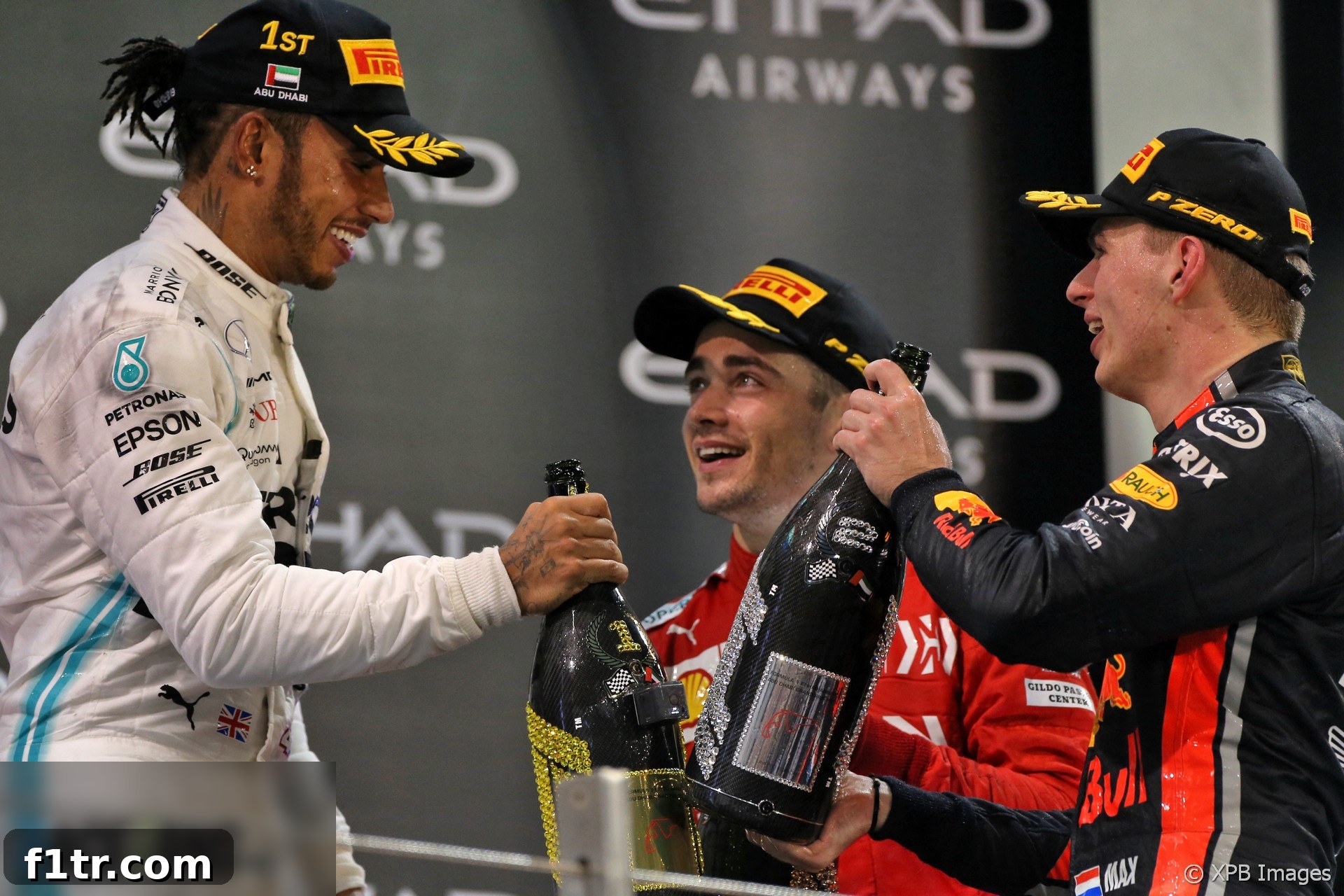
As is customary at Yas Marina, there were arguably more fireworks after the race than during it. However, the final podium of the year, which was only confirmed after the stewards decided not to impose a sporting penalty on Leclerc for Ferrari’s fuel infraction, fittingly featured three of the sport’s brightest stars: Lewis Hamilton, Max Verstappen, and Charles Leclerc. This trio represented the past, present, and exciting future of Formula 1.
In just his first season with Formula 1’s most iconic team, Ferrari, Charles Leclerc made gigantic strides, not only adapting to the immense pressure but also consistently out-scoring a four-time world champion in Sebastian Vettel. His raw speed, aggressive driving, and tactical acumen marked him as a future champion.
Max Verstappen, despite his young age, wielded a remarkable amount of experience at this elite level. He was instrumental in Red Bull’s first season with Honda power, consistently extracting the absolute maximum from his car. His relentless consistency and aggressive talent saw him finish the season ahead of both faster Ferraris in the points standings, a testament to his skill and Red Bull’s strategic prowess.
“These guys have been doing a phenomenal job,” acknowledged Lewis Hamilton after concluding the season with his 11th victory of the year, further cementing his legacy. “I feel really privileged to be in the period of time where they’re here and I’m looking forward to hopefully more close battles with us in the future. I hope it gets close for us next year.”
Many within the sport and among its vast fanbase shared Hamilton’s sentiment. While the Abu Dhabi Grand Prix itself didn’t suggest an immediate shift in the competitive landscape, the final races of the 2019 season offered encouraging signs. These glimpses hinted at a potentially much closer fight between these three formidable drivers – and perhaps their talented teammates as well – when the 2020 Formula 1 season officially commenced. The stage was set for an exhilarating new chapter in the sport’s ongoing narrative.
2019 Abu Dhabi Grand Prix
- 2019 Abu Dhabi Grand Prix Star Performers
- Leclerc would welcome Hamilton as Ferrari team mate
- Vettel aiming for small improvements and fewer mistakes in 2020
- Perez praises Norris’s driving after last-lap pass
- Dominant Hamilton shows F1’s new generation the way in 2019 finale
Browse all 2019 Abu Dhabi Grand Prix articles
F1 Race Reviews
- Antonelli lucks in for second win and becomes youngest F1 championship leader
- Emotional Antonelli grabs first Formula 1 victory in Chinese Grand Prix
- Russell sees off Ferrari threat to lead Mercedes one-two in Melbourne
- Norris clinches F1 title by two points as Verstappen wins finale at Yas Marina
- McLaren strategy blunder in Losail hands Verstappen crucial win and shot at title
Read all F1 race reviews