This session has finished. No further updates will be posted.
- Race Report: Verstappen Defies Norris to Win Japanese Grand Prix After Pit Lane Skirmish
- 2025 Japanese Grand Prix Race Result and Championship Points
- Rate the Race: 2025 Japanese Grand Prix
Verstappen Masters Suzuka, Claims Fourth Consecutive Japanese Grand Prix Title
Max Verstappen has once again stamped his authority on the iconic Suzuka International Racing Course, securing a magnificent victory at the 2025 Japanese Grand Prix. This triumph marks his fourth consecutive win at the revered Japanese circuit, further solidifying his formidable reputation and extending his championship lead. The race unfolded as a captivating blend of strategic brilliance, intense on-track skirmishes, and nail-biting pit lane drama, with McLaren’s Lando Norris mounting a spirited challenge that ultimately proved insufficient against the Red Bull ace.
Pre-Race Buzz: Anticipation and Strategic Forecasts at Suzuka
The atmosphere at Suzuka was electric, buzzing with anticipation as the 2025 Japanese Grand Prix approached its start. Following a stellar qualifying performance, Max Verstappen secured pole position, perfectly positioning him for what was expected to be a fiercely contested race. However, the McLaren duo of Lando Norris and Oscar Piastri had demonstrated impressive long-run pace in practice, suggesting they would be a significant threat over a full race distance. Doubts lingered about Red Bull’s true race potential, especially given Verstappen’s own radio comments during the previous Chinese Grand Prix, where he indicated he could have pushed harder in the first stint. This hinted at untapped performance reserves within the Red Bull RB21, making the strategic battle at Suzuka even more intriguing.
The Looming Threat of Rain
Adding another layer of unpredictability to the already complex strategic landscape was the persistent threat of rain. While the track was dry and bathed in sunlight as the teams prepared for lights out, meteorological forecasts suggested a chance of showers hitting either before the Grand Prix commenced or shortly thereafter. This uncertainty significantly impacted tyre strategy and race management, as wet conditions often reshuffle the competitive order and favor drivers with exceptional car control – a skill Verstappen has consistently demonstrated. Interestingly, Lando Norris appeared to embrace the forecast, remarking on his way to the grid, “The rain came less than expected which I think is good for me,” perhaps suggesting confidence in McLaren’s wet-weather performance or a desire for a mixed-condition race to shake up the established order.
Grid Formations and Tyre Gambits
As the one-hour countdown to the start of the race began, teams finalized their tyre choices, leading to a diverse array of strategies on the grid. Doohan and Stroll opted for the aggressive soft compound tyres, aiming for maximum grip and an early advantage but committing to an early pit stop. In contrast, Lewis Hamilton, Bortoleto, and Ocon chose the durable hard compound tyres, targeting a longer first stint and potentially fewer pit stops. The majority of the field, including the front-runners like Verstappen and the McLarens, started on medium compound tyres, balancing grip with longevity. This strategic variety promised an enthralling race with staggered pit windows and numerous overtaking opportunities. With the drivers meticulously forming up on the grid, the iconic Suzuka circuit, renowned for its high-speed corners and demanding layout, was poised to deliver another unforgettable Formula 1 spectacle. Russell’s race engineer, Dudley, confirmed a clearer immediate forecast, stating, “Currently no rain on the radar,” offering a temporary sense of relief from the weather uncertainty.
Race Start: Verstappen Holds Firm as Early Battles Erupt
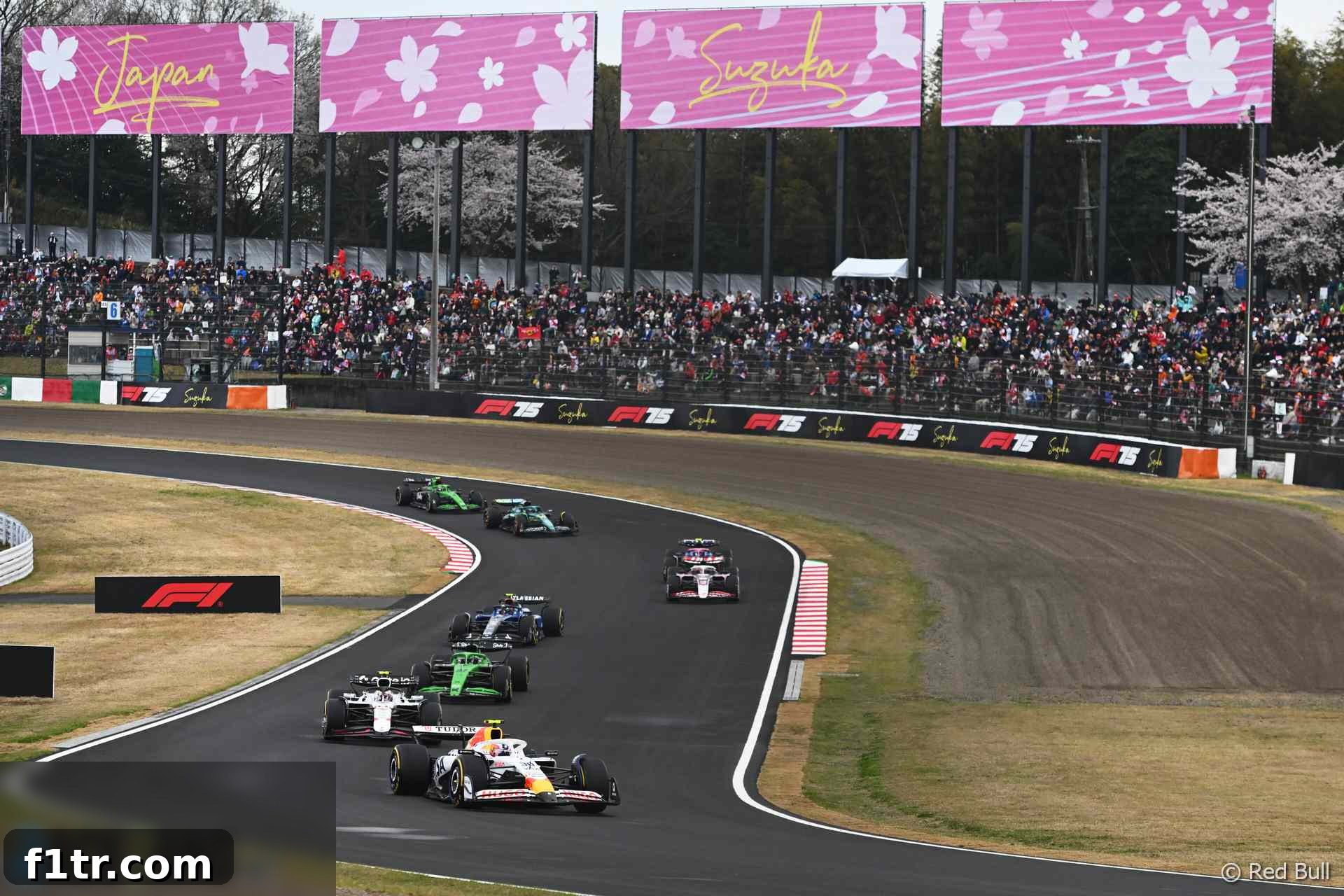
The lights went out, and the 2025 Japanese Grand Prix burst into life! Max Verstappen launched off the line with precision, successfully defending his pole position and maintaining a crucial lead over Lando Norris. Despite the intense pressure from behind, the top 10 positions remained unchanged through the frantic opening corners, a testament to the drivers’ disciplined starts. Further back in the pack, Daniel Lawson experienced a momentary snap of oversteer in the challenging Spoon corner, creating an immediate opportunity for local hero Yuki Tsunoda, who capitalized on the incident to snatch 13th position, much to the fervent cheers of the Japanese spectators.
Early Laps: Technical Concerns and Strategic Positioning
Despite his strong start, Verstappen quickly relayed concerns about his car’s performance to his race engineer, Gianpiero Lambiase. As early as Lap 3, he reported, “My upshifts are again really, really bad,” a sentiment he reiterated on Lap 5, specifying, “The upshifts are worse in the first sector.” These recurring technical issues with his gearbox hinted at underlying challenges, yet Verstappen remarkably managed to maintain a lead of just under a second over Norris on Lap 2, skillfully keeping out of the critical DRS activation window.
Meanwhile, Antonelli, still early in his Formula 1 career, briefly cut the chicane at the end of the second lap. Suzuka’s generous run-off areas at that section proved forgiving, allowing him to rejoin the track without incident or penalty, a fortunate escape. By Lap 5, Norris had indeed dropped out of DRS range of Verstappen, but his McLaren teammate, Oscar Piastri, was now closely shadowing Norris, indicating strong pace from the Australian and potentially a strategic play from the McLaren pit wall. Further down the order, Carlos Sainz executed a precise overtake on Nico Hulkenberg for 15th position at the hairpin on Lap 6, showcasing the ongoing midfield skirmishes.
Norris’s Mounting Pressure and Hamilton’s Ascent Through the Field
As the race settled into a rhythm, Mercedes’s Lewis Hamilton began his charge up the order. On Lap 6, Hadjar ran slightly wide through the demanding Spoon corner, an error that Hamilton swiftly exploited. Utilizing the powerful DRS on the pit straight, Hamilton effortlessly surged past Hadjar, claiming seventh position and demonstrating the raw speed of his Mercedes W16. Lambiase, keen to reassure his lead driver, communicated to Verstappen that his “Shifts should improve over the next two or three laps,” aiming to alleviate concerns about the gearbox issues.
By Lap 8, Norris had established a consistent two-second gap behind Verstappen. This stability raised intriguing questions: was Norris genuinely struggling to match the Red Bull’s pace, or was Verstappen strategically managing his tyres, perhaps holding a significant performance reserve? Conversely, Norris might have been deliberately keeping his distance to avoid Verstappen’s turbulent aerodynamic wake, thereby preserving his own tyre life. Regardless, the McLaren team understood the imperative to prevent the gap from widening further, as every tenth of a second would make a potential overtake more challenging. The tightly packed midfield behind them underscored that this was shaping up to be a race heavily influenced by tyre management and strategic precision, rather than outright speed differentials.
A brief but significant weather update reached the McLaren pit wall on Lap 10, with Joseph informing Norris: “There is possible rain, lap 20, class one, one lap, doesn’t change our plan.” This forecast of a minor, localized shower suggested a brief interruption rather than a full-scale wet race, allowing teams to largely stick to their dry tyre strategies. On the same lap, Lance Stroll became one of the first drivers to make a scheduled pit stop, swapping his soft tyres for hards. This move indicated either an aggressive long-stint strategy, aiming to run to the end without another stop, or an attempt to gain track position through an early undercut.
Mid-Race Pace Wars and the Anticipation of Pit Stops
The McLaren drivers began to noticeably ramp up their pace as the first pit window approached. On Lap 11, Norris delivered the fastest lap of the race, crucially ensuring that the gap to Verstappen remained under two seconds. This was a clear demonstration of his underlying speed and tactical patience. Oscar Piastri also recorded a personal best lap, highlighting McLaren’s growing threat. Joseph’s message to Norris, “No sign of graining on any compound. This is a rear thermal limiting race,” provided critical insight into the tyre degradation characteristics – indicating that overheating of the rear tyres, rather than actual surface wear, was the primary factor limiting outright pace. Further back, Alex Albon voiced his displeasure with his own car’s gearshifts, echoing Verstappen’s earlier complaints but seemingly with greater intensity and frustration.
Doohan initiated a flurry of pit stop activity among the wider field on Lap 16, becoming the second driver to pit. Verstappen, keen to maintain his advantage, responded to McLaren’s increasing pace with his fastest lap time of the race so far on Lap 15, reasserting his control at the front. By Lap 18, Norris had successfully reduced Verstappen’s lead to a mere 1.7 seconds, applying sustained pressure on the Red Bull driver. This shrinking gap triggered strategic discussions within the Red Bull garage, with Verstappen potentially having a window to pit and emerge ahead of Alonso and Bearman, especially if they were also nearing their own scheduled stops. Russell subsequently made his pit stop and rejoined the track behind Bearman and Alonso, illustrating the effectiveness of well-timed early pit calls.
The Pivotal Pit Stop Drama: A High-Stakes Clash in the Lane
The race truly ignited around Lap 21, as strategic pit stops began to dictate the flow of the race among the front-runners. McLaren made the first decisive move, calling Oscar Piastri into the pits for a fresh set of hard compound tyres. It was a well-executed stop, meticulously timed to potentially execute an undercut on his teammate, Norris, and even the race leader, Verstappen. The crucial question lingered: would McLaren prioritize team order or allow the undercut to play out? Verstappen, acutely aware of the unfolding strategies, radioed Lambiase: “You want me to push or not?” to which his engineer responded with a definitive, “Yeah, push now,” signaling the start of a critical performance window.
The Norris vs. Verstappen Pit Lane Skirmish
The Red Bull pit wall reacted swiftly to McLaren’s move, bringing Max Verstappen into the pits on Lap 22. Crucially, Lando Norris followed him into the pit lane on the very same lap. This synchronized pit stop led to one of the most dramatic and controversial moments of the entire race. McLaren executed a lightning-fast pit stop for Norris, resulting in both cars exiting their respective pit boxes almost side-by-side. As they accelerated down the narrow pit lane, Norris initially found himself halfway alongside Verstappen, seemingly gaining a marginal advantage. However, the available asphalt quickly ran out, forcing Norris onto the grass. He immediately conveyed his heated frustration to his engineer, Joseph: “He forced me off.” Verstappen, from his cockpit, offered a different, rather blunt assessment: “He drove himself into the grass,” and added a pointed observation, “He pressed the pit limiter off too early. There’s no way that was legal.” This contentious incident was immediately noted by the race stewards for investigation, though subsequent reports would confirm “no further action” was taken. The underlying strategic enigma for many observers was McLaren’s decision to pit Norris on the very same lap as Verstappen, a move that inherently diminished the potential for gaining track position through an undercut, and instead created a perilous direct confrontation.
Post-Pit Stop Reshuffle and Mid-Race Developments
In the aftermath of the thrilling pit stop drama, the race order underwent a significant reshuffle. Antonelli, yet to make his pit stop on his original set of medium tyres, found himself surprisingly leading the race on Lap 24, with Lewis Hamilton, also on an extended first stint, in a strong second position, four seconds behind. Hadjar occupied third, creating an unusual and temporary top three. Meanwhile, Alex Albon expressed his furious dissatisfaction with his team’s tactical call, vehemently criticizing them for not pitting him before Bearman. Despite his frustration, he managed to maintain his position ahead of the Haas driver after his own eventual pit stop. Carlos Sainz also attracted the attention of the stewards for potentially gaining an advantage by leaving the track, adding another incident to the race director’s growing list of reviews.
By Lap 29, Verstappen began to relentlessly close in on Hamilton, who was still running second, while Norris was also actively narrowing the gap to Verstappen, setting the stage for renewed battles for the lead. Lap 31 witnessed Lewis Hamilton lock up his tyres significantly at the challenging chicane, a critical error that prompted him to immediately dive into the pits for his scheduled stop. This allowed Antonelli, still impressively leading on old tyres, to further extend his time at the front. However, this prolonged stint on aging medium compound tyres was always a temporary measure, and on Lap 32, Antonelli finally relinquished his unexpected lead, making his own pit stop. With Antonelli off-sequence, Max Verstappen was thus restored to the front of the race, now holding a 1.3-second advantage over Norris, with Piastri a further 2.2 seconds behind. This re-established the primary battle for the closing stages of the Grand Prix.
Strategic Team Orders and Race Management
The mid-to-late stages of the race also saw a series of strategic team orders come into play, underscoring the complex priorities within various Formula 1 outfits. Gasly was instructed to allow Doohan through for 15th position, a clear demonstration of a collaborative effort within their team to optimize overall performance. Earlier in the race, Sainz appeared to let Albon by, suggesting a similar dynamic was at play. Ocon also received a request to allow Bearman past, responding with a pragmatic, “Probably next lap I’ll let him past,” indicating his compliance while carefully managing his own race pace. These moments highlighted the intricate interplay of individual driver performance and broader team objectives in the high-stakes environment of Formula 1.
The Final Stages: Verstappen’s Unyielding Grip and Triumph
With just 17 laps remaining in the Grand Prix, the top 10 positions largely mirrored the starting order, with the notable exception of Lewis Hamilton, who had skillfully climbed ahead of Hadjar. However, the gaps at the very front remained tight, setting the stage for a tense and dramatic conclusion. On Lap 37, Lando Norris had meticulously whittled Verstappen’s lead down to just under 1.3 seconds. Despite this shrinking margin, the realistic prospect of Norris launching a direct, definitive attack for the lead appeared slim, primarily due to the inherent difficulty of overtaking at Suzuka without a substantial tyre or pace advantage. At this stage of the race, only one backmarker, Lance Stroll, was anticipated to be lapped by the leaders before the chequered flag, thereby minimizing the impact of traffic on the leading battle.
A momentary concern arose for Verstappen on Lap 40 when Lambiase informed him he might have an “issue with the flap” after his pit stop – likely referring to a potential issue with the front wing flap, which could significantly affect the car’s aerodynamic balance and overall downforce. Despite this potential setback, Verstappen continued to push relentlessly, maintaining his formidable pace and composure.
McLaren, ever pushing the boundaries, relayed a crucial message to Piastri, suggesting that Norris “should start pushing soon instead of saving his tyres,” signaling a strategic imperative to either close the remaining gap or prepare for a final, decisive charge. On Lap 47, Norris did indeed increase his pace, but critically, he was unable to get within the crucial DRS activation range of Verstappen, whose raw pace and consistency remained unyielding. Stroll, the sole backmarker in contention to be lapped, expertly and smoothly allowed the three leaders to pass him on the pit straight, ensuring no interference in their high-stakes battle.
As the final laps rapidly dwindled, the spirited challenge from Norris began to visibly fade. On Lap 49, Oscar Piastri was right on Norris’s tail, a situation that ironically mirrored Norris’s own desire to be closer to Verstappen. Over the very last lap of the Grand Prix, Norris ultimately fell back from Verstappen, and his valiant yet ultimately unsuccessful challenge for the lead concluded.
Max Verstappen Seals Fourth Consecutive Suzuka Victory
And with a triumphant roar, the chequered flag waved: Max Verstappen crossed the finish line to claim a resounding victory at the 2025 Japanese Grand Prix! This magnificent achievement marks his fourth consecutive win at the legendary Suzuka circuit, a truly remarkable feat that stands as a testament to his unparalleled driving skill, strategic brilliance, and the consistent, dominant performance of his Red Bull Racing team. His ability to manage the race expertly from the front, overcome minor technical challenges, and fend off a strong, strategic challenge from McLaren, unequivocally underscored why he remains the benchmark in modern Formula 1.
Related Articles: 2025 Japanese Grand Prix Insights
- McLaren has to accept upsetting either of its drivers sometimes – Stella
- Verstappen ‘can test our car, I look forward to seeing his disappointment’ – Norris
- Verstappen insists McLaren domination claim was ‘no joke’ after Piastri’s doubt
- Extra mandatory pit stop won’t create more passing at tracks like Suzuka – Sainz
- Mercedes took note of Verstappen’s out-lap tactics after stunning Suzuka pole position
Browse all 2025 Japanese Grand Prix articles