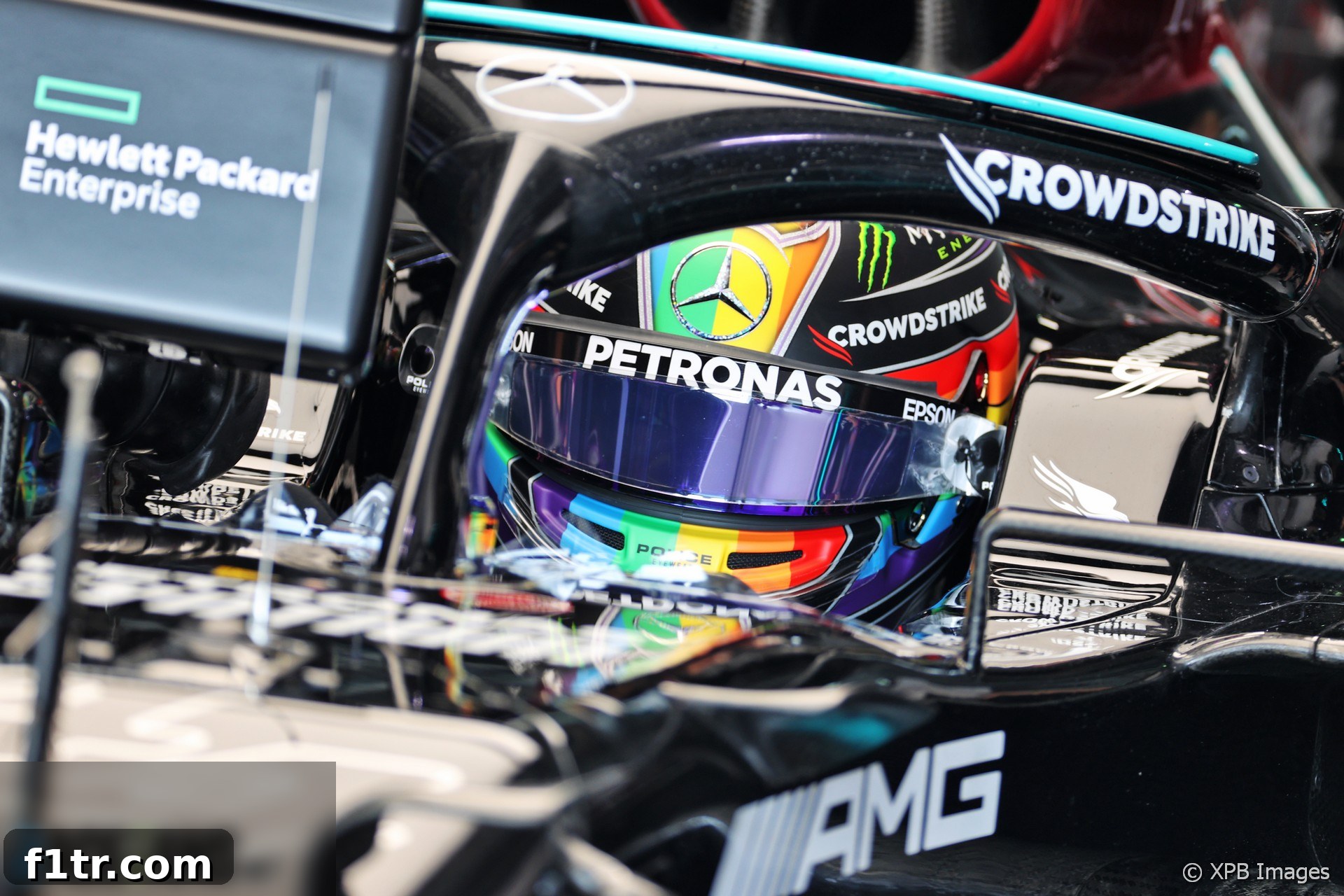
In a powerful demonstration of his commitment to social justice and human rights, Lewis Hamilton, the seven-time Formula 1 world champion, made a significant statement at the Qatar Grand Prix. Hamilton replaced his customary helmet design with a vibrant interpretation of the Progress Pride flag, drawing global attention to LGBTQ+ rights and broader human rights issues in regions where such liberties are often suppressed. This bold move underscored Hamilton’s evolving role as a leading advocate within the world of sport, leveraging his immense platform to foster awareness and encourage change.
Lewis Hamilton’s Qatar Grand Prix Helmet: A Symbol of Progress
Hamilton’s choice of the Progress Pride flag, rather than the traditional rainbow flag, was a deliberate and deeply symbolic one. Created by Daniel Quasar in 2018, this updated design expands upon the well-known LGBTQ+ rainbow with additional stripes arranged in a chevron pattern. This modern iteration is specifically engineered to be more inclusive, representing a wider array of marginalized groups who often face discrimination and under-representation globally.
The Progress Pride flag incorporates black and brown stripes, acknowledging the unique challenges and historical marginalization faced by LGBTQ+ people of color. Furthermore, it features light blue, pink, and white stripes, which are emblematic of the transgender community. In a significant update added in 2021, the design also includes a yellow triangle and a purple circle, specifically to represent intersex individuals, ensuring their visibility within the broader queer movement. The familiar rainbow colors within the flag continue to represent lesbian, gay, bisexual, transgender, queer, and other identities, while also giving a nod to those living with HIV/AIDS. By adopting this comprehensive symbol, Hamilton effectively amplified the voices of many communities striving for acceptance and equal rights, transforming his helmet into a powerful visual manifesto for inclusivity and justice on the global stage of Formula 1.
Hamilton’s Call to Action: F1’s Duty to Human Rights
Prior to the Qatar Grand Prix, Lewis Hamilton vocalized his conviction that Formula 1, along with other major sports, bears a crucial responsibility to highlight human rights concerns in the countries it visits. “These places need scrutiny,” Hamilton asserted. “It needs the media to speak about these things. Equal rights is a serious issue.” His words resonated deeply, particularly given Qatar’s stringent anti-LGBTQ+ laws, where same-sex relationships are subject to severe penalties, including imprisonment. Hamilton’s outspoken advocacy underscored the ethical dilemmas faced by sports organizations operating in regions with questionable human rights records.
The decision to hold the FIFA football World Cup in Qatar in 2022 has similarly drawn intense scrutiny, with organizers eventually announcing that rainbow flags would be permitted in stadia. This context highlights a growing tension between commercial interests and social responsibility in global sports. Hamilton’s gesture transcended mere symbolism; it was a direct challenge to the silence that often surrounds these issues, urging both the sport and its audience to confront uncomfortable truths. His actions served as a reminder that the glamour of elite racing should not overshadow the fundamental principles of human dignity and equality.
A Message of Unity: “We Stand Together”
Complementing the visual statement of the Progress Pride flag, Hamilton also replaced his long-standing personal motto, “Still I Rise,” inspired by Maya Angelou’s powerful poem, with the direct and unequivocal statement: “We Stand Together.” This shift from an individual affirmation of resilience to a collective declaration of solidarity further amplified his message of unity and shared responsibility. The new motto, prominently displayed on his helmet, reinforced the idea that the fight for equality is a collective endeavor, requiring mutual support and allyship across diverse communities.
Confirming his unwavering commitment, Hamilton announced that he intended to wear the same helmet design not only for the Qatar Grand Prix but also for the subsequent races in Saudi Arabia and the season finale in Abu Dhabi. This decision to carry the message through multiple events in the Middle East demonstrated a consistent and sustained effort to maintain pressure and visibility on human rights issues in the region. He shared that he had not encountered any “negative feedback” regarding his design, which also featured the phrase “love is love.” Hamilton expressed a sincere hope that his actions would prompt dialogue and lead to tangible support for the LGBTQ+ community in these host nations. “I hope that someone reaches out and I would love to know what is happening here and what they’re doing to help support that community more, the LGBTQ+ community. I wait to hear,” he stated, inviting direct engagement and seeking concrete actions beyond mere gestures.
A Growing Movement: Vettel and Beyond
Lewis Hamilton’s advocacy is not an isolated incident within Formula 1. Other prominent drivers have also used their platforms to champion similar causes. Notably, Sebastian Vettel, another highly respected and influential figure in motorsport, displayed pride colors during the pre-race ‘We Race As One’ ceremony at the Hungarian Grand Prix weekend. Vettel’s choice to wear a rainbow-colored shirt, which briefly caused a minor controversy with the FIA, demonstrated a shared understanding among some drivers about the importance of using their visibility for social good. These instances suggest a nascent but growing movement within Formula 1, where athletes are increasingly willing to speak out on ethical matters, challenging the traditional separation of sport and politics.
The collective actions of drivers like Hamilton and Vettel contribute significantly to shifting the narrative around sports and social responsibility. They prompt essential conversations about the values that underpin global sporting events and whether the pursuit of competition should ever come at the expense of fundamental human rights. By making these visible statements, these athletes encourage fans, organizations, and host nations alike to reflect on inclusivity and equality, pushing for a more just and equitable world both within and outside the racing circuits.
Other Notable Helmet Designs at the Qatar Grand Prix
Daniel Ricciardo’s 2021 Qatar Grand Prix Helmet: A Touch of Sparkle
While Lewis Hamilton’s helmet carried a profound social message, other drivers opted for aesthetic revisions tailored to the unique conditions of the Qatar Grand Prix. Daniel Ricciardo, known for his vibrant and often playful helmet designs, also revised his livery for the weekend. His updated helmet featured an added sparkle, specifically chosen to catch and reflect the floodlights under which the first of three consecutive night races was held. Ricciardo’s design highlighted the visual spectacle of night racing, adding an extra layer of dynamism to his already distinctive look and captivating fans with its dazzling effect.
Pierre Gasly’s 2021 Qatar Grand Prix Helmet: Golden Highlights
Pierre Gasly also applied a subtle yet effective retouch to his usual helmet design for the Qatar event. His update included the addition of striking gold coloring, strategically placed to enhance visibility and brilliance under the powerful night lights of the Losail International Circuit. These golden accents provided a refined touch to his helmet, ensuring it stood out during the twilight and nighttime sessions, reflecting the unique ambiance of racing in Qatar.
The Impact of Athlete Activism in Motorsport
Lewis Hamilton’s decision to wear the Progress Pride flag helmet at the Qatar Grand Prix represents a pivotal moment in the intersection of sports and social activism. It transcends a mere fashion statement, serving as a powerful catalyst for dialogue and a direct challenge to human rights abuses in host nations. By utilizing his prominent platform, Hamilton has not only raised awareness for LGBTQ+ rights but also set a precedent for other athletes and sports organizations to reflect on their ethical responsibilities. His continued commitment to carry this message to subsequent races in Saudi Arabia and Abu Dhabi further solidifies his dedication to these causes, making a sustained and impactful statement across multiple controversial venues.
The collective actions of drivers like Hamilton and Sebastian Vettel signal a growing consciousness within Formula 1 regarding its global footprint and the moral obligations that come with it. As F1 continues to expand into diverse regions, the pressure on the sport to align its commercial ventures with a commitment to universal human rights will undoubtedly intensify. Hamilton’s helmet, therefore, is more than just a piece of racing gear; it is a symbol of hope, a call to action, and a testament to the power of individual athletes to drive significant social change and spark crucial conversations on a worldwide scale.
Further Insights into the 2021 Qatar Grand Prix
- Pirelli’s investigation into Qatar tyre failures indicates kerbs caused punctures
- Horner rejects talk of title fight pressure after criticism over marshal comment
- “I don’t know how much slower I can go”: Inside Ricciardo’s unnecessary economy run
- ‘No regulator in the world will be popular’ with a title fight this intense – Masi
- Why drivers backed Hamilton’s call for clarity after meeting over Verstappen incident
Browse all 2021 Qatar Grand Prix articles