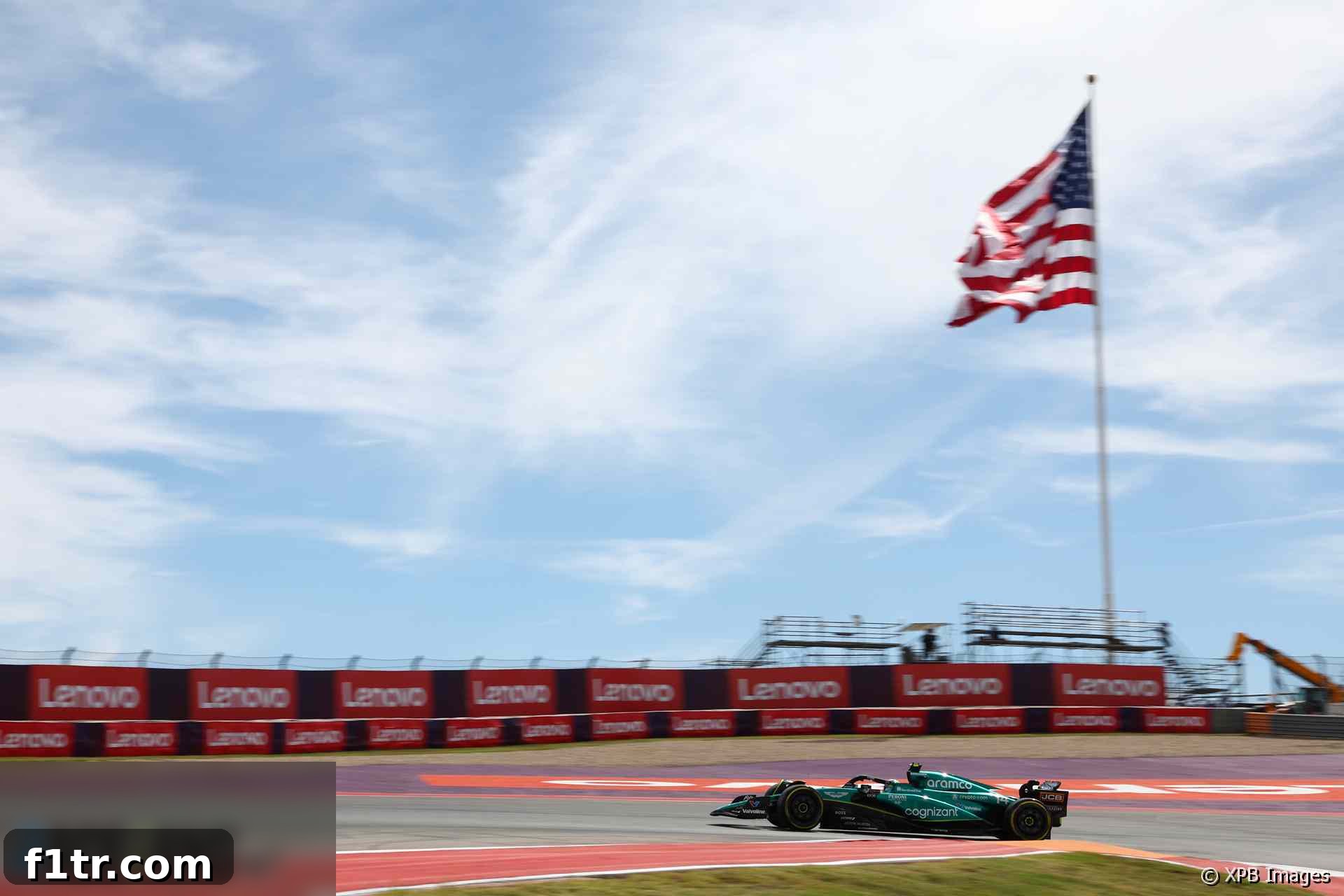
Aston Martin’s US Grand Prix Gamble: A Costly Lesson in Upgrade Strategy
The 2023 Formula 1 United States Grand Prix proved to be a weekend of mixed fortunes and harsh lessons for Aston Martin. What began as an ambitious attempt to accelerate their car’s performance with significant upgrades ultimately led to an underwhelming overall showing, particularly during the crucial initial stages. Team Principal Mike Krack openly acknowledged that the decision to introduce a brand-new floor during a sprint race weekend format was a high-risk strategy that failed to yield immediate dividends, instead culminating in a challenging and data-rich experience.
Both Fernando Alonso and Lance Stroll, the seasoned drivers entrusted with the AMR23, encountered significant difficulties from the moment they hit the track at the Circuit of the Americas. The team had meticulously developed a new floor, a critical aerodynamic component designed to boost the car’s downforce and efficiency. However, the unique structure of a sprint weekend drastically compresses the available practice time, leaving teams with just a single hour on Friday to validate new parts, gather essential data, and optimize their car’s setup before qualifying and parc fermé conditions are imposed.
The Perilous Nature of Sprint Weekend Upgrades: A Race Against Time
The inherent challenge of deploying major aerodynamic upgrades during a sprint event cannot be overstated. Unlike a standard Grand Prix weekend, which grants teams three extensive practice sessions totaling three hours, sprint formats drastically cut this down to one fleeting 60-minute session. This narrow window demands absolute perfection; any operational glitch, mechanical issue, or driver error can cripple a team’s ability to understand their new components and set up the car effectively. Aston Martin found themselves directly in the crosshairs of this unforgiving reality.
Tragically for the British outfit, their Friday practice session at COTA was severely compromised by recurring brake problems affecting both cars. These issues translated into a critical loss of track time, preventing the team from completing their planned data acquisition runs. Fernando Alonso, despite his best efforts, was limited to just 25 minutes of running, while Lance Stroll managed a mere five laps in the entire hour-long session. This minimal mileage meant Aston Martin was effectively operating in the dark, lacking crucial insights into the new floor’s behavior, its interaction with the car’s overall balance, and its performance on the famously bumpy Austin circuit.
Mike Krack’s assessment of the situation was direct and unequivocal. “The fact is that on Friday we should have done our homework, we didn’t do it, and we had the consequences all over the weekend,” he stated. Krack highlighted a long-standing, unwritten rule within Formula 1: “don’t bring the upgrades to the sprint weekends.” He acknowledged that the team knowingly took a calculated risk, and when such gambles don’t pay off, complaints are unwarranted. This experience served as yet another “lesson learned,” underscoring that while other teams occasionally manage successful sprint weekend upgrades, the execution must be flawless – a standard Aston Martin unfortunately could not meet on this occasion.
Strategic Sacrifice: The Bold Parc Fermé Breach
Following a disappointing Saturday sprint race where both drivers failed to score points, Aston Martin made a bold and highly unconventional strategic decision. They opted to break parc fermé regulations, which typically lock in car specifications after Friday qualifying. This allowed the team to make extensive changes to both cars, including running different specifications, for Sunday’s main Grand Prix. The consequence of this decision was a mandatory pit lane start for both Alonso and Stroll, immediately putting them at a significant disadvantage against the rest of the field.
However, this seemingly punitive decision was a deliberate and pragmatic move aimed at maximizing data collection. For the Grand Prix, Fernando Alonso reverted to the team’s older specification floor, providing a vital performance benchmark. Conversely, Lance Stroll continued to race with the new floor, enabling Aston Martin to conduct crucial back-to-back comparisons between the two specifications under race conditions. This split strategy, though costing them immediate grid positions and potential points, was deemed essential for understanding the true performance characteristics of their new package and guiding future development. It was a clear prioritization of long-term insight over short-term gain.
Stroll’s Sunday Resurgence and Alonso’s Frustrated Pace
Despite starting from the pit lane, Lance Stroll delivered an impressive and much-needed performance in the main race. Battling through the field with determination, he ultimately crossed the finish line in seventh place – his best result in nine rounds. This comeback was a significant boost for the Canadian driver and the team, hinting at the potential of the new upgrades when properly understood and configured. Stroll himself confirmed the positive impact of the changes made to his car, stating, “We changed a lot of things on the car, so I think it was much better. [The upgrades] didn’t work out yesterday or the day before, but they worked better today.” This feedback suggests that the fundamental components hold promise, requiring only further refinement and setup optimization.
Fernando Alonso, running the older specification floor, was equally demonstrating formidable pace before his race was prematurely ended. After completing 49 laps, he was forced to retire due to significant floor damage. Krack vividly described the Circuit of the Americas as “brutal,” explaining that a considerable section – approximately half a meter in length – had broken off the right-hand floor edge. While a retirement is always disheartening, this incident paradoxically provided invaluable data for Aston Martin’s engineers. The damaged component offered direct evidence of the extreme stresses and forces the car endures on such a demanding track, crucial for future design iterations.
Alonso characterized his Sunday performance prior to retirement as a “super race,” underscoring the underlying pace the AMR23 possessed. However, the frustration of failing to score any points for only the second time all season was palpable. “Great comeback, a lot of pace in the car,” Alonso lamented. “We started from the pit lane and we were aiming to finish eighth, so it was a very good race for us. It is painful because the whole weekend we were lacking pace, and that was not good, and in the race today we had a lot of pace but we still have to retire. So zero points, it hurts.” His words perfectly captured the mixed emotions of a weekend where potential was glimpses but tangible rewards were elusive.
The Long-Term Perspective: A High-Speed “Test Session”
Both Mike Krack and Fernando Alonso emphasized that the Sunday Grand Prix effectively transformed into an intensive, high-speed test session for the team. “We went again into the race completely blind with new set-ups for both cars, even different packages between the both cars, so a little bit as a test session,” Alonso confirmed. The close proximity of both cars for a significant duration – with Krack noting “six or seven seconds difference, and also no car in between” – provided a goldmine of comparative data. This crucial information will undergo meticulous analysis by the team’s engineers to fully comprehend the true performance characteristics of the new floor and other setup adjustments.
This strategic approach, prioritizing deep learning over immediate championship points, is absolutely vital for Aston Martin’s long-term development trajectory. Following an exceptionally strong start to the 2023 season, the team had experienced a noticeable dip in performance, making a clear understanding of their upgrades paramount for re-establishing competitiveness and maintaining their battle for a top-four position in the Constructors’ Championship. The comprehensive learnings from Austin, particularly concerning the new floor’s behavior and the car’s resilience on a challenging, bumpy circuit like COTA, will be meticulously integrated into their development plans for the remainder of the current season and, most critically, for the design and conceptualization of their 2024 challenger.
Implications for Future Races and Development Cycles
The United States Grand Prix served as a potent reminder of the inherent complexities, unforgiving nature, and constant evolution demanded by Formula 1 development. While the immediate outcome was certainly disappointing from a points perspective, the strategic decision to prioritize comprehensive data collection over a conventional, unoptimized race strategy could prove immensely beneficial in the long run. The extensive and varied data gathered from both cars, running different specifications and enduring a spectrum of challenges, will be instrumental in refining the AMR23’s current package and guiding the foundational principles of the 2024 car.
Aston Martin’s proactive and transparent stance in dissecting their challenges, rather than merely lamenting missed opportunities, reflects a mature, determined, and forward-thinking team culture. The insights gleaned from the US Grand Prix weekend will not only aid them in unlocking the true potential of their new floor but also highlight areas where their operational procedures and risk assessment for sprint weekends require further refinement. The relentless pursuit of marginal gains in Formula 1 is an endless cycle of learning and adaptation, and Austin, despite its immediate frustrations, has undoubtedly contributed a significant wealth of knowledge to Aston Martin’s overarching quest for sustained peak performance.
Key Takeaways from Aston Martin’s Austin Experience
- High-Risk, High-Reward Strategy: Introducing major aerodynamic upgrades on a sprint weekend necessitates absolute perfection and carries substantial risk due to minimal practice time.
- Operational Setbacks: Persistent brake issues on Friday severely crippled data collection on the new floor, compromising the entire weekend’s preparation.
- Strategic Data Acquisition: The unconventional decision to break parc fermé and incur pit lane starts was a deliberate tactical sacrifice to gather crucial comparative data between new and old car specifications.
- Valuable Learnings Despite Outcome: Even with a retirement and limited running, the team acquired invaluable information regarding the new floor’s behavior, the car’s resilience, and the stresses experienced on the demanding COTA circuit.
- Long-Term Development Focus: The weekend, though difficult for championship points, ultimately served as a vital, high-speed test session to inform future car development and understand the AMR23’s upgrade path more thoroughly.
Aston Martin’s journey in the cutthroat world of Formula 1 is characterized by ambitious growth, innovation, and an unwavering pursuit of championship contention. The US Grand Prix may be viewed as a stumble in their competitive stride, but it was a calculated stumble forward, offering profound and enduring lessons that will undoubtedly shape their trajectory in the coming races and seasons. The team is now faced with the critical task of translating these hard-won insights into tangible performance improvements, ensuring that future strategic gambles are meticulously calculated risks with a significantly higher probability of delivering the desired success on track.