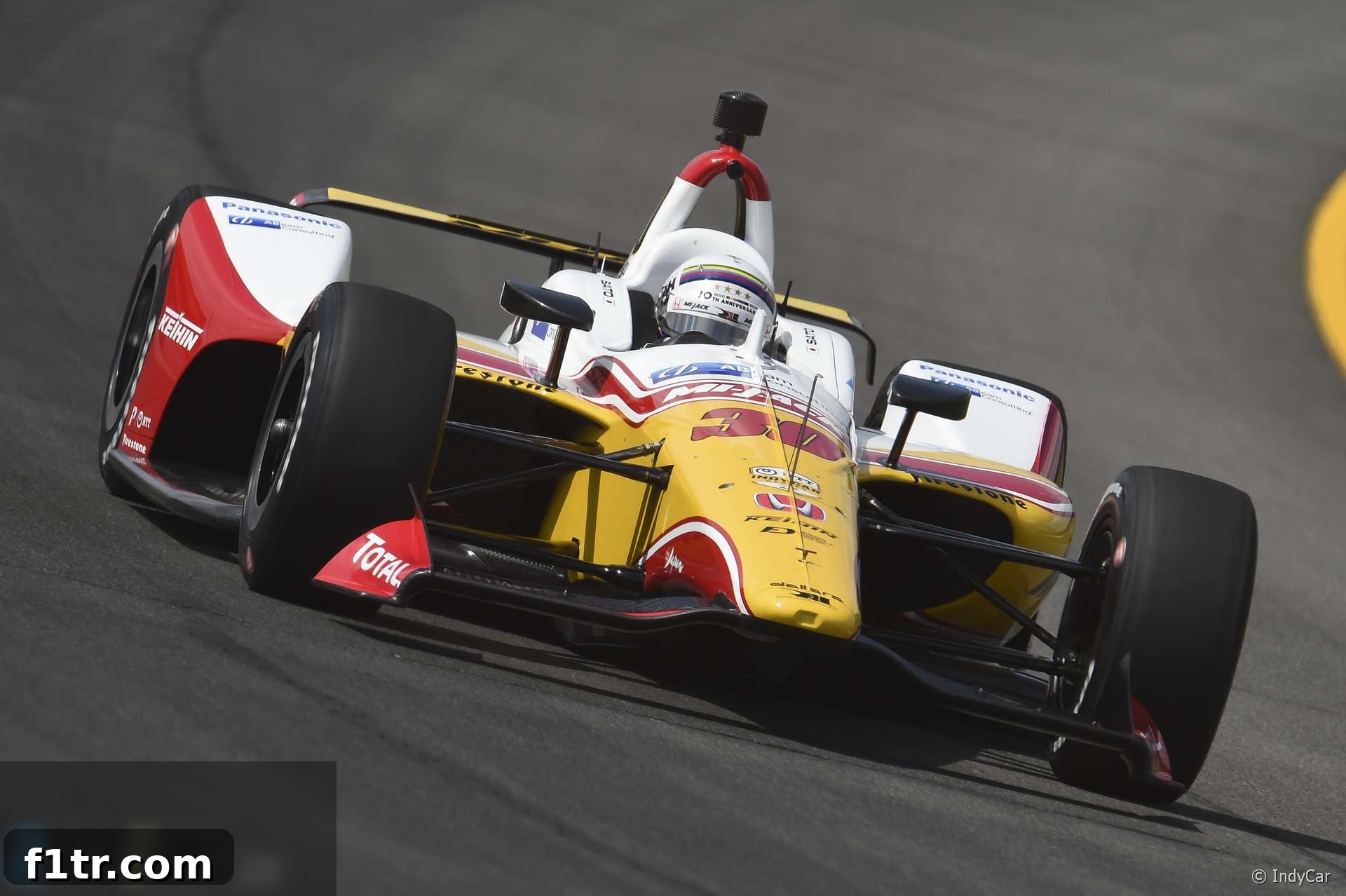
The world of open-wheel racing, particularly the high-octane spectacle of IndyCar, is often characterized by razor-thin margins, strategic brilliance, and, at times, unavoidable controversy. The 2019 Pocono 500, a race that promised thrilling action on one of IndyCar’s most unique ovals, delivered more than just excitement; it sparked a fiery debate over driver accountability following a dramatic first-lap collision. At the heart of this contentious incident stood two formidable competitors: Takuma Sato, a seasoned veteran and Indianapolis 500 champion, and Alexander Rossi, a perennial championship contender. Their entanglement in Turn Two not only brought an abrupt end to the race for several drivers but also ignited a war of words, prompting a detailed investigation and a strong defense from Sato’s team, Rahal Letterman Lanigan (RLL) Racing. This article delves into the crash, the accusations, the critical role of onboard data, and the enduring discussion around what truly constitutes a “racing incident” in elite motorsport.
Advert | Become a Supporter & go ad-free
The Controversial Start at Pocono: A Multi-Car Collision
The 2019 ABC Supply 500 at Pocono Raceway, known as “The Tricky Triangle” for its distinctive three turns, began under a shroud of anticipation. Oval races, especially on superspeedways, are inherently perilous, demanding absolute precision and nerves of steel from drivers navigating high speeds in close quarters. Just moments into the race, as the field thundered towards Turn Two, chaos erupted. Takuma Sato, driving the No. 30 Honda for Rahal Letterman Lanigan Racing, found himself in a skirmish with Alexander Rossi of Andretti Autosport. The contact between their machines initiated a chain reaction that quickly enveloped three other prominent drivers: Ryan Hunter-Reay, Felix Rosenqvist, and James Hinchcliffe. The resulting spectacular shunt, involving five high-profile cars, left a trail of crumpled carbon fiber and dashed championship aspirations, forcing a significant red flag period and setting a somber tone for the remainder of the event.
The immediate aftermath of such a dramatic incident often sees raw emotions surface, especially when championship points are at stake. For Alexander Rossi, who was locked in a tight battle with Josef Newgarden for the coveted IndyCar championship title, the crash was a catastrophic blow. Losing valuable ground and suffering significant damage so early in the race fueled his immediate and fiery reaction, setting the stage for a public dispute that would dominate motorsport headlines for days.
Alexander Rossi’s Accusation: “Disgraceful” Driving
In the immediate wake of the Pocono pile-up, a visibly frustrated Alexander Rossi did not mince words. Speaking to reporters, he unequivocally placed the blame squarely on Takuma Sato, describing his rival’s driving as “disgraceful.” Rossi’s contention was that Sato had deliberately steered his car left, into the path of Rossi’s No. 27 machine, initiating the calamitous contact. The implications of such an accusation are profound in professional racing, potentially tarnishing a driver’s reputation and suggesting a lack of judgment or even dangerous intent. Given the high stakes of the championship and the sheer danger of superspeedway racing, Rossi’s strong condemnation resonated widely within the racing community and among fans. He was not just disappointed; he was outraged, feeling that an avoidable error had jeopardized his title hopes and, more critically, the safety of his fellow competitors.
The direct impact on Rossi’s championship campaign was undeniable. While Josef Newgarden continued to collect points, Rossi faced a monumental uphill battle, adding a layer of strategic frustration to his emotional reaction. This context is crucial to understanding the intensity of his initial comments, which quickly escalated the incident beyond a mere racing mishap into a full-blown controversy demanding clarity and accountability.
Takuma Sato’s Swift Rebuttal: Social Media Evidence
Takuma Sato, known for his aggressive yet precise driving style, was not one to silently accept such a severe accusation. In a remarkably swift and public response, the Japanese driver utilized social media platforms to present his counter-narrative. Sato posted compelling images and video footage, specifically leveraging his onboard camera and telemetry data, which he asserted provided irrefutable proof of his innocence. His message was clear: the visual evidence would exonerate him from any blame regarding the first-lap crash. This modern approach to dispute resolution in motorsport, where drivers can quickly share their perspective and data directly with the public, bypassed traditional channels and allowed for immediate engagement with the controversy.
The digital defense quickly drew a response from Rossi, who, upon reviewing Sato’s shared content, doubled down on his initial claims. Rossi’s counter-argument suggested that Sato’s actions were influenced by an attempt to gain a drafting advantage from Scott Dixon, stating, “I think you’ll find that if you watch the video, it was you moving down trying to get ole Scotty D’s [Scott Dixon’s] tow which caused this whole situation.” This back-and-forth highlighted the complexities of split-second decisions at high speed and how different perspectives, even with seemingly objective data, could lead to conflicting interpretations of responsibility.
Rahal Letterman Lanigan Racing’s Official Defense and Onboard Data Analysis
As the debate raged, Takuma Sato’s team, Rahal Letterman Lanigan (RLL) Racing, felt compelled to intervene with an official statement, lending significant weight to Sato’s defense. RLL’s involvement transformed the individual driver dispute into a team-backed declaration, emphasizing the gravity of the accusations and their impact on a driver’s professional standing. The team’s statement firmly categorized the Pocono incident as a “racing incident,” a term frequently used in motorsport to describe collisions where no single driver is deemed entirely at fault, but rather a consequence of aggressive, high-speed competition.
Crucially, RLL’s statement elaborated on their meticulous review of Takuma Sato’s onboard data and camera footage. This technical analysis formed the cornerstone of their defense. “The data and video clearly shows that Takuma did not turn down the track into Alexander in this incident and in fact the first steering wheel movement made by Takuma was to the right, as he tried to correct his car after the initial contact,” the statement asserted. This detailed technical insight directly contradicted Rossi’s claim that Sato steered left, instead suggesting an instinctive correction *after* contact, not an initiating maneuver. The power of onboard telemetry and high-definition video in modern racing cannot be overstated; it provides an objective, scientific basis for analyzing complex incidents that occur in fractions of a second, often allowing for a definitive reconstruction of events that eyewitness accounts or slow-motion replays alone might misinterpret.
RLL further contextualized the incident within the broader landscape of IndyCar racing. They stated, “This sort of accident is part and parcel of this type of racing and with track position being vital at every stage of each race is, in our view, a part of the sport. It’s a racing incident and we as a team wish to publicly state that we stand behind our drivers and have absolute faith in their ability to race and perform at the highest level for RLL.” This declaration underscored the team’s unwavering support for Sato and highlighted the inherent risks and aggressive nature of IndyCar competition, particularly on ovals where drivers push the limits for every inch of track position. Their comparison to their own championship aspirations being impacted by a crash at Pocono in 2015 demonstrated an empathetic understanding of the frustration experienced by other teams and drivers, yet maintained their stance on Sato’s lack of culpability. The statement concluded with a standard acknowledgment of the AMR Safety Team, a vital component of any racing event, particularly after a multi-car incident.
The Nuance of a “Racing Incident” and Its Championship Implications
The designation of an event as a “racing incident” is often a nuanced judgment in motorsport. It implies that while a collision occurred, it was a consequence of intense competition, drivers pushing the limits, and the inherent risks of racing, rather than a deliberate foul or gross negligence by a single participant. In the case of the Pocono 500 crash, RLL’s steadfast assertion that it was a racing incident sought to de-escalate the personal blame game and refocus on the competitive nature of the sport. However, such incidents rarely occur without significant repercussions, especially in the context of a championship battle.
For Alexander Rossi, the crash undeniably carried “championship implications,” as acknowledged by RLL itself. Every point lost, every DNF (Did Not Finish) due to an incident, can be the difference between hoisting the Astor Challenge Cup and finishing as a runner-up. The frustration expressed by Rossi was not merely about a damaged car, but about the potential derailment of months of hard work and strategic planning. This also harks back to RLL’s own experience in 2015, where a crash at Pocono similarly impacted their title aspirations while second in the standings, providing a poignant reminder of how devastating such an early exit can be.
Beyond the immediate championship fight, these high-profile incidents also reignite discussions about driver safety, track design, and the ever-present balance between aggressive racing and responsible conduct. The Pocono 500 crash serves as a powerful reminder of the fine line drivers tread at unimaginable speeds, where a fractional misjudgment or an unexpected move can have catastrophic consequences for multiple competitors. The subsequent analysis of onboard data not only offers clarity but also contributes to the ongoing evolution of safety protocols and officiating standards within IndyCar racing, aiming to make the sport as safe as possible without diminishing its inherent thrill.
Conclusion: Data, Debate, and the Spirit of IndyCar Racing
The first-lap crash at the 2019 Pocono 500, involving Takuma Sato and Alexander Rossi, became more than just a multi-car pile-up; it evolved into a compelling case study in modern motorsport. It showcased the immediate emotional responses of drivers, the power of social media in public disputes, and, most importantly, the critical role of advanced telemetry and onboard camera data in determining accountability. Rahal Letterman Lanigan Racing’s robust defense of Takuma Sato, backed by undeniable digital evidence indicating Sato’s initial steering input was a correction rather than an aggressive turn, effectively shifted the narrative towards labeling the incident as an unavoidable “racing incident.”
While the debate highlighted the fierce competition and the pressures of championship racing, it ultimately underscored the integrity that teams strive to maintain for their drivers. The incident at Pocono remains a testament to the unpredictable nature of IndyCar, a series where high speeds, close quarters, and daring maneuvers converge to create moments of breathtaking excitement alongside moments of heart-stopping drama. As the dust settled, and despite lingering frustrations, the focus returned to the next race, where the spirit of competition and the quest for victory continue to define the thrilling world of open-wheel racing.
Explore More IndyCar Insights
- IndyCar driver McLaughlin cleared of injury after crashing through barrier at Barber
- Schumacher says his IndyCar feels like ‘an F2 car, just with better tyres’
- IndyCar “way faster than Formula 1” in some corners, says Grosjean
- FIA to award more F1 superlicence points to IndyCar drivers from 2026
- Schumacher to race full-time in IndyCar with RLL in 2026
Browse all IndyCar articles