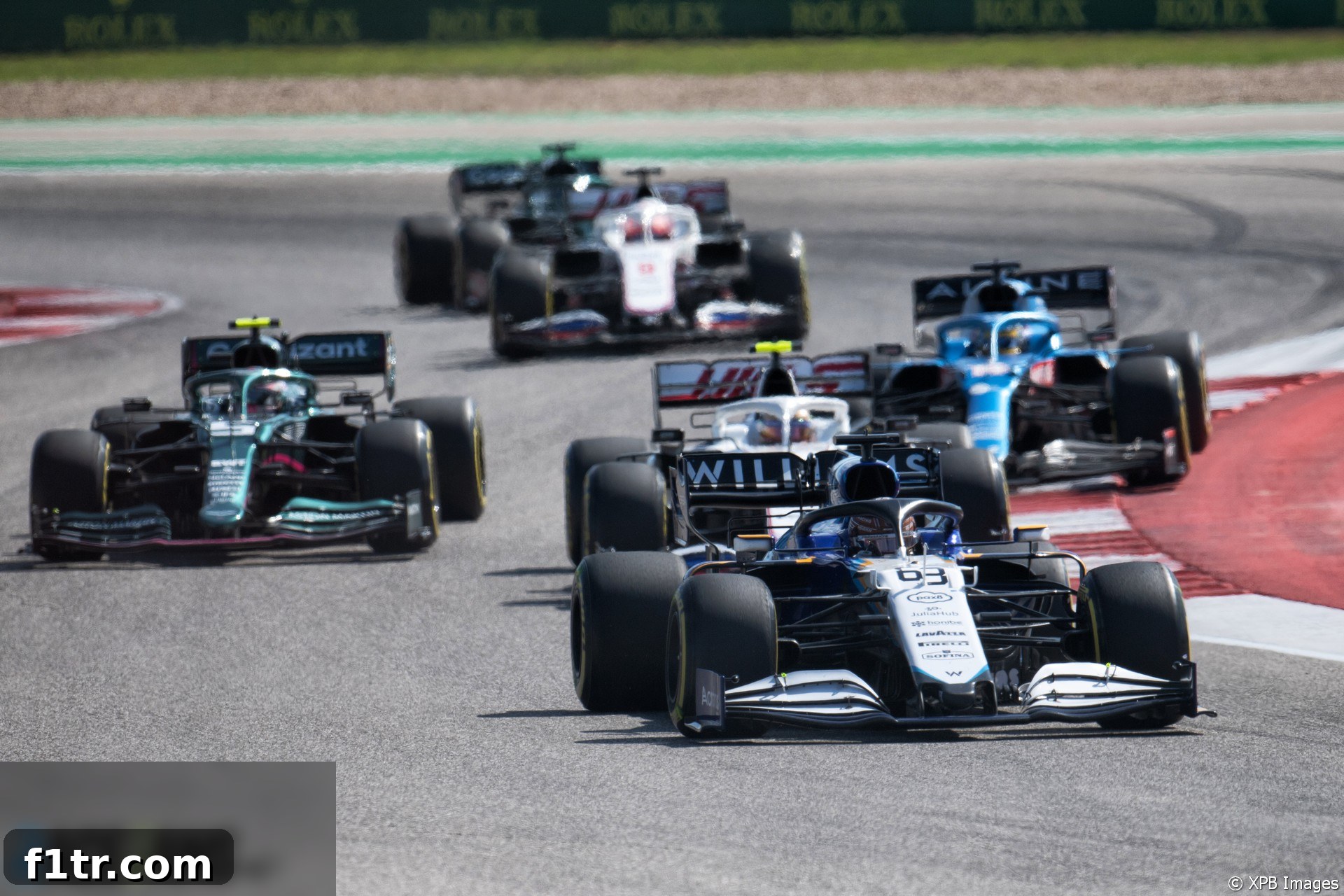
In a revealing insight into his mindset during the concluding stages of the 2021 Formula 1 season, George Russell disclosed that Williams’ secure championship standing afforded him the latitude to experiment with his driving approach and embrace a more aggressive, risk-taking style in the remaining races. This strategic shift came at a pivotal moment in his career, with his highly anticipated move to champion team Mercedes-AMG F1 looming for the following season.
Russell, often lauded for his qualifying prowess and dubbed “Mr. Saturday,” sometimes faced scrutiny regarding his race starts. However, the United States Grand Prix at the Circuit of the Americas (COTA) showcased a significant improvement, where he executed a commendable getaway, clawing back six positions from his starting grid slot. With Williams having established a crucial points buffer over their closest competitors, Alfa Romeo and Haas, and Russell’s future firmly secured with a top-tier team, he articulated a newfound freedom to adopt a bolder strategy on track.
“I think the pressure’s been lifted off my shoulders for a while now, particularly concerning these first laps,” Russell remarked, reflecting on his evolving approach. “I’m more confident to really attack it and go for it. Moving from P20 to P14 at the start of today’s race was, for me, a strong indication of this newfound confidence. Being in this position now, where we have that small but significant buffer in the Constructors’ Championship, it’s allowing me to go out there and truly push the limits. To be honest, I’m quite enjoying it.”
This deliberate push into uncharted territory, however, hasn’t been without its minor setbacks. Russell candidly admitted that this experimental phase had led to him committing a few more errors than typically associated with his generally precise driving style. “I’m not a driver who usually makes a huge amount of mistakes, but I’ve wanted to push myself beyond my comfort zone,” he explained. “That’s why we observed an off in Free Practice 3, and a slight excursion in qualifying at Zandvoort. I’m simply trying to really explore and push the absolute limit, just to discern if there is any more performance or understanding to be extracted in these final few races of my tenure with Williams.”
The 2021 season marked a significant turning point for Williams Racing. After several arduous years languishing at the back of the grid, the team had demonstrated a tangible upturn in performance. Securing valuable points, largely thanks to Russell’s exceptional drives and Nicholas Latifi’s contributions, had propelled them ahead of Alfa Romeo and Haas in the Constructors’ Championship. This buffer was not merely a numerical advantage; it was a psychological one, liberating Russell from the intense pressure of having to chase every single point to defend the team’s standing. It allowed him the luxury of focusing on personal development and maximizing his learning curve before his high-profile move to Mercedes, an opportunity few drivers get to experience in a competitive F1 environment.
Despite Russell’s personal progress, the United States Grand Prix proved challenging for Williams as a collective. The team unfortunately failed to add to their points tally in Austin. Russell attributed this to their inability to fully optimize the car’s performance at the unique Circuit of the Americas track. “Globally, this weekend, I just struggled for pace,” he lamented. “It’s a very strange circuit with its unique characteristics.”
The Circuit of the Americas is renowned for its undulating layout, including the dramatic uphill run to Turn 1, a series of high-speed esses reminiscent of Suzuka, and tight, technical sections. Russell highlighted a specific issue that plagued their performance. “I felt there wasn’t much adhesive grip from the Tarmac itself, and I believe all the drivers were sliding around quite a lot. We simply didn’t optimize our setup to make the most of those conditions. I started last, managed a good start to move up to 14th, and essentially just stayed there for the remainder of the race. Nothing was gained, nothing was lost in terms of points, which was somewhat mitigated by the fact that our immediate rivals in Alfa Romeo also didn’t manage to score any points.”
Russell further elaborated on the specific demands of COTA, emphasizing the critical role of aerodynamic downforce for competitiveness. “I think it’s about getting on top of the tyre management, but primarily, the amount of downforce you could generate was really, really key this weekend,” he stated. The nature of the track, with its blend of high-speed corners and demanding sections, disproportionately rewards cars with superior aerodynamic efficiency.
Drawing an apt analogy, Russell encapsulated the performance disparity seen at Austin: “It was one of those races where the rich got richer and the poor got poorer.” This metaphor perfectly illustrates how tracks that heavily favor a specific car characteristic, such as downforce, tend to widen the performance gap between the leading teams and those in the midfield or at the back. “We know precisely where we stand with our downforce levels; we’re simply not up there with the top guys,” Russell acknowledged, pinpointing the fundamental reason behind Williams’ struggles at COTA. This inherent limitation meant that even with Russell’s aggressive approach and improved starts, the car’s fundamental lack of aerodynamic grip prevented them from challenging for points on a track that demanded an abundance of it.
As the 2021 season drew to a close, Russell’s tenure at Williams became a fascinating case study in driver development and strategic freedom. His ability to push boundaries, even at the cost of minor errors, was a testament to his ambition and preparation for the monumental challenge of joining Mercedes. This period of calculated risk-taking not only honed his skills but also offered a unique opportunity to explore the absolute limits of a Formula 1 car without the intense pressure of fighting for a championship or securing a future contract. His final races with Williams served as a crucial bridge, allowing him to grow as a driver before stepping into the spotlight of one of Formula 1’s most dominant teams, ready to apply the lessons learned from his experimental phase. His candid reflections provided a rare glimpse into the mental fortitude and strategic thinking required at the pinnacle of motorsport, especially during a transitional phase of a celebrated career.
2021 United States Grand Prix Coverage
- Mercedes encouraged despite ‘toughest race for a long time’ in Austin
- For the sake of the title fight, F1 must get a grip on its track limits problem
- Pit stop problems costing Ferrari “quite a lot of points” – Sainz
- Sold-out crowd of 380,000 at COTA shows F1 can add third US race – Brawn
- While the pressure’s off I can “push myself” more – Russell
Browse all 2021 United States Grand Prix articles