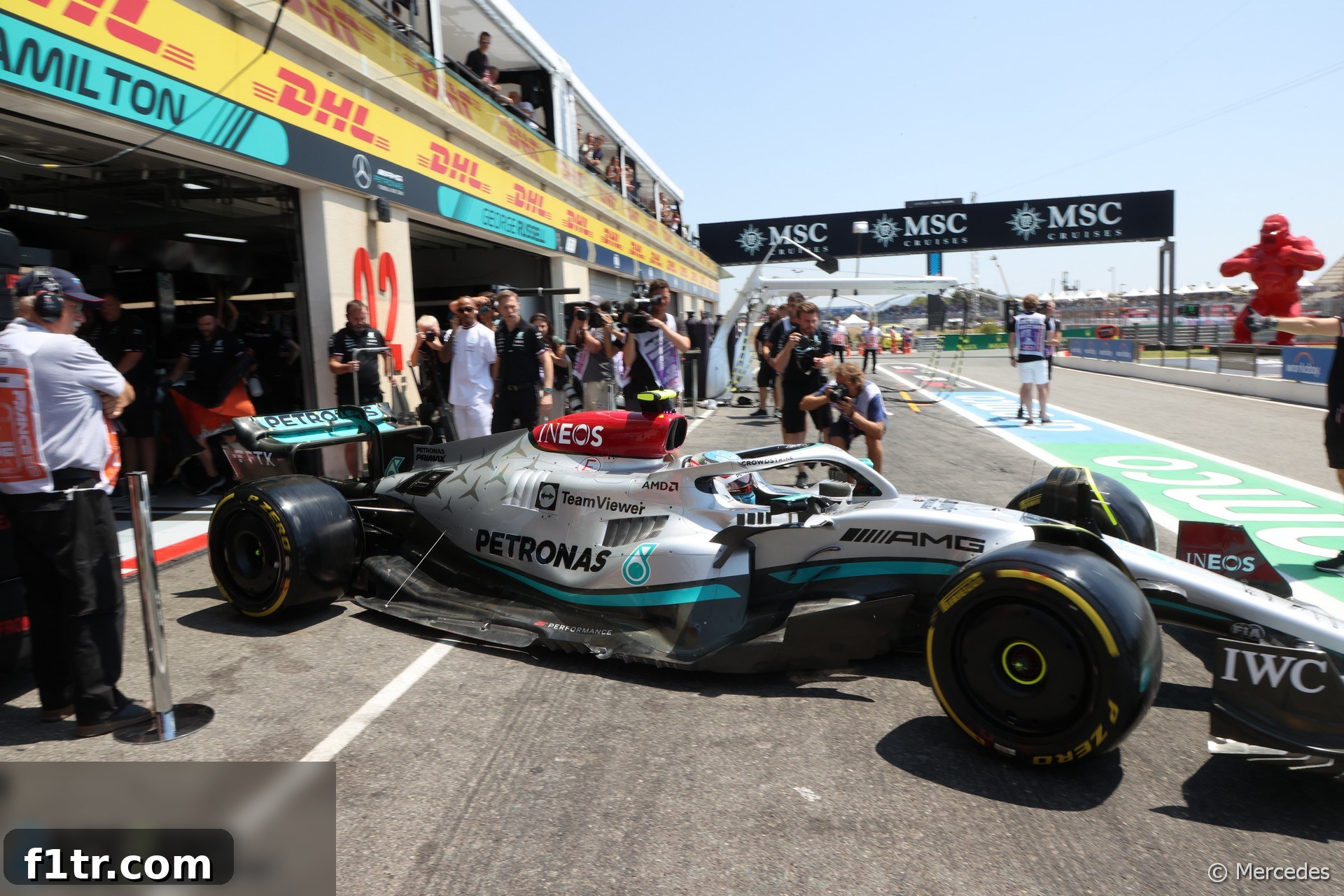
Mercedes F1: Re-evaluating the Radical W13 Sidepod Design and the Quest for Performance
The 2022 Formula 1 season introduced a seismic shift in technical regulations, ushering in a new era dominated by ground effect aerodynamics. Amidst this significant overhaul, Mercedes-AMG Petronas F1 Team, the reigning constructors’ champions, took a particularly audacious approach with their W13 challenger. They debuted a strikingly radical sidepod design, often dubbed the “zero-sidepod” concept, which sought to minimize aerodynamic drag and maximize airflow to the car’s rear. This bold engineering gamble, however, has not yielded the immediate success Mercedes has grown accustomed to, as the team has found itself consistently trailing the pace-setting Ferrari and Red Bull Racing.
The unique, aggressively slim sidepod solution of the W13 was a stark contrast to the designs employed by its closest competitors. While Red Bull and Ferrari adopted more conventional, albeit highly refined, interpretations of the new regulations, featuring prominent downwash sidepods, Mercedes pushed the boundaries. This divergence in design philosophy has been a major talking point throughout the season, especially as other teams, including Aston Martin and Williams, have increasingly converged on sidepod concepts that bear a strong resemblance to Red Bull’s highly effective package.
Evaluating the W13’s Design Direction: Andrew Shovlin’s Pragmatic Outlook
Despite the prevailing narrative that Mercedes’ distinct sidepod concept might be the root cause of their performance deficit, Andrew Shovlin, Mercedes’ head of trackside operations, offered a more nuanced perspective. His insights underscore the complex interplay of factors contributing to a modern Formula 1 car’s performance. Shovlin emphasized that merely altering the sidepod design in isolation would unlikely be a silver bullet for Mercedes’ competitiveness, suggesting the issues run deeper than a single aerodynamic component.
“We don’t think that just changing our sidepod will change our competitiveness,” Shovlin stated during a recent FIA press conference. “We’re certainly not of that mind. Nor are we wedded to saying this is how the Mercedes car must look.” This frank admission highlights a pragmatic approach within the team, indicating a willingness to move away from their initial vision if it proves to be suboptimal. It signifies that Mercedes prioritizes performance above design dogma, a characteristic of top-tier F1 teams.
The Evolution of F1 Aerodynamics: Learning from Rivals for Future Success
Shovlin further elaborated on the team’s ongoing aerodynamic analysis, confirming that Mercedes engineers are meticulously studying rival designs from across the grid. This continuous learning process is fundamental in Formula 1, especially in a new regulatory era where understanding the optimal solutions is a dynamic challenge. “From the very early part of the year we’re looking at other teams’ bodywork and certainly with a view to next year, looking up and down the grid to see ideas,” Shovlin explained. This doesn’t necessarily mean a direct copy, but rather an exploration of different concepts and their potential synergies.
The implication is that Mercedes is not just seeking to replicate another team’s successful design but rather to synthesize the most effective elements from various approaches. “It may be that we don’t just take another team’s idea, we’re looking at combinations of different concepts,” he added. This strategic vision suggests a comprehensive review of their aerodynamic philosophy, aiming to integrate the best aspects of competitor designs into their own unique package for the future. Such a process is inherently gradual, requiring extensive research, development, and simulation before significant changes can be implemented.
While Mercedes remains open to a complete overhaul for their 2023 challenger, Shovlin cautioned against expectations of dramatic visual changes to the W13 within the current season. “But it’s a gradual process. I think fundamentally our car isn’t going to change appearance massively this season but I’d be surprised if next year’s car looks the same.” This statement strongly hints that the W14, the car for the 2023 season, could bear a significantly different aerodynamic profile, potentially signaling a departure from the “zero-sidepod” concept if ongoing analysis deems other solutions more effective.
Gradual Progress in the 2022 Season: Closing the Gap, But Challenges Remain
Despite the inherent design challenges, Mercedes has not been static. The team has consistently introduced a series of updates to the W13 over recent races. These incremental changes, focusing on areas like the floor, diffuser, and front wing, have demonstrably helped the team to mitigate some of its initial struggles, most notably the severe porpoising that plagued them in the early part of the season. This dedicated development effort has allowed Mercedes to progressively close the performance gap to their front-running rivals, turning the W13 into a more stable and predictable platform.
However, Shovlin candidly acknowledged that the latest round of updates, while beneficial, would not be sufficient to propel either of their drivers, Lewis Hamilton or George Russell, into direct contention for pole position against the likes of Max Verstappen or Charles Leclerc. The pursuit of outright qualifying pace has been a persistent Achilles’ heel for Mercedes in 2022, a challenge that requires deeper systemic solutions rather than minor aerodynamic tweaks. The team’s strength has often been its race pace, allowing them to salvage strong results from challenging starting positions, but the qualifying deficit remains a hurdle.
French Grand Prix: A Reality Check on Pace and Progress
The context of the French Grand Prix weekend provided a real-world test of Mercedes’ progress. Shovlin detailed the team’s modest expectations for the updates brought to Paul Ricard. “In terms of performance, we brought a small update, but not what that’s going to see us leapfrog any teams,” he confirmed. The key question for the team was how well the circuit characteristics would suit the W13 compared to previous venues like Austria (where they struggled) or Silverstone (where they showed stronger form).
A significant positive emerging from the initial practice sessions in France was the notable reduction in the car’s bouncing. “I think if you look at yesterday the positives were that the car wasn’t bouncing, I think we’re now at the better end of that. There was effectively none and we’re able to run the car where we want to,” Shovlin observed. Eliminating porpoising has been a critical objective, as it allows the team to run the car at its optimal ride height, unlocking more of its aerodynamic potential and improving driver confidence. This improvement indicates a fundamental understanding and rectification of one of the W13’s core issues.
Despite this progress, the raw pace comparison against the championship leaders remained stark. “On single-lap pace we’d certainly say Max is out of reach, it looks like Charles is well out of reach,” Shovlin admitted. This honest assessment underscored the persistent gap in ultimate speed, particularly over a single qualifying lap, where Red Bull and Ferrari continued to demonstrate superior performance. Nevertheless, the team harbored ambitions for a strong showing, targeting the second row of the grid if they could execute their strategy flawlessly. “But we could be able to fight for a second row today if we do a good job,” he added, reflecting a hopeful but realistic outlook for the qualifying session.
Driver Dynamics and Team Learning at Paul Ricard
The start of the French Grand Prix weekend was not without its complications for Mercedes. Lewis Hamilton’s preparations were disrupted as Nyck de Vries took his place for the first free practice session, a mandatory allocation for young drivers. This meant Hamilton had less track time to acclimatize to the circuit and the car’s setup, a factor that invariably impacts a driver’s initial rhythm and confidence.
As a direct consequence, George Russell, who completed both Friday practice sessions, appeared to be in better shape from the outset. “I think George had a better session than Lewis. Lewis missing FP1 is one thing but then the balance wasn’t where he wanted it in FP2,” Shovlin noted. Recovering from a suboptimal car balance in a short FP2 session is challenging, making it difficult for a driver to fine-tune the setup and extract maximum performance. Furthermore, the team encountered difficulties in completing a satisfactory length of long runs, crucial for understanding tire degradation and race pace.
Despite these minor setbacks, the overarching sentiment within the team remained positive and focused on continuous improvement. Both Hamilton and Russell have consistently demonstrated their ability to push the W13 beyond its perceived limits, extracting valuable points and podiums even when the car has been far from the fastest. Their feedback and data analysis are indispensable to the engineering team’s ongoing development efforts. “But we’re still looking to be, I think, podium contender rather than win contender. But every weekend we’re learning and that’s the exciting thing at the moment for us is just understanding the rules better and better,” Shovlin concluded, encapsulating Mercedes’ current position: fiercely competitive for podiums, while relentlessly striving to master the new technical regulations and return to the pinnacle of Formula 1.
Beyond 2022: Mercedes’ Vision for Future F1 Success
The 2022 season for Mercedes is undoubtedly a transitional period, a recalibration after years of unparalleled dominance. The insights from Andrew Shovlin and the team’s ongoing development efforts underscore a crucial strategic direction: while the focus remains on extracting maximum performance from the W13 for the remainder of the current campaign, a significant portion of their intellectual and technical resources is already being channeled into the W14 for 2023. The statements about not being “wedded” to the current sidepod design are not merely reactive but indicative of a deeper, more profound reassessment of their aerodynamic philosophy.
This comprehensive review will likely involve a meticulous analysis of what made Red Bull and Ferrari so formidable under the new regulations, particularly their ability to generate consistent downforce without inducing severe porpoising. Mercedes will undoubtedly be looking at combinations of different concepts, synthesizing the best aspects of rival designs with their own innovative approaches. The goal is clear: to build a W14 that is not just competitive but capable of challenging for both the Constructors’ and Drivers’ Championships once again. This requires addressing the W13’s fundamental weaknesses, such as its single-lap qualifying pace and high-speed corner performance, areas where Ferrari and Red Bull have often held a distinct advantage.
The journey back to the top is a marathon, not a sprint. Mercedes’ consistent updates, their transparent communication about challenges, and their commitment to learning from every race and every rival demonstrate a resilience inherent in championship-winning teams. The expectation that the 2023 car will look significantly different from the W13 signals a proactive and decisive approach to reclaiming their position at the forefront of Formula 1. This continuous learning curve, especially in the context of the sport’s radical new technical era, is what keeps the Mercedes F1 team motivated and on track for future success, driven by the ambition to once again be championship contenders.
Related F1 Insights and Analysis
- Ferrari’s season of missed chances led to “difficult” criticism for Binotto
- McLaren looking into why their starts are “more inconsistent” this year
- Mercedes expect Hungarian GP will ‘expose our qualifying weakness’
- Hamilton and Russell ‘out-performing a car that’s not good enough’ – Wolff
- “We need to decide now”: Inside Sainz and Ferrari’s French GP strategy dilemma
Browse all 2022 French Grand Prix articles