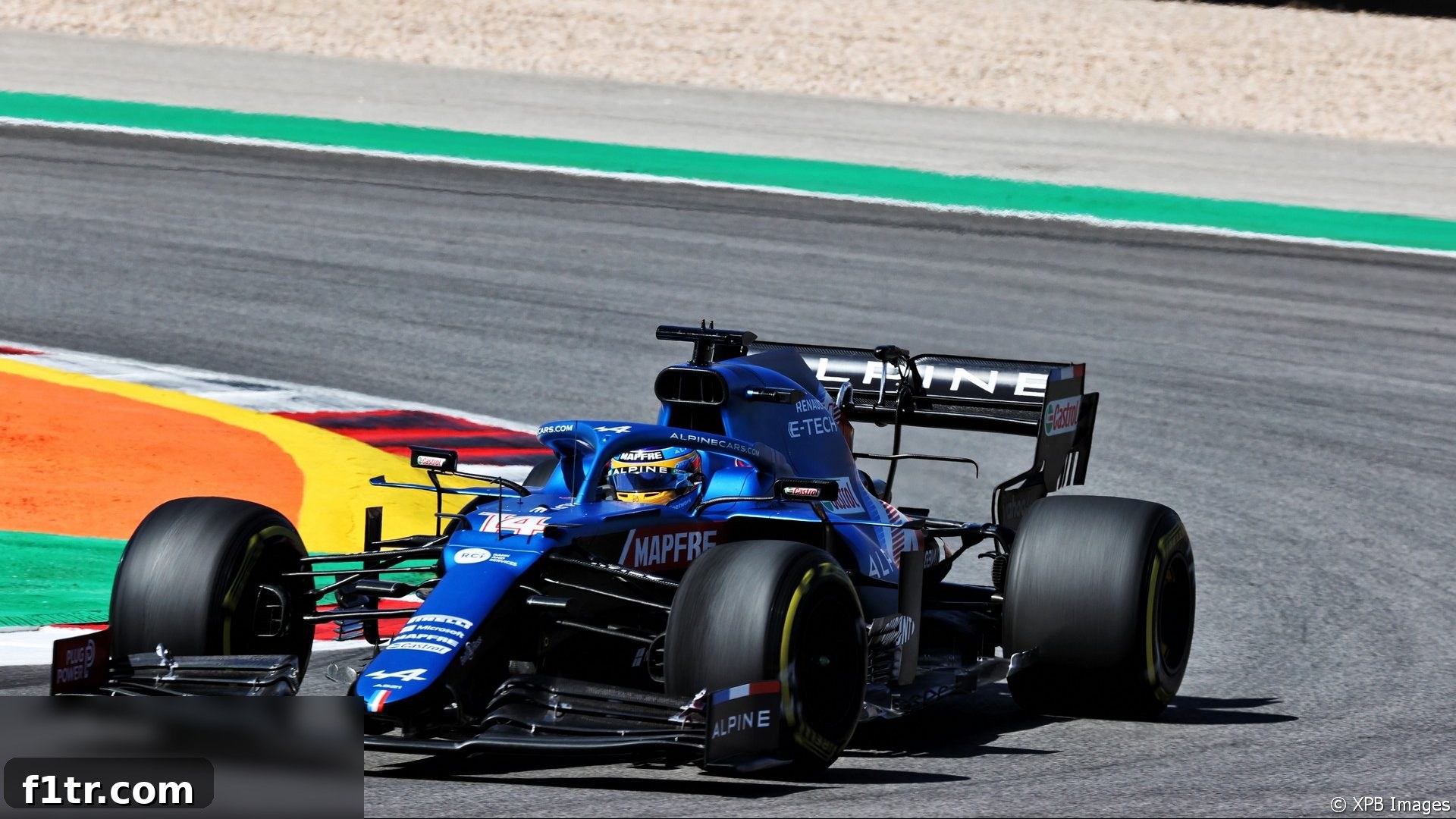
Fernando Alonso Exhibits Cautious Optimism After Impressive Alpine F1 Practice in Portimão
Two-time world champion Fernando Alonso delivered a compelling performance for the Alpine F1 Team during Friday practice at the Autodromo do Algarve, indicating significant progress for the French outfit. Despite placing fifth fastest, the seasoned Spaniard tempered expectations, expressing reservations about Alpine’s ability to replicate their top-six showing in Saturday’s critical qualifying session for the Portuguese Grand Prix.
Alonso concluded the day just a mere hundredth of a second quicker than his teammate Esteban Ocon, who finished sixth. This remarkable synchronization of pace between the two Alpine drivers sparked considerable interest within the paddock, suggesting a strong baseline performance for the team as they continue their development in the highly competitive 2021 Formula 1 season.
Alpine’s Promising Start: A Comfortable Car from Lap One
“It was good,” Alonso remarked, reflecting on a highly productive day of on-track action. “I think we were happy with the car today. Obviously, it’s only Friday, but we were comfortable from lap one, and we didn’t touch much the set-up because everything felt reasonably okay.”
This immediate comfort with the A521 car represents a crucial positive for Alpine. Friday practice sessions in Formula 1 are fundamentally dedicated to fine-tuning car setups, gathering essential data on tyre behaviour, and allowing drivers to fully acclimate to the specific track conditions. Alonso’s observation that the car felt “comfortable from lap one” and required minimal setup alterations implies that Alpine arrived in Portimão with a robust and well-balanced baseline setup. This efficiency suggests that the car’s inherent characteristics aligned favorably with the demands of the challenging Algarve circuit right from the outset.
Such an effective start to a Grand Prix weekend is invaluable, especially for a team like Alpine, which is locked in an intense battle within the midfield. It permits the engineering team to dedicate more time and resources to optimizing long-run race pace and conducting thorough qualifying simulations, rather than grappling with fundamental balance issues. This sentiment of satisfaction with the car’s initial feel is a clear indicator of growing confidence and a stronger understanding of their package, vital elements as they strive to consistently challenge for significant championship points.
Optimizing Performance: The Nuances of Friday Practice
The ability to find a comfortable setup early on allows teams to maximize their track time. Instead of spending precious hours adjusting roll bars, spring rates, or aerodynamic elements, Alpine could focus on the finer details. This includes experimenting with different tyre compounds for both qualifying simulations and longer race stints, understanding fuel loads, and exploring various engine modes. For Alonso, a driver known for his meticulous feedback, having a stable platform from the start means he can provide more precise input on marginal gains, rather than core problems. This translates into a more efficient use of data and a higher probability of unlocking latent performance throughout the weekend.
Alonso’s Algarve Debut: Mastering a New and Unique Challenge
The 2021 Portuguese Grand Prix marked Fernando Alonso’s inaugural competitive experience at the demanding Autodromo do Algarve. Despite his illustrious career spanning over two decades and countless circuits worldwide, learning a new track, especially one as idiosyncratic as Portimão, invariably presents its own distinct set of demands.
“We tried to put some laps just for me to get used to the track and to know a little bit more about the tyres,” Alonso elaborated. His approach was multi-faceted: not only to commit the intricate layout, significant elevation changes, and critical braking points of the circuit to memory but also to gain a profound understanding of how the specific Pirelli tyres interacted with the unique asphalt of Portimão.
The Algarve circuit is famously nicknamed the “rollercoaster” due to its dramatic undulations, blind crests, and a complex blend of high-speed sweeps and technically demanding sections. These characteristics necessitate extremely precise car placement, exceptional driver instinct, and an intimate understanding of the available grip levels. For a driver of Alonso’s unparalleled caliber, rapid adaptation to novel environments is a hallmark of his enduring skill, and his swift integration with the circuit’s demands was visibly reflected in his impressive lap times throughout the practice sessions.
Adding another layer of complexity to the weekend, Alonso observed a subtle but significant change: “The asphalt seems a little bit different compared to last year, so we had to review a little bit of the data that we had from the tyres.” Changes in a track’s surface can profoundly impact tyre degradation, overall grip levels, and ultimately, car performance. Teams typically rely heavily on extensive historical data for tyre management and strategy, but when the track surface evolves, these historical insights must be swiftly re-evaluated. This process demands intensive real-time data analysis, immediate and accurate feedback from the drivers, and agile adjustments to tyre pressures, cambers, and overall car setup to optimize performance for the revised conditions. This intricate detail vividly illustrates the continuous challenge and profound adaptability required at the pinnacle of motorsport.
Guarded Expectations: The Nuanced Reality of Friday Pace
Despite concluding Friday practice less than four-tenths of a second slower than Lewis Hamilton’s pace-setting Mercedes, Fernando Alonso adopted a distinctly pragmatic and cautious view regarding Alpine’s prospects for Saturday’s qualifying session. The often-substantial disparity between Friday practice performance and true qualifying potential is a recurring theme in Formula 1, frequently influenced by varying fuel loads, engine modes, and strategic setup approaches employed by different teams.
“We have to wait and see tomorrow,” he soberly cautioned. “I think the positions will not be too different compared to Imola or to Bahrain.” This statement from the experienced campaigner reflects a realistic and grounded assessment of Alpine’s established position within the competitive pecking order. While a top-five finish in practice is undoubtedly encouraging and a morale booster, the inherent raw speed of front-running teams like Mercedes and Red Bull, who frequently “sandbag” or utilize more conservative engine modes and heavier fuel loads on Fridays, typically emerges far more prominently during the high-stakes qualifying sessions.
“I don’t think that there is any big changes in the order; it’s just a different Friday, a different approach, maybe compared [to other] teams. But let’s see. Fingers crossed that we can keep this pace tomorrow.” Alonso’s skepticism is deeply rooted in his extensive years of experience, a profound understanding that while Alpine’s Friday pace was genuinely strong, rival teams likely possess additional performance reserves to unleash when it truly counts. The concept of a ‘different approach’ refers to the diverse testing programs executed by teams; some prioritize extensive long-run race pace simulations, while others focus more intensely on single-lap qualifying runs. Alpine’s strategy appeared to yield immediate results, but the definitive test of their single-lap speed against their formidable rivals would undoubtedly come in the demanding Q1, Q2, and Q3 sessions.
The primary objective for Alpine on Saturday would be to solidify their standing as a robust midfield contender, ideally challenging established teams such as Ferrari and McLaren. Securing a consistent presence within the top ten would be absolutely crucial for accumulating valuable championship points in Sunday’s race, particularly given the intensely competitive and tightly packed nature of the 2021 midfield battle.
The Thrill of Portimão: A Driver’s Unfiltered Perspective
Beyond the technical analyses and strategic considerations, Fernando Alonso clearly reveled in his inaugural driving experience at the Autodromo do Algarve, frequently emphasizing the sheer enjoyment the circuit provided.
“The track is good, actually, to drive; it felt good and felt enjoyable every lap,” he enthusiastically declared. Such high praise from a driver renowned for his exceptionally discerning taste in circuits speaks volumes about Portimão’s intricate design and engaging character. Its naturally flowing nature, harmoniously combined with the undulating terrain and challenging corners, presents a unique driving experience that most Formula 1 drivers universally appreciate.
However, he also astutely highlighted a specific characteristic that introduces an element of risk, particularly prevalent during free practice sessions: “There’s some blind corners that when people are doing a slow-fast, slow-fast, it’s a bit of risk when you don’t see the cars in front.” This observation refers to the common practice during free practice where drivers execute a slow cool-down lap immediately following a fast, aggressive push lap. On circuits featuring significant elevation changes and numerous blind apexes, driver visibility can be severely compromised, creating potentially hazardous situations when encountering slower-moving cars on track. This specific danger is substantially mitigated during the qualifying sessions and the actual race, where all cars are pushing at comparable speeds, and stringent blue flag rules are rigorously enforced to manage traffic.
Looking forward to the race itself, Alonso expressed genuine optimism for exciting on-track action: “But I guess in the race, we don’t do that technique anymore, and it’s going to be fun. Hopefully, we see some overtaking with the double DRS this year.” The mention of “double DRS” is particularly noteworthy for the Portimão circuit. The Drag Reduction System (DRS) empowers drivers to activate a flap on their rear wing, significantly reducing aerodynamic drag and consequently increasing top speed on designated straight sections of the track, thereby facilitating overtaking maneuvers. The presence of two distinct DRS zones at Portimão theoretically amplifies the opportunities for overtakes, which is invariably a welcome prospect for both drivers and dedicated fans, promising a dynamic, strategic, and thoroughly engaging Grand Prix.
Alpine’s Trajectory in the 2021 Season and Beyond
Fernando Alonso’s impressive performance in Portimão serves to underscore Alpine’s relentless ongoing efforts to firmly establish themselves as consistent front-runners within Formula 1’s fiercely competitive midfield. The 2021 season, which notably marked the rebranding of the Renault team to Alpine, has been a significant journey of adaptation, strategic development, and continuous improvement. With Alonso’s high-profile return to the sport and Esteban Ocon’s consistent progress, the team harbors ambitious goals to surpass their fifth-place finish in the Constructors’ Championship from the preceding year. Their strong showing in Friday practice strongly suggests that the intensive development work carried out at their Enstone chassis factory and Viry-Châtillon engine facility is beginning to yield tangible results, with the A521 demonstrating enhanced balance, greater stability, and potentially a wider operating window compared to its predecessor.
The internal dynamic and healthy competition between Alonso and Ocon are also pivotal to Alpine’s long-term success. While Alonso’s vast experience and unparalleled feedback are invaluable assets for car development and strategic insights, Ocon’s raw speed and unwavering commitment consistently push the team to higher performance levels. Their remarkably close performance in Friday practice, with only a minuscule fraction of a second separating their best efforts, indicates a healthy competitive environment and, crucially, a consistent car from which both drivers can effectively extract maximum performance. Such consistency and parity across both cars are absolutely vital for maximizing championship points on race day and steadily progressing up the constructors’ standings.
Conclusion: A Promising Foundation for Alpine at Portimão
Fernando Alonso’s robust and encouraging showing in Friday practice at the Portuguese Grand Prix constructs a compelling narrative for the Alpine F1 Team. While his cautiously optimistic outlook for qualifying judiciously highlights the inherent competitive realities of Formula 1, the overarching message conveyed is one of significant progress, a comfortable and well-balanced car, and a team that is clearly moving in the right direction. The veteran driver’s remarkably quick adaptation to the unique and often challenging characteristics of the Autodromo do Algarve, coupled with his genuine appreciation for the circuit, effectively sets the stage for what promises to be an intriguing and action-packed race weekend. All eyes will undoubtedly be focused on Alpine during qualifying to ascertain whether they can effectively translate their impressive Friday pace into a strong and competitive grid position, thereby further solidifying their ascent in the intensely competitive landscape of the 2021 Formula 1 season.
2021 Portuguese Grand Prix Insights
For more detailed coverage, expert analysis, and exclusive insights surrounding the event, we invite you to explore these carefully curated related articles:
- Pirelli’s tyre choice for Portuguese GP wasn’t “too hard”, Hamilton concedes
- Who are the top F1 juniors bidding for a grand prix debut in 2022?
- 2021 Portuguese Grand Prix Star Performers
- Race gains encourage Ricciardo after ‘unacceptable’ qualifying performance
- Sainz says top-five finish was possible after first no-score for Ferrari
Browse all 2021 Portuguese Grand Prix articles