This article contains details of the plot of F1: The Movie.
F1: The Movie and the Unforgettable True Story of Martin Donnelly
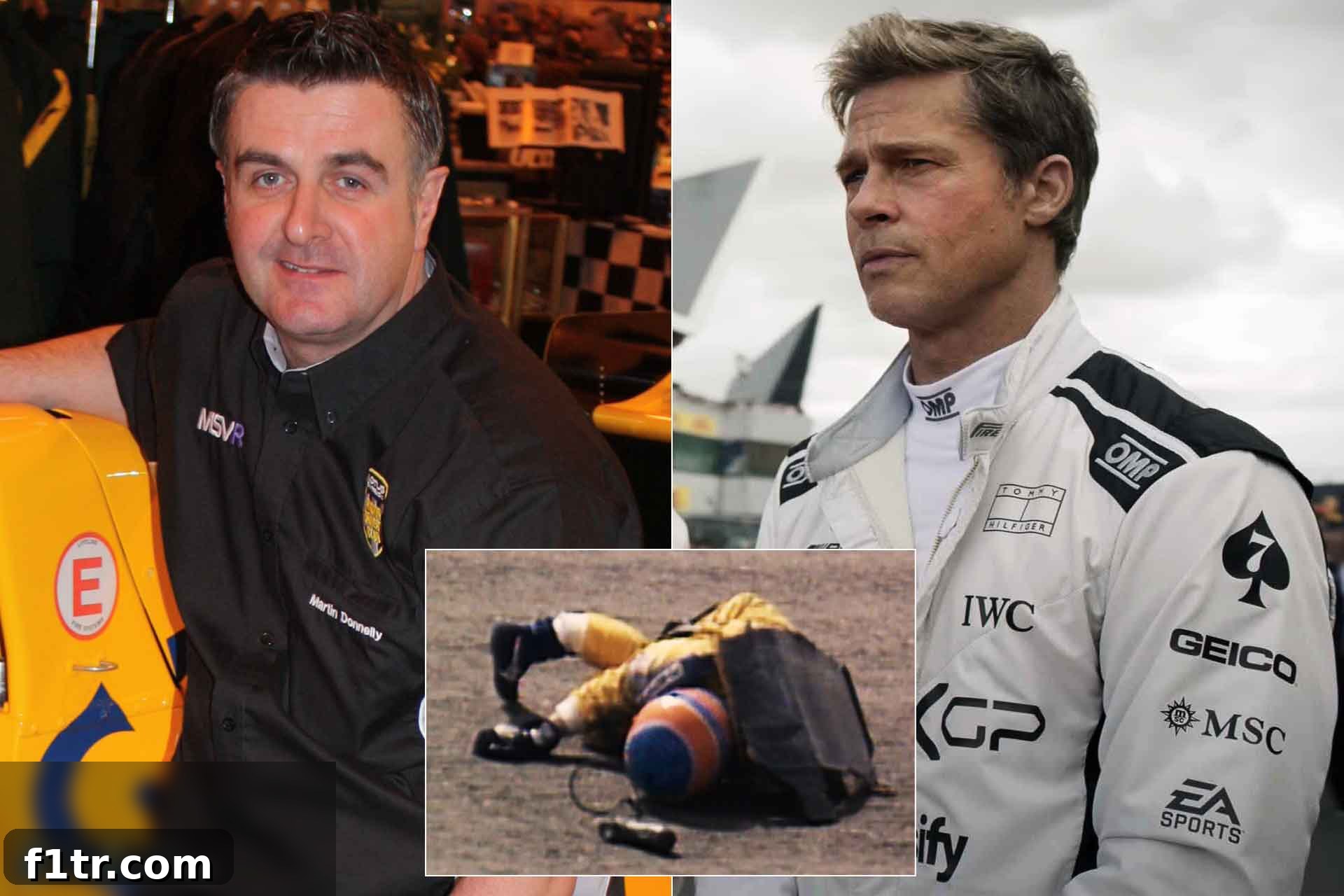
As the final credits roll on “F1: The Movie,” a poignant acknowledgement appears on screen: “thanks to Martin Donnelly.” This subtle yet powerful dedication bridges the gap between Hollywood fiction and the stark realities of Formula 1 history, hinting at the profound real-life inspiration behind one of the film’s most dramatic and pivotal plot points. The movie, which opens in cinemas globally today, commences with a harrowing crash, a scene meticulously crafted to echo a truly career-ending moment for the British racing driver.
The Echo of Reality: Donnelly’s Crash and Sonny Hayes’ Story
In “F1: The Movie,” the fictional driver Sonny Hayes, portrayed by the acclaimed actor Brad Pitt, endures a catastrophic accident that forces him out of Formula 1. The film’s narrative places this life-altering event approximately three decades before Hayes makes his triumphant and unexpected return to the pinnacle of motorsport. While the movie fictionalizes the specific timing and the character’s identity, the visceral impact and the profound, life-altering consequences are directly drawn from the terrifying incident that befell Martin Donnelly at the 1990 Spanish Grand Prix. Donnelly, a driver of immense promise and burgeoning talent, saw his Grand Prix career abruptly terminated after just 15 appearances following that very crash.
The cinematic portrayal of Hayes’ accident is a masterful blend of genuine archival footage and newly filmed scenes, creating a sequence that feels both authentically period-specific and emotionally raw. This meticulous combination ensures maximum impact for the audience. However, it is the shockingly real truth behind these dramatized reenactments that resonates most deeply: the scenes depicting Donnelly’s contorted body lying motionless on the asphalt, with tragic remnants of his car seat still attached to his back, are chillingly authentic. This unwavering commitment to portraying such brutal reality underscores the inherent dangers within motorsport, dangers that were undeniably more pronounced and less mitigated in the pre-modern safety era of Formula 1.
Martin Donnelly: A Rising Star in a Perilous Era of F1
Martin Donnelly, despite often describing himself as “quiet and shy,” possessed an undeniable natural talent and an aggressive driving style that quickly garnered significant attention within the fiercely competitive world of Formula 1. His journey through the junior categories was marked by a series of impressive achievements, all hinting at a remarkably bright future in the sport. In 1986, as a rookie in British Formula 3, he clinched four victories, immediately establishing himself as a formidable presence. Two years later, a mid-season transition to Formula 3000 – the direct equivalent of today’s Formula 2 – saw him continue to impress with a string of strong results, catching the discerning eye of numerous F1 team principals and talent scouts.
The 1989 season proved to be particularly pivotal for Donnelly. While he may have been somewhat overshadowed by his supremely talented team mate, Jean Alesi, both drivers made their respective Formula 1 debuts that year, signaling their arrival on the world stage. Donnelly’s opportunity for a full-time, regular drive, however, came in the subsequent 1990 season with the iconic Lotus team. Lotus, a name synonymous with F1 history and innovation, was unfortunately experiencing a significant and painful decline at this point. Just three short years prior, the team had been a front-running powerhouse, consistently securing victories with the legendary Ayrton Senna. By the dawn of the 1990s, however, the team’s fortunes had dramatically reversed, and they found themselves struggling desperately at the back of the grid, a shadow of their former glory.
The Troubled Lotus 102: A Machine on the Brink
The car Donnelly was tasked with driving for the 1990 season, the Lotus 102, was a stark testament to the team’s challenging financial and technical circumstances. It was, at its core, a largely modified version of the previous year’s chassis, hastily adapted to accommodate a heavier and more powerful Lamborghini V12 engine. This engine replaced the smaller, lighter Judd V8 that had preceded it. This hurried and compromised engineering decision immediately raised serious concerns about the car’s overall structural integrity, handling balance, and, critically, its fundamental safety. Derek Warwick, Donnelly’s vastly more experienced team mate, vividly recalled the car’s inauspicious and frankly disastrous debut before the world’s assembled press, an incident that served as an ominous harbinger of the inherent fragility embedded within the design.
“Driving out of the factory,” Warwick recounted in a revealing 2020 interview with RaceFans, “the engine pulled out the back of the monocoque so we couldn’t have any drive. That was the start for me of worrying about the strength of the chassis.” Such an alarming structural failure right out of the factory gates highlighted the profound technical challenges and the pervasive sense of danger facing both the Lotus team and its drivers. Despite these persistent reliability problems, the car’s fundamental flaws, and the team’s struggling resources, both Donnelly and Warwick displayed remarkable skill, professionalism, and unwavering determination. They consistently managed to qualify the car in the competitive midfield and frequently brought it home in the top ten. Warwick secured two valuable points-scoring top-six finishes, while Donnelly, in his first full season, achieved a commendable seventh place and two eighth-place finishes, showcasing his raw pace, adaptability, and unwavering commitment to extracting every ounce of performance from a challenging machine.
The Fateful Weekend: Jerez 1990 – Hopes and Heartbreak
By the time the Formula 1 circus arrived at Jerez for the 14th round of the demanding 1990 season, Martin Donnelly was performing with a maturity, confidence, and sheer speed that completely belied his limited experience at the highest level. He was consistently challenging his vastly more seasoned team mate, Derek Warwick, in the crucial qualifying sessions, often trailing by mere hundredths of a second. This incredibly close competition unequivocally underscored his burgeoning talent and fueled growing speculation and excitement within the paddock and among the media.
The motorsport world was already abuzz with significant news: Ferrari’s talisman, Nigel Mansell, had announced his impending retirement at Silverstone, thereby creating a considerable void for a charismatic British star to step into. The British press, ever eager to champion rising national talent, quickly turned their collective attention to Donnelly. Autosport, a highly prominent and influential motorsport publication, famously featured him on the cover of an August issue, emblazoned with the provocative and hopeful headline: “Is Donnelly the next Mansell?” This question perfectly captured the immense hope and genuine excitement surrounding his potential, suggesting he was truly on the cusp of becoming a leading figure in Formula 1.
Recognizing this immense potential and critically eager to secure his long-term future, Lotus acted swiftly and decisively. On the Friday morning of practice for the Spanish Grand Prix, Donnelly signed a new, highly anticipated contract with the team. The terms of this agreement were exceptionally promising for his career trajectory, indicating a clear path to becoming a team leader. “I was going to be the number one driver with Mika Hakkinen as number two,” Donnelly himself revealed in a candid 2010 interview with RaceFans. This not only showcased the team’s profound faith in him but also positioned him alongside a future two-time world champion. Tragically, as Donnelly himself lamented with profound sadness, “But we never got that far.”
The Catastrophic Crash: A Moment that Changed Everything
Later that fateful Friday, during the intensely competitive first qualifying session, Martin Donnelly briefly topped the timing screens – a fleeting, tantalizing glimpse of the immense talent and speed that Lotus had just so heavily invested in. However, as he navigated a treacherous sequence of high-speed right-hand bends towards the very end of the lap, disaster struck with brutal suddenness. Without any warning, the front suspension of his Lotus 102 catastrophically failed. At a staggering speed of over 220 kilometers per hour, the car was violently and uncontrollably pitched into the unforgiving guard rail at the very edge of the track.
The impact was so utterly devastating that the Lotus 102 disintegrated into myriad pieces, scattering debris across the circuit and tragically ejecting Donnelly’s body onto the asphalt. The scene was one of unimaginable horror, chaos, and immediate panic. Pierluigi Martini, one of the next drivers to arrive at the scene, displayed remarkable presence of mind, courage, and quick thinking, immediately parking his Minardi in front of Donnelly’s prone form. This heroic action shielded him from further danger from oncoming traffic and alerted other drivers to the critical situation ahead. The FIA medical delegate, Professor Sid Watkins, a man renowned for his tireless dedication to driver safety, was instantly dispatched to the scene. However, due to the lengthy layout of the circuit, it took him almost two-and-a-half agonizing minutes to complete nearly a full lap and reach the critically injured driver.
The Aftermath: A Fight for Life and a New Chapter Beyond F1
A stunned and profound silence descended upon the entire paddock as television cameras zoomed in on Donnelly’s motionless body, broadcasting the chilling and horrific reality of the accident to millions of viewers worldwide. Derek Warwick, witnessing the unfolding horror, sprinted with desperate urgency from the pits to his team mate’s side, holding him and offering what comfort he could until Professor Watkins finally arrived. Upon reaching the scene, Watkins immediately began performing cardiac massage, a stark testament to the critical severity of Donnelly’s condition and the desperate race against time to save his life. The minutes that followed were absolutely critical, defining the incredibly fine line between life and death in the raw, unforgiving crucible of Formula 1.
Martin Donnelly’s life remained in an exceptionally critical condition long after the initial, devastating impact. Four days after the crash, he was carefully airlifted back to England, where he remained under heavy sedation for over two excruciating weeks to mitigate the immense strain on his severely injured body. His injuries were extensive, life-threatening, and frankly horrific: he suffered complex fractures to both legs, his left thigh, collarbone, and cheekbone. The sheer force of the impact was so brutal that it even cracked his crash helmet, resulting in significant and dangerous head injuries. He endured kidney failure, necessitating prolonged dialysis treatment, and bravely battled a severe lung infection. His survival, given the extent of his injuries, was nothing short of miraculous, a testament to his incredible resilience, the swift and heroic actions of those on the scene, and the dedicated, world-class medical care he subsequently received.
Though he made an extraordinary and courageous recovery, Donnelly’s top-flight racing career was irrevocably over. He never returned to the pinnacle of motorsport as a competing driver. Instead, he channeled his enduring and passionate love for racing into other avenues. He later established his own successful racing team and made a handful of appearances in touring car races, demonstrating an unwavering spirit and an inspiring refusal to be defeated by his past. These endeavors allowed him to remain deeply connected to the sport he loved, albeit in a different capacity, showcasing a remarkable tenacity and unwavering passion in the face of profound adversity.
Fictional Comeback vs. Real-Life Legacy in Motorsport
The compelling narrative of “F1: The Movie” sees Sonny Hayes, Brad Pitt’s character, make a dramatic and inspiring return to Formula 1 three decades after his devastating crash. This fictional comeback offers a powerful story of redemption, perseverance, and the ultimate second chance in a sport that rarely offers one. In stark contrast, Martin Donnelly’s real-life journey took a different, yet equally inspiring and profoundly courageous path. The closest he came to reliving his Grand Prix days was a poignant and deeply emotional demonstration run in 2011. At the prestigious Goodwood Festival of Speed, he once again squeezed himself into the tight, familiar cockpit of a Lotus 102 – the very model that had nearly claimed his life 21 years prior. It was an intensely emotional and symbolic experience, one he famously likened to meeting a former girlfriend – a complex mixture of fond memories, lingering pain, wistful nostalgia, and a profound sense of what might have been.
This is not the first time Donnelly’s career-ending crash has captured the attention and imagination of filmmakers and documentary creators. His story played a significant and emotional role in the critically acclaimed 2010 documentary “Senna,” where the Brazilian legend Ayrton Senna was shown visiting the immediate aftermath of Donnelly’s accident, highlighting the close-knit, dangerous, and often tragic community of Formula 1 drivers. Its reappearance as a central theme in “F1: The Movie” ensures that a new and vast generation of viewers will learn about Martin Donnelly, a driver who unequivocally deserves to be remembered not solely for the dreadful crash that so cruelly cut short his career, but for the immense potential, raw talent, captivating speed, and sheer grit he displayed throughout his promising time in motorsport. His profound and moving story serves as a powerful, timeless reminder of the undeniable human element that lies at the very heart of the high-octane spectacle of Formula 1.
“F1: The Movie”: A Bridge to Formula 1’s Rich and Enduring History
“F1: The Movie” not only promises to deliver an exhilarating and visually spectacular cinematic experience but also acts as a vital bridge, connecting modern audiences with the rich, complex, and often brutal history of Formula 1. By drawing direct inspiration from real-life events and figures like Martin Donnelly’s career-defining crash, the film adds profound layers of depth, authenticity, and emotional resonance to its narrative. It serves as a compelling reminder to viewers that behind the undeniable glamour, cutting-edge technology, and breathtaking speed, there are profound human stories of boundless ambition, extraordinary courage, heartbreaking tragedy, and inspiring resilience.
For fans both new to the sport and those who have followed it for decades, the movie offers a compelling and often moving look at the immense sacrifices and unwavering passions that truly define the world’s most elite motorsport. As “F1: The Movie” opens in cinemas across most territories today, and specifically in North America on Friday, June 27th, it extends an open invitation to everyone to delve deeper into the captivating and often poignant world of Formula 1, acknowledging its legends, celebrating its heroes, and remembering the indelible marks they left on the sport, both on and off the track. Read RaceFans’ full, in-depth review of the movie here.