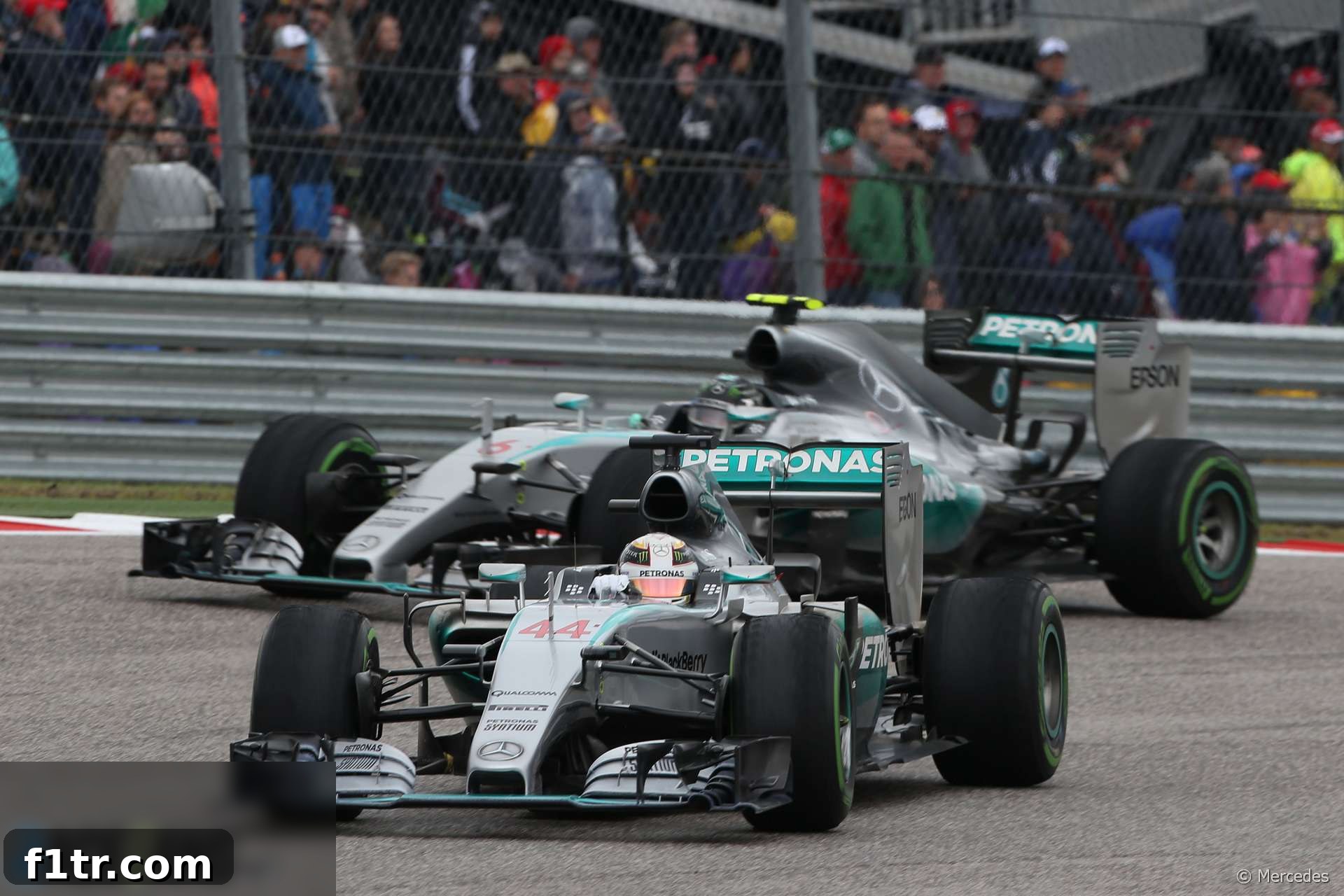
In a race that encapsulated the very essence of a Formula 1 championship showdown, Lewis Hamilton showcased the indelible hallmarks of a true champion, expertly navigating a treacherous United States Grand Prix to clinch his third world title. His triumph at the Circuit of the Americas was a testament to raw speed, unyielding force, and, as is often the case in motor racing’s most dramatic moments, a timely dash of fortune. It was a victory forged in the crucible of unpredictable weather, audacious on-track battles, and strategic masterstrokes that kept the global audience captivated until the very last lap.
Advert | Become a Supporter & go ad-free
The lead-up to the grand prix was far from conventional. Two days of relentless, almost uninterrupted rain had plunged the event into uncertainty, forcing a condensed schedule that saw a truncated qualifying session conducted just hours before the main race. This unique scenario added an extra layer of tension and unpredictability, as teams and drivers had minimal dry running to fine-tune their setups. However, as if orchestrated by a higher power for maximum drama, the skies miraculously cleared just in time for the start of the race, leaving behind a damp, challenging track that promised an exhilarating contest.
What unfolded was nothing short of spectacular: a thrilling spectacle of relentless action and multiple incidents, serving as a magnificent, high-stakes backdrop for the pivotal title decider. The mixed conditions ensured that driver skill, strategic acumen, and sheer bravery would all play defining roles in determining the ultimate victor.
Hamilton’s Aggressive Start Sets the Tone
A Champion’s Forceful Declaration at Turn One
Just four hours after securing pole position in the hastily rearranged qualifying session, Nico Rosberg lined up at the head of the field, marking his third consecutive start from the front. The track, still slick with residual moisture, meant every car on the grid was shod with intermediate tyres. Rosberg, keenly aware of his recent failures to convert pole into victory at the previous two races, was desperate to maintain his lead and finally break his win drought.
In the preceding race, Rosberg had successfully kept Hamilton at bay, only for a mechanical issue to scupper his chances a few laps later. Before that, at Suzuka, Hamilton had simply outmanoeuvred him off the line, sweeping past at the first corner with an almost dismissive ease. As the five lights extinguished at the Circuit of the Americas, Rosberg must have harboured a sinking feeling that history was about to repeat itself. Yet, the sheer ferocity of Hamilton’s attack at Turn 1 likely caught him off guard. Hamilton, aiming for the apex, missed it by several meters as he forcefully drove Rosberg completely off the racing line. This audacious move created an immediate gap, allowing both Red Bull drivers and Sergio Perez’s Force India to momentarily split the two Mercedes contenders.
Post-race, Hamilton offered his perspective on the incident: “That wasn’t intentional. We both [braked] very deep into it and I understood he was on the outside and in the wet that’s where the grip is, so he was turning and I wasn’t turning so we touched.” Regardless of intent, the aggressive manoeuvre sent a clear message: Hamilton was not merely here to participate; he was here to seize his destiny, with every ounce of his formidable talent and unwavering resolve.
Advert | Become a RaceFans supporter andgo ad-free
Red Bull’s Wet Weather Prowess Challenges Mercedes
The Dynamic Shift as Track Conditions Evolve
The race initially unfolded with a familiar narrative: Lewis Hamilton quickly asserting his dominance by taking the lead. However, unlike many of his previous dominant performances, Hamilton found himself unable to pull away. Daniil Kvyat, who had skilfully snatched second place from his Red Bull teammate into Turn 3 on the opening lap, remained within a few tenths of Hamilton, a constant threat in the Mercedes’ mirrors. It was only the superior straight-line grunt of the Mercedes engine that allowed Hamilton to maintain his slender advantage on the longer straights.
Meanwhile, Rosberg had swiftly recovered fourth place from Perez on the first lap but struggled to make inroads on the Red Bulls ahead. The early phase of the race was punctuated by numerous incidents due to the tricky conditions. On lap five, a Virtual Safety Car (VSC) period was declared to clear debris from a series of first-lap collisions that had scattered across the track. This intervention played a crucial role in altering the race’s dynamic. At the time of the VSC, Rosberg was over three seconds adrift of Daniel Ricciardo, who was running third. Under the VSC, this gap dramatically shrunk to less than a third of its original size, effectively gifting Rosberg an opportunity to close on the Red Bulls.
As the VSC period concluded, Hamilton, in a tactical move, slowed the field to ensure he could get a cleaner getaway. This inadvertently benefited his teammate, Rosberg, who capitalised brilliantly. He surged past Ricciardo at Turn 3 with remarkable speed and then dispatched Kvyat on the approach to Turn 12, achieving these overtakes without the aid of DRS. The Red Bulls, conversely, appeared to struggle with reheating their tyres after the Safety Car periods, a critical disadvantage in the cooler, damp conditions. However, as the track gradually began to dry out, their inherent wet-weather pace re-emerged, and they quickly latched back onto the rear wings of the Mercedes cars. Both Hamilton and Rosberg had expressed concerns about front tyre degradation during their pre-race reconnaissance laps, an issue that became more pronounced as the race progressed.
Kvyat and Ricciardo demonstrated exceptional strength through the flowing sequence of Turns 16, 17, and 18, consistently gaining time on their rivals there. At the end of lap 12, Kvyat launched an ambitious dive down the inside of Rosberg at the final corner, attempting a bold overtake. The move, however, proved too optimistic; Kvyat slithered onto the run-off area, allowing Rosberg to regain the position. While Kvyat’s attempt failed, it indirectly opened the door for Ricciardo. Having already passed Kvyat, Ricciardo then capitalised on Rosberg going too deep into Turn 1, sweeping past the Mercedes to move up a position.
Just three laps later, Ricciardo executed a masterful move on Hamilton. Taking a tighter line into Turn 16, he held his nerve through the subsequent corners, emerging in the lead of the Grand Prix. As he drove past the pits, he hugged the pit wall, visibly seeking any available cooling water for his tyres, which had been pushed to their absolute limit during his charge to the front. The Red Bull, defying expectations, was leading the United States Grand Prix.
Advert | Become a RaceFans supporter andgo ad-free
Mercedes Unleashes Dry Weather Superiority
The Strategic Gamble and Inevitable Comeback
Ricciardo’s time at the front, however, was fleeting. Hamilton’s intermediate tyres were rapidly losing their effectiveness, with Ricciardo immediately clocking laps over a second faster. Rosberg, meanwhile, was filling Hamilton’s mirrors, indicating an imminent overtake. Within just two laps, Rosberg found a way past his struggling teammate. By this point, Hamilton had already made the decisive call to switch to slick tyres, recognising the changing track conditions.
Marcus Ericsson had unknowingly acted as the crucial bellwether, bravely switching to slick tyres on lap 16 and immediately posting competitive middle sector times, validating the gamble. Jenson Button followed suit on lap 17, and on the next lap, Hamilton was among five more drivers to make the critical switch to dry-weather rubber. Being the first of the front-runners to pit for slicks, however, didn’t immediately help Hamilton regain his lost positions. Rosberg and both Red Bull drivers came in on the very next lap, and despite the Red Bull’s double-stack pit stop, Kvyat managed to emerge ahead of Hamilton.
But with the track decisively transitioning from wet to dry, Mercedes’ inherent crushing superiority, particularly in raw pace, was unequivocally restored. Hamilton, determined to reclaim his position, made a move on Kvyat down the inside at Turn 12 with DRS on lap 21, but ran wide onto the run-off, momentarily dropping back behind. Undeterred, on the very next lap, both Mercedes cars, demonstrating their sheer speed, effortlessly swept past their Red Bull rivals in the same DRS zone, before even reaching the braking point. By lap 26, Hamilton had closed in on and passed Ricciardo in a similar fashion, securing second place and setting his sights on his teammate.
The Championship Climax: Hamilton vs. Rosberg
Multiple Interruptions and a Fateful Spin
As the race approached its halfway mark, Nico Rosberg had established a seemingly comfortable 12-second lead over Hamilton. It appeared he was cruising towards a victory that would keep the championship battle alive for at least another week. However, the relentless drama of the United States Grand Prix was far from over. His substantial lead was suddenly eradicated when Marcus Ericsson, who had provided the earlier slick-tyre validation, came to a halt at the exit of Turn 11 due to an electrical fault, necessitating a Safety Car period.
Both Mercedes drivers, despite still needing to make further pit stops later in the race, opted to stay out under the Safety Car. When the race restarted after a lengthy delay, they left the rest of the field in their wake, consistently lapping over two seconds quicker than anyone else. Hamilton, displaying a clear edge, steadily chipped away at Rosberg’s lead, regularly shaving tenths off his lap times. As lap 37 commenced, he was within DRS range, poised to strike. But before he could launch his decisive attack, another interruption brought the race to a standstill.
Nico Hulkenberg, who had been aggressively positioning himself to overtake the struggling Ricciardo at Turn 12, suffered a catastrophic front wing failure on his Force India. Robbed of crucial downforce, Hulkenberg lost control and clattered into the luckless Ricciardo. While the Red Bull managed to continue, Hulkenberg was forced to pull off the track with broken suspension, leading to a second Virtual Safety Car period, piling on the strategic complexity.
Advert | Become a RaceFans supporter andgo ad-free
Rosberg immediately seized the opportunity presented by the VSC to make his final pit stop, fitting a fresh set of soft tyres. As all drivers had started on intermediate tyres, there was no mandatory requirement to use the medium compound. Despite the healthy margin Mercedes had over the rest of the field, they controversially decided against double-stacking their drivers, opting to keep Hamilton out on track, thereby promoting him into the lead. Behind Hamilton, Max Verstappen and Sebastian Vettel were running, attempting to stretch their current tyres to the finish, having pitted earlier during the Ericsson Safety Car period. Rosberg emerged from his pit stop in fourth, but with Hamilton still needing to make his final stop, the number six Mercedes was very much still on a victory course.
Hamilton’s inevitable final pit stop eventually came during the day’s fourth interruption and second full Safety Car period. This was triggered by Daniil Kvyat, who, with just 15 laps remaining, spun into the Turn 20 barrier, ending his promising race. Ferrari also smartly brought Vettel in during this Safety Car, giving him the strategic advantage of a fresh set of soft tyres for the final dozen laps. This cost him just one position to Verstappen, a position he effortlessly reclaimed once the Safety Car peeled into the pits and the race resumed.
As the race restarted for the final, thrilling dash to the flag on lap 47, Rosberg, whose tyres were five laps older than Hamilton’s, immediately pulled an impressive one-and-a-half seconds clear. The momentum seemed to be firmly with Rosberg; it looked as though he had done enough to secure the victory, forcing Hamilton to wait another week to potentially clinch the title. However, destiny, in its most dramatic form, intervened. As Rosberg accelerated out of Turn 15 for the 48th time, his rear wheels lost traction, resulting in a sudden, catastrophic wheelspin that sent his Mercedes slewing onto the run-off area. A stunned Rosberg later reflected: “I’m assuming that it’s a mistake that I made, just getting too much wheelspin, going away on the cold tyres, the tyres weren’t fully up to temperature yet.”
In a flash, Hamilton surged past his teammate, inheriting a lead he would not relinquish. The championship was now “so close that I could smell it,” he later described. “I was just head down, everything that I’ve got from all these years. Everything that I’ve built up, everything that I’ve learnt comes into this.” A race that had delivered enough drama for an entire Formula 1 season had no more surprises left for Lewis Hamilton in the final eight laps. He crossed the chequered flag, securing his third victory at the Circuit of the Americas – and, more significantly, his momentous third World Championship title.
Advert | Become a RaceFans supporter andgo ad-free
Chaos in the Midfield: Retirements and Reshuffled Positions
The Fates of Raikkonen, Massa, Alonso, and Others
While the focus was largely on the championship battle at the front, the midfield provided its own share of high-octane drama and strategic intrigue. Sebastian Vettel, though he chose not to risk a last-lap lunge at Rosberg—the pair were separated by a mere six-tenths of a second at the start of the final tour—could have potentially denied Hamilton the title, had he pushed harder. Perhaps mindful of the troubles such aggressive moves caused his teammate in a previous race, Vettel held back. Likewise, Rosberg’s lingering rancour over Hamilton’s Turn 1 incident wasn’t deep enough for him to intentionally cede second place to Vettel, a move that would have postponed Hamilton’s celebrations but cost Mercedes a crucial one-two finish.
Max Verstappen, in a testament to his burgeoning talent, delivered a fine drive to finish fourth. The young Dutchman briefly passed Vettel only to run wide at Turn 12, a minor error in an otherwise impressive performance. Kimi Raikkonen, always outspoken, took strong exception to Verstappen’s aggressive defending at one point, complaining vehemently that the then 18-year-old was “forcing me off the circuit.” Raikkonen then threatened, “If that is legal then I will do the same next time.” He never got the chance to test his theory; after switching to slick tyres, he spun into a barrier. Although he managed to get going again, rapidly rising brake temperatures forced him to pit and ultimately retire from the race.
Raikkonen was one of a significant eight retirements during the chaotic race, a list that sadly included both Williams drivers. Felipe Massa was involved in a first-lap collision with Fernando Alonso at Turn 1 and later parked his car in the pits with a suspension problem. The McLaren driver, Alonso, eventually slipped out of the points due to a persistent glitch in Honda’s latest engine. Late in the race, Alonso inquired about Massa’s fate: “Has he got a penalty for the start?” The reply came: “No, he has retired.” To which a candid Alonso responded, “Well I am not sad for that,” highlighting the intense rivalries on track.
A frustrated Romain Grosjean also retired after being hit at the start of the race. Jenson Button, ever the opportunist, shrewdly capitalised on the spate of retirements, skilfully guiding his McLaren to sixth place, behind Perez. He initially finished seventh on the road but was promoted one spot when Carlos Sainz Jnr received a five-second penalty for speeding in the pit lane. The young Toro Rosso driver was arguably fortunate not to face further censure after causing contact with Ricciardo by making a sudden change of direction in the braking zone for Turn 12.
Ricciardo, with his wounded car still struggling from the Hulkenberg collision, bravely brought his car home in eighth place, behind Pastor Maldonado and Felipe Nasr. Nasr himself had incurred the wrath of his team by hitting Ericsson on lap one, a testament to the chaotic opening stages. With Ricciardo battling his damaged car and Alonso nursing persistent problems, Alexander Rossi, the Manor driver, briefly looked set for a shock points finish in his home race, a Cinderella story that ultimately did not materialise as he finished 12th.
Advert | Become a RaceFans supporter andgo ad-free
‘Standing on the Same Line as Senna’: A Legacy Cemented
Hamilton’s Emotional Connection to His Childhood Hero
Ever since his dramatic entry into Formula One, much has been written about Lewis Hamilton’s profound idolisation of the legendary Ayrton Senna. Earlier in the year, Hamilton had equalled Senna’s impressive tally of 41 Grand Prix victories, a significant milestone in itself. His latest triumph at the Circuit of the Americas carried even deeper personal significance, as he had now matched his childhood hero’s record of three World Championships. This achievement was not merely a statistic; it was the culmination of a lifelong dream, a powerful connection to the driver who had inspired him from his earliest days in karting.
While Hamilton’s previous two championship successes were secured in the nail-biting tension of final-round showdowns, the third, clinched earlier in the season, felt no less special to him. “This one still feels just as special, if not more special,” he reflected, his voice imbued with emotion. “I think this has to have topped last year for me, being as it’s equalling Ayrton.” This statement underscored the immense personal weight and emotional resonance of drawing level with Senna’s formidable legacy. Hamilton spoke candidly about the unpredictable nature of his journey: “Of course, I drive every year and I believe that I have the ability to win but with the way life goes, sometimes you have the luck with you, sometimes it’s not. Sometimes you have a good car, sometimes you don’t. I really didn’t think a few years ago that I would be sitting here.”
His third World Championship also served as a resounding vindication of his audacious decision to leave McLaren in 2012, a move that many in the paddock and beyond had doubted the wisdom of at the time. The shift to Mercedes, then a team still building towards championship contention, was seen by some as a career risk. Yet, Hamilton’s foresight and belief in the Mercedes project proved prophetic. “I thought that I would win championships at this team and as I said, that is why I moved here,” Hamilton asserted. “It was never ‘I’m just going to take a chance.’ I did my due diligence and I believed it was the right choice.”
The sentiment of fulfilling a childhood dream resonated deeply: “As a kid, I just wanted to be world champion and so it’s kind of crazy to think that me and Ayrton, in terms of championships, stand on the same line which is just the greatest.” This victory, hard-fought and dramatically won, cemented Lewis Hamilton’s place not just among the pantheon of Formula 1 greats, but directly alongside the man who ignited his passion for racing, fulfilling a destiny he had envisioned since childhood.
Advert | Become a RaceFans supporter andgo ad-free
2015 United States Grand Prix Related Articles
- Verstappen and Rosberg take second Driver of the Weekend wins
- Fan Ratings: High praise for US GP, mixed reviews for Mexico’s return
- Full Team Radio Transcript: 2015 United States Grand Prix
- Predictions Championship Results: 2015 United States Grand Prix
- Top Ten Moments in Pictures: 2015 United States Grand Prix
Browse all 2015 United States Grand Prix articles
More F1 Race Reviews
- Antonelli’s Second Win: Youngest F1 Championship Leader Emerges
- Emotional Victory: Antonelli Claims First F1 Win in Chinese Grand Prix
- Russell Dominates Melbourne, Leads Mercedes One-Two Finish
- Norris Clinches F1 Title by Two Points in Yas Marina Thriller
- McLaren Blunder in Losail Hands Verstappen Crucial Win and Title Shot
Read all F1 race reviews