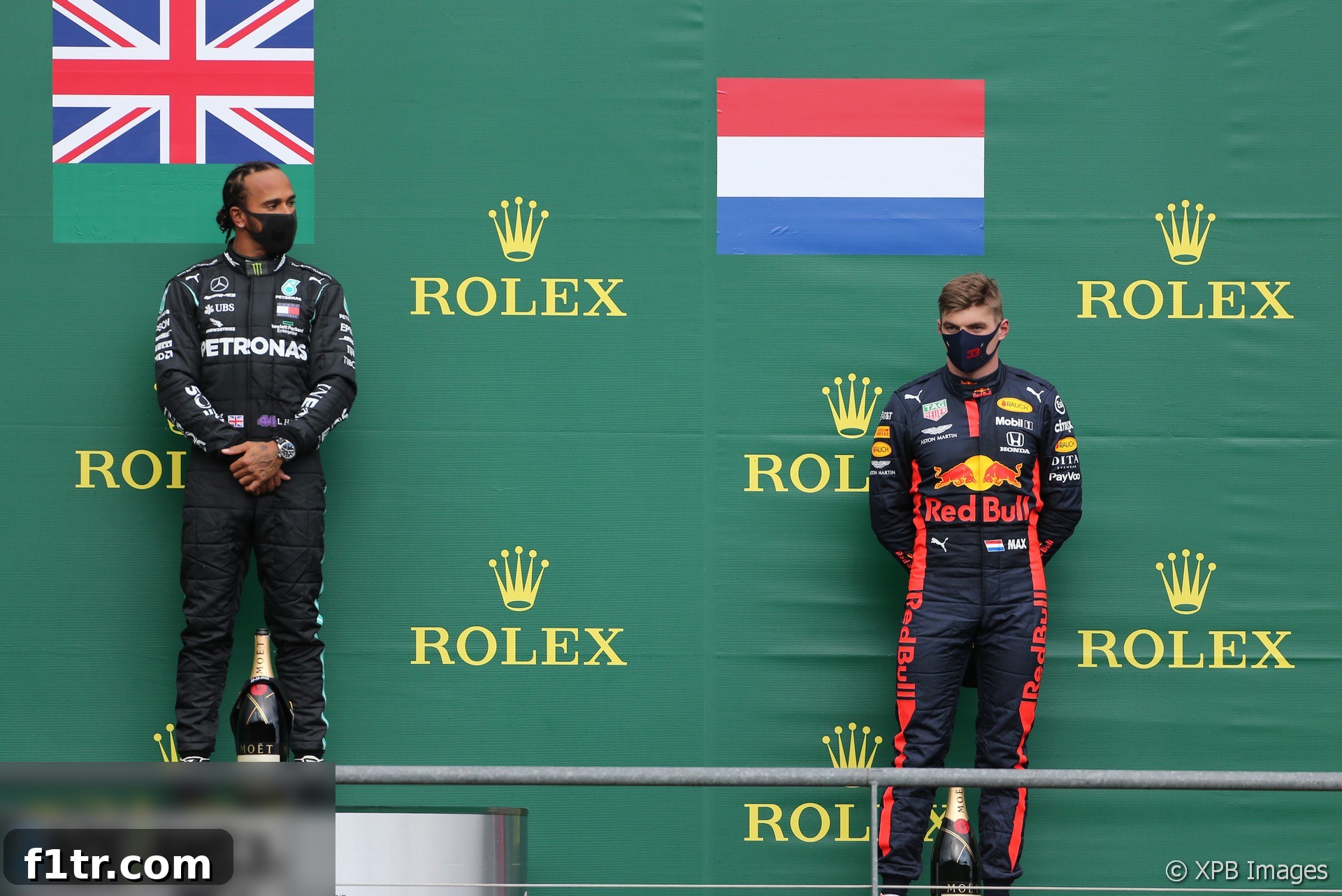
The exhilarating world of Formula 1 consistently delivers high drama, fierce competition, and intense scrutiny. In the midst of one of the sport’s most dominant eras, Lewis Hamilton, the reigning champion at the time, offered a pointed assessment of rival team Red Bull Racing. Hamilton suggested that despite possessing a formidable car, Red Bull was failing to operate at its peak potential, primarily because only one of their drivers, Max Verstappen, was consistently challenging the mighty Mercedes duo.
Seven races into the season, the standings painted a clear picture. Max Verstappen held a strong second position in the drivers’ championship, albeit 47 points adrift of Hamilton. However, the chasm between Verstappen and his teammate, Alexander Albon, was a staggering 62 points. This significant gap underscored a critical issue for Red Bull: Albon had consistently been outscored by Verstappen in every race they had both completed, creating a strategic imbalance that Hamilton was quick to highlight.
Hamilton’s critique centered on the strategic limitations imposed by Albon’s performance deficit, particularly in qualifying. Albon frequently started races several positions behind Verstappen, which, according to Hamilton, severely curtailed Red Bull’s tactical options on race day. In Formula 1, track position is paramount, and having two cars starting high up the grid offers a multitude of strategic advantages, from splitting tire strategies to covering off rival attacks and creating effective slipstream opportunities.
The Strategic Disadvantage of a Single Challenger
“What you’ve got to look at with the Red Bulls is I think they’ve got a very good car – people downplay it but they’ve got a very, very strong car,” Hamilton shared with Sky Sports. “Max is doing a great job with it.” Hamilton’s acknowledgment of Red Bull’s potent machinery served to amplify his subsequent point about their underperformance. He believes the car itself is capable of challenging for victories and championships, but the team’s internal dynamics prevent them from fully realizing this potential.
The crux of Hamilton’s argument lay in the comparative strength of Mercedes’ driver pairing. “Unfortunately, both drivers aren’t there like me and Valtteri [Bottas] are. That makes it harder for them.” The synergy between Hamilton and Bottas allowed Mercedes to deploy multifaceted strategies, effectively boxing in opponents or forcing them into compromised positions. With two cars consistently at the front, Mercedes could dictate the pace, manage tire degradation across two different strategies, and collectively fend off any sole challenger. This collective strength translated directly into crucial Constructors’ Championship points and an enhanced strategic playbook.
Hamilton drew upon his own extensive career experience to underscore his point, recalling similar situations during his tenure at McLaren. “I’ve experienced it many years ago when I was at McLaren and I was the driver that was always at the front and didn’t have a team mate backing up.” He vividly remembered the pressures and limitations of being the sole front-runner, shouldering the entire burden of challenging rivals without the strategic support of a second car. “So you equally don’t get the constructors’ points, but then can’t play strategy on the cars that your racing against. So they’ve got that, he’s kind of there on his own,” Hamilton concluded, empathizing with Verstappen’s isolated position within Red Bull’s strategic framework.
This imbalance not only impacts race-by-race strategy but also has significant repercussions for the Constructors’ Championship, a critical battle for financial rewards and prestige in Formula 1. While Verstappen was scoring consistently high points, Albon’s struggles meant Red Bull was losing out on vital points that a more evenly matched second driver could secure. This deficit makes challenging Mercedes for the Constructors’ title an uphill battle, as Mercedes routinely had both Hamilton and Bottas finishing in strong points-paying positions.
Christian Horner’s Defense of Alexander Albon
Earlier in the same race weekend, Red Bull team principal Christian Horner had staunchly defended Alexander Albon’s performances. Albon had joined the team midway through the previous season, replacing Pierre Gasly ahead of the Belgian Grand Prix. Horner acknowledged the public scrutiny but maintained that the full picture was often overlooked. “Everybody’s obviously got an opinion on this topic but they don’t have really the facts,” Horner stated, implying a deeper understanding of Albon’s situation within the team.
Horner pointed to the inherent difficulties with the 2020 car, suggesting it was a tougher beast to master compared to its predecessor. “Alex is doing a good job in what’s been a difficult car this year. It’s a different car to last year, I’d say the car’s harder to drive than 12 months ago.” A more challenging car can amplify any slight deficiencies in a driver’s adaptation or confidence, particularly for a younger, less experienced driver like Albon, whereas a seasoned talent like Verstappen might be better equipped to extract its maximum potential regardless of its quirks. This insight provides context for Albon’s struggles, suggesting they might not solely be down to driver ability but also the characteristics of the machinery he was tasked with taming.
Horner highlighted Albon’s strong racecraft, particularly on Sundays, despite his qualifying struggles. “His racing has been very strong on a Sunday but he’s struggled with the car over a single lap. And, of course, Max has been so strong at getting the most out of the car.” This distinction is crucial; while Albon might struggle to extract peak performance in a single qualifying lap, his ability to manage tires, make overtakes, and maintain pace in race conditions indicated underlying talent. The challenge, however, is that poor qualifying positions often negate strong race pace, making it difficult to climb into podium contention from the midfield.

The Red Bull team principal also drew comparisons to legendary figures in Formula 1 history to contextualize the immense challenge of being Verstappen’s teammate. “You think back to some of the great drivers, whether it’s a [Michael] Schumacher or an [Ayrton] Senna, and being a driver alongside those guys was very tough. I think that’s a similar situation that the seat alongside Max has at the moment.” This comparison elevates Verstappen to the pantheon of F1 greats, suggesting that any driver would find it incredibly difficult to match his raw speed and relentless performance, thereby mitigating some of the criticism leveled at Albon.
Horner expressed unwavering confidence in Albon’s potential for improvement. “Alex is only going to get better. He’s still pretty young and inexperienced. This is only his second season of F1 racing and we’re doing all that we can to support him and develop him.” This long-term view emphasizes Red Bull’s commitment to nurturing talent, a hallmark of their driver development program. They believed Albon possessed the raw ability and simply needed more time and support to fully unleash it.
Unfortunate Incidents and Hidden Potential
To further bolster his defense, Horner highlighted specific instances where Albon’s results were unfairly impacted by circumstances beyond his control. He pointed to the season-opening Austrian Grand Prix, where Albon was in contention for a podium finish, or even a potential win, before being involved in a collision with Lewis Hamilton. “This is a driver that nearly won the first race of the year. Strategically we were sharp, he obviously got turned around by Lewis that race. He was fighting for the podium and should have been on the podium in Brazil at the end of last year [where Hamilton also hit him].”
These two high-profile incidents, both involving contact with Hamilton and both costing Albon significant points and potential podiums, painted a picture of misfortune rather than a complete lack of pace. Had these incidents not occurred, Albon’s points tally would have looked considerably healthier, and the perception of his performance might have been drastically different. These “what if” scenarios are common in F1, but in Albon’s case, they were particularly impactful given the intense scrutiny on his position within Red Bull.
Horner concluded with a strong vote of confidence: “I think he’ll have more Sundays like that in the coming races where he’s competing and fighting for podium finishes on merit. So, the team has confidence in him and belief in him and we’re happy with our choice.” This statement underscored Red Bull’s internal belief in Albon’s capabilities and their commitment to helping him fulfill his potential, rejecting the narrative that he was simply not good enough.
Impact on the 2020 F1 Season and Beyond
The contrasting perspectives from Hamilton and Horner encapsulate the perpetual dilemma for top F1 teams: the balance between individual brilliance and cohesive team performance. While Verstappen’s exceptional talent provided Red Bull with a clear championship contender, Albon’s struggles meant the team was consistently fighting Mercedes with only one hand. This dynamic directly affected Red Bull’s ability to mount a sustained challenge against Mercedes in the Constructors’ Championship, and by extension, made Verstappen’s bid for the Drivers’ title even more arduous.
The discussion around Albon’s performance highlights the immense pressure faced by drivers in the high-stakes environment of Formula 1, especially when paired with a generational talent like Max Verstappen. It also underscores the strategic depth of the sport, where every driver’s contribution, or lack thereof, can have profound implications for team strategy and championship outcomes.
Ultimately, while Lewis Hamilton’s comments served as a stark reminder of the advantage Mercedes held with two top-tier drivers, Christian Horner’s defense offered a more nuanced view of Albon’s situation, emphasizing potential, development, and the role of misfortune. The debate surrounding Red Bull’s second driver continued to be a significant talking point throughout the 2020 F1 season, illustrating the critical importance of a cohesive and high-performing driver lineup in the relentless pursuit of Formula 1 supremacy.
2020 F1 season
- Grosjean to make F1 test return tomorrow for first time since Bahrain horror crash
- Pictures: Wrecked chassis from Grosjean’s Bahrain fireball crash to go on display
- Bottas vs Rosberg: Hamilton’s Mercedes team mates compared after 78 races each
- F1 revenues fell by $877 million in Covid-struck 2020 season
- Hamilton and Mercedes finally announce new deal for 2021 season
Browse all 2020 F1 season articles