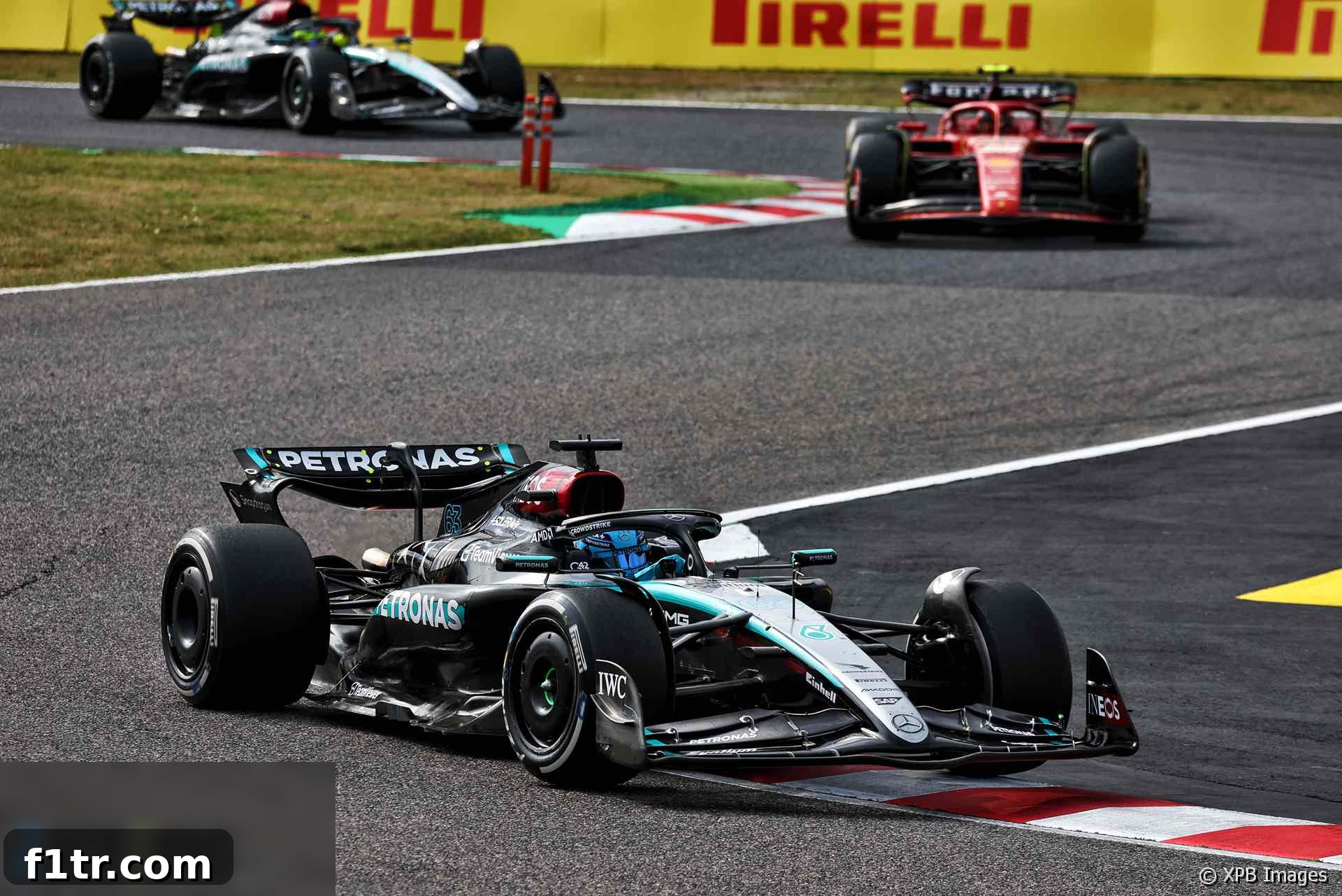
The intense on-track battle between Mercedes’ George Russell and McLaren’s Oscar Piastri at the recent Formula 1 Japanese Grand Prix culminated in a comprehensive post-race investigation. Following detailed scrutiny, the race stewards ultimately decided to take no further action against either driver. This ruling has ignited widespread discussion about the interpretation of F1 racing ethics, the inherent challenges of applying complex regulations in high-speed, dynamic scenarios, and the ongoing demand for consistency in stewarding decisions.
High Stakes at Suzuka: Russell and Piastri’s Clash for Crucial Points
The Suzuka International Racing Course, revered globally for its challenging layout and iconic corners, once again delivered a weekend of thrilling motorsport action. Amidst the spectacle, the battle for seventh place in the closing stages of the Grand Prix became a particular flashpoint. Two highly talented former Formula 2 champions, George Russell and Oscar Piastri, found themselves locked in a captivating duel, each fiercely vying to secure valuable championship points for their respective teams.
Piastri, driving for the resurgent McLaren team, initially held the advantage. However, Russell, behind the wheel of his Mercedes, was aggressively pushing to find an overtaking opportunity. The stage for their decisive encounter was set at the circuit’s final chicane, a notoriously tricky section that demands precision and bravery, offering one of the last genuine overtaking opportunities on the lap before the long pit straight.
Advert | Become a Supporter & go ad-free
The Suzuka Chicane Showdown: An Incident Under Intense Scrutiny
The critical moment unfolded as Russell launched a bold overtaking attempt on Piastri into the first right-hand apex of the final chicane. Russell committed to an ambitious out-braking maneuver, pushing his Mercedes to the very limits of grip and car control. As both cars navigated the tight entry, they reached the initial apex simultaneously, creating a high-pressure situation.
It was at this crucial juncture that Piastri, finding himself under immense pressure and with seemingly no space to maneuver, was forced to leave the track. Consequently, he cut across the second left-hand section of the chicane, rejoining the circuit momentarily ahead of Russell’s Mercedes. The immediate aftermath saw Piastri voice his perspective and frustration over the team radio. “He didn’t give me anywhere to go at the chicane, so I had to cut,” he relayed, clearly indicating his belief that Russell’s maneuver had compelled him off the circuit.
Recognizing the potential breach of racing regulations and the dynamic nature of the incident, race stewards swiftly noted the event. They announced that a full investigation would be initiated once the chequered flag had officially brought the Grand Prix to a close. Despite Piastri’s initial re-entry ahead, Russell’s persistent pursuit ultimately paid off on the very next and final lap. The Mercedes driver successfully completed the overtake along the pit straight, ultimately securing a hard-fought seventh place.
The Stewards’ Deliberation: Untangling a Complex Racing Judgment
The post-race investigation into the Russell-Piastri incident proved to be a lengthy and intricate process, extending over two hours beyond the conclusion of the Grand Prix. The stewards, a panel of experienced officials, were tasked with meticulously reviewing all available evidence, including telemetry data, onboard camera footage, photographic evidence, and driver testimonies. After their exhaustive review, they determined that no further action was warranted against either George Russell or Oscar Piastri for the incident.
However, their official report was notable for highlighting the significant “challenges” encountered in reaching this conclusion, indicating a lack of clear precedent or definitive guidance for certain nuanced aspects of the event. Their findings underscored several key points in their rationale. Firstly, the stewards concluded that Russell’s entry into the chicane was not an illicit “dive in” maneuver – a term frequently associated with overly aggressive, uncontrolled, and potentially dangerous attempts to overtake. Instead, they explicitly found that Russell was “in control at the entry” of the corner, demonstrating a measured approach despite the aggression.
Furthermore, based on established driving standards and the proximity of the cars, Russell’s front axle was deemed to be sufficiently ahead of Piastri’s mirrors as they entered Turn 16. According to the FIA’s regulations, this positioning entitled Russell to “racing room.” This entitlement suggests that Piastri should have afforded Russell adequate space on the track to complete the corner safely.
Yet, the investigation also unveiled a crucial detail that added significant complexity to the decision: photographic evidence submitted by the McLaren team indicated that there was minor contact between the two cars in the middle of the chicane. This contact, while seemingly slight, was deemed significant enough to directly prompt Piastri’s evasive action. The stewards explicitly stated that Piastri abandoned the conventional racing line through the left-hander to avoid “risking another collision with perhaps more serious consequences.” This acknowledgment of physical contact and Piastri’s defensive reaction added intricate layers to an already challenging scenario, demonstrating the fine line between aggressive racing and actionable infractions.
Intriguingly, despite acknowledging the contact and Piastri’s evasive maneuver, the stewards also determined that Russell had left “sufficient room” for the McLaren driver to navigate the remainder of the corner while staying on track. This apparent contradiction—Piastri being forced off due to contact, yet Russell technically leaving sufficient room—underscores the often subjective interpretations inherent in racing incidents and the difficulty in assigning blame. The stewards finally noted that Piastri rejoined the track safely, maintaining his position initially before Russell ultimately completed the definitive overtake.
Consensus and Controversy: Driver Perspectives and Regulatory Gaps
In a rare display of competitive camaraderie, both George Russell and Oscar Piastri, along with their respective team representatives, expressed a shared sentiment that the incident “did not warrant the imposition of any penalty.” While this joint agreement might suggest a common understanding among the competitors regarding fair racing, the stewards explicitly stated that this consensus was not a determining factor in their final decision. This highlights the independent and impartial nature of the F1 judicial process, where rulings are made strictly based on regulations and empirical evidence, rather than accommodating driver or team opinions.
A particularly significant point raised by the stewards in their report was the perceived inadequacy of the current driving standards guidelines. These guidelines, which were updated by the FIA prior to the 2024 season, reportedly do not provide clear and specific directives on the expected actions or consequences for a driver who retains their position after being forced off the track due to a collision, or in avoidance of one, and subsequently rejoins safely. This identified regulatory gap presents a significant challenge for achieving consistent stewarding decisions across different races and may inevitably lead to similar complex judgments in future scenarios. It strongly suggests a need for further refinement and clarification within the FIA’s extensive rulebook to encompass such specific and frequently occurring racing scenarios.
Advert | Become a RaceFans supporter andgo ad-free
Official Stewards’ Decision: A Deeper Look into the Rationale
The official document issued by the stewards offers transparent insight into their detailed thought process, meticulously outlining the specific points they considered as undisputed factual evidence to arrive at their nuanced conclusion:
This incident provided a number of challenges in arriving at a decision.
There are a number of matters that, based on the “level of comfort” criteria used by the International Court of Appeal in accepting evidence, we accept as fact:
1. That the driver of car 63 [Russell] did not “dive in” and was in control at the entry to turn 16.
2. That coming into turn 16 car 63’s front axle was in front of the mirrors of car 81 [Piastri] hence according to the driving standards, car 63 was entitled to “racing room” on turn 16.
3. That car 63 bounced off the inside kerb and then collided with car 81 (based on photographic evidence tabled by car 81).
4. That the driver of car 81, having felt the impact from car 63, took evasive action by driving off the track rather than risking another collision with perhaps more serious consequences.
5. That the driver of car 63 left sufficient room on the exit of turn 16 for car 81 to take the turn remaining on track.
6. That car 81 cut the chicane and returned safely to the track in front of car 63.
The driving standards are however silent on what action is required of a driver who leaves the track to avoid a collision or is forced off, safely rejoins the track and retains position.
Not that this is a determining point, we note that both drivers and team representatives agreed this incident did not warrant the imposition of any penalty.
Implications for Future F1 Racing and Stewarding Standards
The decision to take no further action in the Russell-Piastri incident at the Japanese Grand Prix carries significant implications that extend far beyond the immediate race result. It arguably reinforces the FIA’s stance on promoting hard but fair racing, allowing drivers the latitude to battle closely without immediate penalties for every minor contact or track deviation, provided that overall safety is maintained and no significant or lasting advantage is unfairly gained.
However, the explicitly identified “silent” aspect of the current driving standards highlights a critical area for ongoing improvement within Formula 1’s regulatory framework. As F1 cars become increasingly robust, and drivers continually push the absolute limits of performance, such ambiguous and complex scenarios are highly likely to recur. The establishment of clearer, more comprehensive guidelines could significantly reduce the degree of subjectivity inherent in stewarding decisions, thereby leading to greater transparency and consistency, qualities that are frequently demanded and valued by both avid fans and competing teams alike.
This incident serves as a pertinent reminder that while the popular “let them race” philosophy is enthusiastically embraced by many, it must be robustly underpinned by a comprehensive and adaptable regulatory framework. Such a framework is essential to account for all possible eventualities that can arise in the intense heat of top-tier competition. The spirited battle between Russell and Piastri was a testament to their exceptional skill and unwavering competitive spirit, providing a thrilling spectacle for all who witnessed it.
While the stewards’ intricate decision might not universally satisfy everyone, it accurately reflects the incredibly complex nature of interpreting racing incidents under immense pressure. More importantly, it opens the door for further constructive dialogue within the FIA regarding the continuous evolution and refinement of Formula 1’s racing regulations, ensuring they remain relevant and effective in matching the dynamic and ever-changing landscape of the sport.
Advert | Become a RaceFans supporter andgo ad-free
2024 Japanese Grand Prix: Related Content and Analysis
- “Am I in a race here or what?”: How Ferrari aced their Suzuka strategies
- Suzuka showed Mercedes “have a more stable platform” now
- Ferrari’s strategy gains in 2024 are “purely down to the car” – Sainz
- Tsunoda ‘at Verstappen and Alonso’s level’ with Suzuka performance – Marko
- Japan was first race where Red Bull’s winning margin was bigger than last year
Browse all 2024 Japanese Grand Prix articles