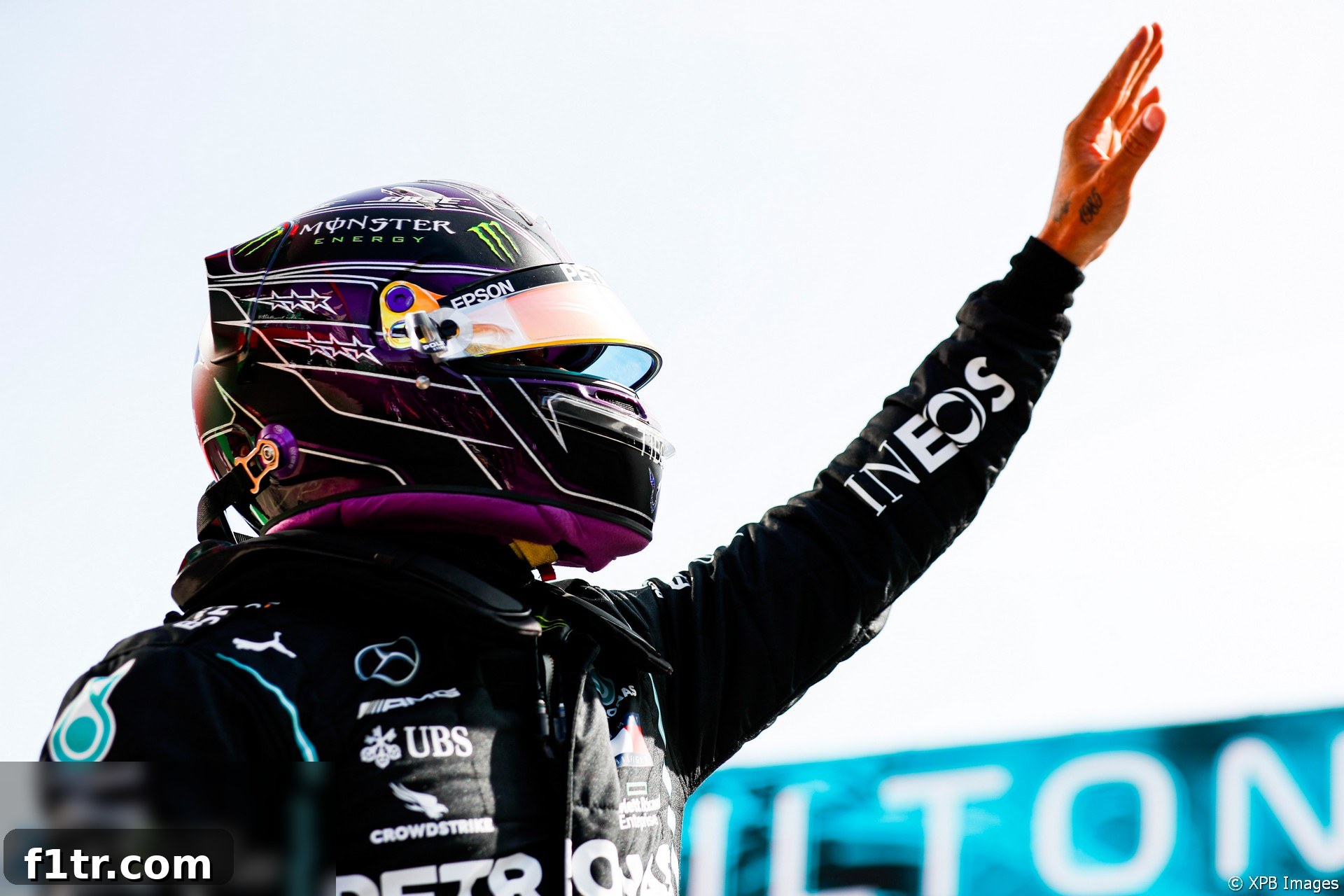
In the thrilling world of Formula 1, few narratives are as captivating as a driver’s journey from seemingly modest practice paces to outright qualifying supremacy. Such was the case for Lewis Hamilton at the 2020 Portuguese Grand Prix, where despite his teammate, Valtteri Bottas, topping every practice session, Hamilton ultimately snatched pole position. This remarkable ability to deliver when it counts has often sparked speculation, but Hamilton vehemently dismisses notions of ‘sandbagging,’ asserting that his performance stems from a meticulous, iterative process of continuous improvement, not hidden speed.
Advert | Become a Supporter & go ad-free
The Anatomy of a Pole Lap: Hamilton’s Methodical Approach
While Valtteri Bottas showcased blistering pace throughout all three practice sessions at the then-unfamiliar Autódromo do Algarve, it was Hamilton who delivered the decisive blow in qualifying, securing pole by a crucial tenth of a second. This consistent pattern has led many to question whether Hamilton deliberately conceals his true speed until the critical qualifying sessions. However, the seven-time world champion offers a far more insightful explanation, likening his approach to “building a wall.”
“It’s like building a wall,” Hamilton explained, “You put one brick, the next, the next, and you just continue to improve throughout.” This analogy perfectly encapsulates his philosophy: a relentless, step-by-step refinement of his driving and car setup. For Hamilton, success isn’t a sudden burst of speed, but the culmination of countless micro-adjustments and relentless dedication throughout the race weekend. This involves intricate work in the background, fine-tuning parameters such as brake bias and differential settings. Brake bias, for instance, dictates how much braking force is applied to the front versus rear wheels, profoundly affecting stability and turn-in. The differential, on the other hand, manages the power distribution between the rear wheels, crucial for optimizing traction out of corners. Mastering these variables, along with perfecting the attack angle for each of Portimão’s demanding corners, requires immense focus and experience.
The Autódromo do Algarve, with its unique undulations and high-speed sections, presented a steep learning curve for all drivers, as it was a new addition to the Formula 1 calendar in 2020. Hamilton’s methodical approach was particularly well-suited to mastering such an unfamiliar and technically challenging circuit. He emphasized that this journey to peak performance “just doesn’t come easy.” His persistent efforts throughout the weekend, even when Bottas seemed to have the upper hand, underscore a deep-seated belief in his process. “I’ve been pushing all weekend. I generally think I’ve been driving really well all weekend. I’ve been really happy with my performances through practice, but he’s always been at the top,” he recounted. This sentiment highlights the mental fortitude required to continually “dig” and maintain self-belief, even when trailing a fast teammate. The elation of crossing the line and securing pole position, therefore, was a profound reward for the sheer hard work invested, an effort Hamilton described as “working our socks off.”
Beyond Practice: Understanding the Nuances of F1 Pace
The gap between practice performance and qualifying results is a common talking point in Formula 1, and it’s essential to understand why. Practice sessions are multi-faceted, serving several critical purposes: understanding the circuit, evaluating different tire compounds, testing various car setups, and gathering data under varying fuel loads. Teams often run different engine modes and fuel strategies during practice, meaning a car topping the timesheets on Friday or Saturday morning might not be running at its maximum potential for a single qualifying lap.
Track evolution is another significant factor, particularly on a new circuit like Portimão. As more cars run, rubber is laid down, and the track ‘greens up,’ offering progressively more grip. Drivers also progressively adapt to the circuit, finding new lines and pushing the limits with each session. While Bottas undoubtedly demonstrated genuine speed and comfort with the Algarve circuit early on, Hamilton’s strength lies in his exceptional ability to synthesize all the data, driver feedback, and track changes to extract every last ounce of performance precisely when it matters most. His meticulousness ensures that by qualifying, the car’s setup is optimized for ultimate one-lap pace, and his driving is honed to perfection.
The Autódromo do Algarve: A Circuit Demanding Precision and Adaptability
The 2020 Portuguese Grand Prix marked Formula 1’s debut at the Autódromo Internacional do Algarve, or Portimão circuit. Nestled in the rolling hills of Portugal’s Algarve region, this track is renowned for its dramatic elevation changes, blind crests, and a challenging mix of high-speed corners and technical sections. Its undulating nature and relatively new asphalt presented a unique challenge to drivers and engineers alike. Adapting to such an unfamiliar layout, where grip levels and optimal racing lines were constantly evolving, demanded a driver capable of rapid learning and precise feedback.
For Hamilton, mastering Portimão was not about immediate raw speed but about a systematic approach to understanding every curve and elevation change. He focused on dissecting each corner, experimenting with different entry speeds, apex points, and exit strategies. This methodical build-up, combined with continuous adjustments to the car’s setup, allowed him to unlock the circuit’s secrets progressively. His eventual qualifying dominance was a testament to his unparalleled ability to analyze, adapt, and ultimately extract peak performance from both himself and his machinery on an unfamiliar and demanding stage.
The Ineffectiveness of “Sandbagging” for a Champion
The term “sandbagging” in motorsports refers to the practice of deliberately hiding a car’s true performance during practice sessions to lull competitors into a false sense of security or to avoid revealing a competitive advantage too early. It’s a strategic maneuver often debated among fans and pundits.
Hamilton candidly admitted to having attempted this tactic earlier in his career, particularly during his formative years in junior categories like Formula 3. However, his experience led him to conclude that it was ultimately an ineffective and counterproductive approach. “I don’t have anything to hide, I don’t hold anything back,” he stated, outlining his current philosophy. “I’ve never, personally, felt that that’s worked.”
His reasoning is pragmatic: holding back during practice means sacrificing valuable track time and data that could be used for genuine car development and driver refinement. Every lap in practice is an opportunity to learn, optimize, and push the limits safely. If a driver intentionally drives below their potential, they are not pushing the car to its absolute limits, nor are they fully exploring setup changes. This can lead to a less optimized package come qualifying and the race. For a driver like Hamilton, who thrives on pushing boundaries and constantly extracting marginal gains, such an approach would be detrimental. “I remember trying it when I was in Formula 3 or something like that and it never ended. So that’s never been something that’s part of my philosophy,” he reiterated, underscoring his belief in a transparent, maximum-effort approach from the very first lap.
Teammate Rivalry: The Internal Battle for Supremacy
The dynamic between teammates in Formula 1 is often one of the most intense, as both drivers have access to largely identical machinery. Valtteri Bottas’s consistent top performance in practice sessions at Portimão certainly put pressure on Hamilton. For a driver of Hamilton’s caliber, trailing a teammate, even in practice, serves as a powerful motivator. It confirms that the pace is there within the car and that the challenge lies in personal execution and setup optimization. This internal competition pushes both drivers to continually elevate their game.
Qualifying, however, is a different beast. It’s a single-lap shootout where nerves, precision, and the ability to extract peak performance in a brief window are paramount. Hamilton’s ability to “switch on” for qualifying, to find that extra tenth or two, often sets him apart. His experience allows him to manage tire temperatures perfectly, hit every apex with surgical accuracy, and maintain absolute focus under immense pressure. Beating a fast and determined teammate like Bottas to pole position, especially after being outpaced throughout practice, speaks volumes about Hamilton’s mental strength and unparalleled skill in high-stakes moments.
Advert | Become a RaceFans supporter andgo ad-free
The Enduring Legacy of Hamilton’s Qualifying Prowess
Lewis Hamilton’s journey to pole position at the 2020 Portuguese Grand Prix stands as a microcosm of his storied career: a testament not to hidden pace, but to an unwavering commitment to incremental improvement, meticulous preparation, and profound self-belief. His explanation of “building a wall” provides invaluable insight into the mind of a champion who understands that sustained excellence comes from diligent, transparent effort, rather than tactical subterfuge. In a sport where every millisecond counts, Hamilton’s consistent ability to unlock ultimate pace when it truly matters reinforces his status as one of Formula 1’s greatest qualifiers, transforming perceived deficits into dominant pole positions through sheer will and skill.
2020 Portuguese Grand Prix
Browse all 2020 Portuguese Grand Prix articles