The highly anticipated second day of Formula 1 pre-season testing at the iconic Circuit de Catalunya in Barcelona delivered a potent mix of impressive performance, strategic innovation, and a few minor setbacks, setting the stage for what promises to be an thrilling 2020 F1 season. As teams continued to push their new machinery to the limits, gathering crucial data and refining setups, the paddock buzzed with intrigue and anticipation.
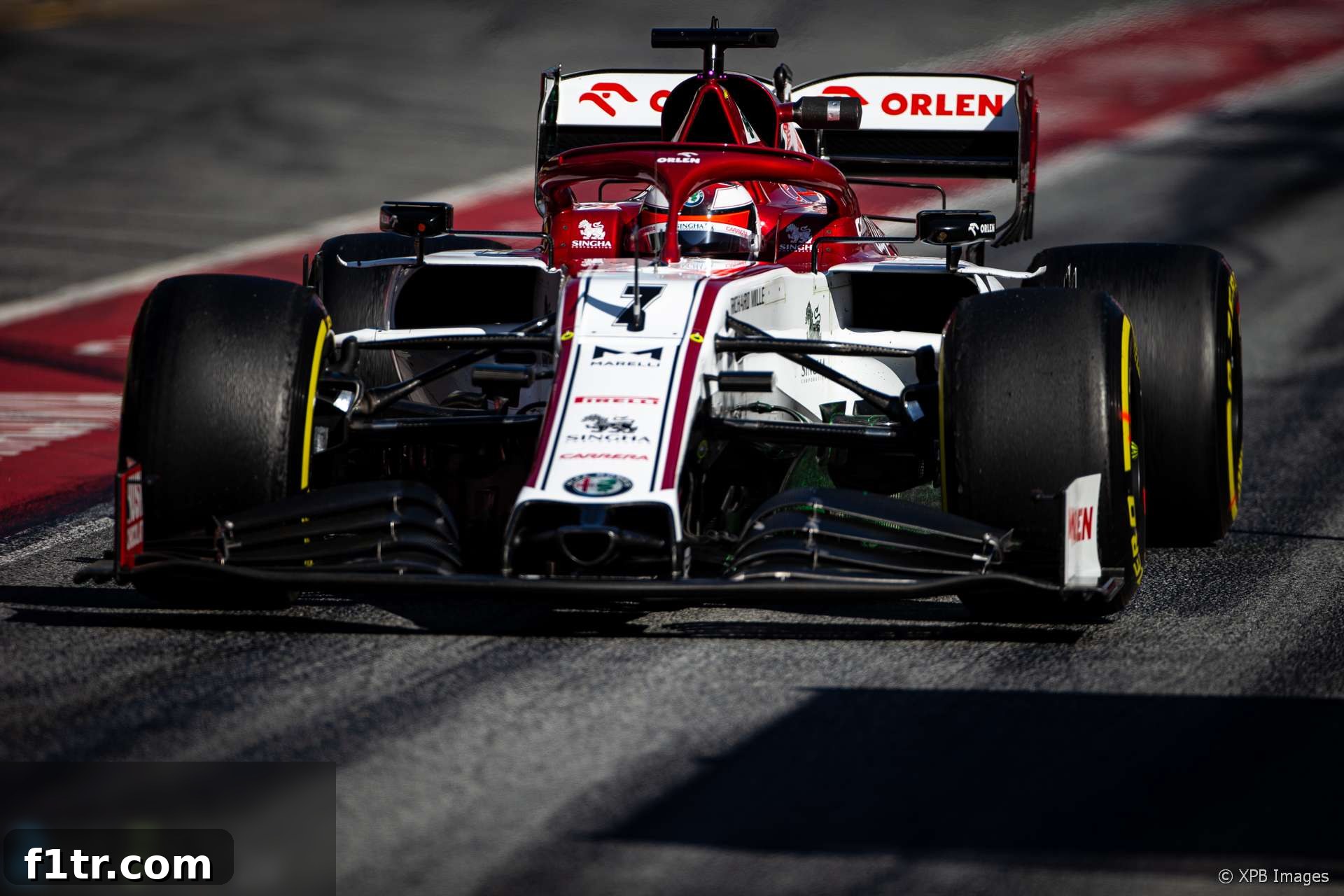
Emerging as the unexpected pace-setter on Day 2 was Kimi Raikkonen, the veteran Finn showcasing the potential of the Alfa Romeo C39. Raikkonen clocked the fastest time of the day, a remarkable 1’17.091, trailing only a tenth of a second behind Lewis Hamilton’s benchmark from the opening day. This performance from the ‘Iceman’ not only underscored Alfa Romeo’s promising start to testing but also hinted at a competitive package, a welcome sight for fans and a potential dark horse for the midfield battle. Raikkonen’s impressive lap count, exceeding two full Grand Prix distances, highlighted the C39’s strong reliability and allowed the team to amass a wealth of data across various tire compounds and fuel loads.
Despite his stellar performance, Raikkonen also had the dubious distinction of causing the first red flag of the entire pre-season test. With just 17 minutes remaining in the session, his Alfa Romeo came to an abrupt halt approaching Turn 9. While the specific cause was not immediately confirmed, such late-session stoppages are often a result of teams pushing component limits or minor electrical glitches, rather than fundamental design flaws. For Alfa Romeo, it was a momentary pause in an otherwise highly productive day, allowing them to thoroughly inspect the car and understand its behavior at the edge of performance.
Behind Raikkonen, Sergio Perez continued Racing Point’s strong showing, securing the second-fastest time overall. The Mexican driver demonstrated both speed and consistency, covering an impressive 145 laps in the RP20. Racing Point, affectionately dubbed the “Pink Mercedes” due to its visual similarities to the championship-winning W10, appears to have found a potent package early on, suggesting they could be formidable contenders in the mid-field. Perez’s high mileage further solidified the team’s confidence in their new challenger’s durability.
The third position on the time sheets went to Daniel Ricciardo, who shared driving duties in the Renault RS20 with teammate Esteban Ocon. While Ricciardo posted a competitive time, the RS20 was notably the only car on track to cover fewer than 100 laps (41 for Ricciardo, 52 for Ocon, totaling 93). This limited mileage for Renault raises some questions regarding their early testing program, particularly concerning reliability or the team’s strategic focus on specific test items rather than outright lap accumulation. While raw pace is important, comprehensive data collection through high lap counts is paramount in pre-season testing to ensure a robust foundation for the demanding F1 season ahead.
Alexander Albon, in the Red Bull RB16, enjoyed a steady and productive day, securing the fourth-fastest time after accumulating 134 laps. After a brief initial period dedicated to fine-tuning his seat and cockpit ergonomics, Albon quickly found his rhythm, demonstrating solid pace and contributing significantly to Red Bull’s data gathering efforts. Red Bull typically uses the early testing days to focus on understanding the car’s behavior and reliability, rather than chasing headlines, and Albon’s diligent performance aligned perfectly with this approach. His consistent lap times and high mileage bode well for his confidence and adaptation to the new car.
Meanwhile, Romain Grosjean proved to be the busiest driver of the day, logging an outstanding 158 laps in his Haas VF-20. This remarkable endurance run came despite a minor setback when he spun into a barrier backwards, causing damage to his rear wing. The incident caused a temporary disruption but the Haas team quickly repaired the car, allowing Grosjean to continue his marathon testing program. His relentless effort highlights Haas’s commitment to improving reliability and understanding their 2020 package after a challenging previous season. Collecting extensive data on various settings and tire characteristics was clearly a priority for the American outfit.
The Mercedes-AMG Petronas F1 Team continued to be a focal point of the paddock, with their drivers collectively completing 183 laps. However, it was Lewis Hamilton who truly captured attention with the debut of Mercedes’ innovative ‘DAS’ (Dual-Axis Steering) device. This ingenious system, which appears to allow drivers to adjust the toe angle of their front wheels by pushing or pulling the steering wheel, sparked immediate debate and scrutiny. The FIA had previously confirmed the system’s legality for the 2020 season, acknowledging its clever design within the existing technical regulations. DAS has the potential to offer a significant strategic advantage, primarily by optimizing tire temperatures more effectively, particularly on straights, before entering corners. This could translate into improved tire life and enhanced performance over a race stint, showcasing Mercedes’ relentless pursuit of marginal gains and technological leadership.
While Hamilton’s day was filled with groundbreaking innovation, the afternoon proved less smooth for teammate Valtteri Bottas. His session was curtailed by an electrical problem detected in the W11 while in the pits. The car was promptly pushed into the garage and isolated as a precautionary measure, preventing Bottas from adding further to his 77 laps. Such technical glitches are a normal part of pre-season testing as teams push components to their limits, but Mercedes will be keen to understand and rectify the issue swiftly to maintain their reputation for bulletproof reliability.
Advert | Become a RaceFans supporter andgo ad-free
2020 F1 Pre-Season Testing Day Two Lap Times
| Pos. | Car number | Driver | Team | Model | Best time | Gap | Laps | Tyres |
|---|---|---|---|---|---|---|---|---|
| 1 | 7 | Kimi Raikkonen | Alfa Romeo | C39 | 1’17.091 | 135 | C5 | |
| 2 | 11 | Sergio Perez | Racing Point | RP19 | 1’17.347 | 0.256 | 145 | C3 |
| 3 | 3 | Daniel Ricciardo | Renault | RS20 | 1’17.749 | 0.658 | 41 | C3 |
| 4 | 10 | Alexander Albon | Red Bull | RB16 | 1’17.912 | 0.821 | 134 | C2 |
| 5 | 10 | Pierre Gasly | AlphaTauri | AT01 | 1’18.121 | 1.030 | 147 | C2 |
| 6 | 5 | Sebastian Vettel | Ferrari | SF1000 | 1’18.154 | 1.063 | 73 | C4 |
| 7 | 63 | George Russell | Williams | FW43 | 1’18.266 | 1.175 | 116 | C3 |
| 8 | 16 | Charles Leclerc | Ferrari | SF1000 | 1’18.335 | 1.244 | 49 | C3 |
| 9 | 44 | Lewis Hamilton | Mercedes | W11 | 1’18.387 | 1.296 | 106 | C1 |
| 10 | 4 | Lando Norris | McLaren | MCL35 | 1’18.474 | 1.383 | 137 | C3 |
| 11 | 8 | Romain Grosjean | Haas | VF-20 | 1’18.496 | 1.405 | 158 | C3 |
| 12 | 31 | Esteban Ocon | Renault | RS20 | 1’18.557 | 1.466 | 52 | C2 |
| 13 | 77 | Valtteri Bottas | Mercedes | W11 | 1’19.307 | 2.216 | 77 | C2 |
Advert | Become a RaceFans supporter andgo ad-free
2020 F1 Season News & Analysis
As the 2020 Formula 1 pre-season testing progresses, stay informed with the latest updates and in-depth analysis from the grid. From technical innovations to driver performances, the lead-up to the season promises a wealth of stories.
- Grosjean to make F1 test return tomorrow for first time since Bahrain horror crash
- Pictures: Wrecked chassis from Grosjean’s Bahrain fireball crash to go on display
- Bottas vs Rosberg: Hamilton’s Mercedes team mates compared after 78 races each
- F1 revenues fell by $877 million in Covid-struck 2020 season
- Hamilton and Mercedes finally announce new deal for 2021 season
Browse all 2020 F1 season articles