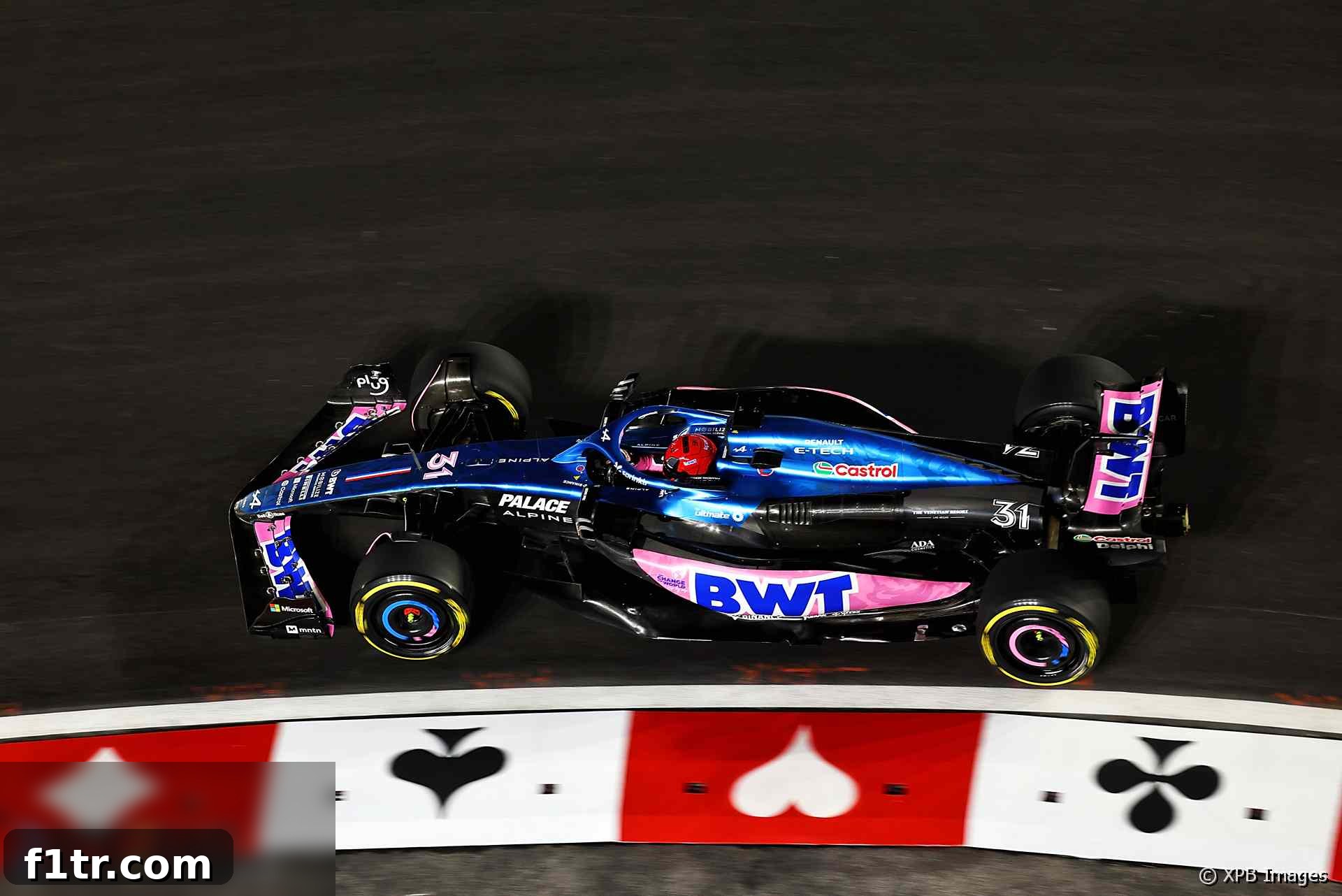
Esteban Ocon Blames Max Verstappen for Las Vegas Grand Prix Q1 Elimination
A heated incident during the first round of qualifying for the Las Vegas Grand Prix saw Esteban Ocon eliminated from the session, with the Alpine driver swiftly pointing the finger of blame at reigning world champion Max Verstappen. Ocon’s unexpected Q1 exit meant he would start Saturday’s inaugural Las Vegas race from a disappointing 17th position on the grid. This result stood in stark contrast to his teammate Pierre Gasly, who sensationally secured a fourth-place grid slot, highlighting the clear potential of the Alpine car.
The Qualifying Crucible: High Stakes on the Las Vegas Strip
Formula 1 qualifying sessions are notorious for their cut-throat nature, where drivers push their machinery to the absolute limit, often navigating treacherous traffic scenarios to find crucial tenths of a second. The brand-new Las Vegas Street Circuit presented an even steeper learning curve, with its unique layout featuring incredibly long straights and challenging low-speed corners, all under the bright lights of the iconic Strip. For Q1, the initial phase, all 20 cars scramble for a place in the top 15, making track positioning and traffic management a critical component of success.
The pressure on drivers is immense, with a single mistake or an untimely encounter with another car capable of ruining an entire weekend. For Esteban Ocon, who was fighting to advance, securing a clean, unimpeded lap was paramount. The cold track temperatures of Las Vegas, combined with the new asphalt surface, meant that grip levels were constantly evolving, making the window for optimal tire performance incredibly narrow. These factors set the stage for the dramatic confrontation that would unfold between Ocon and Verstappen in the dying moments of the session.
The Incident Unfolds: A Clash of Ambitions on Track
The sequence of events leading to Esteban Ocon’s Q1 elimination began to escalate as the qualifying session neared its conclusion. With time rapidly running out and drivers desperate to improve their lap times, Max Verstappen was observed leading a small procession of cars, including Zhou Guanyu and Yuki Tsunoda, as they approached Turn 14 on the circuit. Verstappen’s race engineer, Gianpiero Lambiase, relayed instructions to the Red Bull driver: “stay in front of Zhou but let Tsunoda through,” under the impression that the AlphaTauri driver was commencing a push lap, a belief that would later prove inaccurate.
Concurrently, Esteban Ocon and his teammate Pierre Gasly were rapidly closing the gap on this group. As Lambiase informed Verstappen that “Tsunoda’s coming through now,” Ocon executed a decisive move. He skillfully overtook the line of cars, including Tsunoda, thereby inserting himself between the AlphaTauri and Verstappen as they exited Turn 14. This sudden change in track order immediately drew an agitated response from the Red Bull pit wall.
“What the f*** is that Alpine doing?” an exasperated Verstappen questioned over his team radio. Lambiase, seemingly caught off guard, replied, “No idea. Just build a gap to the cars ahead, Max. No threats behind.” However, the “threat” had already materialized. As Tsunoda accelerated to pass Verstappen, Ocon simultaneously found his own rhythm, propelling his Alpine past the Red Bull as they hurtled towards the final corner of the lap. It was at this critical juncture, as both drivers navigated their approach to Turn 1, that the incident reached its flashpoint.
Max Verstappen, reacting to being overtaken, aggressively moved to the inside for Turn 1 and braked significantly later than Ocon anticipated. This maneuver forced Esteban Ocon wide at the exit of the corner, critically compromising his line and speed for the crucial first sector of his flying lap. The immediate consequence was a substantial loss of momentum and valuable time, a deficit that proved impossible for Ocon to recover throughout the remainder of his lap. Verstappen’s frustration continued to boil over, as he later lambasted his rival as a “stupid idiot” on the team radio. Ocon, equally incensed, completed his compromised lap and vehemently expressed his anger: “That’s a joke, honestly. Verstappen diving into one like crazy.” His race engineer, Josh Peckett, quickly offered commiserations, confirming the impact of the incident: “That would have been comfortably in with a normal first sector. Sorry about that.” The harsh reality of the situation was later conveyed to Verstappen by Lambiase: “For what it’s worth, Max, he didn’t make it through in Q1.”
Esteban Ocon’s Dilemma: Traffic, Delta Time, and a Crucial Lap
Esteban Ocon’s post-qualifying reflections provided crucial insight into the constraints and pressures he faced during the session. He revealed that his initial flying lap in Q1 had been severely compromised by heavy traffic, particularly in the critical final corner and through the sequence of Turns 7 to 9. This rendered his first effort effectively useless and underscored the absolute necessity of a clean second attempt. “On the first lap I got traffic in the worst possible sector, in the last corner and from turn seven to nine,” Ocon explained, emphasizing the challenging start to his qualifying.
Adding another layer of complexity was Formula 1’s stringent maximum lap time rule. This regulation dictates that drivers must maintain a certain pace during out-laps and cool-down laps to prevent dangerous speed differentials on track. Ocon was acutely aware of this rule’s implications, having incurred a penalty for falling foul of it at the preceding Brazilian Grand Prix. “We were not respecting the delta so we have to go, for the lap. We were plus on the delta, there was three cars queuing, but we had to go. We were going to be illegal and I already got penalised last race for one of these things so it shouldn’t happen again. I had no choice, I had to go,” Ocon stressed, highlighting the compelling need to maintain his pace and start his final flying lap.
Ocon drew a clear distinction between his situation and Max Verstappen’s. He argued that Verstappen, with his Red Bull’s superior pace and a likely secure position for Q2, had no legitimate reason to impede the start of Ocon’s critical final lap. “The difference between me and him is that I have to do that lap because I had traffic in that first lap. And if I don’t do the second one, I’m out. He has plenty of pace so he can afford not to do his second lap,” Ocon elaborated. The Alpine driver estimated that the disruption at Turn 1 cost him “a good seven, seven-and-a-half tenths or something,” a colossal time loss that decisively ended his hopes of advancing. “So it was easily going to be through for us,” he lamented, convinced that his raw pace was sufficient had he not been disrupted.
Max Verstappen’s Reaction and the Unspoken Etiquette of Qualifying
Max Verstappen’s immediate, expletive-filled reaction to the incident, labeling Esteban Ocon a “stupid idiot,” perfectly encapsulated the high-pressure environment of F1 qualifying. While the article doesn’t offer a direct explanation from Verstappen for his actions, his aggressive move into Turn 1 suggests a blend of frustration at being overtaken during what he might have considered his own preparation lap and an instinct to defend his track position. In qualifying, there’s often an unwritten code of conduct where drivers on build-up laps attempt to give space to those on flying laps, but the lines can blur when multiple cars are vying for position and preparing for their own crucial attempts.
Verstappen’s competitive nature is well-known, and in the heat of the moment, his reaction was swift and decisive. While the stewards ultimately did not deem the incident worthy of a formal penalty, the consequences for Ocon were profound and irreversible. This episode serves as a powerful reminder of how finely balanced the margins are in Formula 1 and how crucial every decision, and every on-track interaction, can be during the high-stakes qualifying sessions.
Implications for Alpine: A Race of Recovery and Strategic Adjustments
The immediate and most significant consequence of the incident for Esteban Ocon was his disheartening P17 starting position for the Las Vegas Grand Prix. This places him firmly in a challenging recovery race, requiring an exceptional performance to climb through the field and secure valuable points for Alpine. The disappointment for Ocon was compounded by the stellar performance of his teammate, Pierre Gasly, who managed to qualify in an impressive fourth place, showcasing the underlying speed and potential of the Alpine A523 car on the demanding Las Vegas circuit.
Starting from 17th means Ocon will face a significant uphill battle. He will need to contend with fierce midfield traffic, manage tire degradation effectively, and potentially capitalize on any safety car periods or strategic opportunities that may arise during the race. The unique characteristics of the Las Vegas track, with its long straights offering overtaking zones, could aid his recovery, but progress will undoubtedly be hard-fought. Alpine’s strategists will be working tirelessly to devise an optimal plan, considering various tire compounds and pit stop windows, to maximize Ocon’s chances of salvaging a respectable result.
Despite the frustrating qualifying outcome, Esteban Ocon maintained a degree of optimism regarding the car’s inherent performance. “I think the pace of the car looked promising. Hopefully we can use that tomorrow in the race to catch back up,” he affirmed, channeling his disappointment into a resolute determination for Sunday’s main event. His ability to convert this qualifying setback into a strong race performance will be crucial for Alpine’s aspirations in the Constructors’ Championship.
Understanding the F1 Maximum Lap Time Rule in Detail
The “maximum lap time” rule in Formula 1 is a cornerstone safety regulation, meticulously enforced to prevent drivers from dangerously slowing down during non-competitive laps in qualifying and practice sessions. This rule mandates that drivers complete their out-laps and in-laps – as well as any other laps not designated as flying laps – within a predetermined “delta” time. This delta is typically calculated as a percentage above the fastest time recorded for a specific sector or the entire lap, ensuring a minimum speed threshold is maintained across the circuit.
The primary rationale behind this regulation is to mitigate the risk of severe accidents caused by significant speed differentials between cars on flying laps and those circulating at a much slower pace. Such disparities are particularly hazardous on crowded circuits or during intense qualifying periods. Drivers who fail to adhere to this maximum lap time face strict penalties, which can range from financial fines to grid position drops, as Esteban Ocon personally experienced at the preceding Brazilian Grand Prix, making him acutely sensitive to its enforcement.
For Ocon in Las Vegas, this rule presented a critical constraint. Despite encountering traffic and facing the challenge of creating a clear space, he was legally compelled to maintain a certain minimum pace to stay within the prescribed delta. This obligation eliminated the common strategy of backing off significantly to create a larger gap ahead, a tactic often employed in less strictly regulated circumstances. Consequently, the maximum lap time rule played a pivotal role in Ocon’s decision to push forward, directly contributing to the tense on-track confrontation with Max Verstappen and ultimately shaping the outcome of his qualifying session.
Conclusion: A Vegas Qualifying Defined by Controversy and Resilience
The inaugural Las Vegas Grand Prix qualifying session will be etched into Esteban Ocon’s memory for its controversial and frustrating conclusion. His elimination from Q1, which he directly attributed to an aggressive maneuver by Max Verstappen, vividly illustrated the immense pressure and razor-thin margins that define Formula 1 qualifying. The incident brought into sharp focus the complex dynamics of track management, the critical implications of the delta time rule, and the delicate balance between competitive driving and potentially obstructing a rival’s crucial lap.
While Ocon now faces the challenging task of recovering from 17th on the grid, his unwavering determination and the demonstrated pace of the Alpine car offer a beacon of hope for a strong performance on race day. This episode serves as a powerful reminder of how rapidly fortunes can shift in motorsport and how individual moments of on-track interaction can have profound, weekend-altering consequences for a driver. The outcome of Saturday’s race will ultimately reveal whether Ocon can transform this qualifying disappointment into a resilient and memorable recovery drive, further embodying the relentless competitive spirit that is the hallmark of Formula 1.