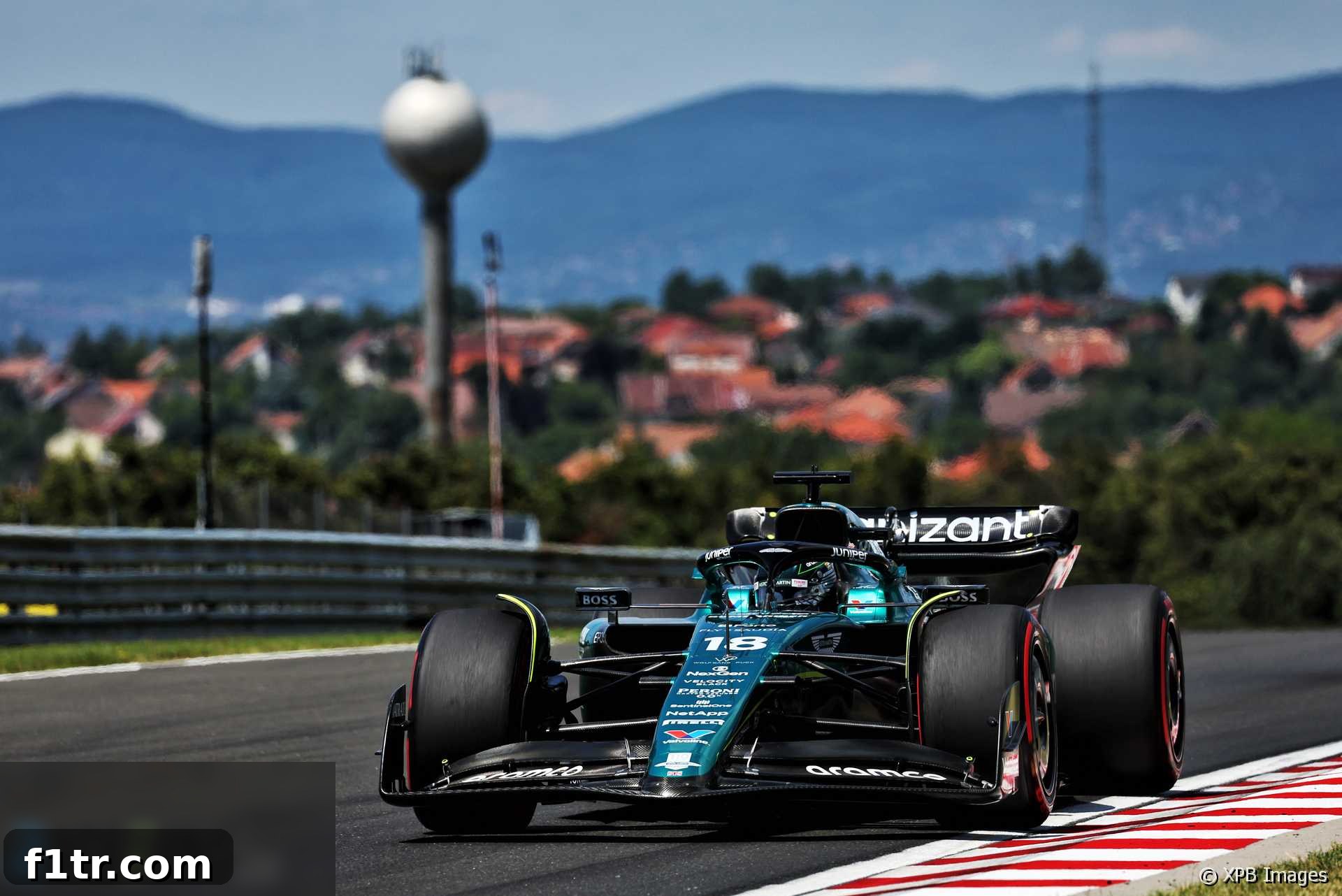
Aston Martin’s impressive early-season performance, which saw them emerge as a surprising challenger for podiums, has recently faltered, leading to a critical re-evaluation of their development strategy. Following a challenging Hungarian Grand Prix, the team acknowledges that it has lost its position as Formula 1’s second-fastest outfit, prompting a significant introspection into their technical direction.
The Hungaroring race proved particularly difficult for the AMR23s, with seasoned campaigner Fernando Alonso and his teammate Lance Stroll securing only the lowest two points-scoring positions. This stark contrast to their early-season form, which yielded an incredible six podium finishes in the first eight races, underscores the severity of their recent decline. Over the preceding two Grands Prix, the team managed to collect a mere nine points, a meagre return for a team that had consistently punched above its weight.
Despite this downturn, Team Principal Mike Krack exudes confidence in Aston Martin’s ability to recover. He asserts that the team has adopted a methodical approach, patiently waiting to fully comprehend the root causes of their performance dip before implementing any corrective measures. This deliberate strategy aims to avoid rushed decisions and ensure that any changes are precisely targeted and effective.
“It took us a couple of weeks to identify what the issues are and also confirm them,” Krack explained in a detailed response to a question from RaceFans. He elaborated on the inherent complexity of diagnosing performance issues in Formula 1: “Because you go to one event, you have issues, you go to another one, they are a little bit different, and then you don’t know. So you always have to wait a little bit not to take a direction that then you just put parts on the car for the sake of putting parts on the car. This is not what we want to do. But we are quite confident in what we can do over the next races will give us improvements.” This statement highlights the scientific and data-driven approach essential in modern F1, where incremental gains are hard-won and missteps can be costly.
Krack pinpointed the Hungarian Grand Prix as the definitive moment that compelled the team to confront the reality that their car was no longer matching the performance levels of their primary rivals. “I think Hungary was the last element in the puzzle because it is a track where we expected to be a bit more competitive and we were not,” he stated. “That was the last data point to confirm that we have maybe not gone in the right direction.” The Hungaroring, with its tight and twisty layout, was initially expected to favour the AMR23’s strong low-speed cornering capabilities, making the poor result particularly concerning and undeniable.
With the impending four-week summer break following the challenging Belgian Grand Prix, Krack cautiously predicts that it will take “a couple of races” before Aston Martin can fully implement and see the benefits of their planned remedies. The timeline for F1 development is intricate and lengthy, encompassing everything from identification and analysis to design, manufacturing, and track testing. “Between identifying and then trying to put the right steps in place, producing the parts in the right quantities, it will be a couple of weeks,” he explained. “It will not be straightforward.” This realistic outlook underscores the significant effort and coordination required to turn around a car’s performance in the hyper-competitive world of Formula 1.
Among the crucial races slated after the summer hiatus is the Italian Grand Prix at Monza, renowned as the fastest circuit on the F1 calendar. Krack acknowledged the unique demands of this iconic venue: “Monza is a bit special. I think in Monza you shouldn’t try to make too many experiments.” This suggests a careful balance between implementing new parts to address underlying issues and ensuring reliable performance on a high-speed track where stability and aerodynamic efficiency are paramount. He added, “We will have something for all the races that try to address step by step the points. But I cannot really say when it is fixed, because we will get more data points actually [in Spa].” The Belgian Grand Prix at Spa-Francorchamps, with its diverse layout, will offer further critical data for the team’s ongoing analysis and development.
Aston Martin’s early-season prowess in slow corners led Fernando Alonso to express high hopes for the Hungaroring, even suggesting it could be a venue where the team might contend for victory. Instead, they endured their lowest points haul of the season. This significant downturn is largely attributable to the rapid development pace of competing teams, most notably McLaren, which have introduced substantial upgrades that have surpassed Aston Martin’s progress.
“At the time Fernando was saying that, obviously the situation was also a different one in terms of competitiveness,” Krack reflected, acknowledging the shifting sands of F1’s pecking order. “I think in the meantime you have seen that other teams have caught up and brought performance to their car, which we didn’t match. And that is the main reason why we fell back and why we were slower than we were hoping that we were.” This honest assessment highlights the relentless development race in F1, where standing still effectively means moving backwards.
Krack further indicated that a contributing factor to the car’s diminished competitiveness on slower tracks stems from changes made to enhance other aspects of their performance. This illustrates the inherent trade-offs and delicate balance required in F1 car design. “You change one thing, but you never change one thing and everything else is fine,” he elaborated. “You always have side effects when you do changes. You need to weigh what do you use, for example, a part that makes more downforce but has a different character or vice-versa? And we think that in one or two situations we have done not the right choice.” This insight reveals the complex decision-making process, where engineers must constantly balance conflicting priorities and accept that optimizing one area might inadvertently compromise another.
The sheer complexity of the current generation of ground effect cars significantly complicates the development process, as Krack emphasizes. “The cars are super-complicated. It is really not just [about] adding downforce,” he stated. He elaborated on the multi-faceted challenges: “The characteristics, you have porpoising effect with floor loading and stuff like that. So I think it has become very, very complex to improve the performance. It’s also not just downforce offset it’s also a lot of balance issues that you have.” This underscores how modern F1 cars are intricate aerodynamic machines, where even small changes can have cascading effects on stability, balance, and overall performance, requiring meticulous analysis and highly precise engineering.
While some team principals have argued that Formula 1’s budget cap restricts their ability to close the formidable gap to the dominant Red Bulls, Krack offers a contrasting perspective. He firmly disagrees that the cost cap is a valid excuse for Aston Martin’s current predicament. “To use the cost cap as an excuse not to progress, I think at this stage of the season is a little bit strange,” he commented. “This is not the case for us so we will try to improve the car further, understand these limitations, work on them and try to bring parts and upgrades for the next races that fix them.” This highlights Aston Martin’s internal focus on optimizing their existing resources and technical understanding rather than pointing to external financial constraints.
Similarly, Krack downplayed Fernando Alonso’s recent assertion that the new tyre compounds introduced at the British Grand Prix had disadvantaged Aston Martin. While acknowledging a slight difference, Krack does not view this as the overarching explanation for their troubles. “That would be an easy excuse, wouldn’t it? We see that there is a little difference with these tyres, but they were brought on safety [grounds] and so from that point of view everybody has to run them and it’s the same for everybody,” he articulated. “I think we should not use this as an excuse for competitiveness because it’s the same tyres that we have to use going forward. So it’s about learning as much as possible about them and moving on, but I think it would be too easy to say it’s tyres.” This pragmatic stance reinforces the team’s commitment to finding internal solutions rather than external factors.
Krack attributes Aston Martin’s current competitive dip to “a lot of little things” working in combination, rather than a single, easily identifiable issue. He stresses the continuous learning process within the team: “We have learned a lot in the last couple of weeks on what is good and what is not so good. And it’s always complex because you have different circuits, you have the reflectiveness of the game – others are also moving so you have no fixed references. It takes a while always to identify really where are your weaknesses and also compared to where your car was before. So it’s always a lot of things in combination and you really need to try to identify one after the other. I think we have made good steps over the last one or two weeks in terms of identifying, but bringing then the modifications this will take a while.” This holistic view emphasizes the dynamic and ever-evolving nature of Formula 1 development, where success hinges on continuously understanding and adapting to a moving target.
Despite the recent challenges, Krack expressed immense encouragement regarding the team’s response to their slump in competitiveness. He admitted, “I was very surprised, actually,” explaining that he had prepared himself to boost team spirits after the disappointing Hungarian Grand Prix result. However, his expectations were pleasantly subverted by the team’s immediate and proactive reaction. “After the race on Sunday I already prepared a couple of lines for our debrief. But the reaction I’ve seen from the team straight away in the Sunday debrief and the Monday briefing at the factory which we do with all the employees was fantastic. It was really like, okay, what do we do now?”
He continued to laud the immediate dedication shown across various departments: “You could see the lights did not go off in the composites shop, did not go off in the analysis departments. The reaction of the team has been fantastic. It’s very encouraging to see that you do not have to say, like ‘everything is going to be better’ and all that, it was really a very competitive spirit and it’s very encouraging for the future to see that.” This powerful demonstration of resilience, competitive drive, and immediate problem-solving collective action within the Aston Martin team offers a strong foundation for their anticipated recovery and future success in Formula 1.
Bringing the F1 news from the source
RaceFans strives to bring its readers news directly from the key players in Formula 1. We are able to do this thanks in part to the generous backing of our RaceFans Supporters.
By contributing £1 per month or £12 per year (or the equivalent in other currencies) you can help cover the costs involved in producing original journalism: Travelling, writing, creating, hosting, contacting and developing.
We have been proudly supported by our readers for over 10 years. If you enjoy our independent coverage, please consider becoming a RaceFans Supporter today. As a bonus, all our Supporters can also browse the site ad-free. Sign up or find out more via the links below:
- Become a RaceFans Supporter
- RaceFans Supporter FAQ
2023 Belgian Grand Prix Related Articles
- Haas drivers fear losing battle for seventh after “grim weekend” in Spa
- Mercedes optimistic they’re “in the right place for winter” with development plan
- Ferrari not convinced by call to equalise engines: ‘Renault is not so far away’
- Ferrari staying “calm” amid swings in performance from race to race
- Pirelli proposes new “super-intermediate” to address wet weather tyre problems
Browse all 2023 Belgian Grand Prix articles