The 2018 Azerbaijan Grand Prix delivered a spectacle of unpredictability and high drama, etching itself into Formula 1 folklore as one of the most captivating races in recent memory. The Baku City Circuit, renowned for its tight sections and blistering straightaways, once again provided a stage for unexpected heroes and heartbreaking misfortunes. From rookie breakthroughs to seasoned veterans facing crushing disappointment, this race had it all, culminating in a surprising change in the championship dynamic.
Amidst the chaos, two drivers celebrated significant career milestones. Charles Leclerc, in only his fourth Formula 1 start, showcased remarkable composure and skill to secure his first career points, finishing an impressive sixth for Sauber. He masterfully navigated the ever-changing conditions, gaining seven crucial positions over the course of the race. This was a feat matched by both Stoffel Vandoorne and Marcus Ericsson, who also made substantial progress through the field.
However, the biggest mover on the day was Brendon Hartley, who gained an astonishing nine places to snatch his inaugural F1 point. Driving for Toro Rosso, Hartley’s breakthrough came after a turbulent start to his Formula 1 career, and he capitalized on the numerous incidents that unfolded. His teammate, Pierre Gasly, was also on course for points but unfortunately clashed with Kevin Magnussen during one of the race’s frantic restarts, highlighting the fine margins and brutal nature of racing in Baku.
A Race of Highs and Lows: Bottas’s Agony
The race was particularly cruel to Valtteri Bottas, who delivered a phenomenal performance that ultimately ended in heartbreak. Having started from third, Bottas meticulously managed his tyres and strategy, finding an incredible rhythm on a set of super-soft tyres that were remarkably at least 40 laps old. His blistering pace on worn rubber brought him into strong contention for what looked like a guaranteed victory. He had taken the lead and seemed poised to control the race to the flag, demonstrating exceptional control and speed.
Tragically, with just three laps remaining, destiny intervened. As he sped down the main straight, Bottas’s left-rear tyre suffered a sudden puncture after hitting a piece of debris scattered on the track from an earlier incident. The devastating blow robbed him of a certain win, forcing him to retire and watch his championship hopes take a significant hit. This moment served as a stark reminder of the fine line between glory and despair in motorsport, captivating spectators with its raw emotion.
Red Bull’s Self-Inflicted Wounds
Perhaps the most defining moment of the 2018 Azerbaijan Grand Prix was the collision between the two Red Bull Racing drivers, Daniel Ricciardo and Max Verstappen. Their fierce, wheel-to-wheel battle had been a prominent subplot throughout the race, with both drivers pushing the limits against each other. Ricciardo had successfully overtaken his teammate once, only to drop back behind him after their pit stops. The intensity escalated as Ricciardo sought to reclaim his position.
The data revealed an interesting twist: Ricciardo’s overall pit stop time was actually faster than Verstappen’s. However, he emerged behind his teammate for two key reasons. Firstly, Ricciardo encountered traffic on his out-lap, costing him valuable time. Secondly, Verstappen, much like Bottas, showed exceptional ability to extract significant performance from his worn super-soft tyres, maintaining a strong pace. This set the stage for their dramatic clash. On lap 40, as Ricciardo attempted a pass into Turn 1, Verstappen moved to defend, resulting in a devastating double DNF for the team. This incident not only cost Red Bull a significant haul of points but also opened the door for their rivals to capitalize on the ensuing chaos.
Race Unfolds: Safety Cars and Strategic Gambles
The Azerbaijan Grand Prix was punctuated by multiple Safety Car periods, which significantly reshaped the race dynamics and strategies. These interventions created several opportunities for drivers to pit for fresh tyres, or conversely, to attempt audacious long stints. The restarts were particularly thrilling, featuring intense jostling for position and numerous overtakes, as drivers fought for every inch of tarmac on the narrow Baku street circuit. It was during one such restart that Bottas tragically collected debris, altering the course of the race in its final stages and elevating Lewis Hamilton to an unexpected victory.
For a deeper dive into the thrilling events of the 2018 Azerbaijan Grand Prix, we invite you to explore the comprehensive data visualizations below, which offer detailed insights into driver performance and race progression. These interactive charts, typically rendered dynamically on our platform, provide a lap-by-lap breakdown of positions, gaps, and strategic choices that defined this memorable race.
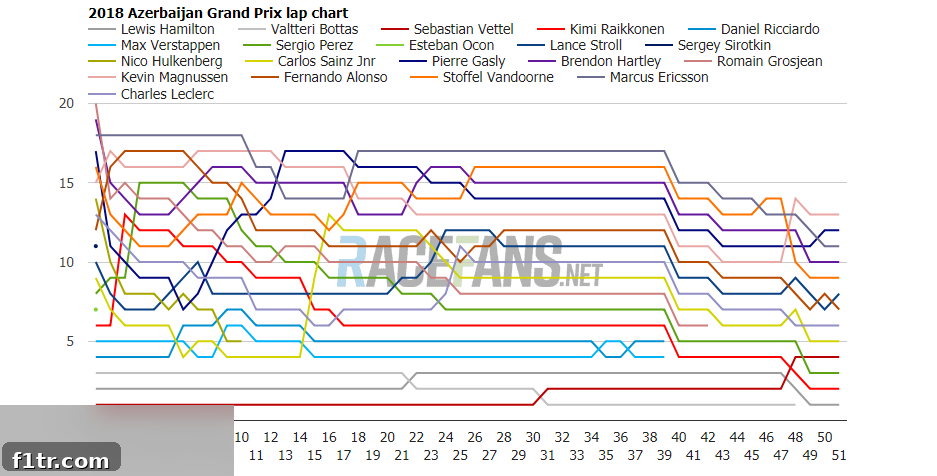
2018 Azerbaijan Grand Prix Lap Chart
The positions of each driver on every lap. Click name to highlight, right-click to reset. Toggle drivers using controls below:
2018 Azerbaijan Grand Prix Race Chart
The gaps between each driver on every lap compared to the leader’s average lap time. Very large gaps omitted. Scroll to zoom, drag to pan and right-click to reset. Toggle drivers using controls below:
Position Change Analysis
The table below provides a fascinating look at how each driver’s position evolved throughout the race. It highlights the incredible gains made by drivers like Brendon Hartley and Charles Leclerc, as well as the significant losses experienced by others, reflecting the unpredictable nature of the Baku circuit and the impact of incidents and safety car periods. Analyzing these changes reveals who made the most of the opportunities presented and who fell victim to the race’s challenges.
| Driver | Start position | Lap one position change | Race position change |
|---|---|---|---|
| Lewis Hamilton | 2 | 0 | 1 |
| Valtteri Bottas | 3 | 0 | -11 |
| Sebastian Vettel | 1 | 0 | -3 |
| Kimi Raikkonen | 6 | 0 | 4 |
| Daniel Ricciardo | 4 | 0 | |
| Max Verstappen | 5 | 0 | |
| Sergio Perez | 8 | -1 | 5 |
| Esteban Ocon | 7 | ||
| Lance Stroll | 10 | 2 | 2 |
| Sergey Sirotkin | 11 | ||
| Nico Hulkenberg | 14 | 4 | |
| Carlos Sainz Jnr | 9 | 2 | 4 |
| Pierre Gasly | 17 | 6 | 5 |
| Brendon Hartley | 19 | 4 | 9 |
| Romain Grosjean | 20 | 6 | |
| Kevin Magnussen | 15 | -2 | 2 |
| Fernando Alonso | 12 | -4 | 5 |
| Stoffel Vandoorne | 16 | 3 | 7 |
| Marcus Ericsson | 18 | 0 | 7 |
| Charles Leclerc | 13 | 1 | 7 |
2018 Azerbaijan Grand Prix Lap Times
This section presents all the lap times recorded by the drivers during the race (in seconds, excluding very slow laps that might indicate issues). This visualization, if interactive, would allow for detailed comparison of driver pace throughout different stints and under varying race conditions. Scroll to zoom, drag to pan and toggle drivers using the control below:
2018 Azerbaijan Grand Prix Fastest Laps
The fastest lap achieved by each driver is a testament to their raw pace and the car’s ultimate performance potential. It often indicates moments when drivers were pushing their limits or benefited from clear air and optimal tyre performance. Valtteri Bottas’s fastest lap, recorded on incredibly old tyres, underscores his exceptional pace before his unfortunate retirement.
| Rank | Driver | Car | Fastest lap | Gap | On lap |
|---|---|---|---|---|---|
| 1 | Valtteri Bottas | Mercedes | 1’45.149 | 37 | |
| 2 | Lewis Hamilton | Mercedes | 1’45.412 | 0.263 | 35 |
| 3 | Daniel Ricciardo | Red Bull-TAG Heuer | 1’45.419 | 0.270 | 34 |
| 4 | Sebastian Vettel | Ferrari | 1’45.530 | 0.381 | 38 |
| 5 | Max Verstappen | Red Bull-TAG Heuer | 1’45.771 | 0.622 | 31 |
| 6 | Sergio Perez | Force India-Mercedes | 1’46.206 | 1.057 | 51 |
| 7 | Kimi Raikkonen | Ferrari | 1’46.523 | 1.374 | 50 |
| 8 | Lance Stroll | Williams-Mercedes | 1’46.815 | 1.666 | 50 |
| 9 | Carlos Sainz Jnr | Renault | 1’46.856 | 1.707 | 50 |
| 10 | Romain Grosjean | Haas-Ferrari | 1’46.880 | 1.731 | 34 |
| 11 | Charles Leclerc | Sauber-Ferrari | 1’47.403 | 2.254 | 31 |
| 12 | Fernando Alonso | McLaren-Renault | 1’47.449 | 2.300 | 32 |
| 13 | Stoffel Vandoorne | McLaren-Renault | 1’47.666 | 2.517 | 50 |
| 14 | Marcus Ericsson | Sauber-Ferrari | 1’47.925 | 2.776 | 51 |
| 15 | Pierre Gasly | Toro Rosso-Honda | 1’48.035 | 2.886 | 38 |
| 16 | Kevin Magnussen | Haas-Ferrari | 1’48.155 | 3.006 | 35 |
| 17 | Brendon Hartley | Toro Rosso-Honda | 1’48.288 | 3.139 | 51 |
| 18 | Nico Hulkenberg | Renault | 1’48.867 | 3.718 | 10 |
| 19 | Esteban Ocon | Force India-Mercedes | |||
| 20 | Sergey Sirotkin | Williams-Mercedes |
2018 Azerbaijan Grand Prix Tyre Strategies
Tyre strategy played a pivotal role in the outcome of the race, especially with multiple Safety Car periods influencing pit stop windows. This table details the tyre compounds used by each driver across their stints, including the number of laps completed on each set. It reveals the strategic gambles, the durability of certain compounds, and how teams adapted to the ever-changing race conditions, notably Bottas’s incredibly long initial stint on super softs.
| Stint 1 | Stint 2 | Stint 3 | Stint 4 | Stint 5 | |
|---|---|---|---|---|---|
| Lewis Hamilton | Super soft (22) | Soft (18) | Ultra soft (11) | ||
| Kimi Raikkonen | Ultra soft (1) | Soft (39) | Ultra soft (11) | ||
| Sergio Perez | Ultra soft (2) | Soft (38) | Super soft (11) | ||
| Sebastian Vettel | Super soft (30) | Soft (10) | Ultra soft (11) | ||
| Carlos Sainz Jnr | Ultra soft (15) | Soft (25) | Ultra soft (11) | ||
| Charles Leclerc | Super soft (24) | Soft (16) | Ultra soft (11) | ||
| Fernando Alonso | Super soft (1) | Soft (39) | Ultra soft (11) | ||
| Lance Stroll | Super soft (23) | Soft (17) | Ultra soft (11) | ||
| Stoffel Vandoorne | Super soft (17) | Soft (8) | Ultra soft (14) | Ultra soft (7) | Ultra soft (5) |
| Brendon Hartley | Soft (1) | Ultra soft (21) | Super soft (17) | Ultra soft (12) | |
| Marcus Ericsson | Super soft (1) | Soft (17) | Ultra soft (18) | Ultra soft (15) | |
| Pierre Gasly | Ultra soft (12) | Soft (27) | Ultra soft (12) | ||
| Kevin Magnussen | Super soft (1) | Soft (38) | Ultra soft (12) | ||
| Valtteri Bottas | Super soft (40) | Ultra soft (8) | |||
| Romain Grosjean | Soft (2) | Super soft (38) | Ultra soft (2) | ||
| Max Verstappen | Super soft (38) | Ultra soft (1) | |||
| Daniel Ricciardo | Super soft (37) | Ultra soft (2) | |||
| Nico Hulkenberg | Ultra soft (10) | ||||
| Esteban Ocon | |||||
| Sergey Sirotkin |
2018 Azerbaijan Grand Prix Pit Stop Times
Efficiency in the pit lane can make or break a race, especially in a Grand Prix as fraught with incidents and Safety Cars as Baku. This table details the elapsed time for each driver’s pit stop, highlighting the fastest stops and showing which teams performed under pressure. The differences in these times, often measured in fractions of a second, underscore the immense pressure on pit crews and the impact on a driver’s track position.
| Driver | Team | Pit stop time | Gap | On lap | |
| 1 | Lance Stroll | Williams | 19.737 | 23 | |
| 2 | Max Verstappen | Red Bull | 19.765 | 0.028 | 38 |
| 3 | Daniel Ricciardo | Red Bull | 19.925 | 0.188 | 37 |
| 4 | Sebastian Vettel | Ferrari | 20.037 | 0.300 | 30 |
| 5 | Valtteri Bottas | Mercedes | 20.192 | 0.455 | 40 |
| 6 | Lewis Hamilton | Mercedes | 20.377 | 0.640 | 22 |
| 7 | Stoffel Vandoorne | McLaren | 20.760 | 1.023 | 39 |
| 8 | Pierre Gasly | Toro Rosso | 20.782 | 1.045 | 12 |
| 9 | Brendon Hartley | Toro Rosso | 20.809 | 1.072 | 22 |
| 10 | Sebastian Vettel | Ferrari | 20.823 | 1.086 | 40 |
| 11 | Stoffel Vandoorne | McLaren | 20.887 | 1.150 | 25 |
| 12 | Carlos Sainz Jnr | Renault | 20.967 | 1.230 | 40 |
| 13 | Stoffel Vandoorne | McLaren | 20.978 | 1.241 | 46 |
| 14 | Charles Leclerc | Sauber | 21.058 | 1.321 | 24 |
| 15 | Brendon Hartley | Toro Rosso | 21.072 | 1.335 | 39 |
| 16 | Stoffel Vandoorne | McLaren | 21.103 | 1.366 | 17 |
| 17 | Kimi Raikkonen | Ferrari | 21.149 | 1.412 | 40 |
| 18 | Lance Stroll | Williams | 21.236 | 1.499 | 40 |
| 19 | Pierre Gasly | Toro Rosso | 21.287 | 1.550 | 39 |
| 20 | Lewis Hamilton | Mercedes | 21.329 | 1.592 | 40 |
| 21 | Fernando Alonso | McLaren | 21.371 | 1.634 | 40 |
| 22 | Brendon Hartley | Toro Rosso | 21.376 | 1.639 | 1 |
| 23 | Carlos Sainz Jnr | Renault | 21.516 | 1.779 | 15 |
| 24 | Romain Grosjean | Haas | 21.725 | 1.988 | 2 |
| 25 | Kevin Magnussen | Haas | 21.778 | 2.041 | 39 |
| 26 | Charles Leclerc | Sauber | 22.030 | 2.293 | 40 |
| 27 | Romain Grosjean | Haas | 22.757 | 3.020 | 40 |
| 28 | Marcus Ericsson | Sauber | 25.378 | 5.641 | 18 |
| 29 | Sergio Perez | Force India | 26.174 | 6.437 | 40 |
| 30 | Sergio Perez | Force India | 28.109 | 8.372 | 2 |
| 31 | Kimi Raikkonen | Ferrari | 30.012 | 10.275 | 1 |
| 32 | Marcus Ericsson | Sauber | 32.629 | 12.892 | 36 |
| 33 | Kevin Magnussen | Haas | 35.608 | 15.871 | 1 |
| 34 | Marcus Ericsson | Sauber | 44.107 | 24.370 | 1 |
| 35 | Fernando Alonso | McLaren | 56.710 | 36.973 | 1 |
2018 Azerbaijan Grand Prix Related Articles
For more content related to this unforgettable race, explore the articles below:
- 2018 Azerbaijan Grand Prix Star Performers
- Top ten pictures from the 2018 Azerbaijan Grand Prix
- Baku provides another race to remember – but not for luckless Bottas
- Leclerc is first points-scorer from Monaco in 978 races
- Paddock Diary: Azerbaijan Grand Prix day four
Browse all 2018 Azerbaijan Grand Prix articles