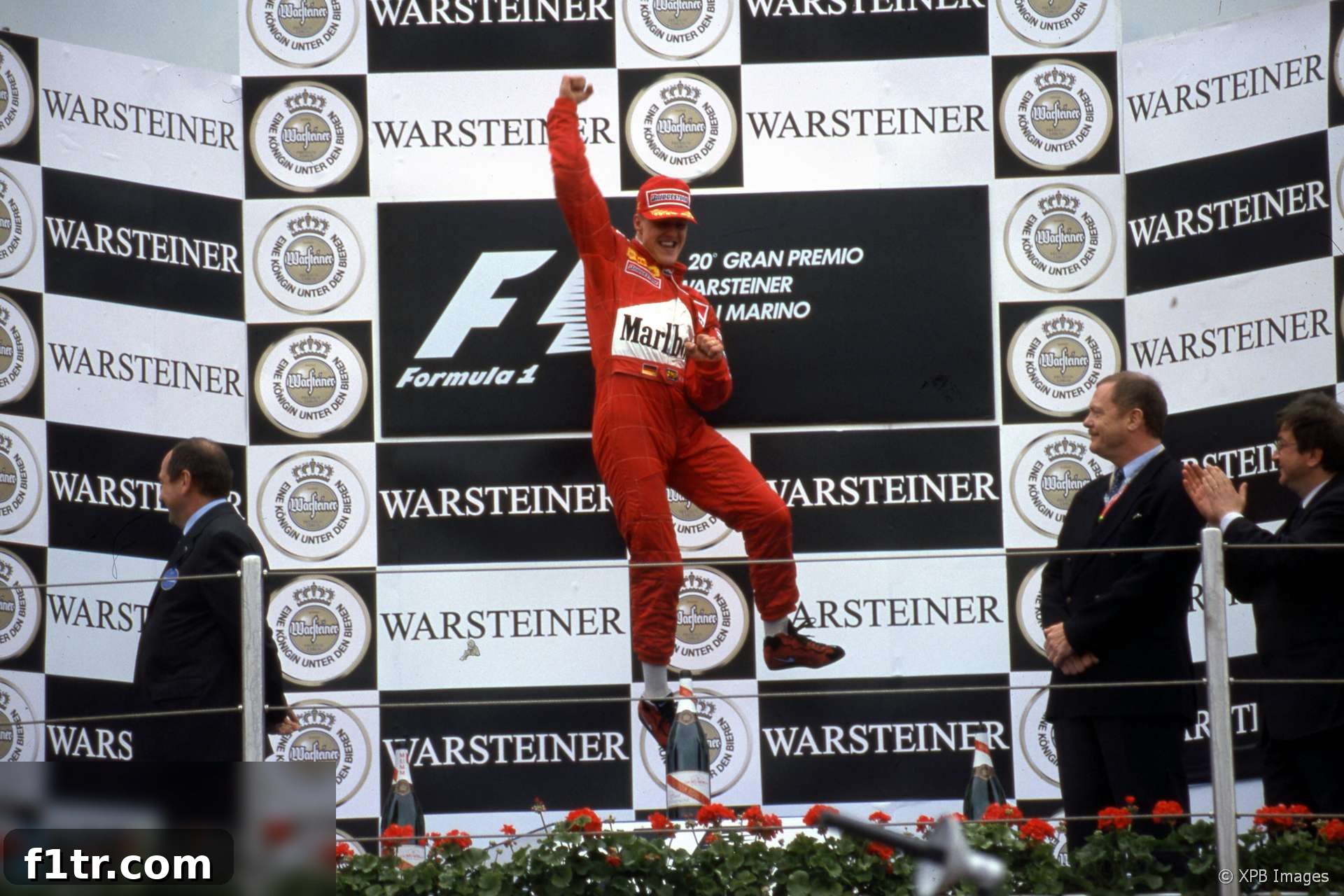
The dawn of the 2000 Formula 1 season had seen Michael Schumacher assert immediate dominance, securing victories in the opening two races. The scoreboard emphatically read Schumacher 20 points, Mika Hakkinen a sobering nil. As the championship caravan prepared to return to Europe for the heart of its demanding schedule, McLaren, the reigning champions, were under immense pressure, desperate to register their first championship points and challenge Ferrari’s early surge.
The European leg, comprising eleven of the next twelve races, was traditionally inaugurated by the San Marino Grand Prix. This iconic event was hosted at the Autodromo Enzo e Dino Ferrari in Imola, Italy, rather than within the diminutive principality of San Marino itself – a necessity given San Marino’s lack of a circuit meeting international F1 standards.
Imola, a circuit steeped in history and known for its high-speed character, was holding its fifth Grand Prix since undergoing significant safety revisions following the tragic events of 1994. While some purists felt these changes had somewhat “neutered” its raw appeal at the time, a retrospective view twenty years later highlights its unique blend of blistering speeds and unforgiving, cramped confines. This characteristic sharply contrasted with many of the more expansive, modern tracks emerging in the calendar, making Imola a formidable test of car and driver alike.
2000 San Marino Grand Prix Qualifying: McLaren’s Raw Pace Shines
McLaren’s surprising failure to score points in the first two races had begun to chip away at the typically unshakeable optimism of team principal Ron Dennis. Despite the mechanical issues that had plagued their early season, the McLaren MP4/15 consistently demonstrated formidable raw pace, especially over a single qualifying lap. The team remained confident that their car was fundamentally the benchmark, and Imola provided the perfect stage to prove it.
Mika Hakkinen, the reigning world champion, reaffirmed McLaren’s single-lap prowess by snatching a superb pole position. Even with a couple of minor errors on his fastest lap, Hakkinen masterfully extracted every ounce of performance from his McLaren, posting a time of 1’24.714. Michael Schumacher, driving the Ferrari F1-2000, joined him on the front row, just a mere 0.091 seconds adrift, highlighting the razor-thin margins at the front.
The battle for the second row saw David Coulthard, Hakkinen’s McLaren teammate, secure third place, a couple of tenths clear of Rubens Barrichello in the second Ferrari. Coulthard’s performance underscored McLaren’s overall qualifying strength. Fifth place went to Ralf Schumacher in his Williams, demonstrating the car’s potential. However, his rookie teammate, Jenson Button, found the distinctive and challenging kerbs of Imola particularly tricky to navigate, resulting in a disappointing 18th position on the grid.
Meanwhile, the Sauber team arrived at Imola in significantly improved form, having successfully resolved the rear wing failures that had forced their withdrawal from the previous Brazilian Grand Prix. Pedro Diniz delivered an impressive qualifying performance, securing a strong tenth position for the Swiss outfit. In stark contrast, Benetton’s struggles continued unabated. Giancarlo Fisichella, competing in the first of his two home races and surprisingly second in the championship standings after the opening rounds, found himself barely clear of the backmarker Minardis, qualifying a lowly 19th. This was eight places behind his teammate Alexander Wurz, signaling deeper issues within the Enstone-based team.
2000 San Marino Grand Prix Qualifying Results
| Position | Driver | Team | Time |
|---|---|---|---|
| 1 | Mika Hakkinen | McLaren | 1’24.714 |
| 2 | Michael Schumacher | Ferrari | 1’24.805 |
| 3 | David Coulthard | McLaren | 1’25.014 |
| 4 | Rubens Barrichello | Ferrari | 1’25.242 |
| 5 | Ralf Schumacher | Williams | 1’25.871 |
| 6 | Heinz-Harald Frentzen | Jordan | 1’25.892 |
| 7 | Eddie Irvine | Jaguar | 1’25.929 |
| 8 | Jarno Trulli | Jordan | 1’26.002 |
| 9 | Jacques Villeneuve | BAR | 1’26.124 |
| 10 | Pedro Diniz | Sauber | 1’26.238 |
| 11 | Alexander Wurz | Benetton | 1’26.281 |
| 12 | Mika Salo | Sauber | 1’26.336 |
| 13 | Pedro de la Rosa | Arrows | 1’26.349 |
| 14 | Ricardo Zonta | BAR | 1’26.814 |
| 15 | Jean Alesi | Prost | 1’26.824 |
| 16 | Jos Verstappen | Arrows | 1’26.845 |
| 17 | Johnny Herbert | Jaguar | 1’27.051 |
| 18 | Jenson Button | Williams | 1’27.135 |
| 19 | Giancarlo Fisichella | Benetton | 1’27.253 |
| 20 | Gaston Mazzacane | Minardi | 1’28.231 |
| 21 | Marc Gene | Minardi | 1’28.333 |
| 22 | Nick Heidfeld | Prost | 1’28.361 |
2000 San Marino Grand Prix: A Strategic Masterclass
When the lights went out for the 2000 San Marino Grand Prix, Mika Hakkinen made a faultless getaway from pole position, instantly establishing his lead. However, directly behind him, Michael Schumacher suffered from “massive wheelspin” off the line, losing crucial momentum. Desperate to defend his position from David Coulthard, the Ferrari driver aggressively veered across the track, effectively boxing in his McLaren rival as they navigated the infamous Tamburello corner for the first time. This audacious move momentarily hampered Coulthard, allowing Rubens Barrichello to sweep past the McLaren into third place, giving Ferrari a crucial 2-3 advantage behind Hakkinen.
Further back in the field, Jacques Villeneuve executed a spectacular start, catapulting his BAR car past four rivals off the grid. He slotted into an impressive fifth position, just ahead of Jarno Trulli’s Jordan. This early shuffling of the pack created a small but significant gap, enabling Hakkinen and Schumacher to pull away from the chasing pack, setting the stage for a private duel at the front. Crucially for McLaren, their car finally appeared to have the reliability to go the full race distance – a marked improvement from the previous rounds.
In this era of Formula 1, where strategic refueling played a pivotal role, raw on-track pace was only one piece of the puzzle. The early phase of the race saw Hakkinen meticulously building a lead over Schumacher, demonstrating the McLaren’s superior balance and speed on a heavy fuel load. Barrichello maintained a solid third, keeping Coulthard at bay and acting as an effective buffer for Schumacher.
McLaren’s first strategic gamble involved bringing Coulthard into the pits earlier than Barrichello, hoping to use the undercut to free him from behind the Ferrari. Unfortunately for them, the strategy did not yield the desired outcome; Barrichello, with a later stop and perhaps a slightly longer initial stint, managed to retain his third position. Meanwhile, Schumacher’s first pit stop was noticeably longer than Hakkinen’s. This allowed the Finn to significantly extend his lead, establishing a comfortable advantage of nearly six seconds by the time the first round of pit stops had been completed across the leading cars.
Hakkinen continued to extend his lead, seemingly in control, when an unexpected electronic glitch briefly cost him a couple of vital seconds. At almost the same moment, Schumacher experienced a heart-stopping moment while attempting to lap Pedro Diniz. Diniz, perhaps overzealous in his effort to get out of the way, swerved unpredictably, forcing Schumacher to take evasive action. These minor incidents, though seemingly insignificant at the time, would prove to be pivotal.
The second round of pit stops ultimately proved to be the decisive turning point of the race. Despite Hakkinen having established a lead exceeding five seconds at one stage, McLaren’s mid-race stint for their lead driver was comparatively short. This critical decision allowed Ferrari the luxury of an additional four laps at a low fuel pace for Schumacher. Combined with Ferrari’s famously efficient and rapid pit crew, this masterstroke was precisely what Schumacher needed. He emerged from his second stop in the lead, swinging the race dramatically in his favor for the final stint. McLaren fared better with Coulthard’s second stop, which finally enabled him to successfully undercut and get ahead of Barrichello, securing a podium position.
In the closing stages, Hakkinen, despite his best efforts and with a lighter car, found himself able to close the gap to Schumacher. However, the German’s defensive driving, coupled with the immense pressure of racing a Ferrari at its home track – a scenario often jokingly described as a “treasonable offence” to overtake a red car for the lead in Italy – meant that Hakkinen had to concede. He ultimately settled for a hard-fought second place, unable to find a way past the unyielding Ferrari.
Behind the leading quartet, the race devolved into a demanding battle of attrition. Heinz-Harald Frentzen, who had shown promise in qualifying, was forced to retire with yet another of Jordan’s increasingly familiar gearbox problems. Ralf Schumacher’s strong run in the Williams was also cut short by a critical loss of fuel pressure, sidelining him from contention. Further down the field, Eddie Irvine missed out on a valuable points finish after inadvertently engaging his car’s speed limiter button, a frustrating mistake that cost him dearly. A thrilling contest ensued for the remaining points positions, with Jacques Villeneuve ultimately benefiting from his blistering start to secure fifth place, despite a relentless and spirited charge from Mika Salo in the Sauber, who finished closely behind him.
The struggles for the Prost and Benetton teams continued throughout race day. Both Prost cars, driven by Jean Alesi and Nick Heidfeld, retired early on with hydraulic issues, leading to cynical jokes about the team booking mid-afternoon flights home for the remainder of the season given their persistent lack of reliability. Benetton also failed to make significant inroads, with Alexander Wurz and Giancarlo Fisichella finishing ninth and eleventh respectively, failing to score championship points.
Championship Implications and Future Outlook
After three races of the 2000 season, Michael Schumacher maintained a perfect record, accumulating a maximum haul of 30 points. Reigning champion Mika Hakkinen, despite his undeniable stellar qualifying pace and a strong performance at Imola, had only six points to show for his efforts. The gap was substantial, but the San Marino Grand Prix had offered a glimmer of hope for McLaren. They had finally demonstrated that their MP4/15 possessed the reliability to complement its outright speed, dispelling some of the early season doubts.
McLaren team principal Ron Dennis, ever the pragmatist, argued that the race wasn’t lost in the pits, but rather on the track due to Hakkinen’s mid-race power loss and a broken floor, which collectively cost him crucial time. This perspective suggested that while Ferrari’s strategy was superb, McLaren felt external factors played a significant role in their defeat.
Nevertheless, the battle for the championship was now undeniably engaged between the two titans of the sport, Michael Schumacher and Mika Hakkinen. The San Marino Grand Prix confirmed that these two drivers, backed by their respective powerhouse teams, would be the primary contenders for the title. However, the championship narrative was about to take another unexpected turn at the upcoming British Grand Prix at Silverstone, unusually held in April. With the season still in its infancy, the question on everyone’s mind was: what dramatic twists and turns could possibly unfold next?
2000 San Marino Grand Prix Race Result
| Position | Driver | Team | Laps | Time / laps / reason |
|---|---|---|---|---|
| 1 | Michael Schumacher | Ferrari | 62 | 1:31’39.776 |
| 2 | Mika Hakkinen | McLaren | 62 | +1.168 |
| 3 | David Coulthard | McLaren | 62 | +51.008 |
| 4 | Rubens Barrichello | Ferrari | 62 | +29.276 |
| 5 | Jacques Villeneuve | BAR | 61 | +1 lap |
| 6 | Mika Salo | Sauber | 61 | +1 lap |
| 7 | Eddie Irvine | Jaguar | 61 | +1 lap |
| 8 | Pedro Diniz | Sauber | 61 | +1 lap |
| 9 | Alexander Wurz | Benetton | 61 | +1 lap |
| 10 | Johnny Herbert | Jaguar | 61 | +1 lap |
| 11 | Giancarlo Fisichella | Benetton | 61 | +1 lap |
| 12 | Ricardo Zonta | BAR | 61 | +1 lap |
| 13 | Gaston Mazzacane | Minardi | 60 | +2 laps |
| 14 | Jos Verstappen | Arrows | 59 | +3 laps |
| 15 | Jarno Trulli | Jordan | 58 | Gearbox |
| 16 | Pedro de la Rosa | Arrows | 49 | Spun off |
| 17 | Ralf Schumacher | Williams | 45 | Fuel system |
| 18 | Jean Alesi | Prost | 25 | Hydraulics |
| 19 | Nick Heidfeld | Prost | 22 | Hydraulics |
| 20 | Jenson Button | Williams | 5 | Engine |
| 21 | Marc Gene | Minardi | 5 | Spun off |
| 22 | Heinz-Harald Frentzen | Jordan | 4 | Gearbox |
2000 Formula 1 World Championship Standings After San Marino
Following the thrilling strategic battle at Imola, the championship standings reflected Michael Schumacher’s commanding start to the 2000 season. His flawless performance in the first three races placed him firmly at the top, building a significant early lead over his closest rivals. Mika Hakkinen, despite his strong qualifying pace and a second-place finish, still faced an uphill battle to close the points gap, but the race proved McLaren had the potential to challenge.
The season was clearly shaping up to be a classic duel between Ferrari and McLaren, with Schumacher and Hakkinen poised to resume their epic rivalry. The Imola race served as a stark reminder that while outright speed was vital, flawless execution, strategic foresight, and the relentless efficiency of the pit crew were equally, if not more, crucial in the fight for Formula 1 supremacy.
Grand Prix Flashback: Explore More Iconic Races
- 40 years ago today: How a tyre war prompted Senna’s unfinished Monaco masterpiece
- Schumacher seals record-breaking 10th constructors championship for Ferrari
- Strategic superiority clinches Schumacher’s first Ferrari title
- Disaster for Hakkinen brings title within Schumacher’s grasp
- Schumacher turns the tide against McLaren on tragic day at Monza
Browse all Grand Prix flashbacks