Lewis Hamilton Dominates Spanish Grand Prix, Mercedes Secures First 1-2 Finish
The 2018 Spanish Grand Prix marked a resounding return to form for Lewis Hamilton, showcasing a performance of sheer dominance that solidified his championship aspirations. The Mercedes-AMG Petronas driver masterfully secured his 64th career victory and an impressive 74th pole position, extending Mercedes’ remarkable winning streak at the Circuit de Barcelona-Catalunya to six consecutive years. This triumph was not just a standalone success; it also saw Hamilton prolong his record-breaking points-scoring streak to an incredible 30 races, a testament to his unparalleled consistency and the formidable reliability of his Mercedes challenger.
While Hamilton’s command of the race was undeniable, he narrowly missed out on a perfect hat-trick of pole position, victory, and fastest lap. That coveted fastest lap was snatched by Daniel Ricciardo, who unleashed a blistering tour of the circuit in his Red Bull. This marked Ricciardo’s third fastest lap of the season, underlining his raw pace and aggressive driving style, with his Mercedes counterpart Valtteri Bottas having claimed the other two earlier in the year. Despite missing the hat-trick, Hamilton’s performance sent a clear message to his rivals about his intentions for the championship.
Mercedes’ Resurgence and Verstappen’s Podium Return
The Spanish Grand Prix delivered a pivotal moment for Mercedes, as Valtteri Bottas joined Lewis Hamilton on the podium, sealing the team’s first one-two finish of the 2018 season. This dominant display not only boosted Mercedes’ points tally but also provided a significant psychological uplift for the team, demonstrating their capability to perform at the highest level after a somewhat inconsistent start to the year. Bottas’s strong second-place finish underscored the team’s collective strength and strategic prowess, allowing them to consolidate their position in the Constructors’ Championship.
Adding another layer of excitement to the podium celebration was Max Verstappen, who secured his first podium finish of the season. This third-place result was particularly significant for Verstappen, who had faced a challenging start to the year marred by several incidents. His mature and composed drive in Spain provided a much-needed boost to his confidence and was a welcome sight for Red Bull Racing, marking their 150th podium finish in Formula 1 history. This achievement highlighted Red Bull’s enduring presence at the sharp end of the grid and Verstappen’s undeniable talent when given the opportunity.
Verstappen’s strong showing in Spain propelled him up the Drivers’ Championship standings, placing him one point ahead of Spanish veteran Fernando Alonso. For Alonso, the race held special significance, as he scored points in his home Grand Prix for the first time since his return to McLaren. This result was a clear indication of the progress McLaren had made with their new Renault power unit, offering a glimmer of hope for a more competitive season for the two-time world champion.
Alonso’s Unwavering Consistency and Unique Teammate Record
Fernando Alonso’s performance throughout the early stages of the 2018 season was a testament to his enduring skill and determination. The Spanish driver had been in the points at every race leading up to the Spanish Grand Prix, a remarkable feat shared only by championship contenders Lewis Hamilton and Sebastian Vettel. This consistency, often achieved in a car not always capable of challenging the front-runners, further cemented Alonso’s reputation as one of the most gifted drivers on the grid.
Beyond his consistent points scoring, Alonso held another unique distinction: he was the only driver in the entire field who remained undefeated by his teammate in both race finishes and qualifying sessions throughout the season. This impressive record underscored his continued ability to extract every ounce of performance from his machinery and maintain a significant edge over his garage partner, Stoffel Vandoorne. It highlighted Alonso’s unwavering commitment and competitive spirit, even when the ultimate prize of race victories seemed out of reach.
The Enduring Rivalry: Carlos Sainz vs. Fernando Alonso
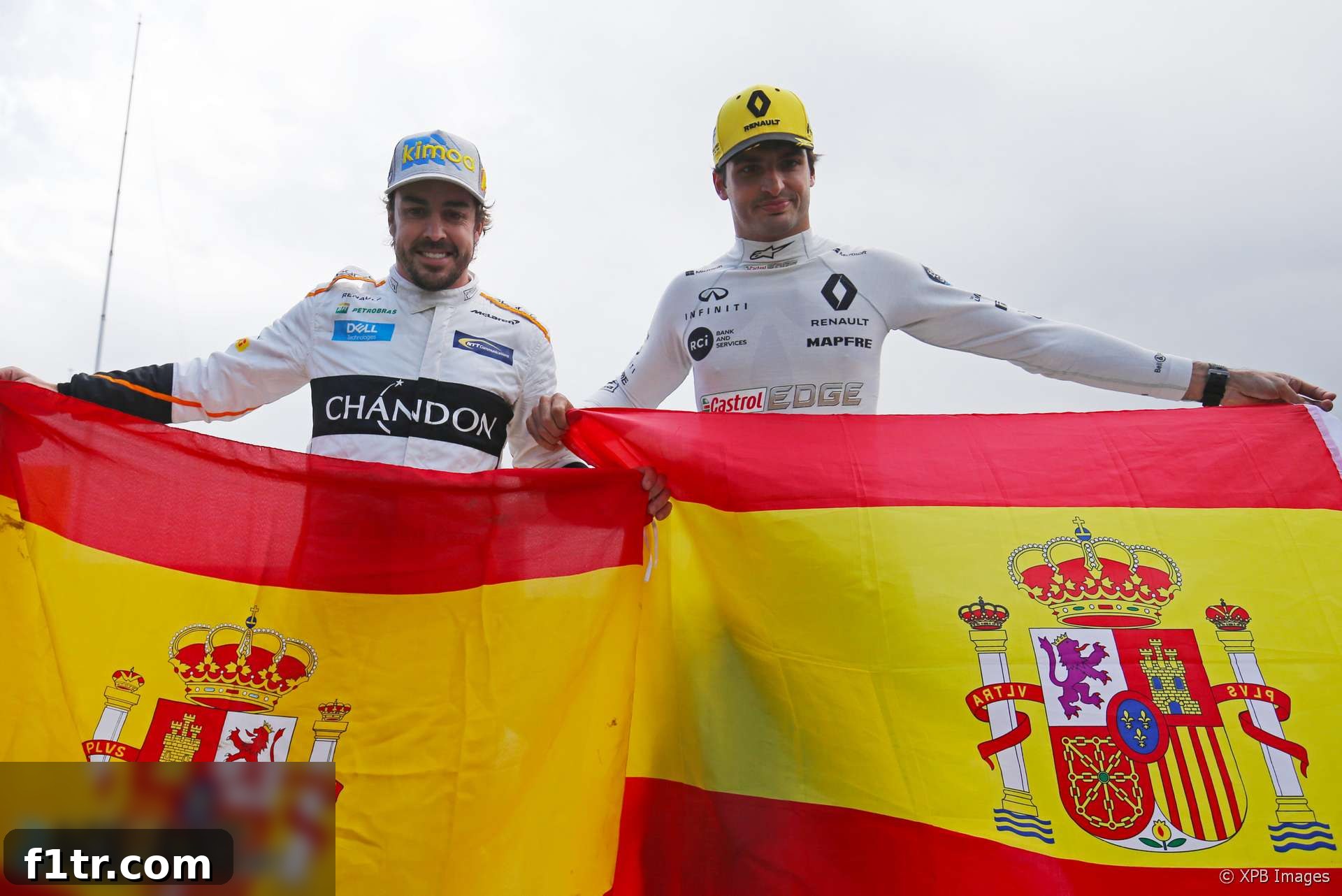
The Spanish Grand Prix always brings a special focus on the local heroes, and Carlos Sainz Jnr once again delivered a memorable performance on home soil. Sainz continued his impressive streak of scoring points in every Spanish Grand Prix he had started in his Formula 1 career. Furthermore, he maintained his consistent record of taking the chequered flag before Fernando Alonso in each of those home races, a significant bragging right in their ongoing national rivalry.
This rivalry between Sainz and Alonso has been a captivating subplot in Formula 1 since Sainz’s debut. Carlos Sainz had largely been the top-scoring Spanish driver since entering F1, illustrating his rapid ascent and competitive edge. The points battle between the two compatriots has historically been incredibly close, fluctuating with the performance of their respective teams. At the end of the 2015 season, Sainz held a narrow lead of 18-11 in cumulative points. However, a more competitive McLaren-Honda package in 2016 allowed Alonso to edge ahead, closing the year with a 65-64 advantage.
The 2017 campaign proved challenging for Alonso, and Sainz capitalized, forging a significant lead of 118-82 in the cumulative standings by the season’s end. The 2018 season, with the much-improved McLaren-Renault package, saw Alonso begin to out-score Sainz in individual races. Despite this recent upturn for Alonso, Sainz still maintained a significant cumulative advantage, standing at 137 points to Alonso’s 114 at the time of the Spanish Grand Prix. This dynamic rivalry kept fans engaged, eager to see which Spanish ace would ultimately claim supremacy.
Emerging Talents: Leclerc’s Points and Stroll’s Lap One Prowess
The final point of the Spanish Grand Prix went to rookie sensation Charles Leclerc, continuing his impressive debut season with Sauber. This crucial point placed him one point clear of his McLaren counterpart, Stoffel Vandoorne, further solidifying his strong start. As Monaco’s first home driver in 24 years, Leclerc’s consistent points-scoring performances in the last two races in a row built considerable anticipation for his home Grand Prix, showcasing his immense potential and adaptability to Formula 1.
Lance Stroll, driving for Williams, narrowly finished outside the points, but his race was nonetheless remarkable. He did well to reach the chequered flag at all, having been almost eliminated on the very first lap in a dramatic incident involving Romain Grosjean. Stroll’s ability to recover and continue in the race highlighted his resilience. Furthermore, Stroll once again demonstrated his exceptional skill in navigating the chaos of the opening lap. Building on his record from 2017, where he made up the most places on lap one, he was once again at the top of the board for the 2018 season, having gained an incredible 18 places on the first lap – twice as many as any other driver. This unique talent for gaining positions at the start underlined his aggressive approach and excellent car control.
Teammate Dynamics: Williams and Mercedes
The 2018 season offered fascinating insights into teammate dynamics across the grid. At the rear, Sergey Sirotkin and Lance Stroll, both driving the challenging FW41 Williams car, stood out as the most closely-matched teammates in terms of pure performance. The two rookies averaged a mere 0.017 seconds difference in qualifying, with Sirotkin holding that tiny advantage over the sophomore driver. This incredibly tight battle underscored the difficulty of extracting performance from the troubled Williams chassis and the raw speed of both young talents.
Interestingly, the next closest teammate pairing in terms of qualifying performance could be found at the complete opposite end of the grid: Lewis Hamilton and Valtteri Bottas at Mercedes. Hamilton held an average advantage of 0.018 seconds over Bottas, demonstrating just how finely tuned the battles within top teams can be, even when they are dominating the competition. This stark contrast highlighted the varying pressures and performance margins across the Formula 1 field.
Comprehensive Season Statistics and Further Insights
The Spanish Grand Prix provided a wealth of data and critical statistics that reshaped the early season narratives. For those eager to delve deeper into the intricate details of the championship and driver performances, a comprehensive review of the year so far in statistics is available:
- 2018 F1 Championship Points
- 2018 F1 Season Records
- 2018 F1 Race Data
- 2018 F1 Qualifying Data
- 2018 F1 Retirements and Penalties
- 2018 F1 Strategy and Pit Stops
The Circuit de Barcelona-Catalunya consistently offers fascinating insights into car performance and driver skill, often setting the tone for the European leg of the season. Did you uncover any other intriguing statistics or facts from the Spanish Grand Prix that captured your attention? Share your observations and analysis in the comments section below, and join the discussion about this pivotal race and its implications for the rest of the 2018 Formula 1 season.
Enhance your Formula 1 experience: Become a RaceFans supporter and enjoy an ad-free browsing experience!
More on the 2018 Spanish Grand Prix
- 2018 Spanish Grand Prix Star Performers
- F1’s Spanish Stars Remain Closely Matched in Fourth Season as Rivals
- Top Ten Pictures from the 2018 Spanish Grand Prix
- Commanding Win Puts Hamilton’s Bid for a Fifth Title On Track
- Sirotkin Was in Severe Pain from “Dangerous” Seat Problem
Browse all 2018 Spanish Grand Prix articles