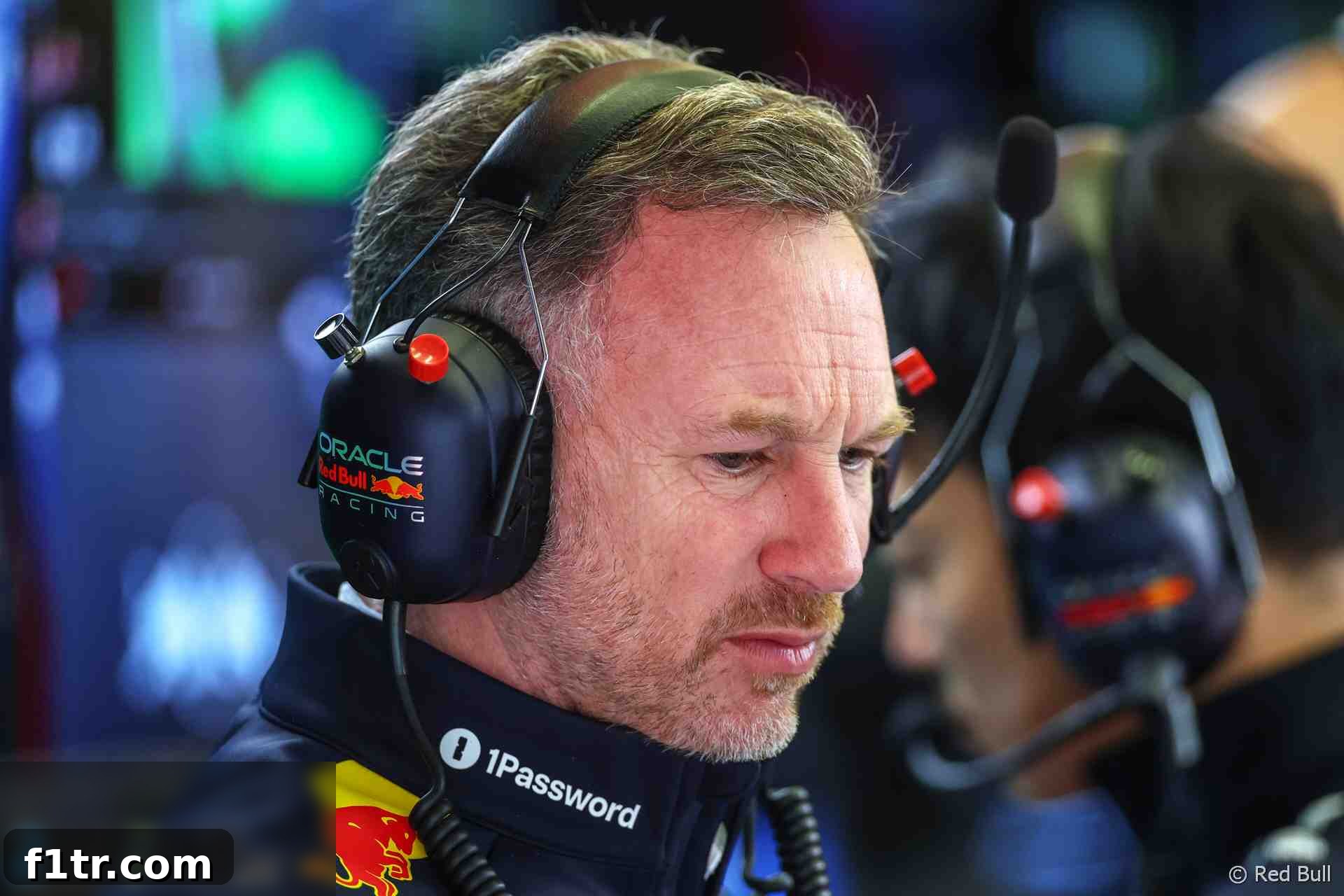
In a momentous announcement that has resonated throughout the Formula 1 community, Christian Horner, the revered team principal of Red Bull Racing, has officially confirmed his departure from the team. This marks the end of an extraordinary 20-year tenure, a period during which he transformed a nascent racing entity into one of motorsport’s most dominant forces. His initial statement following the news was a heartfelt tribute, extending gratitude not only to his dedicated team members and invaluable suppliers but also to the formidable rivals who have pushed Red Bull Racing to achieve unprecedented heights.
Horner, at 51 years old, stands as the longest-serving team principal in the history of Formula 1. He has been at the helm since Red Bull’s inception into the sport two decades ago, spearheading an incredible journey that has yielded six constructors’ championships and a remarkable eight drivers’ titles – four each for the legendary Sebastian Vettel and the phenomenal Max Verstappen. This unparalleled success story is a testament to his visionary leadership, strategic acumen, and unwavering dedication.
Advert | Become a Supporter & go ad-free
A Farewell Message: Two Decades of Unforgettable Moments
In a deeply personal and reflective message shared across social media platforms, Horner articulated the profound emotions accompanying his departure. “After an incredible journey of 20 years together, it is with a heavy heart that today I say goodbye to the team I have absolutely loved,” he wrote. This sentiment encapsulates the deep bond he forged with every individual within the Red Bull Racing family, emphasizing that “Every one of you, the amazing people at the factory, have been the heart and soul of everything that we have achieved.”
His message underscored the collective spirit and resilience that defined his leadership. “Win and lose, every step of the way, we have stood by each other as one and I will never forget that. It’s been a privilege being part of and leading this epic team and I am so proud of our collective accomplishments and you all,” he added. This highlights the culture of unity and mutual support that Horner meticulously cultivated, which became a cornerstone of Red Bull’s enduring success.
Horner also extended his heartfelt appreciation to the broader ecosystem that fuels Formula 1. “Thanks to the amazing partners and fans who enabled us to go racing. Your support has helped grow the team from its humble beginnings to an F1 powerhouse that laid claim to six constructors’ championships and eight drivers’ championships.” This recognition of external support reflects his understanding of the symbiotic relationship between a team, its commercial allies, and its passionate global fanbase. From its modest origins, Red Bull Racing, under Horner’s guidance, blossomed into a formidable competitor, consistently challenging for and securing the sport’s highest honours, much to the delight of its ever-growing legion of supporters worldwide.
The Indispensable Role of Rivalry in Motorsport
In a refreshing display of sportsmanship, Horner made a point to acknowledge the crucial role played by Red Bull’s competitors in shaping their journey and achievements. “Equally, thank you to our rivals, with whom there would be no racing at all,” he stated. This recognition goes beyond mere formality, touching upon the fundamental nature of competitive sport.
“You’ve pushed us, challenged us, and enabled us to achieve accolades we never dreamed possible. The competition has made every victory sweeter and every setback an opportunity to develop and grow,” Horner explained. This perspective underscores a profound truth in Formula 1: true greatness is often forged in the crucible of intense rivalry. The relentless pursuit of an edge against formidable opponents fuels innovation, sharpens strategies, and drives continuous improvement. Without the likes of Ferrari, Mercedes, and other top-tier teams constantly raising the bar, Red Bull’s own triumphs would undoubtedly feel less significant and perhaps even less achievable.
He concluded this tribute to his competitors by stating, “Formula 1 is a sport built on relentless ambition, passion, and respect. The rivalries have been fierce, but the mutual drive to innovate and raise the bar is what has made this journey so special.” This speaks volumes about Horner’s philosophy: while the competition on track is fierce and unyielding, an underlying respect for the collective effort to advance the pinnacle of motorsport binds everyone together. It is this dynamic, where adversaries inadvertently elevate each other, that has defined Red Bull’s era of dominance and contributed to F1’s captivating spectacle.
Advert | Become a RaceFans supporter andgo ad-free
Horner’s Enduring Legacy: From Jaguar to F1 Powerhouse
Christian Horner’s legacy extends far beyond the impressive tally of championships. He leaves behind a team that he meticulously molded from a struggling operation into a global motorsport giant. When Red Bull acquired the Jaguar Racing team from Ford, it was a mid-field outfit with sporadic flashes of potential but lacked consistent success and a clear direction. Horner, entrusted with the daunting task of building a winning team from scratch, embraced the challenge with characteristic zeal.
Under his astute leadership, Red Bull Racing transformed into a formidable force. He shrewdly brought in key talents, most notably the legendary aerodynamicist Adrian Newey, whose genius combined with Horner’s organizational prowess created an unstoppable synergy. The team’s infrastructure was overhauled, a vibrant and dynamic culture was instilled, and a relentless pursuit of engineering excellence became its hallmark. This transformation culminated in the dominant years with Sebastian Vettel, securing four consecutive double world championships from 2010 to 2013, an unprecedented feat for a relatively young team.
After navigating the challenging hybrid era where Mercedes dominated, Horner once again orchestrated Red Bull’s resurgence. His persistence in forging a partnership with Honda proved pivotal, laying the groundwork for the current era of dominance with Max Verstappen. The team has secured three consecutive drivers’ titles with Verstappen and multiple constructors’ championships, showcasing an adaptability and resilience that are hallmarks of Horner’s tenure.
Moreover, Horner’s visionary approach is evidenced by the team’s ambitious plans to become a power unit manufacturer next year, establishing Red Bull Powertrains. This bold move, to bring engine development in-house, represents a significant strategic shift and a monumental undertaking, further solidifying Red Bull’s long-term commitment and independence in Formula 1. It is a testament to Horner’s foresight and courage that he leaves the team poised not just as a chassis builder, but as a comprehensive motorsport entity capable of developing every critical component of an F1 car.
“It’s been an honour to be part of this incredible era of motorsport,” Horner reflected. “I leave with immense pride in what we’ve achieved and also with what’s in the pipeline for 2026 — and huge respect for everyone who’s made F1 the pinnacle it is today.” His words convey a deep satisfaction with his contributions and a hopeful outlook for the future he helped shape, emphasizing the continuous evolution and collective effort that define Formula 1 as the apex of motorsport.
A New Era: Laurent Mekies Steps Up
The baton of leadership at Red Bull Racing will now pass to Laurent Mekies, who previously served as the team principal for Red Bull’s sister F1 team, Racing Bulls (formerly AlphaTauri). Mekies brings a wealth of experience to the role, having held significant positions within the FIA and various Formula 1 teams, including a stint as Sporting Director at Ferrari. His deep understanding of F1’s technical and sporting regulations, combined with his leadership experience, makes him a well-suited successor to Horner.
In an official statement released by Red Bull, Oliver Mintzlaff, CEO for corporate projects and investments, expressed profound gratitude for Horner’s unparalleled contributions. “We would like to thank Christian Horner for his exceptional work over the last 20 years,” Mintzlaff stated, acknowledging the indelible mark Horner has left on the organization. “With his tireless commitment, experience, expertise and innovative thinking, he has been instrumental in establishing Red Bull Racing as one of the most successful and attractive teams in Formula One.” This statement unequivocally underlines the monumental impact Horner had in shaping Red Bull Racing’s identity and success.
Mintzlaff’s message concluded with a tribute to the departing principal and a warm welcome to his successor: “Thank you for everything Christian, you will forever remain an important part of our Team history. And of course, welcome Laurent, we wish you all the best in this new venture.” This transition signifies a new chapter for Red Bull Racing, one built on the robust foundations laid by Christian Horner and now entrusted to Laurent Mekies to carry forward into a promising, yet challenging, future.
Miss nothing from RaceFans
Get a daily email with all our latest stories – and nothing else. No marketing, no ads. Sign up here:
Advert | Become a RaceFans supporter andgo ad-free
Formula 1 Insights & Updates
Explore more in-depth analyses and breaking news from the world of Formula 1:
- Verstappen loathes F1’s new generation of cars – but what do his rivals reckon?
- The ‘throwback weekend’ is back in fashion. But it’s a flawed concept – especially for F1
- Is Formula 1’s double race cancellation a blessing in disguise?
- Todt admits Schumacher crashed on purpose – but did it really cost him two titles?
- 25 of the most memorable radio exchanges from the ‘Max and GP show’
Browse all Formula 1 articles