Christian Horner Defends Alexander Albon After Challenging Eifel Grand Prix Outing
Red Bull Racing Team Principal Christian Horner has unequivocally come to the defense of Alexander Albon following a particularly arduous race for the young Anglo-Thai driver at the iconic Nürburgring circuit during the Eifel Grand Prix. Albon’s race was marred by a series of unfortunate events, culminating in a premature retirement, yet Horner was keen to emphasize the underlying potential and positive aspects of Albon’s weekend performance, painting a picture of a driver whose efforts were unfairly overshadowed by circumstance.
A Race Plagued by Misfortune: Albon’s Eifel Grand Prix Story
The Eifel Grand Prix proved to be a crucible for Alexander Albon, where a promising qualifying session gave way to a deeply frustrating race day. His challenges began almost immediately, impacting his strategy and confidence from the outset and setting the tone for an afternoon of unforeseen obstacles.
Early Setback: The Peril of a Flat-Spotted Tyre
On the very first lap of the race, Albon suffered a significant and costly setback when he flat-spotted a tyre while braking hard into Turn 3. This incident was not merely a minor inconvenience; a flat spot creates severe vibrations throughout the car, critically compromising grip, balance, and, most importantly, driver safety. Horner explained the immediate and critical nature of the situation: “We had a big lock-up into turn three on the opening lap and our concern was that he’d gone pretty much through to the canvas and we were seeing vibrations increasing to the point that it was past our threshold. So from a safety point of view we had to pit him at that point.” This unavoidable incident necessitated an unplanned, early pit stop to replace the damaged tyre, effectively sending Albon to the back of the field and forcing him onto an alternative, sub-optimal strategy that would severely hamper his progression through the race.
Controversial Collision and a Debatable Penalty
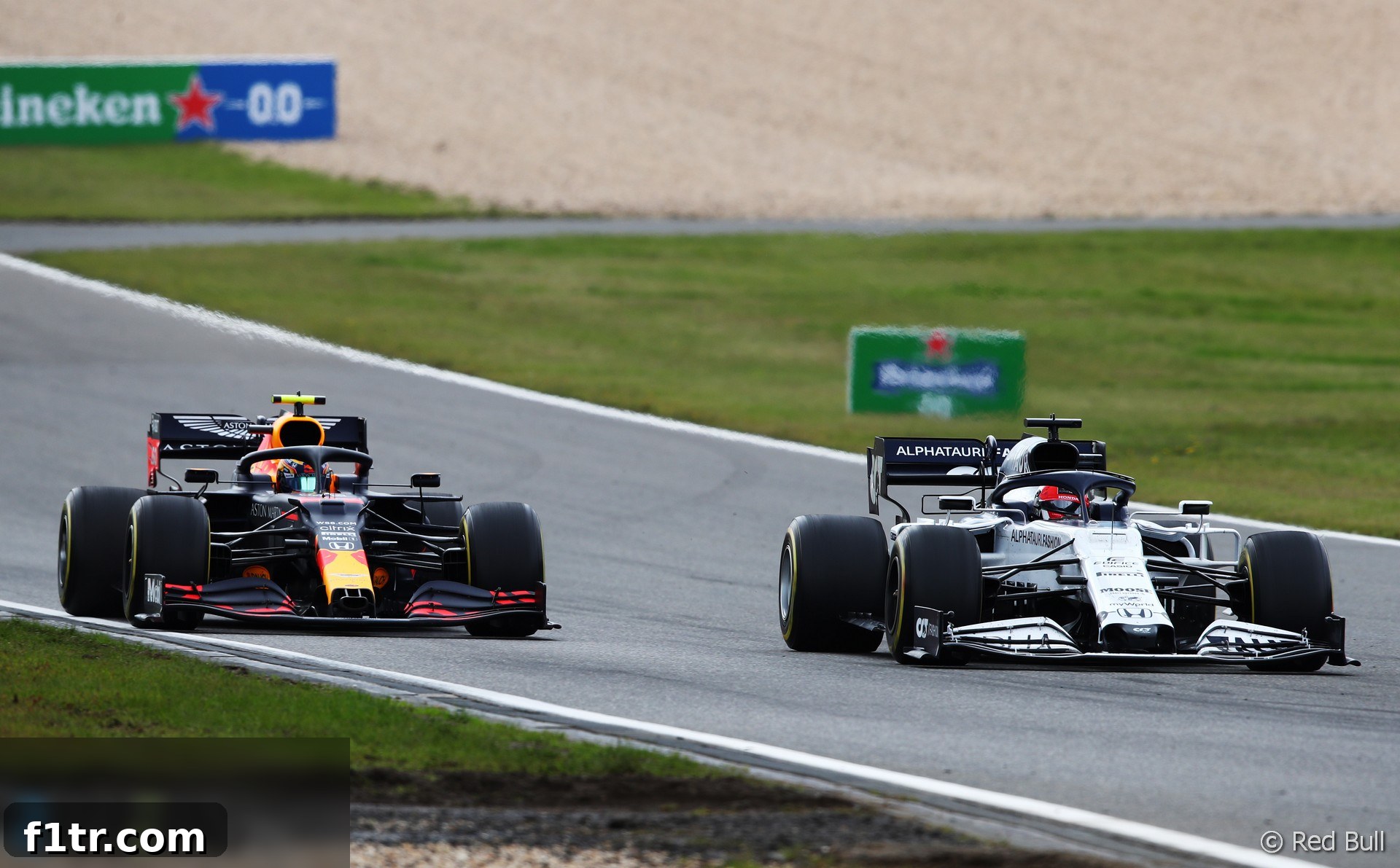
As Albon bravely attempted to recover lost ground and fight his way back through the field, he encountered further difficulties that compounded his woes. A collision with AlphaTauri driver Daniil Kvyat resulted in a 10-second time penalty, adding insult to injury to an already challenging afternoon. The incident occurred as Kvyat, having run wide and briefly off-track, rejoined the racing line. Horner voiced his strong disapproval of the stewards’ decision regarding the penalty, suggesting it lacked a balanced understanding of the incident’s dynamics: “The penalty felt a bit harsh to me. Daniil had been off the track, rejoined, it felt a bit on the harsh side.” This comment from the Red Bull team principal clearly indicated a perception within the team that the circumstances of the incident, particularly Kvyat’s prior excursion off-track, warranted a more lenient view from the race officials, or perhaps no penalty at all.
The Cruel Hand of Fate: Unavoidable Technical Retirement
Despite these significant challenges and the imposed penalty, Horner noted that Albon was beginning to demonstrate promising recovery pace, meticulously working his way back through the pack with determination. However, his efforts were ultimately rendered futile by an unrelated technical issue that brought his race to an abrupt and premature end. Albon’s car was forced to retire due to a pierced radiator, a direct consequence of picking up debris from the track—a common, yet unlucky, occurrence in motorsport. Horner elaborated on the critical nature of the problem and the team’s difficult decision: “He then started to make good progress back through the field. But he was very unlucky in that he’s picked up some debris that pierced a radiator on the cooling circuit and we just saw our temperatures started to go sky-high. Before losing an engine, we had no choice but to stop the car.” This severe mechanical failure, entirely outside Albon’s control and stemming from sheer bad luck, sealed his fate for the race, denying him any chance of salvaging a points finish from what had become an increasingly difficult and frustrating afternoon.
Horner’s Unwavering Support: Highlighting Albon’s Untapped Potential
Despite the series of unfortunate events that culminated in Albon’s retirement and a challenging final result, Christian Horner remained steadfast in his defense, choosing to focus on the positives and the inherent potential demonstrated throughout the weekend, rather than dwelling solely on the difficult race outcome. His commentary served to remind observers of the nuances often lost in the simple tallying of points.
Acknowledging Underlying Pace and Significant Progress
Horner expressed his genuine satisfaction with various aspects of Albon’s performance leading up to and during parts of the Eifel Grand Prix. He was particularly pleased with Albon’s qualifying effort, where the driver showcased genuine speed and made a significant step forward in closing the often-daunting gap to his highly-rated teammate, Max Verstappen. “He was almost on a second row of the grid, a few hundreds of a second off that, he was a lot closer to his team mate than he was in Russia,” Horner remarked. This improvement in qualifying pace is a crucial metric for any Red Bull driver, serving as a primary indicator of raw speed and a better understanding of the car’s intricate setup. Albon’s ability to get within a whisker of the front row was a clear sign of his growing confidence and capability.
The “What If” Scenario: Unseen Race Pace Potential
Furthermore, Horner offered a compelling speculation on what Albon might have achieved had his race not been severely curtailed by the early pit stop and subsequent, unavoidable technical failure. He firmly believed that Albon possessed the underlying pace and race craft to contend fiercely with strong midfield runners, stating with conviction, “I think he would have been racing Perez and Ricciardo even with that flat spot and the early stop.” This insightful comment underscores Horner’s profound confidence in Albon’s inherent speed and race acumen, suggesting that without the intervention of these external, uncontrollable factors, a much stronger and more representative result was undoubtedly within reach. It frames the unfortunate DNF not as a reflection of Albon’s performance, but rather as a matter of cruel misfortune that obscured his true potential on the day.
The Pressure Cooker of Red Bull Racing: Context for Albon’s Challenges
Alexander Albon’s tenure at Red Bull Racing was consistently under intense scrutiny, a characteristic shared by many talented drivers who have occupied the challenging second seat alongside the formidable Max Verstappen. The Eifel Grand Prix, while showcasing some improved performance, also starkly highlighted the unique pressures and unforgiving nature of top-tier Formula 1 racing, especially within a championship-contending team like Red Bull.
The Unrelenting Comparison to Max Verstappen
Being Max Verstappen’s teammate is arguably one of the toughest and most scrutinized roles in all of Formula 1. Verstappen, an undeniable generational talent, consistently extracts every ounce of performance from the car, setting an incredibly high and often unmatchable benchmark for any driver alongside him. Any driver in that coveted seat is inevitably compared, not just on outright pace, but on consistency, adaptability, race results, and even qualifying margins. While Albon had shown flashes of brilliance and moments of strong performance, maintaining that elite level of consistency weekend in and weekend out, without major incidents or technical woes, proved to be an immense and ongoing challenge. Horner’s remarks about Albon being “a lot closer to his team mate” were particularly significant, indicating that closing this performance gap was a primary objective and a vital sign of progress for both Albon and the team.
High Stakes and High Expectations
Red Bull Racing operates with the explicit and unwavering objective of winning both the Constructors’ and Drivers’ Championships. This ambitious goal necessitates both cars performing at an extremely high and consistent level to maximize constructors’ points and provide crucial strategic flexibility against formidable rivals like Mercedes. When one car consistently struggles, even due to factors beyond the driver’s direct control, it inevitably puts immense pressure on both the driver and the team management. Public defenses, such as those passionately offered by Christian Horner, are therefore crucial in such high-pressure environments, serving to boost driver morale, project an image of unwavering team unity, and strategically manage the external narratives that often swirl around a driver’s performance.
Looking Ahead: A Glimmer of Hope Amidst Adversity
In his closing remarks, Christian Horner articulated the profound disappointment of not seeing Albon’s discernible potential translate into a tangible, points-scoring result at the Nürburgring, especially after what he considered “a pretty sensible weekend” overall. The sentiment was clear and deeply felt: “So it’s a shame for him not to see that come to fruition today because he’s had a pretty sensible weekend. […] So I think it’s a shame that he didn’t get a result out of today because I think there was more to come.”
This statement encapsulates the bittersweet nature of Albon’s Eifel Grand Prix experience. While the final classification showed a retirement, Horner’s comments painted a vivid picture of a driver who was undeniably making strides, finding better form, and demonstrating the raw speed and talent required at the pinnacle of motorsport. It was a race where circumstances seemingly conspired against him at every turn, overshadowing genuine improvements and leaving many, including his supportive team principal, to genuinely wonder what might have been achieved under different conditions. Horner’s steadfast defense underscored the team’s continued belief in Albon’s capabilities, even as the harsh and unpredictable realities of Formula 1 — from unavoidable racing incidents to unforeseen mechanical failures — sometimes obscure a driver’s true performance and potential.
2020 Eifel Grand Prix Related Articles
- Renault “not scared of anywhere” in remaining races
- Bottas “needs a miracle” to overturn Hamilton’s 69-point lead
- 2020 Eifel Grand Prix Star Performers
- Leclerc sees ‘quite a few positives’ in Ferrari’s Nurburgring weekend
- Mercedes relied on DAS “more than ever” at cold Nurburgring
Browse all 2020 Eifel Grand Prix articles