New FIA Guidance for F1 Driver Retirements at Japanese Grand Prix: Enhancing Safety and Race Flow
Formula 1 has rolled out pivotal new guidance for drivers concerning the proper procedure for stopping their cars during sessions at the Japanese Grand Prix. This critical update is part of a broader initiative by the Fédération Internationale de l’Automobile (FIA) to bolster safety protocols and streamline race management, particularly when a car needs to retire from competition.
The introduction of this detailed guidance follows significant changes to the regulations, notably granting the race director unprecedented powers to instruct teams to retire severely damaged cars. This revised rule, which came into effect for the current season’s inaugural race, underscores the FIA’s unwavering commitment to driver and trackside personnel safety, as well as maintaining the integrity and flow of the race.
Understanding the New Rule: Empowering the Race Director for Enhanced Safety
Under the updated regulations, the race director now possesses the authority to order a team to stop a car under specific circumstances. These conditions are meticulously defined to cover situations where a car poses an immediate risk or becomes an undue hindrance to the competition:
- If a car “has significant and obvious damage to a structural component which results in it being in a condition presenting an immediate risk of endangering the driver or others.” This clause directly addresses the dangers posed by cars with compromised structural integrity, which could break apart further, shed dangerous debris, or become unpredictable on track.
- If a car “has a significant failure or fault which means it cannot reasonably return to the pit lane without unnecessarily impeding another competitor or otherwise hindering the competition.” This point is crucial for minimizing disruption, preventing slow-moving or erratic cars from becoming obstacles on the racing line, and avoiding unnecessary Safety Car or Virtual Safety Car deployments.
This proactive approach empowers race control to make swift decisions, preventing situations from escalating into more dangerous or disruptive scenarios. It shifts the responsibility dynamics, placing a greater emphasis on immediate safety over potential strategic gains that might lead teams to keep damaged cars on track.
The Sergio Perez Precedent: A Catalyst for Change
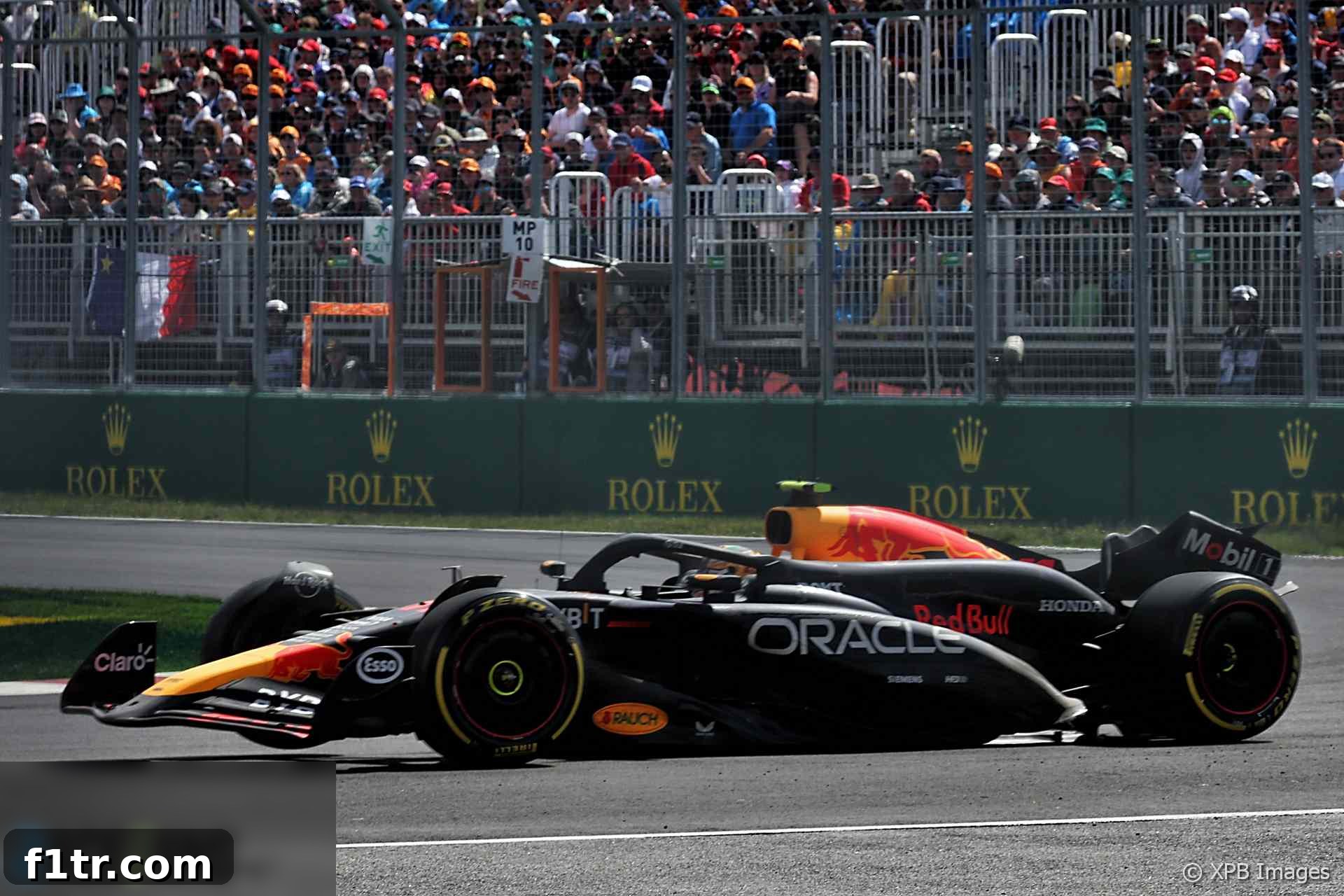
A recent and highly publicized incident involving Red Bull driver Sergio Perez at a previous Grand Prix served as a stark reminder of the challenges posed by damaged cars on track and undoubtedly influenced the FIA’s decision to enact these new regulations. During the 2023 Japanese Grand Prix, Perez incurred a three-place grid drop for a subsequent race, and his team, Red Bull, was fined €25,000 after stewards concluded that he had created a dangerous situation.
Perez had driven his significantly damaged car back to the pits instead of immediately retiring on the spot. The stewards’ investigation revealed that “the team confirmed in the hearing that the driver had been advised to bring the car back to the pits as they were trying to avoid a Safety Car situation.” This strategic maneuver, aimed at preventing a Safety Car period that could have jeopardized his teammate Max Verstappen’s lead, inadvertently created a heightened safety risk due to the debris shed by Perez’s car and its impaired handling.
The incident highlighted a critical tension between sporting strategy and paramount safety. While teams naturally seek competitive advantages, the FIA’s revised rules firmly re-establish that safety must always take precedence. The new guidance and the race director’s expanded powers are direct responses to prevent such situations from recurring, ensuring that the safety of drivers, marshals, and spectators is never compromised for strategic gain.
Strategic Retirement: Minimizing Disruption, Maximizing Safety
The core of the new guidance issued by the race director specifies precisely where drivers should position their cars if they need to retire. This isn’t just about stopping anywhere; it’s about stopping in designated safe zones. These instructions pinpoint the nearest locations where drivers can find emergency exit gaps in the trackside barriers. These gaps are strategically placed to allow marshals to swiftly and safely recover vehicles without the need for a full Safety Car or even a Virtual Safety Car (VSC) deployment, if possible.
By providing clear, predefined retirement locations, the FIA aims to:
- **Enhance Safety:** Removing damaged or broken-down cars from the live track as quickly and safely as possible reduces the risk of secondary accidents caused by debris or stationary obstacles.
- **Minimize Race Disruption:** Efficient car recovery through designated marshal points helps avoid or shorten Safety Car or VSC periods, thereby preserving the integrity of the racing spectacle and minimizing impacts on race strategies.
- **Streamline Operations:** Clear instructions empower marshals to act more decisively and efficiently, knowing exactly where to expect a retired vehicle and how best to access it.
- **Reduce Ambiguity for Drivers:** Drivers, often under immense pressure, will have clear instructions on how to handle a retirement, removing guesswork in critical moments.
This systematic approach represents a significant step forward in optimizing race management during unforeseen incidents, demonstrating a proactive stance on safety that benefits everyone involved in Formula 1.
Navigating Suzuka: A Circuit-Specific Approach
Suzuka International Racing Course in Japan is renowned for its unique figure-of-eight layout, high-speed sections, and a series of challenging corners that demand extreme precision from drivers. Its complex nature, with tight run-off areas in some sections and close proximity to barriers, makes clear retirement guidance particularly vital. The designated retirement zones take into account the track’s specific characteristics, marshal access points, and the safest recovery routes. The detailed breakdown ensures that drivers can anticipate where to stop, even in the heat of a race, contributing to smoother and safer incident management.
Specified Retirement Locations at Suzuka
The following table provides a comprehensive overview of the specified retirement locations across the iconic Suzuka circuit, detailing which side of the track drivers should position their cars depending on their location:
| Turn Numbers | Location | Position to Retire Car |
|---|---|---|
| Start line to Turn Two | First Turn | Left-hand side |
| Turn Three and approach | Right-hand side | |
| Turns Four and Five | Esses | Left-hand side |
| Turn Six and start of Seven | Dunlop | Right-hand side |
| Mid-Turn Seven | Left-hand side | |
| Turn Seven exit to Turn Eight entry | Right-hand side | |
| Turn Eight exit to Turn Twelve | Degner One and Two, Hairpin | Left-hand side |
| Turn Twelve to Turn Fifteen | Spoon Curve | Right-hand side |
| Turn Fifteen to Sixteen | 130R | Left-hand side |
| Turn Sixteen to Seventeen | Chicane | Right-hand side |
| Turn Seventeen exit to Start line | Final Turn | Left-hand side |
The Driver and Team Perspective: A Shift in Responsibility
For Formula 1 drivers and teams, these new guidelines represent a significant shift. No longer is the decision to bring a damaged car back to the pits solely a strategic choice; it is now heavily governed by explicit safety directives and the authority of the race director. Drivers must be acutely aware of their car’s condition and the new instructions. Teams, in turn, bear a greater responsibility to accurately assess car damage and advise their drivers according to the FIA’s regulations, even if it means sacrificing potential competitive advantages.
This necessitates enhanced communication protocols between the pit wall and the cockpit, particularly in high-stress situations. The emphasis is firmly placed on immediate compliance with safety directives, reinforcing the idea that no race position or championship point is worth risking a serious incident. The penalties for non-compliance, as demonstrated by the Perez case, are a clear deterrent, ensuring that all participants adhere to the spirit and letter of these new safety-focused rules.
Beyond Suzuka: A Precedent for Global F1 Safety
While this initial guidance focuses specifically on the Japanese Grand Prix at Suzuka, it is highly probable that such detailed, circuit-specific retirement plans will be implemented across the entire Formula 1 calendar. The FIA’s continuous drive for improved safety standards often sees successful initiatives at one venue adopted globally. This systematic approach to managing retired cars could become a blueprint for all circuits, tailored to their unique layouts and logistical considerations.
This evolution in regulations reflects F1’s ongoing commitment to pushing the boundaries of safety without compromising the thrill of the sport. By proactively addressing potential hazards and providing clear, actionable guidance, the FIA continues to ensure that Formula 1 remains at the pinnacle of motorsport, balancing intense competition with paramount safety.