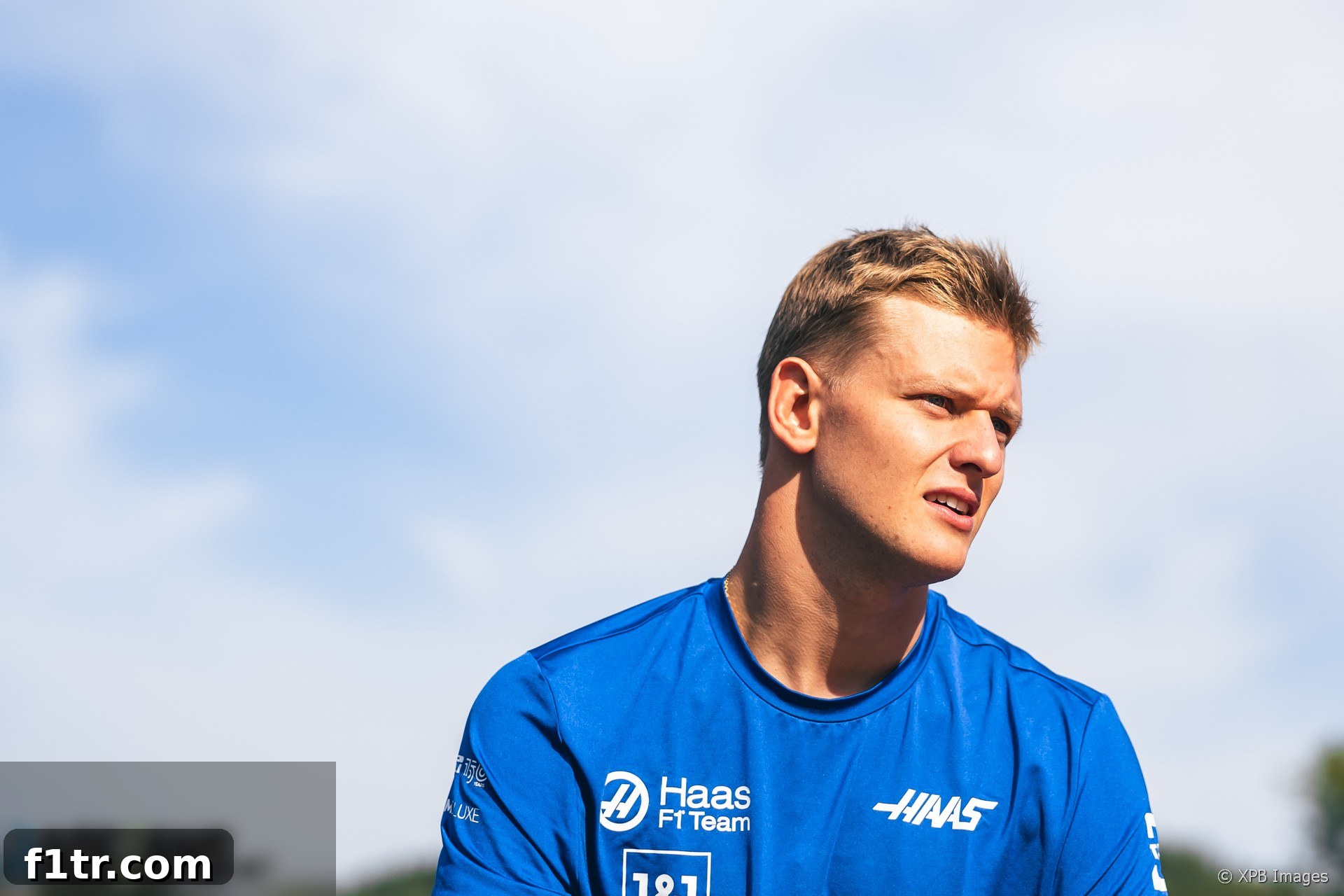
Mick Schumacher’s F1 Farewell: A Season of Frustration and Missed Opportunities at Haas
It’s no mere coincidence that the three drivers compelled to leave the Formula 1 grid at the close of the 2022 season found themselves occupying the bottom three positions in the RaceFans driver rankings for the year. Among this trio, however, Mick Schumacher perhaps harbored the most profound sense of frustration at not being granted a further opportunity to prove his mettle in the pinnacle of motorsport.
The Shadow of a Legend and a Challenging Debut
Schumacher’s rookie season in 2021, realistically, amounted to little more than an extended test session. With virtually zero development invested in their 2021 challenger, Haas strategically poured all their available resources into preparing their 2022 machine, designed for Formula 1’s highly anticipated new technical era. This left Schumacher to navigate his debut year in a largely uncompetitive car, often relegated to the rear of the field.
Despite the limitations of his machinery, the young German did benefit from a unique comparison. His teammate, Nikita Mazepin, proved to be no match. Schumacher consistently out-performed Mazepin in every conceivable category, securing a clear psychological advantage as he approached the crucial 2022 season. This dominant display against his rookie counterpart had set a promising, albeit limited, precedent for what Schumacher could achieve under more favorable circumstances.
A New Benchmark: Magnussen’s Return and Early Struggles
However, by the time Schumacher arrived in Bahrain for the opening race of 2022, a significant change had occurred. It wasn’t Mazepin who sat opposite him in the garage, but the seasoned veteran, Kevin Magnussen. Suddenly, Schumacher was faced with a genuine benchmark, an experienced driver to truly measure his capabilities against. This also presented an invaluable opportunity to work collaboratively with a seasoned professional to maximize the potential of Haas’s extensively developed new car – a car that, as events would soon prove, was more than capable of challenging for points.
Yet, during the initial phase of the season, when the Haas VF-22 was arguably at its most competitive, Schumacher simply failed to unlock its full potential. Over the first four rounds, Magnussen rapidly accumulated 15 points, including a remarkable fifth-place finish in Bahrain that sent shockwaves through the paddock. In stark contrast, Schumacher failed to record a single top-10 finish, leaving many to question his ability to convert the car’s speed into tangible results.
Costly Incidents and Mounting Pressure
The first major setback of Schumacher’s season arrived in Jeddah. His heavy accident during qualifying was arguably the most violent impact suffered by any driver throughout the entire season, utterly destroying his car and necessitating a trip to the hospital. While thankfully deemed fit and well, his car was far from it. With a scarcity of spare parts, Haas made the difficult decision to withdraw Schumacher from the race, leaving him as a mere spectator as Magnussen secured ninth place, earning the team their second consecutive points finish and further highlighting the missed opportunity for Mick.
Following a disappointing weekend for Haas in Melbourne, where Schumacher managed to pass Magnussen in the final laps to finish ahead – a small consolation – the second-year driver then endured what was arguably his worst run of the season. At Imola, a weekend marred by poor form, he qualified a significant eight places behind Magnussen. His race was further complicated by a spin into Fernando Alonso at the first chicane, followed by another spin at the Variante Alta. He ultimately finished ahead of only Daniel Ricciardo, who had spent the entire race battling a severely damaged car.
In Miami, Schumacher was tantalizingly close to securing his first-ever Formula 1 points after the final Safety Car period. However, a late-race clash with his mentor, Sebastian Vettel, tragically destroyed any hope of him finally adding to his team’s tally. Spain proved to be another challenging weekend where the team as a whole struggled for pace, but Schumacher did at least achieve a significant milestone by reaching Q3 in qualifying for the first time in his F1 career, offering a brief moment of optimism.
Then came Monaco, which proved to be perhaps the lowest point of Schumacher’s season. After expertly navigating the treacherous wet start to the race, he lost control entering the iconic Swimming Pool complex, slamming into the barrier and splitting his car apart. This marked his second major wreck of the still-young season, and the repair bills for Schumacher’s incidents were rapidly accumulating. Team principal Guenther Steiner made no secret of his concerns, emphasizing that, given the strict constraints of the F1 budget cap, Schumacher absolutely had to avoid any further shunts for the remainder of the season to protect the team’s financial stability.
A Glimmer of Hope: Breakthrough Moments
Fortunately for Schumacher, his form experienced a significant upturn after this brutal low point. Racing at Montreal for the very first time, he showcased impressive pace, securing his best grid position of his career in sixth place, just behind Magnussen. Unluckily, a hydraulics failure forced him out of the race after only 19 laps, precisely when he was running comfortably within the points-scoring positions. Surely, it seemed, it would not be long before he was finally rewarded with his first well-deserved points.
Indeed, at the very next round at Silverstone, the long-awaited breakthrough finally arrived. Despite falling to the back of the pack in the chaotic early laps, Schumacher demonstrated resilience and skill, methodically catching and passing his teammate on his way to an eighth-place finish. In truth, he was arguably unlucky to finish behind Max Verstappen, having been robustly shoved off the track on the final lap. Nevertheless, this performance felt like a long-awaited turning point, offering tangible proof of his capability.
In Austria, a “new Schumacher” seemed to emerge. He expressed frustration with his team for not utilizing Magnussen to assist him during the sprint race, yet he channeled that energy into a superb Grand Prix performance. He passed his teammate during the main race to move up to seventh, which then became a career-best sixth after Carlos Sainz Jnr retired. Back-to-back points finishes had dramatically transformed the narrative surrounding Schumacher’s season, suddenly putting him in charge of his own destiny for the crucial second half of the year.
The Second Half Slump and Missed Opportunities
However, that strong performance at the Red Bull Ring ultimately marked the final time Mick Schumacher finished in the top half of the field in 2022. The Haas team, unfortunately, began to struggle significantly in keeping pace with the rapid development rate of their rivals. They steadily fell down the pecking order, receiving only a limited boost from their sole major upgrade package introduced around the summer break. This decline in the car’s competitive edge made it increasingly difficult for Schumacher to replicate his earlier points-scoring form.
Schumacher utilized the upgrade to good effect at Zandvoort, being comfortably the better of the two Haas drivers over the weekend. Frustratingly, a front jack problem during a pit stop cost him a critical eight seconds, likely preventing a points finish. Then at Monza, despite having a grand total of just 17 laps across all practice sessions due to penalties and car issues, he showed impressive race pace on medium tyres, bringing himself into contention for points just outside the top 10 behind the Safety Car, only for the race to never restart, denying him another opportunity.
These near misses at Zandvoort and Monza were as close as Schumacher came to points for the remainder of the year. He finished ahead of his teammate on only a couple of occasions over the final six rounds, inadvertently providing Haas with additional reasons to consider an alternative driver rather than retaining him for the 2023 season. He crashed again at Suzuka on his way back to the pits after first practice, adding to his growing list of incidents, and later picked up a track limits penalty at the Circuit of the Americas. In Mexico, he managed a small victory, beating Magnussen across the line by less than two seconds, but it was a fleeting moment.
The Brazilian Contrast and Final Confirmation
Then came the most awkward and defining moment of the season in Brazil. While Schumacher was eliminated slowest on a drying track in Q1, admitting he simply did not realize how much grip there was available, his teammate, Kevin Magnussen, leveraged a brilliant drive and a slice of good fortune to secure a sensational pole position. As great a moment as it was for the team, the contrast between Schumacher’s performance and his teammate’s incredible achievement could not have been more striking, or more damaging to Mick’s prospects. Just days later, his inevitable departure from Haas was finally confirmed, closing a challenging chapter in his nascent Formula 1 career.
Reflecting on a Difficult Chapter: What Next for Mick?
Mick Schumacher has certainly demonstrated glimpses of his potential, proving he can fight for points when his car is capable and his confidence is high. However, this ability was not sustained at a consistent enough level throughout the demanding F1 season. In a long and arduous year, it was ultimately his inability to capitalize during the crucial early phase, when Haas was at its most competitive relative to its rivals, that likely proved to be the decisive factor in costing him his place on the Formula 1 grid. The financial implications of his accidents, coupled with moments of inconsistency, overshadowed his undeniable talent and the significant pressure of carrying one of motorsport’s most legendary surnames.
Whether Mick Schumacher will be granted a second chance to return to the Formula 1 grid remains to be seen. His journey highlights the immense pressures and cut-throat nature of F1, where even drivers with immense potential can find their careers hanging by a thread due to a combination of circumstances, team dynamics, and the unforgiving demands of the sport.
2022 F1 Season: Related Articles
- Mercedes told me “you’re wrong” about 2022 car’s problems – Hamilton
- FIA confirms all 10 F1 teams complied with 2022 cost cap
- Steiner “not ashamed” of panning “slow” Schumacher in Drive to Survive
- Albon believes year out of F1 improved him as a driver
- Hamilton sees diversity gains in F1 years on from his ‘traumatising’ experience of racism
Browse all 2022 F1 season articles