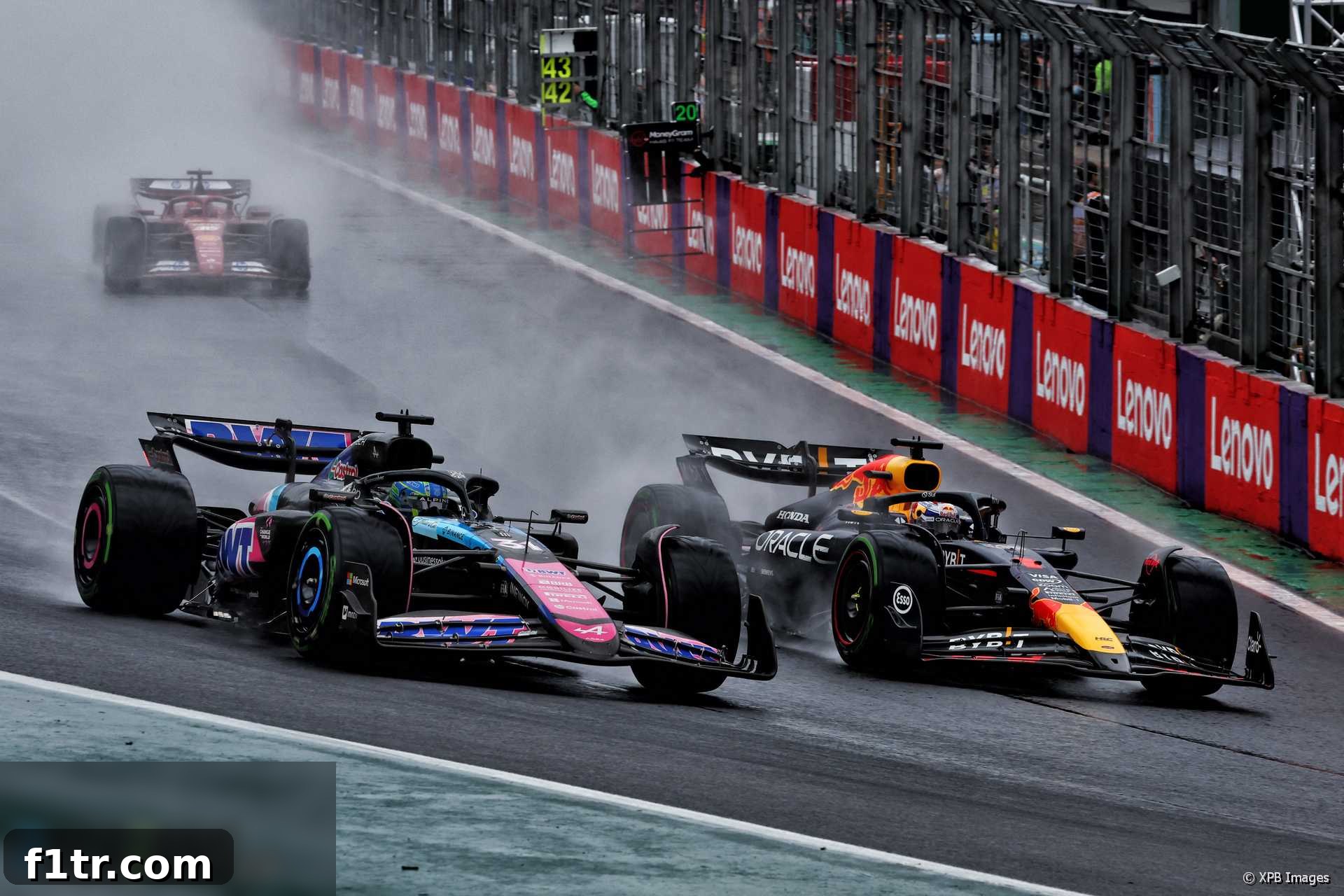
Max Verstappen delivered one of the most memorable performances of his illustrious career at the Brazilian Grand Prix, orchestrating a sensational comeback from an unpromising 17th position on the grid to claim a dominant victory in a truly chaotic and rain-drenched race at Interlagos. This masterclass in wet-weather driving was further highlighted by a remarkable and unexpected double podium finish for the Alpine team, with Esteban Ocon securing a brilliant second place and Pierre Gasly bravely holding off his rivals to clinch third. Verstappen’s triumph not only showcased his extraordinary skill and composure under pressure but also significantly bolstered his championship aspirations, extending his lead over closest contender Lando Norris, who finished sixth after a challenging event.
A Chaotic Prelude: The Brazilian Grand Prix Kicks Off with Unforeseen Drama
The 2024 Brazilian Grand Prix was steeped in drama even before the green lights signaled the start of racing. Anticipating adverse weather conditions, race officials took the rare step of bringing the race start forward by an hour and a half. Despite this, the Interlagos circuit remained treacherous – damp in patches but not actively raining as the drivers embarked on their formation lap, setting the stage for an unpredictable contest. The grid itself was missing a contender, as Alexander Albon was unfortunately unable to start the race. Having suffered extensive damage during qualifying that proved too severe to repair in time, his seventh-place grid slot lay empty, a stark reminder of the circuit’s unforgiving nature.
Formation Lap Fiasco: Stroll’s Early Exit and Norris’s Costly Error
The formation lap itself proved to be a harbinger of the chaos to come. Lance Stroll, navigating the challenging conditions, lost control of his Aston Martin under braking for the fast left-hander of Subida do Lago. His car spun violently, colliding with the wall and sustaining significant damage to its front wing. Despite a valiant effort to rejoin, Stroll’s car became hopelessly beached in the gravel trap, ending his race prematurely and highlighting the perilous grip levels.
The initial start procedure was then complicated by an error from pole-sitter Lando Norris. The McLaren driver mistakenly left his grid position before the ‘Extra Formation Lap’ signal was issued, leading to immediate confusion. Around half the field followed Norris’s lead, while others correctly remained stationary. This procedural breach forced race control to abort the start for a second time, placing Norris under official investigation and further delaying the highly anticipated commencement of the race. The series of events created a palpable tension, forcing teams to hastily re-evaluate strategies amidst the unfolding pandemonium.
Early Race Dynamics: Russell’s Strong Start and Verstappen’s Relentless Climb
After a considerable delay, the race finally got underway, and George Russell immediately made his intentions clear. The Mercedes driver launched off the line with exceptional precision, surging past pole-sitter Lando Norris to seize the lead. Russell quickly established a strong pace, demonstrating impressive car control as he attempted to build a gap over Norris. Behind the leading duo, Yuki Tsunoda held onto a commendable third place, showcasing the AlphaTauri’s competitiveness in the tricky conditions. Esteban Ocon settled into fourth, closely followed by Charles Leclerc, who had skillfully gained fifth position from Liam Lawson during the opening exchanges.
While the battle for the lead unfolded, all eyes were firmly fixed on Max Verstappen. Starting from a challenging 17th on the grid, the Red Bull maestro embarked on a breathtaking charge through the field. Displaying his characteristic blend of aggressive precision and masterful overtaking, Verstappen surgically carved his way past rival after rival on the damp, unforgiving surface. His ascent was relentless, and he quickly climbed into an impressive sixth position, finding himself locked in a tense battle with Charles Leclerc’s Ferrari. Verstappen’s attempts to pass Leclerc were met with staunch resistance from the Ferrari driver, who held his ground admirably until the end of lap 24. Leclerc then made the bold strategic call to be the first of the front-runners to pit, switching to a fresh set of intermediate tyres, signaling the escalating challenge of the track conditions and a potential shift in race strategy.
The Deluge and Disruptions: Safety Cars, Red Flags, and Strategic Resets
As the race progressed, the heavens above Interlagos reopened with renewed ferocity. The intensity of the rain significantly increased, transforming the challenging damp track into a truly treacherous wet-weather circuit. Grip levels plummeted across the entire circuit, and visibility rapidly worsened, creating an environment where even the most experienced drivers struggled to maintain control. These dramatic conditions inevitably led to a series of critical incidents that would fundamentally reshape the outcome of the Grand Prix.
Hulkenberg’s Incident and a Split in Tire Strategies
The deteriorating conditions claimed their first major victim when Nico Hulkenberg, battling to keep his Haas on the track, lost control into the notoriously difficult first corner. His resulting spin brought out the Virtual Safety Car (VSC), providing a crucial strategic window for many teams. Both George Russell and Lando Norris wasted no time, diving into the pits under the VSC to equip their cars with fresh sets of intermediate tyres, hoping this tactical move would give them an advantage as the rain continued. However, in a daring and ultimately inspired strategic gamble, Esteban Ocon and Max Verstappen – both of whom had skillfully overtaken Yuki Tsunoda just prior to the VSC deployment – opted to stay out on their current intermediate tyres, betting on their car’s setup and their superior feel for the challenging conditions.
Colapinto’s Devastating Crash Triggers Red Flag Stoppage
The rain continued its relentless downpour, making racing conditions increasingly perilous. With visibility severely compromised, race control made the decision to deploy the full Safety Car, hoping to neutralize the field and improve safety. Yet, even under Safety Car conditions, the Interlagos circuit proved unforgiving. In a terrifying moment, Franco Colapinto, driving his Williams, lost control as he ascended the steep uphill section towards the final corners. The car aquaplaned, sending him into a violent and heavy collision with the barriers. The severity of the impact, coupled with the significant debris scattered across the track, left race control with no alternative but to red-flag the race, bringing the entire event to a complete halt.
The field was then directed to line up in the pit lane, an unusual and high-pressure scenario that allowed teams and drivers a critical opportunity to regroup, assess damage, and fine-tune strategies during the stoppage. At this pivotal moment, Esteban Ocon emerged as the unexpected leader, a testament to his strong driving and his team’s bold decision to stay out. Max Verstappen, by virtue of his incredible charge and strategic decision, held a commanding second position, closely followed by his Alpine stablemate, Pierre Gasly, who had strategically navigated the chaos to secure a vital third place. Notably, Lando Norris had managed to overtake George Russell just before the Safety Car was deployed, placing him in fourth ahead of Russell, adding another layer of intrigue to the impending restart and the battle for podium positions.
Verstappen Seizes Control: Dominance in the Final Stages
Following a protracted delay, during which engineers worked feverishly on the cars and drivers recalibrated their focus, the race finally resumed under the Safety Car. Esteban Ocon, showing remarkable composure, led the field away from the pit lane. As the Safety Car returned to the pits and racing commenced, the Alpine driver demonstrated exceptional defensive driving, skillfully maintaining his lead and expertly denying the formidable Max Verstappen any immediate opportunity to challenge for first place. Ocon’s tenacity was a highlight, showcasing Alpine’s surprising strength in the demanding conditions.
The intense battles continued behind the front-runners. Lando Norris, possibly pushing the limits of grip or encountering a particularly challenging section of the track, slid off at the notorious Subida do Lago. This costly misjudgment saw him lose valuable ground, surrendering fourth place to a determined George Russell and underscoring the razor-thin margins and inherent risks of racing in such extreme weather.
Sainz’s Retirement and Verstappen’s Decisive Move for the Lead
The chaotic narrative of the race continued with yet another incident. The Safety Car was deployed for a second time, this time triggered by Carlos Sainz Jnr’s unfortunate spin into the barriers at the challenging Laranja corner, bringing an end to his race. This presented another crucial opportunity for a strategic reset. At the subsequent restart, Max Verstappen, having meticulously observed Ocon’s defensive tactics, unleashed his full attacking prowess. He applied immense pressure on the Alpine driver and, with a perfectly executed and audacious maneuver, managed to slip through into the lead at the very first corner. It was a decisive move that left no doubt about his intent to dominate the remainder of the race.
The final restart also proved challenging for Lando Norris, who once again ran wide at the first corner, a mistake that cost him multiple positions and saw him drop back to seventh. However, a stroke of good fortune, or perhaps a momentary lapse from Oscar Piastri at Juncao, handed the position back to his McLaren teammate, allowing Norris to recover some of the lost ground. With Verstappen now firmly in front, he immediately began to pull away from Ocon, rapidly building a significant lead and demonstrating his unparalleled pace and control in the challenging wet conditions. Behind them, Pierre Gasly found himself under relentless pressure from a determined George Russell, who was desperate to improve his position and secure a podium finish.
Alpine’s Unforeseen Triumph and Verstappen’s Championship Stranglehold
As the final laps of the exhilarating Brazilian Grand Prix unfolded, Max Verstappen continued to extend his lead, pulling away from the chasing pack with effortless ease. He crossed the finish line at the end of the 69th lap, claiming his first victory in 11 rounds, a testament to his unwavering focus, exceptional talent, and the Red Bull team’s strategic brilliance. His margin of victory over Esteban Ocon was a commanding well over 15 seconds, a clear indicator of his absolute dominance in the challenging conditions. For Esteban Ocon and the entire Alpine team, second place marked their first and truly remarkable podium finish of the season, a thoroughly deserved achievement that will undoubtedly boost team morale significantly.
The celebrations for Alpine were further amplified by Pierre Gasly’s heroic performance. In a tense and prolonged battle, Gasly successfully held off the persistent advances of a charging George Russell to secure third place. This brilliant display of defensive driving completed a sensational double podium for Alpine, a result that stands as one of the highlights of their season. George Russell, despite his valiant efforts, ultimately had to settle for a solid fourth place, a strong recovery but narrowly missing out on a coveted podium spot. Lando Norris, after a race filled with drama and setbacks, showcased his resilience by crossing the line in fifth, salvaging valuable championship points.
Yuki Tsunoda was elevated to seventh position after Oscar Piastri received a ten-second penalty for an earlier infringement, highlighting the critical importance of clean racing in such tight battles. Liam Lawson delivered a commendable performance to finish eighth, while Lewis Hamilton managed to secure the final point in tenth position, capping off a difficult weekend for the seven-time world champion.
Verstappen’s monumental win at the Brazilian Grand Prix significantly bolstered his championship aspirations. His commanding lead over Lando Norris now stands at an imposing 62 points, with just three rounds remaining in the season. This dominant performance not only showcased his raw speed and unparalleled car control in extreme conditions but also his strategic acumen and ability to thrive under immense pressure, further cementing his status as a true legend of the sport and making this Brazilian Grand Prix an unforgettable chapter in Formula 1 history.
2024 Brazilian Grand Prix Highlights and Analysis
Explore more insights and discussions from the thrilling 2024 Brazilian Grand Prix:
- “I didn’t really want to come back” – Hamilton explains cryptic Brazil radio message
- Ocon’s role in Gasly’s Q2 exit was almost another ‘flare-up’ at Alpine – Oakes
- Interlagos must improve “very bad” new track surface for 2025, say F1 drivers
- “That’s how we silence them”: Verstappen’s stunning Brazil win from start to finish
- Verstappen now has as many wins as F1’s first six world champions combined
Browse all 2024 Brazilian Grand Prix articles