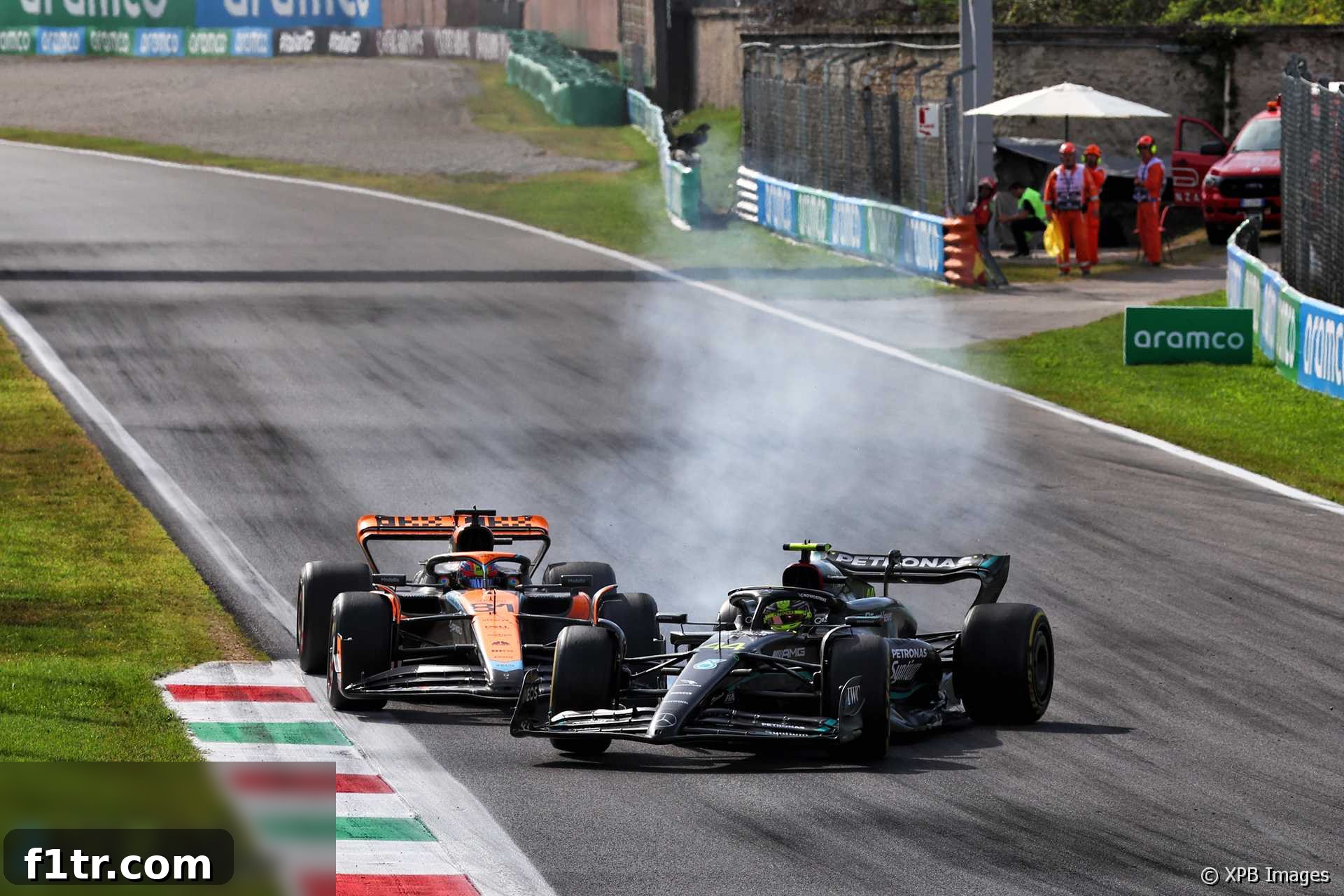
Lewis Hamilton, the esteemed seven-time Formula 1 world champion, promptly issued a sincere apology to McLaren’s burgeoning talent, Oscar Piastri, following their on-track entanglement during the highly charged Italian Grand Prix at Monza. The incident, which saw Hamilton incur a time penalty and drew significant attention from the motorsport community, highlighted the razor-thin margins and intense competitive spirit that define top-tier racing.
The Monza Showdown: Unpacking the Collision at Variante della Roggia
The critical moment unfolded on lap 18 of the thrilling Italian Grand Prix. As the race progressed, Hamilton, driving his Mercedes W14, and Piastri, in his rapidly improving McLaren MCL60, found themselves in a spirited duel for track position. The pair approached the notoriously demanding Variante della Roggia chicane, a challenging sequence of corners following one of Monza’s blistering long straights. This particular section of the circuit often serves as a hotspot for overtakes and, consequently, for potential contact due to its tight nature and heavy braking requirements.
In an attempt to gain an advantage, Hamilton maneuvered his car alongside Piastri. However, in the heat of the moment and amidst the intense pressure, he inadvertently nudged Piastri towards the outer edge of the corner. This unfortunate squeeze resulted in unavoidable contact between the two formidable competitors. The impact was immediately consequential for Piastri, whose front wing sustained damage, necessitating an unscheduled pit stop for a replacement. This crucial halt not only cost the young Australian valuable time on track but also severely compromised his race, effectively extinguishing his hopes of scoring significant points for McLaren at their crucial home event.
Conversely, Hamilton’s Mercedes appeared to escape the contact with minimal immediate damage, allowing him to continue his race without an extra stop. Despite this, the incident was quickly flagged by race control, setting the stage for a review by the stewards, a common procedure in such high-stakes racing scenarios where every maneuver is scrutinized for fairness and adherence to regulations.
Stewards’ Ruling: Hamilton Accepts Responsibility and Penalty
Following a meticulous review of the telemetry and video evidence, the race stewards concluded that Lewis Hamilton was primarily responsible for the collision. Their assessment determined that Hamilton had not afforded Piastri sufficient racing room as they navigated the challenging chicane, leading directly to the contact. As a result of this judgment, Hamilton was handed a five-second time penalty, which was subsequently added to his total race time. In addition to this penalty, two endorsement points were added to his FIA Super Licence, elevating his current tally to four points. The accumulation of twelve endorsement points within a twelve-month period results in an automatic race ban, underscoring the severity with which the FIA treats repeated infringements.
This penalty serves as a powerful reminder of the stringent standards of conduct upheld in Formula 1, even for drivers of Hamilton’s immense stature and experience. The stewards’ unwavering decision reinforces the principle that all competitors, irrespective of their championship accolades or legendary status, are held to the same rigorous standards of safe and respectful racing. It’s a testament to the sport’s commitment to maintaining competitive integrity and driver safety, ensuring that even minor misjudgments carry significant consequences.
Hamilton’s Immediate Candor and Act of Sportsmanship: “It was, obviously, my fault.”
In the immediate aftermath of the incident, Hamilton, ever the professional, initially sought clarification from his Mercedes pit wall regarding the culpability. However, his self-reflection and candid assessment quickly led him to accept full responsibility for the contact. Speaking to journalists, including RaceFans, Hamilton articulated his admission with characteristic honesty: “It was, obviously, my fault, and it actually wasn’t intentional. I got up alongside and just misjudged the gap that I had to the right and clipped him. It could happen at any time.”
This frank admission of error is a hallmark of Hamilton’s long and distinguished career, particularly when reflecting on race incidents. His willingness to take accountability and his desire to personally convey his regret to Piastri were evident. Hamilton further explained his motivation, stating, “I knew shortly afterwards it must have been my fault so I wanted to make sure he knew that it wasn’t intentional. And that’s what gentlemen do, right?” This sentiment resonates deeply within the motorsport community, highlighting a respected code of ethics among many F1 drivers where respect, integrity, and accountability are valued above the fierce competitive rivalry on track. Such gestures play a crucial role in maintaining mutual respect and professionalism, even after a race-altering incident.
Piastri’s Gracious Response: A Display of Maturity and Understanding
On the receiving end of Hamilton’s apology, Oscar Piastri demonstrated a remarkable level of maturity and sportsmanship, particularly impressive for a rookie driver still finding his footing in the demanding world of Formula 1. Despite the significant adverse impact the collision had on his race – forcing an unplanned pit stop and subsequently dropping him out of contention for a points-scoring finish – Piastri accepted Hamilton’s apology with commendable grace. “I can’t ask for anything other than that,” Piastri commented, acknowledging the sincerity behind Hamilton’s gesture and appreciating the veteran’s straightforward communication.
Piastri further elaborated on his perspective of the incident, offering an empathetic view that showcased his understanding of the challenges faced by drivers in such high-speed, close-quarters racing. He explained, “He just moved a bit too far to the right. I think it’s very easy to do in that corner; it’s very narrow.” His composed and analytical response highlights a burgeoning presence and character within the sport, earning him respect not only from his fellow competitors but also from the global fanbase. “He came and apologised, so I don’t think there’s much more to it than that,” Piastri concluded, signifying his willingness to move past the incident professionally and focus on future races.
The Broader Context of Monza: High Stakes at the Temple of Speed
The Italian Grand Prix, held at the historic Autodromo Nazionale Monza, is affectionately known as the “Temple of Speed” for its exceptionally high-speed layout. This circuit is characterized by long, flat-out straights punctuated by demanding chicanes that require extreme braking and precise turn-in. Such a design creates abundant overtaking opportunities but simultaneously elevates the risk of incidents. The Variante della Roggia, in particular, is a notorious flashpoint where drivers push their limits to gain an edge, often leading to close calls and, occasionally, unfortunate collisions like the one involving Hamilton and Piastri.
The intensity of competition at Monza, especially within the fiercely contested midfield battles, frequently contributes to such on-track incidents. While Max Verstappen and Red Bull continued their dominant march at the front, the skirmishes further down the order were pivotal, with every championship point being crucial for both constructors’ standings and individual driver ambitions. The Hamilton-Piastri incident, regrettable as it was, served as a stark and powerful reminder of the unforgiving nature of racing at the pinnacle of motorsport, where even fractional misjudgments can have profound and immediate consequences for a driver’s and a team’s race outcome.
Implications for Championship Battles and Team Dynamics
For Lewis Hamilton and the Mercedes-AMG Petronas F1 Team, the five-second penalty, while a setback, had a relatively contained impact on his final race classification due to his impressive recovery drive. However, in the fiercely competitive constructor’s championship, where Mercedes was locked in a tight struggle with Ferrari and Aston Martin for supremacy behind Red Bull, every single point is invaluable. Incidents such as this, even if they don’t drastically alter the immediate race outcome, can accumulate strategically over a season, influencing tactical decisions and championship prospects.
Conversely, for Oscar Piastri and the McLaren F1 Team, the ramifications were more immediate and directly detrimental. Being forced to pit for a new front wing not only cost Piastri critical track time but also effectively eliminated him from contention for a points-scoring finish. This represented a significant missed opportunity for McLaren, especially considering their recent upswing in performance and their ongoing battle with rivals like Alpine in the constructors’ championship. Piastri’s consistent and impressive performances as a rookie have been a standout feature of the season, and losing out on potential points due to an incident beyond his control is undoubtedly frustrating for a team relentlessly striving for upward mobility and stronger championship finishes.
Formula 1’s Stance on On-Track Incidents and the Spirit of Sportsmanship
Formula 1’s governing body, through its dedicated panel of race stewards, regularly reviews all on-track incidents to uphold the principles of fair play and to ensure the highest safety standards are maintained. Penalties, which can range from minor time additions to grid penalties, drive-through penalties, and endorsement points on a driver’s Super Licence, are issued based on the severity of the contact and the clear culpability identified. This robust system is designed to deter reckless driving while simultaneously acknowledging that motorsport inherently carries risks and that incidents, even among the most skilled and experienced drivers, are an unavoidable part of the competition.
Lewis Hamilton’s prompt and unreserved apology, coupled with Oscar Piastri’s understanding and mature acceptance, perfectly encapsulates the spirit of sportsmanship that, despite the intense rivalries and high stakes, often defines the Formula 1 paddock. While the competition is undoubtedly fierce and every inch of tarmac is contested with vigor, there often remains a profound mutual respect among drivers. They recognize the shared risks, the extraordinary demands, and the unique challenges of their profession. Such gestures of accountability and reconciliation play a vital role in defusing potential tensions, upholding the integrity of the sport, and allowing competitors to move past incidents with professionalism and a forward-looking mindset.
The Italian Grand Prix collision between Lewis Hamilton and Oscar Piastri, though a momentary lapse, provided a compelling narrative that underscored the inherent drama, rapid decision-making, and immediate consequences prevalent in Formula 1. More importantly, it showcased a commendable display of accountability and mutual respect between two generations of racing talent, reinforcing the professional ethos that continues to elevate the sport.
Related Articles: Delving Deeper into the 2023 Italian Grand Prix
For more in-depth analysis, news, and exclusive insights from the 2023 Italian Grand Prix and other pertinent Formula 1 developments, we invite you to explore our comprehensive collection of articles:
- Despite close battles at Monza, F1 drivers want more powerful DRS
- Monza “frustrating” for Alonso but Aston Martin expect better form in coming races
- F1 changed rules to stop Mercedes in 2021 but we won’t ‘cry foul’ now – Wolff
- McLaren will bring ‘follow-up to Austria upgrade’ before focusing on 2024 car
- Magnussen explains why his driving style rarely works with the Haas VF-23
Browse all 2023 Italian Grand Prix articles