The highly anticipated start to the 2026 Formula 1 season in Australia delivered an emphatic message from Mercedes, effectively validating pre-season whispers of their formidable pace. By decisively locking out the front row of the grid for the Australian Grand Prix, the Silver Arrows asserted their dominance in the very first qualifying session of the year. George Russell’s pole position lap was not just impressive; it was a commanding statement, clocking in a remarkable 0.785 seconds quicker than any other competitor. This significant margin immediately positioned Mercedes as the team to beat, setting a high bar for the championship aspirations of their rivals.
However, the narrative of Mercedes’ apparent invincibility might have a few nuanced layers. While their performance was undeniably stellar, it’s crucial to consider that not all of their leading challengers enjoyed smooth and optimal qualifying sessions. Several top teams and drivers faced various setbacks, ranging from technical glitches to driver errors, preventing them from extracting the absolute maximum performance from their cars. This introduces a critical question: does this leave room for optimism among the chasing pack that they could be closer to Mercedes’ pace than the headline qualifying times suggest, or is Mercedes’ advantage truly as monumental as it appeared?
Dissecting the Lap: A Deep Dive into Sector Times
A more granular examination of the qualifying performance, particularly through the lens of sector times, reveals the exceptional execution by Mercedes. Both George Russell and his teammate meticulously strung together their quickest three sector times on their fastest laps. This perfect synthesis of performance across all segments of the Albert Park circuit underscores not only the sheer speed of the W17 chassis but also the precision and consistency of the Mercedes drivers under pressure. Such a feat is a testament to both driver skill and the car’s balanced setup, allowing them to extract every ounce of performance without compromise.
While Mercedes’ perfection was evident, their closest pursuers were not far off in terms of theoretical ultimate pace. The table below illustrates that these rivals often gave away only a few hundredths of a second between their actual best lap and their theoretical ultimate lap (the time achieved by combining their fastest individual sectors). This tiny deficit for other front-runners suggests that had they pieced together their ideal laps, the gaps might have been marginally tighter, though still substantial enough to keep Mercedes comfortably ahead.
| P. | # | Driver | S1 | S2 | S3 | Ultimate lap (deficit) |
|---|---|---|---|---|---|---|
| 1 | 63 | George Russell | 27.498 (1) | 17.284 (1) | 33.736 (1) | 1’18.518 |
| 2 | 12 | Andrea Kimi Antonelli | 27.556 (2) | 17.440 (7) | 33.815 (2) | 1’18.811 |
| 3 | 6 | Isack Hadjar | 27.747 (6) | 17.453 (8) | 34.036 (4) | 1’19.236 (+0.067) |
| 4 | 16 | Charles Leclerc | 27.679 (3) | 17.505 (10) | 34.061 (5) | 1’19.245 (+0.082) |
| 5 | 81 | Oscar Piastri | 27.737 (5) | 17.537 (11) | 33.988 (3) | 1’19.262 (+0.118) |
| 6 | 1 | Lando Norris | 27.754 (7) | 17.568 (13) | 34.077 (6) | 1’19.399 (+0.076) |
| 7 | 44 | Lewis Hamilton | 27.696 (4) | 17.570 (14) | 34.152 (7) | 1’19.418 (+0.060) |
| 8 | 41 | Arvid Lindblad | 28.023 (8) | 17.312 (2) | 34.418 (11) | 1’19.753 (+0.218) |
| 9 | 30 | Liam Lawson | 28.198 (9) | 17.360 (3) | 34.352 (9) | 1’19.910 (+0.084) |
| 10 | 5 | Gabriel Bortoleto | 28.263 (10) | 17.418 (6) | 34.531 (13) | 1’20.212 (+0.009) |
| 11 | 87 | Oliver Bearman | 28.492 (14) | 17.407 (5) | 34.380 (10) | 1’20.279 (+0.032) |
| 12 | 27 | Nico Hulkenberg | 28.577 (16) | 17.405 (4) | 34.311 (8) | 1’20.293 (+0.010) |
| 13 | 10 | Pierre Gasly | 28.283 (11) | 17.557 (12) | 34.605 (14) | 1’20.445 (+0.056) |
| 14 | 31 | Esteban Ocon | 28.499 (15) | 17.469 (9) | 34.489 (12) | 1’20.457 (+0.034) |
| 15 | 23 | Alexander Albon | 28.292 (12) | 17.670 (16) | 34.909 (16) | 1’20.871 (+0.070) |
| 16 | 43 | Franco Colapinto | 28.489 (13) | 17.621 (15) | 34.874 (15) | 1’20.984 (+0.216) |
| 17 | 14 | Fernando Alonso | 28.797 (17) | 18.047 (19) | 35.125 (17) | 1’21.969 |
| 18 | 11 | Sergio Perez | 29.138 (18) | 17.819 (17) | 35.648 (18) | 1’22.605 |
| 19 | 77 | Valtteri Bottas | 29.198 (19) | 17.949 (18) | 35.978 (19) | 1’23.125 (+0.119) |
Analyzing the individual sector rankings further illuminates Mercedes’ advantage. George Russell secured the fastest time in all three sectors, a truly exceptional performance that underscores his complete mastery of the car and the circuit. The ‘Ultimate lap (deficit)’ column provides crucial context: a positive number here indicates how much a driver’s actual best lap was slower than their theoretically achievable best, by combining their quickest times in each sector. For instance, Isack Hadjar’s 0.067s deficit suggests he had more pace in the car than his final qualifying time reflected, hinting at potential for improvement. Conversely, drivers like George Russell and Andrea Kimi Antonelli who have no deficit, indicate they extracted the maximum on their flying laps. This metric will be key throughout the season to gauge a driver’s consistency and a team’s potential for outright pace.
Teams’ Performance: Who is Where in the Pecking Order?
Advert | Become a Supporter & go ad-free
Immediately behind the dominant Mercedes, a tight battle unfolded among Red Bull, Ferrari, and McLaren. The margins separating these three powerhouse teams were incredibly fine, suggesting that any slight advantage in race pace or strategic execution could significantly alter their positions. Red Bull Racing undoubtedly faced a setback with Max Verstappen’s unfortunate early exit from qualifying due to an unforeseen technical issue. This curtailed their ability to showcase their full potential, leaving many to speculate on where the reigning champions truly stand in relation to Mercedes.
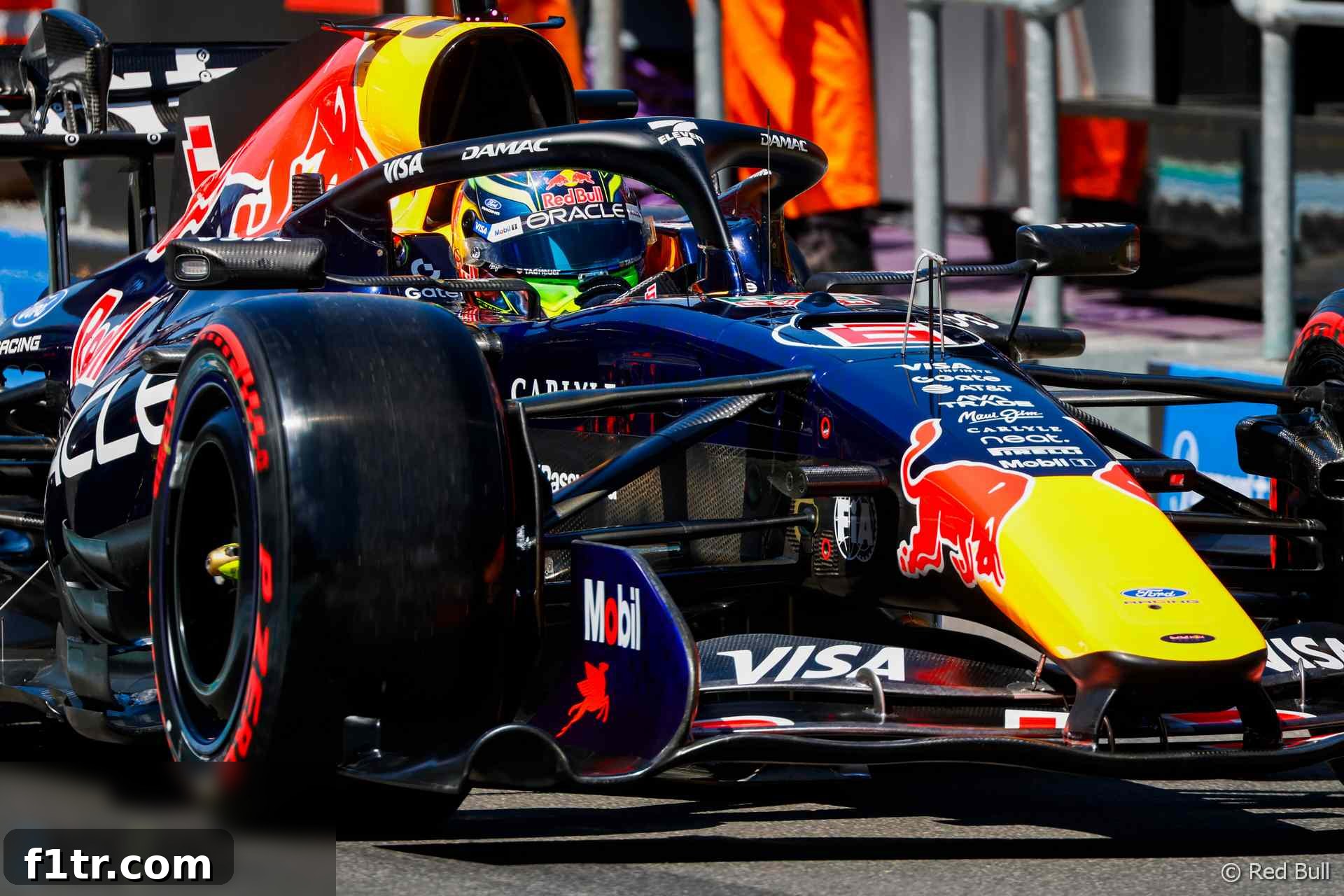
In Verstappen’s absence, new team recruit Isack Hadjar delivered a truly remarkable performance in his first outing for the team. He secured the ‘best of the rest’ position, a commendable achievement behind the flying Mercedes W17s. One can only assume that a driver of Max Verstappen’s calibre might have wrung even more performance from the car, potentially narrowing the gap to the front row. However, Hadjar’s impressive pace throughout practice, consistently closer to Verstappen than many of the four-time world champion’s recent teammates, suggests Red Bull’s car possesses strong underlying performance and that Hadjar is a talent to watch.
Ferrari also endured a less than optimal session, encountering power unit problems from Q2 onwards. While Charles Leclerc estimated that these issues only cost them a tenth or two of a second, this was clearly insufficient to challenge the Mercedes armada. To truly contend for pole, Ferrari would have needed to find an additional three-quarters of a second, a significant margin that highlights the task ahead for the Scuderia. Their focus will undoubtedly be on resolving these reliability concerns and unlocking more raw performance from their engine package.
McLaren, meanwhile, struggled with optimising the energy deployment in their car throughout qualifying. This issue is particularly striking when considering the performance of all three Mercedes power unit customer teams – McLaren, Williams, and Alpine – which collectively made an indifferent start to the season. Despite these challenges, McLaren still managed to position themselves commendably ahead of both Williams and Alpine, demonstrating their chassis’ inherent strength and development potential. They will be keen to iron out the energy management issues to unleash their full race pace.
Further down the grid, the debut of Cadillac, F1’s first all-new team in a decade, provided an interesting benchmark. They found themselves approximately six-tenths of a second adrift of the next slowest car, the troubled Aston Martin AMR26. This gap underscores the immense challenge new entrants face in Formula 1, even with significant resources. Aston Martin, on the other hand, will be deeply concerned by the performance of their AMR26, which appears to be struggling for pace and consistency early in the season, far from their previous aspirations.
As expected, none of this year’s brand-new cars proved to be faster than their predecessors, reflecting the challenging nature of new technical regulations often leading to an initial dip in overall pace. Mercedes, however, managed to get closest to their 2025 performance levels, showcasing their strong understanding and adaptation to the new rules. This ability to retain a significant portion of their previous year’s speed is a key indicator of their engineering prowess and sets them apart from the field.
Interestingly, the second-best team in terms of year-on-year improvement was Haas. This performance uplift, however, must be viewed in context. Haas had a particularly challenging Australian Grand Prix twelve months ago, with their car notoriously struggling in high-speed corners. Their improved showing this year, therefore, reflects a successful address of those specific weaknesses rather than an overall leap in competitive standing relative to the entire grid. Nevertheless, it offers a positive outlook for the American team as they aim for consistent points finishes.
Field Performance: A Look at the Ground Effect Era
While the current generation of cars are generally slower than their immediate predecessors, they hold up favourably when compared to the initial cars produced for the ‘ground effect’ era that began in 2022. George Russell’s impressive pole position lap, for instance, is only six-tenths of a second slower than the fastest time recorded at Albert Park in 2022. This demonstrates the significant progress made in car development and understanding of the ground effect aerodynamics over the past few years. Teams have clearly refined their designs, extracting more performance and efficiency from the regulations, making the cars incredibly quick despite the initial speed reduction imposed by the rule changes.
Advert | Become a RaceFans supporter andgo ad-free
Miss nothing from RaceFans
Get a daily email with all our latest stories – and nothing else. No marketing, no ads. Sign up here:
2026 Australian Grand Prix
- Briatore “not happy at all” with Alpine’s “very weak” performance
- Drivers want rules changes to cut “dangerous” risk of crash at start
- Russell becomes the 68th different Formula 1 driver to lead the world championship
- Hadjar told Red Bull his car’s performance was “embarrassing” and “just c***”
- “How did you not call the pit?” Ups and downs in Hamilton’s first race with new engineer
Browse all 2026 Australian Grand Prix articles