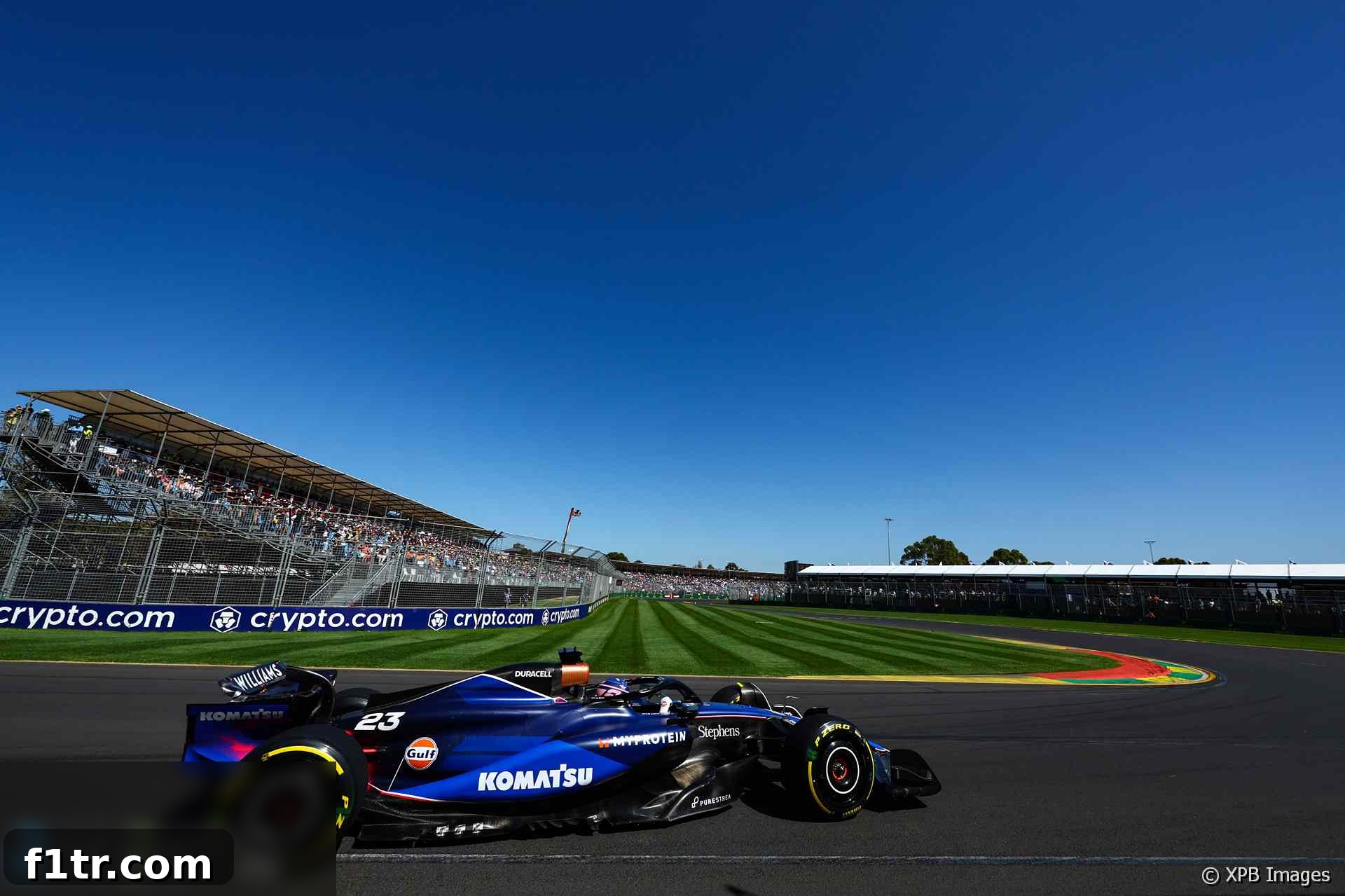
A dramatic and challenging start to the 2024 Australian Grand Prix weekend saw Williams Racing driver Alexander Albon unfortunately forced to withdraw from further participation in Friday’s practice sessions at the iconic Albert Park circuit. The British-Thai driver was involved in a substantial and high-impact crash during the opening free practice session, leaving his FW46 chassis with extensive damage and casting a considerable shadow over Williams’ crucial development and preparation plans for the event.
The unfortunate incident unfolded approximately 40 minutes into the first practice session (FP1). Albon, characteristically pushing the limits of his machine – a common and necessary approach for drivers in early sessions to explore the car’s boundaries – ran wide upon exiting the fast, sweeping Turn 7 left-hander. His Williams FW46 veered off the asphalt, and despite his best efforts to wrestle back control and prevent further escalation, the car snapped across the circuit with alarming speed. This trajectory led to a heavy and unavoidable impact with the barrier positioned on the right-hand side of the track.
The initial collision was exceptionally severe, immediately compromising the car’s intricate suspension system and leaving both front and rear wheels precariously attached only by their safety tethers. In a compounding sequence, as the damaged car rebounded from the first strike, Albon bravely managed to pitch the FW46 into a slide. Regrettably, this manoeuvre resulted in a secondary impact with the barrier on the left-hand side of the track, exacerbating the damage. This second collision completely detached the front-right tyre and inflicted further structural harm to the already battered machine. Mercifully, Williams Racing acted swiftly to confirm that Albon emerged from the high-speed incident unharmed, a powerful testament to the continually evolving and robust safety standards engineered into modern Formula 1 cars. However, the physical integrity of the FW46 was severely compromised, presenting the team with a truly daunting and time-sensitive repair job.
The immediate severity of the crash became unmistakably clear as Albon calmly radioed his apologies to his team before carefully extricating himself from the wreckage. He had been diligently working through his run plan, completing his 12th lap of the day, as he endeavoured to extract the maximum performance from his car around the challenging Albert Park circuit. At the moment of his accident, his best recorded lap time placed him approximately eight tenths of a second off the leading pace, underscoring the relentless competitive intensity that permeates even the preliminary practice sessions as drivers relentlessly strive to find every ounce of performance.
A Significant Setback for Williams Racing’s Critical Development Goals
For a team operating within the highly competitive and financially constrained landscape of Formula 1, particularly under the sport’s stringent budget cap regulations, an incident of this magnitude is far more than just a temporary inconvenience. It represents a substantial and multi-faceted setback, especially given the crucial phase of ongoing car development. Williams had arrived in Melbourne with a specific package of updated aerodynamic components, notably including revised rear brake duct scoops and winglets. These parts were earmarked for vital track testing and validation during Friday’s practice sessions. Missing out on the invaluable data acquisition from FP2, and potentially even FP3 depending on the extensive nature of the necessary repairs, severely hampers the team’s ability to thoroughly evaluate these upgrades, understand their performance impact, and fine-tune the car’s setup for the remainder of the race weekend.
Formula 1 practice sessions are meticulously planned and executed; they are not merely casual laps but vital test beds for a myriad of engineering and strategic considerations. Teams meticulously devise their run programmes to gather critical aerodynamic data, comprehensively assess tire degradation across various compounds, perform long-run simulations essential for race strategy planning, and rigorously validate the performance and reliability of new parts. With Alexander Albon’s FW46 now out of commission for the foreseeable future on Friday, Williams effectively loses an entire car’s worth of crucial data collection. This circumstance effectively halves their on-track research and development capacity for the pivotal Friday sessions. Consequently, Logan Sargeant, Albon’s American teammate, will bear the entire burden of data collection and setup work for the team as he becomes the sole representative for Williams in the second practice session.
Logan Sargeant had completed a commendable 22 laps during FP1, but his workload and responsibility will now exponentially increase as he navigates the demanding Albert Park circuit alone in FP2 and potentially beyond. The pressure on him to provide comprehensive and accurate feedback, as well as to avoid any further incidents, will be immense as Williams strives to salvage their weekend preparation and maximize their limited track time. The dedicated mechanics and engineers will undoubtedly be working tirelessly and under intense pressure to repair Albon’s car. However, the extensive damage reported to the chassis and numerous ancillary components strongly suggests a monumental task that could very well extend deep into Saturday morning, potentially impacting Albon’s crucial qualifying preparation as well.
The Unforgiving Nature of Albert Park: A Circuit That Demands Respect
The Albert Park Circuit, a unique semi-permanent track gracefully nestled within a lush parkland setting in Melbourne, is renowned globally for its technically challenging layout and its inherently unforgiving nature. Its distinctive combination of high-speed sections, complex technical corners, and the ever-present proximity to concrete barriers makes it a true and rigorous test for both the car’s engineering integrity and the driver’s skill and commitment. Turn 7, the specific corner where Alexander Albon’s incident occurred, is a particularly fast entry point that requires absolute precision in judgment and unwavering commitment from the driver. The slightest miscalculation or deviation from the ideal line can, as dramatically demonstrated by the extensive damage to the FW46, lead to significant and costly consequences. The circuit’s demanding characteristics allow for virtually no margin for error, and even the most seasoned and experienced drivers can, and often are, caught out by its nuances.
Adding a layer of historical context and concern, this unfortunate crash marks the second consecutive incident for Alexander Albon at the Melbourne track within competitive sessions. Last year, during the 2023 Australian Grand Prix, he also tragically hit the barrier at Turn 6 on the seventh lap of the race, leading to an early and frustrating retirement. While such incidents are, to some degree, an inherent part of the relentless pursuit of speed and pushing the limits in Formula 1, the recurrence at the same venue will undoubtedly be a significant point of in-depth analysis and strategic review for both Albon and the Williams engineering team as they assess performance and driver approach.
Broader Implications for Williams’ Aspirations in the 2024 Season
Williams Racing had entered the 2024 Formula 1 season with a palpable sense of renewed optimism and a determination to build significantly upon the commendable progress made in the previous year. Their primary objective for the season is to consolidate their position within the highly competitive midfield, consistently challenge for valuable championship points, and close the gap to the front-runners. In this relentless pursuit of enhanced performance, every practice session, every single lap completed, and every piece of data meticulously gathered is absolutely crucial. A major crash, particularly one that sidelines a key driver for multiple critical sessions and necessitates extensive and costly repairs, represents a substantial blow to these carefully constructed aspirations and strategic objectives.
Furthermore, the financial implications under Formula 1’s strict budget cap regulations are an extremely serious consideration for every team. While certain allowances are made for crash damage, repeated or particularly severe incidents can very quickly deplete a team’s allocated budget for development, upgrades, and operational expenses. This unfortunate situation often forces difficult and painful decisions about resource allocation, potentially impacting the pace and scope of future car enhancements throughout the season. Williams will undoubtedly be undertaking a comprehensive evaluation of the full financial and operational impact of this incident as they work tirelessly to get Alexander Albon’s car back on track and minimize any long-term consequences for their 2024 campaign.
Support RaceFans and Enjoy an Ad-Free Experience
RaceFans thrives on the generous contributions of its dedicated readers, whose support is invaluable. By becoming a RaceFans Supporter, you play a vital role in funding the creation of high-quality content, maintaining our robust hosting infrastructure, and developing exciting new features for the future of the platform and our community.
For just £1 per month or £12 per year (or your equivalent local currency), you can join our growing community of supporters. In return, you’ll gain access to an entirely ad-free browsing experience across the entire RaceFans site, allowing you to focus solely on the Formula 1 news, insightful analysis, and engaging discussions you love, without any interruptions.
Join the RaceFans Supporter community today and immerse yourself in an unparalleled, ad-free site experience. Find out more or sign up easily via the links below:
- Become a RaceFans Supporter Now
- Frequently Asked Questions about RaceFans Supporter
2024 Australian Grand Prix News & Analysis
- Alonso calls Australian GP penalty a ‘one-off I’ve had too many of’
- Red Bull saw warning sign of Australian GP brake problem on Saturday – Verstappen
- Failing to punish Alonso would have “opened a can of worms” – Russell
- Leclerc sure “many team principals” are pursuing Sainz for 2025 seat
- “Don’t put me under pressure” – The best unheard team radio from Melbourne
Browse all 2024 Australian Grand Prix articles