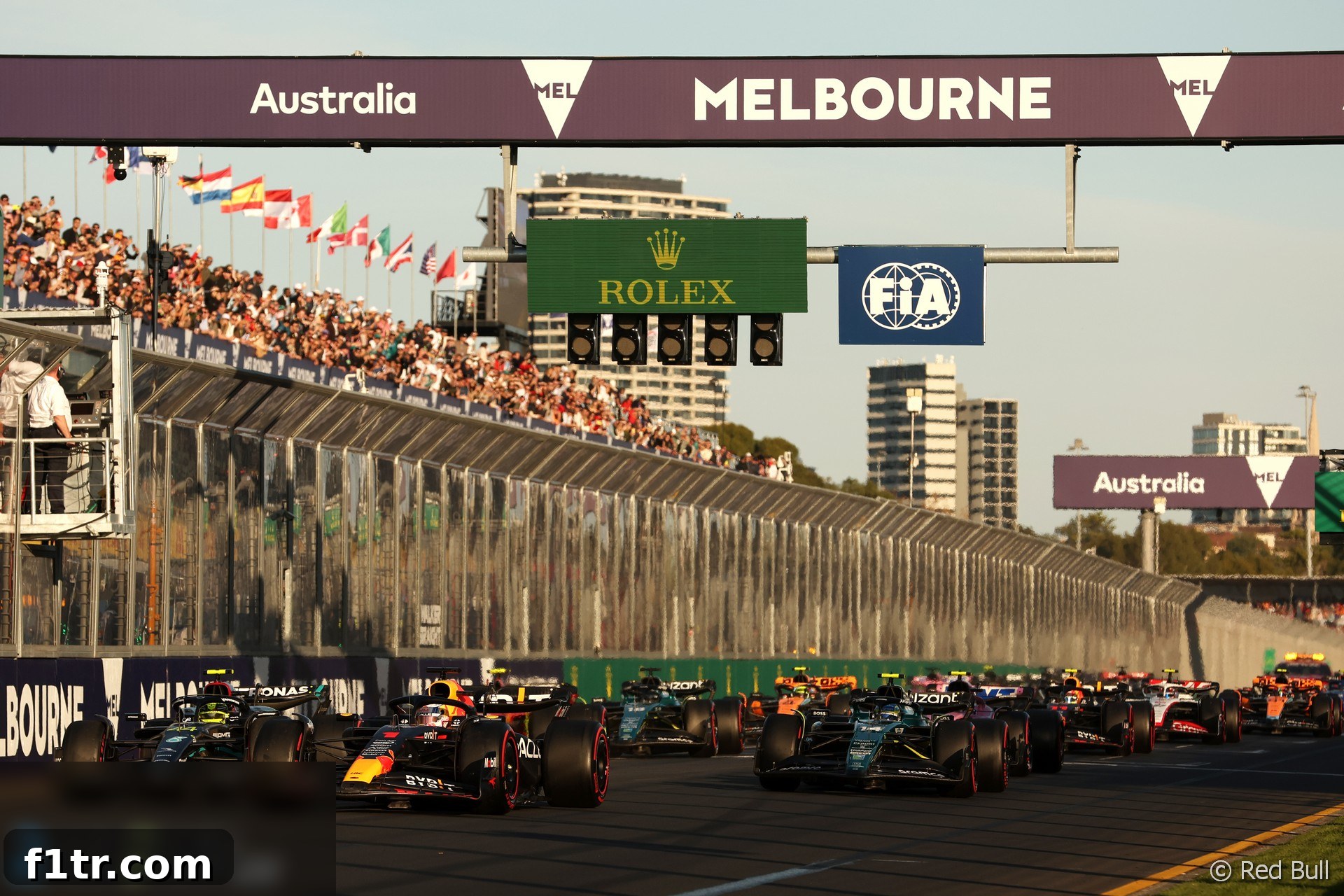
In the thrilling aftermath of the 2023 Australian Grand Prix, a particular moment involving three-time Formula 1 World Champion Max Verstappen ignited a flurry of discussion and debate among fans, pundits, and competitors alike. The Red Bull Racing star, known for his relentless pursuit of perfection and his aggressive racing style, found himself at the center of attention not just for his dominant victory, but for his exceptionally precise, and some argued, audacious grid positioning at the decisive final standing restart of the race. This strategic maneuver, executed with millimeters to spare, raised questions about the fine line between pushing the rules to their absolute limit and potentially overstepping them, echoing past controversies and highlighting the ever-present tension surrounding F1’s stringent regulations.
Verstappen’s car, the formidable RB19, was positioned with its front wheels kiss-on-the-line at the very edge of the white box demarcating his starting slot. This precision, while seemingly minor, can offer a crucial fraction of a second advantage in the milliseconds that define a successful F1 start. The incident gained particular traction on social media, fueled by recent penalties incurred by other drivers earlier in the season, such as Esteban Ocon’s grid position infraction at the Saudi Arabian Grand Prix, which underscored the stewards’ increasingly strict interpretation of the rules. Fans questioned whether Verstappen’s extreme positioning, while ultimately deemed legal, truly adhered to the spirit of the regulations.
The International Sporting Code, the comprehensive rulebook governing all FIA-sanctioned motorsport events, provides the definitive framework for grid starts. Specifically, Article 8.6.1.a states with unequivocal clarity: “For a standing start, [a car] must be stationary at its allocated grid box with no part of the contact patch of its front tyres outside of the lines (front and sides) at the time of the start signal.” This regulation emphasizes the critical importance of exact positioning. The “contact patch” refers to the small area of the tyre that is actually touching the ground. Therefore, even if the majority of the tyre is within the box, any part of the contact patch protruding beyond the white lines – be it the front or the sides – constitutes a breach. This microscopic level of scrutiny illustrates the highly technical nature of Formula 1, where every detail, down to the millimeter, can be subject to official review and potential penalties.
When confronted with inquiries regarding the legality of his start, Max Verstappen offered a characteristically candid explanation, shedding light on the thought process behind his audacious positioning. The Dutchman revealed that his initial approach to the grid box wasn’t entirely perfect. “To be honest with you I think I braked a bit late and then I lost my reference a bit,” Verstappen explained, detailing the initial misjudgment. However, rather than settling for a suboptimal position, he consciously made an adjustment. “But then I looked and I was like I still have a little bit more space. I actually moved a bit forwards and yeah, it was really on the limit.” This deliberate repositioning, after an initial stop, highlights Verstappen’s analytical approach and his relentless drive to extract every conceivable advantage, even in the high-pressure environment of a race start. His concluding remark, “But on the limit is on the limit, it’s not over the limit,” perfectly encapsulates his philosophy – a calculated risk, executed within the boundaries of the rules, showcasing both his immense skill and his deep understanding of the regulations.
The 2023 Australian Grand Prix was punctuated by an unusual number of red flag incidents, leading to no fewer than three standing starts throughout the race. This afforded Verstappen multiple opportunities to refine his getaway, a process he candidly admitted was a learning curve. His initial start from pole position was, by his own admission, not ideal. “The first one was not good,” he conceded, having lost positions to both Mercedes drivers, George Russell and Lewis Hamilton. However, true to his champion’s mentality, Verstappen systematically improved with each subsequent attempt. “Just didn’t really get well off the line. I think, actually it just got better and better, my starts. So at least that’s an improvement.” This iterative improvement culminated in a textbook final start, where he successfully defended his lead against a charging Lewis Hamilton, ultimately securing a well-deserved victory in a chaotic race. His ability to adapt and perfect his technique under immense pressure underscores his status as one of the sport’s all-time greats.
The highly scrutinized final restart pitted Verstappen against Lewis Hamilton, a rivalry that has defined an era of Formula 1. While George Russell had managed to get the jump on Verstappen from second place at the very first start of the race, Hamilton, starting alongside the Dutchman in the critical final phase, expressed palpable disappointment with his own getaway. “Up alongside Max at the end, I really was hoping for a better start than I got,” Hamilton admitted. He observed that both drivers achieved “pretty much similar getaways” initially, but crucially, Verstappen demonstrated superior traction and acceleration in the subsequent phase. “Then he had a better second phase,” Hamilton noted, referring to the critical moments after clutch release where power delivery and tyre grip dictate who pulls ahead. This “second phase” advantage, often a subtle but decisive factor, proved instrumental in allowing Verstappen to maintain his lead and convert his pole position into a race win, leaving Hamilton to rue a lost opportunity to challenge for the lead.
The episode surrounding Verstappen’s grid positioning at the Australian Grand Prix serves as a compelling microcosm of Formula 1 racing: a world where technological prowess meets human ingenuity, and where the boundaries of performance are constantly pushed. The debate it sparked on social media and within the F1 community highlights the increasing transparency brought about by ubiquitous cameras and sophisticated telemetry, allowing every micro-action to be analyzed and scrutinized. It also reignites perennial discussions about consistency in stewarding and the delicate balance between allowing drivers to race hard and enforcing strict adherence to the rules. Verstappen’s “on the limit” approach is a hallmark of elite athletes who operate at the pinnacle of their sport, constantly seeking marginal gains within the legal framework. This incident, while ultimately not resulting in a penalty, underscored the critical nature of precision in F1 and reinforced the idea that championships are often won not just by raw speed, but by meticulous attention to every single detail, from car setup to the precise positioning on the starting grid.
Video: Verstappen’s Precise Grid Position
For those keen to observe the exact moment in question, a video captured by a spectator provides a clear visual of Max Verstappen’s grid positioning at the Australian Grand Prix. The footage shows Verstappen initially bringing his car to a halt within his designated grid box, and then, with remarkable foresight and control, carefully moving his car slightly further forward to optimize his starting advantage, demonstrating the very “on the limit” maneuver he described.
Twitter video if y’all don’t want to use the Streamable link
Thanks @NaturalParadigm for teaching me how to use twitter 😅pic.twitter.com/rmtBLYIaVt
— F1 Tempo (@f1_tempo_) April 3, 2023
Further Reading on the 2023 Australian Grand Prix
For more insights and analyses from the event, explore these related articles:
- Australian GP to forbid fans from entering track at end of this year’s race
- I only missed one chance to score points this year – Albon
- Formula 1’s stewards should listen to drivers less, not more
- Mercedes unsure whether gains seen in Melbourne were ‘track-specific’
- Why Ferrari saw a ‘real step forward in pure performance’ in point-less Australian GP
Browse all 2023 Australian Grand Prix articles