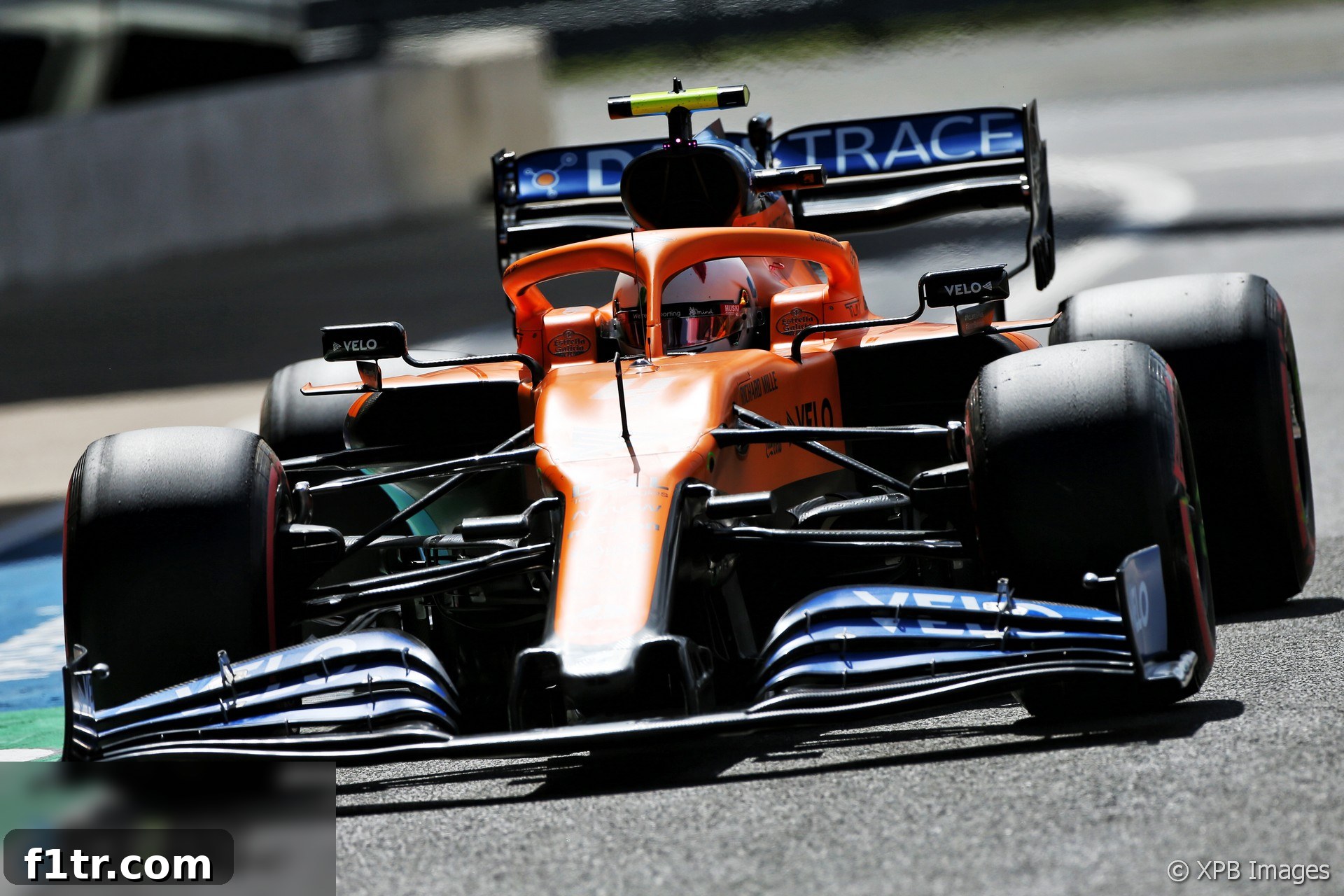
In a breathtaking display of raw talent and precision driving, McLaren’s Lando Norris delivered what he confidently proclaimed as one of the finest qualifying laps of his burgeoning Formula 1 career. This exceptional effort secured him an impressive fifth position on the starting grid, setting a strong precedent for the team heading into Sunday’s race. His performance was particularly notable given the treacherous conditions and the fierce competition that characterized the qualifying session, underlining the young Briton’s growing maturity and confidence behind the wheel of the MCL35.
The journey to P5 was far from straightforward for Norris, who faced an early scare, teetering on the brink of elimination during the initial phase of qualifying. The pressure mounted as McLaren navigated Q1 and Q2, with Norris admitting to a period of uncertainty where the team found themselves “a bit on the cusp of getting knocked out.” However, demonstrating remarkable composure under pressure, he swiftly recalibrated his approach and found a rhythm that would ultimately define his success. This ability to recover and elevate his game when it mattered most speaks volumes about his mental fortitude and adaptability, crucial traits for any top-tier F1 driver.
As qualifying progressed into the decisive Q3 session, Norris unleashed his full potential. He meticulously pieced together a lap that would leave a lasting impression, not just on himself but on his entire engineering team. “I got back in a good rhythm, especially for Q3, and put in probably one of my best laps I’ve done in Formula 1,” Norris recounted, reflecting on the intensity and precision required. This wasn’t merely a fast lap; it was a testament to his understanding of the car, the circuit, and the delicate balance between aggression and control needed to extract every ounce of performance. His engineer was quick to commend his initial Q3 attempt, which was achieved on a used set of soft tyres – a strategic choice that underscored the team’s confidence in his ability to manage tyre wear while pushing the limits. Subsequently, Norris found even more pace on his final run, further cementing his top-five position.
Norris conveyed immense satisfaction with the outcome, recognizing that the grid position surpassed the team’s initial expectations for the day. “I’m very happy,” he stated with a clear sense of achievement. He pointed out the “very, very different” track conditions compared to earlier sessions, which introduced an element of unpredictability to the proceedings. These shifting variables made it challenging for teams to gauge their true potential, adding an extra layer of complexity to setup and strategy. “So it was a bit unexpected, or we didn’t really know what we could achieve,” Norris elaborated, highlighting the dynamic nature of Formula 1 qualifying. However, despite the uncertainties, his final lap stood out as a beacon of exceptional performance, proving McLaren’s capability to adapt and excel.
Meanwhile, on the other side of the McLaren garage, Carlos Sainz Jnr secured a respectable seventh position on the grid, ensuring both McLaren cars started within the top seven. Sainz expressed considerably more contentment with the overall feel of his car this weekend, indicating significant progress in understanding and optimizing its setup. “It looks like we’ve improved a bit the car balance and my feeling with the car in general, I put together some strong laps along qualifying,” Sainz explained, providing insight into the team’s ongoing development efforts. His consistently strong laps throughout the earlier phases of qualifying showcased his command over the MCL35, validating the engineering team’s hard work in refining the car’s characteristics.
However, Sainz’s Q3 session was not without its frustrations. While his earlier form was strong, he admitted to a less-than-perfect final lap, which ultimately cost him valuable tenths. “Just in Q3 [I was] a bit unfortunate, I just didn’t put a very good lap together. I lost the rear on exits quite a lot and that made me lose along the straights. So a bit of a shame there,” he confessed. This slight instability at the rear, particularly when exiting corners, compromised his acceleration onto the straights, preventing him from extracting the absolute maximum performance. Despite this minor setback, securing P7 for the race is a solid result for Sainz and for the team, placing him in a strong position to challenge for points on race day.
McLaren’s Ascendant Performance: A Team on the Rise
The collective qualifying performance of Lando Norris and Carlos Sainz underscores a significant stride forward for McLaren in the fiercely competitive 2020 Formula 1 season. Placing both cars firmly within the top seven grid positions is a powerful statement of intent, signalling the team’s ambition and capabilities. This result is not merely about individual driver brilliance but also reflects the meticulous work of the entire Woking-based outfit, from the strategists in the garage to the engineers back at the factory.
The synergy between Norris and Sainz, often hailed as one of the most dynamic driver pairings on the grid, has been instrumental in McLaren’s consistent improvement. Their collaborative feedback and competitive spirit push the team to new heights, allowing for faster development cycles and more effective car setups. The ability to adapt to “very different conditions” on track, as noted by Norris, speaks volumes about the team’s readiness to tackle diverse challenges throughout a race weekend. This adaptability will be crucial as they aim to convert these strong qualifying positions into significant championship points.
Looking ahead to the race, McLaren finds itself in an enviable strategic position. With Norris starting P5 and Sainz P7, they have multiple options for strategy, allowing them to react to unfolding race events and challenge their midfield rivals, and potentially even some of the front-runners. The car’s improved balance, as highlighted by Sainz, suggests it possesses good race pace, which will be vital for managing tyre degradation and maintaining performance over extended stints. The team’s focus will now shift to optimizing race strategy, anticipating potential safety car periods, and ensuring clean pit stops to maximize their points haul.
Broader Context: The 2020 F1 Season Challenges
The 2020 Formula 1 season was uniquely challenging, marked by the unprecedented global circumstances that reshaped the entire motorsport landscape. Despite the condensed calendar, rigorous health protocols, and the constant pressure to adapt, McLaren consistently demonstrated resilience and a commitment to performance. This backdrop makes the team’s strong qualifying results even more commendable, highlighting their robust operational capabilities and unwavering focus amidst adversity. The competition was tighter than ever, with several teams vying for midfield supremacy, making every tenth of a second in qualifying, and every point in the race, incredibly valuable.
McLaren’s consistent push for improvement throughout the 2020 season paid dividends, positioning them as a strong contender in the Constructors’ Championship battle. Their ability to deliver strong performances with both cars was a key differentiator, and qualifying sessions like this one were crucial in building that momentum. As the season progressed, the team continued to refine their package, addressing weaknesses and enhancing strengths, all contributing to their eventual standing in the championship. This strong qualifying showing is a reflection of that relentless pursuit of excellence.
Related 2020 F1 Season Articles
- Grosjean to make F1 test return tomorrow for first time since Bahrain horror crash
- Pictures: Wrecked chassis from Grosjean’s Bahrain fireball crash to go on display
- Bottas vs Rosberg: Hamilton’s Mercedes team mates compared after 78 races each
- F1 revenues fell by $877 million in Covid-struck 2020 season
- Hamilton and Mercedes finally announce new deal for 2021 season
Browse all 2020 F1 season articles