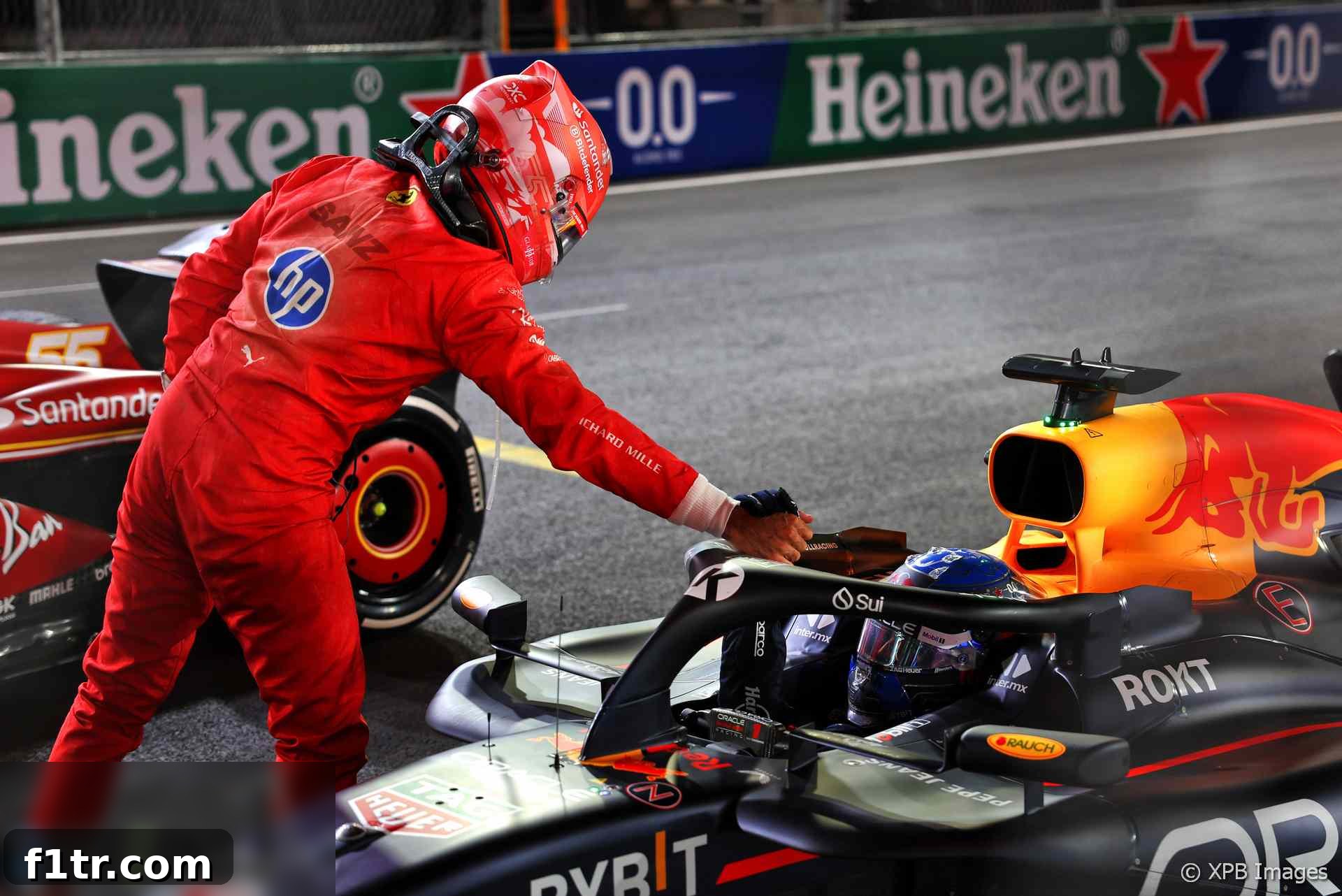
Fresh off clinching his fourth consecutive Formula 1 World Championship, Max Verstappen’s latest triumph has sparked considerable discussion within the paddock. While his consistent excellence and Red Bull Racing’s formidable package once again proved an unbeatable combination over the full season, rival Carlos Sainz Jnr offered a nuanced perspective, suggesting that the highly competitive second half of the season showcased a new vulnerability. Sainz believes that when the cars are more evenly matched, Verstappen’s rivals possess the ability to challenge and even defeat the reigning champion on any given race weekend.
This championship win, while remarkable, tells a different story compared to Verstappen’s prior dominant seasons, particularly the near-unanimous success of 2023. The 2024 campaign began with familiar Red Bull dominance, as Verstappen secured seven victories in the initial ten rounds, building a seemingly insurmountable lead. However, as the season progressed, the competitive landscape shifted dramatically. Rival teams diligently worked on their car developments, closing the performance gap and placing significantly more pressure on Red Bull. This increased competition saw a notable dip in Verstappen’s win rate, as he managed only one more victory in the subsequent twelve rounds of the season. This stark contrast highlights a fascinating evolution in the 2024 championship narrative, moving from a period of overwhelming control to a phase of intense, multi-team battles, ultimately setting the stage for Sainz’s insightful comments.
Max Verstappen Secures Fourth Consecutive F1 Title Amidst Rising Competition
Max Verstappen’s achievement of a fourth straight Formula 1 World Championship solidifies his position as one of the sport’s all-time greats. This latest title is a testament to his unwavering talent, relentless determination, and the exceptional performance of the Red Bull Racing team. However, unlike his previous championship runs, particularly the record-breaking 2023 season where he secured 19 wins out of 22 races, the 2024 season presented a more formidable challenge. The opening half of the campaign saw Verstappen continue his dominant streak, demonstrating the potent combination of his driving prowess and the Red Bull RB20’s raw speed. He systematically converted pole positions into victories, leaving competitors trailing in his wake and reinforcing the notion of an unassailable advantage. This early dominance mirrored the patterns of his previous title-winning years, suggesting another comfortable path to the championship.
Yet, the narrative profoundly shifted as the championship entered its crucial second phase. McLaren, Ferrari, and Mercedes, through relentless development and strategic upgrades, managed to bridge the performance gap to Red Bull. Tracks that once seemed tailor-made for Verstappen’s driving style suddenly became battlegrounds where fractions of a second separated the top contenders. This resurgence of competition created a thrilling spectacle for fans, showcasing the depth of talent across the grid. Verstappen, despite ultimately securing the title, found himself in fiercely contested races, often battling wheel-to-wheel with drivers from rival teams. This phase underscored a crucial point: while his overall consistency and early season advantage were enough to secure the championship, the latter part of the year painted a picture of a more vulnerable, albeit still exceptional, champion. The title was hard-fought, won not just through blistering pace, but also through tactical brilliance and error-free driving under immense pressure from a revitalized pack.
The Shifting Dynamics of the 2024 Season: From Early Dominance to Fierce Battles
The 2024 Formula 1 season will be remembered for its compelling duality. It began with Max Verstappen and Red Bull Racing appearing poised for another unchallenged sweep, building a commanding lead with seven wins in the initial ten rounds. This period was characterized by their superior aerodynamic efficiency, optimized power unit performance, and Verstappen’s uncanny ability to extract maximum performance from the car in diverse conditions. Critics and fans alike speculated whether any team could possibly mount a credible challenge to their supremacy, reminiscent of Verstappen’s near-perfect 2023 season.
However, the narrative began to pivot dramatically in the latter half of the championship. Competitors such as McLaren, Ferrari, and Mercedes, fueled by strategic in-season development, began to unlock significant performance gains from their respective packages. McLaren, in particular, showcased remarkable progress, with Lando Norris and Oscar Piastri consistently challenging for podiums and victories. Ferrari, too, demonstrated bursts of brilliance, capitalizing on tracks that suited their car’s characteristics. This convergence of performance led to a series of races where the gap between Red Bull and its rivals diminished to mere tenths of a second, transforming the championship into a multi-team battle for race wins. Verstappen, who had been an almost guaranteed victor earlier in the year, found himself fighting for every position, often having to settle for lower podium spots or even off-podium finishes. This period of intensified competition, where Verstappen secured only one more win in the subsequent twelve rounds, laid the foundation for Carlos Sainz’s insightful assessment of the season’s true competitive spirit and the champion’s perceived beatability.
Carlos Sainz Jnr: Verstappen is Beatable When Machinery is Equal
Ferrari’s Carlos Sainz Jnr, a former teammate of Verstappen, offered a compelling analysis of the 2024 season, acknowledging the Dutchman’s undeniable talent while simultaneously highlighting a crucial shift in the competitive landscape. Sainz emphatically stated, “As much as I think Max has done an incredible job this year, it just shows in the second half of the season, eight drivers within a tenth [of a second] of each other, we could all beat him week in, week out.” This statement directly challenges the perception of Verstappen as invincible and underscores the belief among his peers that genuine competition exists when the performance gaps between cars narrow. For Sainz, the latter half of the season provided irrefutable proof that multiple drivers possess the skill to contend for victories against the reigning champion.
Sainz further elaborated on the psychological aspect of racing, emphasizing how pressure impacts driver performance. He suggested that when a driver possesses a significant performance margin, errors are easier to avoid, and consistency comes more naturally. “Everyone starts making mistakes when they’re under pressure and everyone starts complaining about their car and everyone starts complaining in the media about their car,” Sainz noted. This highlights a fundamental truth in Formula 1: even the most exceptional drivers are human, and the relentless demands of close combat amplify the likelihood of missteps. When the gap to the nearest rival or even a teammate shrinks to a mere two or three tenths of a second, the mental strain intensifies exponentially. This lack of a comfortable buffer means every corner, every braking point, and every strategic decision becomes critical, dramatically increasing the pressure and revealing the true depth of a driver’s character and skill under duress. The competitive second half of 2024, therefore, served as a crucial proving ground, demonstrating that even Max Verstappen, despite his immense talent, operates within the human parameters of pressure and its potential to induce errors, making the contest for supremacy more thrilling and unpredictable for all involved.
Verstappen’s Perspective: Under-Appreciated Dominance and Consistent Excellence
While Carlos Sainz highlighted the competitive nature of the 2024 season’s latter half, Max Verstappen offered a different reflection, particularly on his previous championship-winning year. Verstappen believes that his performance in 2023, where Red Bull dominated the championship and he secured an astonishing 19 out of 22 race wins, remains largely under-appreciated. He articulated his feelings by stating, “Last year I had a dominant car but I always felt that not everyone appreciated what we achieved as a team, winning [grand prix] 10 in a row.” This sentiment points to the unique challenge faced by drivers who perform at an exceptionally high level in a superior car: the tendency for their individual brilliance to be overshadowed by the machinery. Verstappen feels that the sheer scale of his victories and the team’s relentless pursuit of perfection were often dismissed as merely a function of having the best car, rather than a testament to the immense skill, focus, and dedication required to maintain such an unprecedented level of dominance.
Verstappen further elaborated on the nuances of his 2023 season, explaining that even with a dominant car, achieving such consistent success was far from effortless. “Of course our car was dominant, but it wasn’t as dominant, I think, as people thought it was,” he clarified. This insight suggests that while the Red Bull RB19 was undoubtedly the class of the field, there were still numerous variables and challenges that required peak performance from the driver. He underscored his belief that 2023 was “for sure my best season I will always look back at,” precisely because of the ability to win even when conditions weren’t perfect. He cited instances where “maybe we didn’t have the perfect set-up,” yet the team and he were still “capable, because in the race, our car was always quite strong, to win races.” This speaks to his remarkable adaptability, his profound understanding of race strategy, and his capacity to manage tires and fuel while extracting maximum pace, even when the car wasn’t optimally configured for qualifying. His perspective offers a valuable counterpoint, reminding observers that sustained excellence, even with a performance advantage, requires a rare blend of talent, discipline, and an unwavering commitment to perfection.
A Look at the 2024 Season: Diverse Winners and Intense Battles
The 2024 Formula 1 World Championship, culminating in Max Verstappen’s fourth consecutive title, was characterized by a distinct split in competitive dynamics. While the early rounds saw Verstappen establish a formidable lead, the latter half of the season showcased an exhilarating diversity of winners, underlining Carlos Sainz’s argument about the increasing parity among the top teams and drivers. The following table illustrates the Grand Prix winners throughout the 2024 season, as of the point Max Verstappen clinched his championship title, with the final two races yet to be contested.
| Round | Winning Driver | Winning Team |
|---|---|---|
| Bahrain Grand Prix | Max Verstappen | Red Bull |
| Saudi Arabian Grand Prix | Max Verstappen | Red Bull |
| Australian Grand Prix | Carlos Sainz Jnr | Ferrari |
| Japanese Grand Prix | Max Verstappen | Red Bull |
| Chinese Grand Prix | Max Verstappen | Red Bull |
| Miami Grand Prix | Lando Norris | McLaren |
| Emilia-Romagna Grand Prix | Max Verstappen | Red Bull |
| Monaco Grand Prix | Charles Leclerc | Ferrari |
| Canadian Grand Prix | Max Verstappen | Red Bull |
| Spanish Grand Prix | Max Verstappen | Red Bull |
| Austrian Grand Prix | George Russell | Mercedes |
| British Grand Prix | Lewis Hamilton | Mercedes |
| Hungarian Grand Prix | Oscar Piastri | McLaren |
| Belgian Grand Prix | Lewis Hamilton | Mercedes |
| Dutch Grand Prix | Lando Norris | McLaren |
| Italian Grand Prix | Charles Leclerc | Ferrari |
| Azerbaijan Grand Prix | Oscar Piastri | McLaren |
| Singapore Grand Prix | Lando Norris | McLaren |
| United States Grand Prix | Charles Leclerc | Ferrari |
| Mexican Grand Prix | Carlos Sainz Jnr | Ferrari |
| Brazilian Grand Prix | Max Verstappen | Red Bull |
| Las Vegas Grand Prix | George Russell | Mercedes |
| Qatar Grand Prix | TBD | TBD |
| Abu Dhabi Grand Prix | TBD | TBD |
As the table clearly illustrates, while Max Verstappen secured eight victories by the time he clinched the championship, a remarkable twelve other rounds saw victories from a diverse group of drivers and teams. Carlos Sainz Jnr (Ferrari), Lando Norris (McLaren), Charles Leclerc (Ferrari), George Russell (Mercedes), Lewis Hamilton (Mercedes), and Oscar Piastri (McLaren) all stood on the top step of the podium. This wide spread of winners, particularly prominent in the latter two-thirds of the season, undeniably supports Sainz’s assertion that the competitive playing field became significantly more level. It moved beyond a single-team dominance to a multi-faceted battle, where strategy, driver skill, and track-specific car performance played a more decisive role in determining the victor. The season thus offered a compelling narrative of a champion who, while ultimately unbeatable over the full calendar, faced unprecedented challenges from a resurgent and highly competitive grid, making his fourth consecutive title a testament to resilience as much as raw speed.
Historical Parallels: Sainz and Verstappen as Toro Rosso Teammates in 2015
The current dynamic between Max Verstappen and Carlos Sainz Jnr takes on additional layers of intrigue when recalling their formative years in Formula 1. Both drivers made their F1 debuts as teammates at Scuderia Toro Rosso (now Visa Cash App RB) in 2015, a season that offered an early glimpse into their immense potential and competitive spirits. As rookies, they were closely matched, often pushing each other to the limit in what was considered one of the most exciting team-mate pairings in recent memory. Across the 2015 season, their raw speed and aggressive racing styles were evident, leading to several memorable on-track battles. While Verstappen often garnered headlines for his daring overtakes and remarkable car control, Sainz consistently demonstrated exceptional race craft, technical feedback, and a strong qualifying pace. Their points finishes and overall performance were remarkably similar, with very little separating them, hinting at future championship-caliber talent from both young drivers.
Their time together at Toro Rosso proved to be a pivotal training ground, fostering a rivalry that continues to subtly influence their interactions today. The comparison from their rookie year underscores Sainz’s contemporary arguments about “equal machinery.” In 2015, they were indeed in virtually identical cars, and the competition between them was fierce and largely balanced. This historical context suggests that Sainz’s current belief that Verstappen is beatable when cars are more equal is not merely wishful thinking, but rather a conclusion drawn from direct experience. The fact that Red Bull ultimately promoted Verstappen to their senior team first, during the 2016 season, further fueled their individual ambitions and paths, but the foundational rivalry built at Toro Rosso remains a fascinating backdrop to their ongoing competition on the world stage. It reminds us that behind the multi-championship success, there lies a driver who once competed toe-to-toe with his current challengers in very similar circumstances, offering a powerful validation of the current competitive landscape.
Further Reading on the 2024 Las Vegas Grand Prix and Beyond
Delve deeper into the discussions and analysis surrounding the thrilling conclusion of the 2024 Formula 1 season and its most talked-about events:
- “Disappointing” Las Vegas GP performance prompts ticketing changes for 2025 race
- Vowles clarifies Colapinto’s claim he was concussed in Las Vegas crash
- Norris lost title because McLaren weren’t competitive enough early on – Stella
- Ferrari are now in their longest-ever championship drought
- F1 “was trying too hard” in first year at Las Vegas – Sainz
Explore more articles and analysis on the intense 2024 Formula 1 season.
The 2024 Formula 1 season will undeniably be remembered as a pivotal chapter in Max Verstappen’s illustrious career. While his fourth consecutive championship firmly cements his legacy, the narrative of this particular triumph is rich with complexities. Carlos Sainz’s observations on Verstappen’s beatability in a more level playing field, supported by the diverse array of race winners in the season’s latter half, underscore the evolving competitive dynamics of modern Formula 1. Simultaneously, Verstappen’s reflections on the under-appreciated nature of his previous dominance offer a unique insight into the pressures and expectations placed upon a champion. As the dust settles on another thrilling season, it’s clear that while Verstappen remains the benchmark, the gap is closing, setting the stage for even more enthralling contests in the years to come, where every tenth of a second and every strategic decision will matter more than ever.