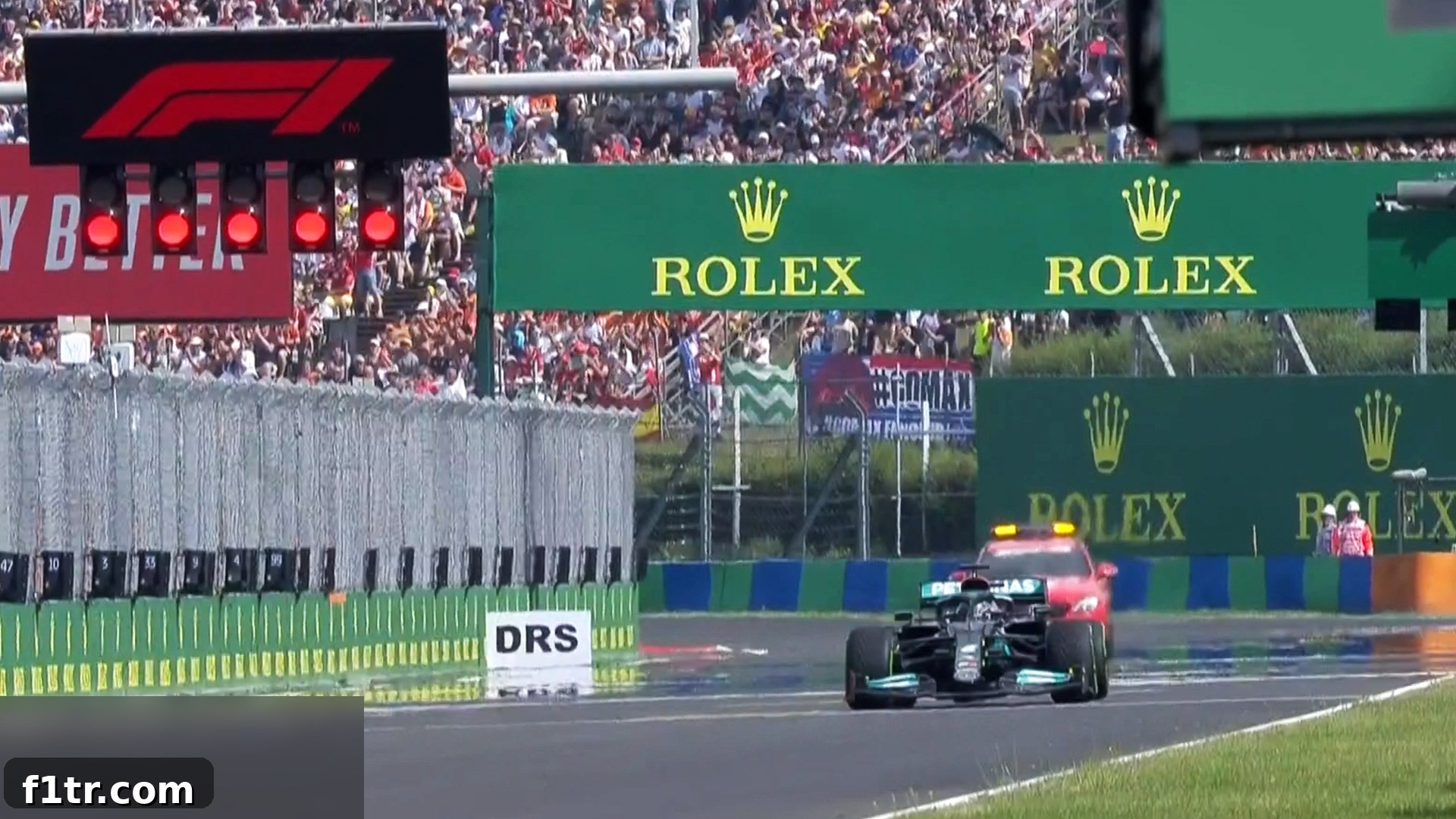
The Unprecedented Single-Car F1 Restart: Hungarian Grand Prix’s Bizarre Moment
The 2021 Hungarian Grand Prix etched itself into Formula 1 history with one of the most astonishing and truly bizarre spectacles ever witnessed: a standing restart where only a single car graced the starting grid. This unprecedented event left an indelible mark on fans, commentators, and even the sport’s most seasoned officials, marking it as one of the most memorable and strategically perplexing moments in recent F1 memory.
Advert | Become a Supporter & go ad-free
The stage for this extraordinary incident was set following a chaotic and rain-soaked opening lap at the Hungaroring circuit. A multi-car pile-up at Turn 1, primarily triggered by Valtteri Bottas, necessitated a red flag, bringing the race to a temporary halt. During this pause, the track conditions rapidly shifted from fully wet to significantly drier, creating a critical strategic dilemma for all competing teams: which tyres would be optimal for the impending restart.
A Grid Like No Other: Lewis Hamilton Stands Alone
As the countdown to the standing restart began, the rapidly drying track presented a clear and immediate strategic challenge. The overwhelming majority of the field, recognizing the swift evolution of the conditions, made a collective decision. On the formation lap to the grid, nearly all drivers peeled off into the pit lane to swap their wet or intermediate tyres for dry-weather slicks. This mass migration to the pits culminated in a truly surreal visual spectacle.
When the five red lights were poised to illuminate for the restart, only one car remained in its designated starting slot: the Mercedes of championship leader Lewis Hamilton. The sight of Hamilton’s silver arrow sitting in solitary grandeur on the grid, surrounded by empty asphalt and silent grandstands, instantly became an iconic image within the annals of Formula 1. It was a moment unparalleled in modern F1, immediately drawing comparisons to the infamous 2005 United States Grand Prix at Indianapolis, where tyre safety concerns led to only six cars starting the race. However, even that controversial event featured multiple competitors; the Hungarian Grand Prix offered a lone protagonist.
Hamilton himself perfectly articulated the widespread astonishment after the race, remarking, “It’s crazy to think we were the only ones on the grid.” His team’s decision to keep him out on intermediate tyres was a high-stakes gamble that, in hindsight, proved to be a misjudgment as the track dried almost instantly after the cars started the formation lap. The initial hope might have been for a sudden return of rain or to gain a significant advantage if rival cars struggled to generate temperature in their cold slick tyres. However, the conditions rapidly favoured dry weather rubber, compelling Hamilton to pit just one lap later, rejoining the race at the very back of the field.
The Rulebook Under Scrutiny: Michael Masi Explains the Unthinkable
The unprecedented single-car restart immediately sparked intense discussion and questions about Formula 1’s intricate sporting regulations. Could a race realistically restart with absolutely no cars present on the grid? According to FIA Formula 1 Race Director Michael Masi, the answer was a surprising and unequivocal yes. Masi elaborated on a scenario even more peculiar than what actually transpired, confirming that the official race restart signal could indeed have been given with a completely empty grid.
The procedure, as Masi meticulously explained, is robustly designed to ensure consistency and fairness, even under the most unusual and unforeseen circumstances. Had Hamilton followed his 14 rivals into the pit lane during the formation lap, two significant outcomes would have defined the race’s trajectory. Firstly, starting from pole position, Hamilton would almost certainly have cruised to an unchallenged victory, having avoided the time-consuming subsequent pit stop from the back of the pack. Instead, he was forced to mount a heroic charge through the field, ultimately salvaging a commendable third-place finish.
Secondly, and critically from a regulatory perspective, the signal to restart the race would still have commenced precisely as per the rulebook, even if the starting grid had been entirely devoid of cars. Masi detailed the exact sequence: “It would have been the [usual] start procedure, so Christian [Bryll, the FIA starter] would have activated the start lights once the last car was in pit lane. The start lights would have been activated, five red lights, red lights go out, once the red lights have gone out, the pit exit would be open.”
This comprehensive explanation illuminates a crucial aspect of Formula 1 officiating: the race’s official resumption is not contingent upon cars being physically present on the grid itself. Instead, it is precisely triggered by the completion of a specific sequence once all cars have either taken their grid slot or entered the pit lane. The arrival of the last car into the pits would have served as the critical trigger for the subsequent starting procedure. “Effectively the race, from our side, the resumption hasn’t recommenced until that point, and that’s the point for everything to be judged upon,” Masi further clarified, emphasizing the FIA’s consistent and unwavering application of the sporting regulations.
A Race Director’s Rare Experience: “I Haven’t Had One of Those Before”
Even for experienced officials like Michael Masi, who had overseen a diverse range of other racing series before assuming the demanding role of F1 Race Director in 2019, the visual of a single car on the grid was an absolute first. His candid reaction perfectly encapsulated the shared astonishment felt across the entire paddock and among millions of viewers worldwide.
“I saw Lewis passed the Safety Car line and then saw Esteban [Ocon] sort of dive in quite late… I haven’t had one of those before,” Masi admitted, reflecting on the truly unique moment. He added, “One [car] for a restart, yes, it was a bit different.” This frank admission from the sport’s highest-ranking official responsible for race control profoundly underscores the sheer rarity and unprecedented nature of the event, firmly cementing its place as a distinct chapter in Formula 1’s rich tapestry of unexpected moments.
The Strategic Fallout and Hamilton’s Heroic Recovery
While the single-car restart provided an unparalleled spectacle of drama, it also profoundly impacted the eventual outcome of the 2021 Hungarian Grand Prix. Hamilton’s immediate pit stop after the restart meant he instantly ceded track position to every car that had initially pitted for slicks, including Esteban Ocon, who inherited a surprise lead. This strategic miscalculation transformed what could have been a relatively straightforward victory for Hamilton into a formidable and gruelling challenge.
Undeterred by the setback, Hamilton embarked on a truly remarkable comeback drive, showcasing his exceptional skill, relentless determination, and the raw pace of his Mercedes W12. He systematically worked his way through the field, executing crucial overtakes and demonstrating the kind of championship-winning resolve that defines his career. His eventual third-place finish, after effectively restarting the race from the very back, was a profound testament to his talent and unwavering commitment, even if it remained shadowed by the missed opportunity for victory.
The incident also served as a stark reminder of the critical importance of tyre strategy in Formula 1, particularly in dynamic, mixed-weather conditions. The rapid drying of the Hungaroring track caught out Mercedes’ strategists, who had gambled on extending their stint on intermediate tyres. In stark contrast, teams like Alpine, who brought Ocon in for slicks at the crucial moment, reaped the extraordinary rewards of their bold decision, with Ocon securing a sensational maiden F1 victory, a fairy-tale ending to an otherwise chaotic race.
Echoes of the Past: The 2005 United States Grand Prix Revisited
The 2021 Hungarian Grand Prix restart immediately evoked haunting memories of the highly controversial 2005 United States Grand Prix. At Indianapolis, tyre supplier Michelin deemed its tyres unsafe for the demanding banked oval section of the track after several high-speed failures during practice sessions. This dire safety concern led to an unprecedented standoff between the Michelin-shod teams and the FIA, ultimately resulting in all fourteen Michelin-equipped cars withdrawing from the race after the formation lap. Consequently, only the six Bridgestone-shod cars started the Grand Prix, creating a farcical spectacle that severely damaged F1’s burgeoning reputation in the crucial American market.
While both events shared the characteristic of an abnormally small number of cars on the starting grid, the underlying reasons for their occurrence differed dramatically. Indianapolis was a profound crisis of safety, regulation, and political impasse; Hungary was a unique strategic gamble executed in rapidly changing conditions, interpreted through the exacting lens of established sporting regulations. Both incidents, however, serve as poignant reminders of how quickly the predictable can morph into the extraordinary in the high-stakes world of Formula 1, consistently challenging conventional perceptions of what a “race start” truly entails.
The Lasting Impact and Formula 1’s Enduring Unpredictability
The 2021 Hungarian Grand Prix restart will undoubtedly be enshrined as one of the most singular and unforgettable moments in Formula 1 history. It profoundly underscored the sport’s inherent capacity for unexpected drama, its robust yet sometimes counter-intuitive rulebook, and the immense pressure placed on teams and drivers to make split-second strategic decisions in rapidly evolving and high-stakes conditions.
This remarkable event not only provided a thrilling and complex narrative for the race itself but also offered a fascinating, real-time insight into the depths and nuances of F1 regulations. It definitively proved that even after many decades of racing, the sport can still surprise, challenge, and utterly captivate its global audience with spectacles that defy all prior expectations. The indelible image of Lewis Hamilton, standing alone on the Hungarian grid, will forever be etched in the minds of F1 enthusiasts worldwide, serving as a powerful symbol of the sport’s enduring unpredictability and its relentless pursuit of excellence under the most extraordinary and unique circumstances.
Advert | Become a RaceFans supporter andgo ad-free
Explore More from the 2021 F1 Season
- Masi ‘basically gifted the championship’ to Verstappen says 2021 FIA steward Sullivan
- Las Vegas race backers looking to extend F1 deal beyond 2025
- Why Mercedes put ‘a reminder of joy and pain’ on display in their factory lobby
- Verdict on error in GT race suggests Mercedes would have lost 2021 Abu Dhabi GP appeal
- Title ‘stolen’ from Mercedes made us ‘underdogs people cheer for’ – Wolff
Browse all 2021 F1 season articles