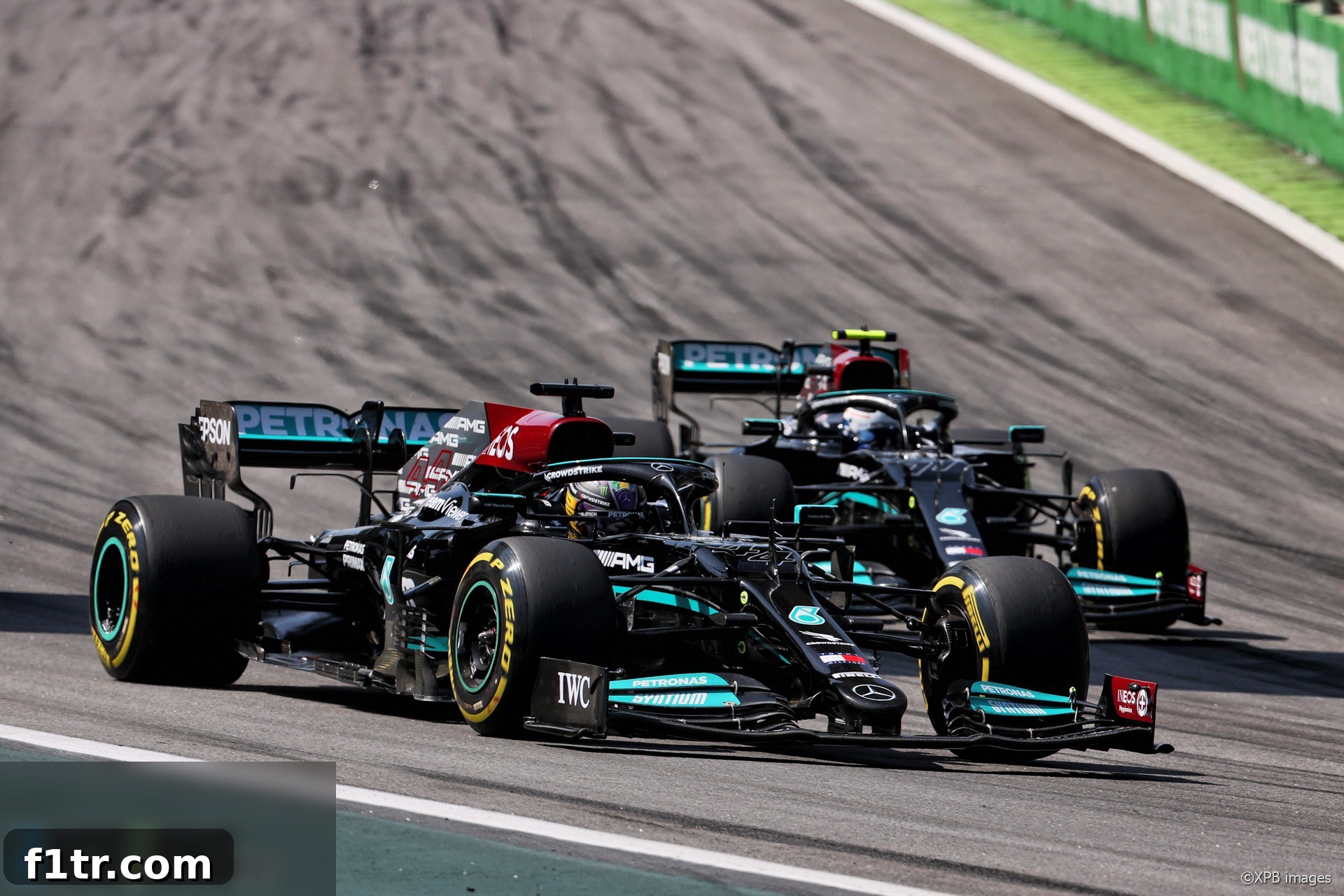
The 2021 Formula 1 season marked a pivotal and challenging chapter in the career of Valtteri Bottas. Entering his fifth year with the dominant Mercedes-AMG Petronas F1 Team, the air was thick with speculation regarding his future. Rumours had been swirling for months that 2021 could be his final season in the silver arrow, a narrative amplified by the stunning performance of George Russell during his stand-in appearance at the 2020 Sakhir Grand Prix. Russell, then with Williams, had impressed immensely, showcasing his potential for a top-tier drive and inadvertently placing immense pressure on Bottas to deliver his best season yet. However, what unfolded was, by many metrics, his most challenging and ultimately least successful campaign with Mercedes.
Indeed, over the course of the year, Bottas found himself facing one of his toughest challenges yet from seven-time world champion Lewis Hamilton. In their five seasons as Mercedes teammates, 2021 arguably saw Hamilton hand Bottas his heaviest beating. Given the circumstances and the ever-present pressure, it came as little surprise when, long before the season’s conclusion, Mercedes announced that George Russell would be promoted from Williams to join Hamilton for the 2022 season, signaling the end of Bottas’s tenure with the Brackley-based squad.
Valtteri Bottas’s 2021 Season: A Deep Dive into Performance Metrics
When scrutinizing the numbers, Bottas’s 2021 performance against his esteemed teammate, Lewis Hamilton, paints a clear picture of struggle. Across various key metrics, this season proved to be his least successful. He qualified ahead of Hamilton in only 22.73% of races, finished ahead in just 17.65% of classified finishes, secured a mere 35.82% of the team’s total points, and spent only 15.64% of racing laps ahead of Hamilton. These figures highlight a significant disparity and underscore the challenges Bottas faced throughout the year. Furthermore, a telling statistic was the team’s inability to secure a single one-two finish together, a stark contrast to previous dominant seasons.
Early Setbacks and Missed Opportunities
The season began with Lewis Hamilton immediately embroiled in intense, wheel-to-wheel duels with Red Bull’s Max Verstappen at the front of the pack. Bottas, meanwhile, found himself in less auspicious circumstances. The second race of the year, the Emilia Romagna Grand Prix at Imola, proved particularly damaging. A heavy collision with George Russell, his potential successor, not only put Bottas out of the race but also sparked widespread discussion and criticism. Many questioned why a Mercedes, a car expected to be comfortably ahead of a Williams, was even racing in such a position. This incident, early in the season, did little to quell the mounting pressure on the Finn and arguably chipped away at his confidence and public perception.
Despite the setback, Bottas showed flashes of his raw speed. He impressively recovered to take pole position at the Portuguese Grand Prix, though he ultimately finished third in the race. However, cruel luck continued to plague him. In Monaco, a weekend where he had comfortably out-qualified his teammate and was running in a strong second position, four places ahead of Hamilton, an excruciating wheel nut failure during a pit stop abruptly ended his race. This incident was arguably his best chance for victory that season and the sudden, mechanical retirement proved to be a devastating blow, robbing him of crucial points and a much-needed morale boost.
A Supportive Role and a Solitary Triumph
Beyond Hamilton’s “brake magic” error during the restart in Azerbaijan, he generally finished ahead of Bottas in every remaining race, with only two significant exceptions. One was the Austrian Grand Prix, where damage sustained from riding the kerbs caused Hamilton’s performance to fade. The other, and undoubtedly Bottas’s highlight of the season, was the Turkish Grand Prix. Here, Bottas delivered a masterful performance in challenging conditions, securing his sole victory of the season. This triumph came on a weekend where Hamilton was hit with a ten-place grid penalty for a power unit component change, creating an opportunity that Bottas seized with conviction.
Throughout the season, Valtteri Bottas frequently played a vital supporting role for Lewis Hamilton in his fierce championship battle against Max Verstappen. There were numerous instances where his strategic positioning and willingness to act as a ‘wingman’ aided Hamilton’s cause, sometimes at the expense of his own points-scoring opportunities. This unwavering commitment to the team’s objectives, even when his own future was uncertain, highlighted his professionalism and dedication. It is also worth noting that despite his struggles, Bottas ended the year significantly closer to his teammate in the points standings compared to how Sergio Perez fared against Max Verstappen at Red Bull, suggesting that while the gap was large, his raw pace was not entirely absent.
The Abu Dhabi Finale: A Missed Opportunity to Influence
Perhaps the most disappointing and impactful result for Bottas came at the dramatic final round in Abu Dhabi. In the high-stakes title decider, Bottas regrettably proved to be a complete non-factor. While Sergio Perez played a crucial, almost heroic role by tactically obstructing Lewis Hamilton, thereby aiding Max Verstappen’s charge, Bottas’s race was hampered from the start. An under-powered engine saw him fall back immediately, and he struggled to make significant progress throughout the race. He eventually crossed the finish line in sixth position, losing two places during the controversial final lap restart that ultimately decided the championship.
This stark contrast in team support at the critical moment underscored the perceived difference in performance and impact between the two second drivers. Bottas’s inability to be a factor at the front, through no fault of his own with the engine issue, was a microcosm of his season’s frustrations, culminating in an anticlimactic end to his Mercedes chapter.
A Legacy of Contribution and Future Outlook
Despite the personal challenges and the eventual parting of ways, Valtteri Bottas’s efforts in 2021 were not in vain for the team. His consistent points contributions, even when not challenging for victories, were instrumental in securing Mercedes their fifth consecutive Constructors’ Championship during his tenure, a testament to his reliability and speed. As Bottas now embarks on a new challenge with Alfa Romeo, Mercedes will be looking ahead. Having lost the drivers’ world championship to Max Verstappen and Red Bull, the team will be fervently hoping that George Russell can bring a fresh impetus and more consistently take the fight to their rivals in 2022, building on the foundation laid by Bottas over his five dedicated years.
Bottas’s time at Mercedes will be remembered for his unwavering professionalism, his significant contributions to five constructors’ titles, and moments of brilliant speed, even if the ultimate individual championship eluded him. His 2021 season, though difficult, ultimately paved the way for a new chapter in his career and a new era for Mercedes, forever linking him to a period of unprecedented dominance in Formula 1.
Lewis Hamilton vs Valtteri Bottas: Key stats
(Please note: Detailed statistical charts for this section are typically generated dynamically and would appear here.)
Lewis Hamilton vs Valtteri Bottas: Who finished ahead at each round
| BAH | EMI | POR | SPA | MON | AZE | FRA | STY | AUS | GRE | HUN | BEL | NET | ITA | RUS | TUR | USA | MEX | BRA | QAT | SAU | ABU | ||
| Hamilton | Q | ||||||||||||||||||||||
| R | |||||||||||||||||||||||
| Bottas | Q | ||||||||||||||||||||||
| R |
(Please note: This table would typically be populated with indicators showing which driver finished ahead in qualifying (Q) and the race (R) for each Grand Prix.)
Lewis Hamilton vs Valtteri Bottas: Qualifying gap
Times based on the last qualifying round at each race weekend in which both drivers set a time. Negative indicates Lewis Hamilton was faster, positive means Valtteri Bottas was faster.
(Please note: This section would display a dynamic chart illustrating the qualifying time differences between the two drivers across the season.)