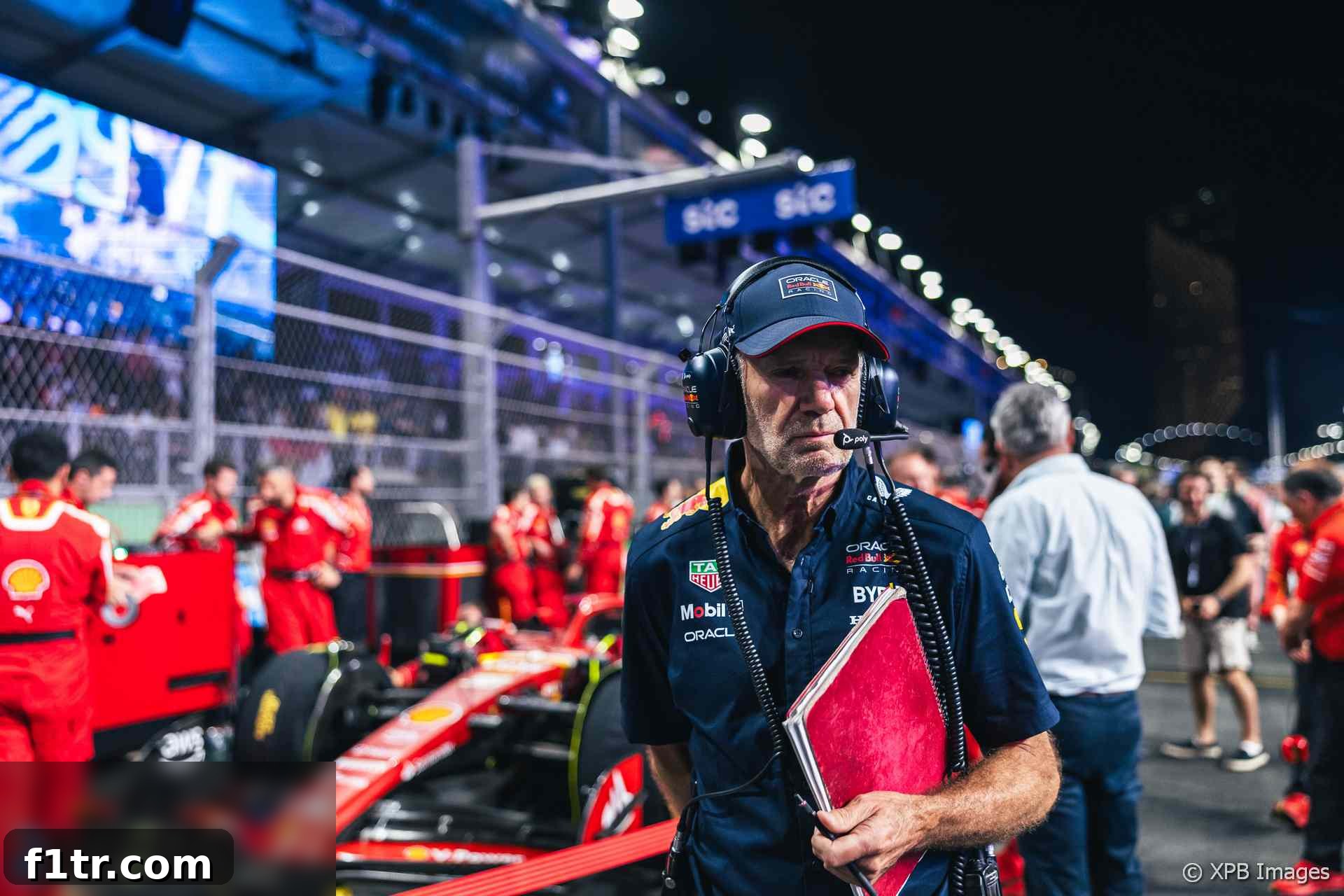
The landscape of Red Bull Racing, a team synonymous with unparalleled success in recent Formula 1 seasons, is undergoing a profound transformation. While their on-track performance remains stellar, evidenced by four victories in the first five Grands Prix of the year, a series of off-track developments has cast a long shadow over the team’s steadfast claim of “business as usual.” The internal investigation into team principal Christian Horner’s conduct, though officially concluded with his exoneration, ignited a firestorm of speculation that has refused to dissipate, fueling persistent rumors of internal discord within the leadership ranks. Now, a bombshell announcement has confirmed the departure of their legendary chief technical officer, Adrian Newey, marking an undeniable shift in the team’s dynamics.
Advert | Become a Supporter & go ad-free
While Red Bull’s official statement carefully avoided any explicit connection between Newey’s exit and the recent controversies, the timing of his decision immediately raises a critical question that echoes throughout the F1 paddock: Why would the architect of their current dominance choose to leave a team at the absolute zenith of its performance, designing the very cars that are rewriting the sport’s record books? This isn’t merely a high-profile personnel change; it’s a seismic event with far-reaching implications for Red Bull’s future and the competitive balance of Formula 1.
To understand the significance of Newey’s departure, one must look back at his career, particularly a similar moment a decade ago. In stark contrast to today’s unparalleled success, Newey seriously considered leaving Red Bull when the team’s championship streak had come to an abrupt halt, facing an uncertain future with uncompetitive power units. “I really didn’t want to leave,” Newey revealed last year to the official F1 channel, “but we were in this position where Renault hadn’t produced a competitive engine in the turbo hybrid era.” He recounted a dispiriting conversation with then-Renault CEO Carlos Ghosn, which solidified his belief that Renault was unwilling to invest sufficiently to make their engines competitive. This created what he described as a “dark tunnel,” a future without visible prospects for victory, forcing him to consider alternatives.
Newey’s dilemma then was profound. Mercedes had an unassailable engine advantage, and a move to Ferrari, while tempting, posed questions about equal equipment. He elaborated on his historical apprehension regarding Ferrari, stating, “Ferrari had a great engine but we’d used Ferraris initially and I’d taken us away from Ferrari in the first year to Renault because I believed, rightly or wrongly, that if you’re in a championship battle, Ferrari would never give us equal equipment.” This historical insight underscores Newey’s consistent pursuit of environments where pure engineering merit can thrive, free from political or strategic compromise. His decision to stay then was ultimately a gamble on Red Bull’s long-term vision, a gamble that paid off handsomely, but it illustrates his willingness to walk away when the fundamental conditions for success are compromised.
Advert | Become a RaceFans supporter andgo ad-free
Adrian Newey’s career is marked by periods of remarkable stability interspersed with decisive moves when his situation within a team became untenable. His initial Formula 1 triumphs at Williams, where his designs propelled the team to multiple championships between 1992 and 1997, ended abruptly due to a lack of consultation regarding driver choices. Sir Frank Williams, the revered founder of the team, famously lamented his inability to retain Newey, whose departure was triggered by Williams’s decision to sign Jacques Villeneuve and Heinz-Harald Frentzen, while simultaneously ousting the popular Damon Hill, without seeking Newey’s input on these crucial personnel changes.
Reflecting on Newey’s unique impact, Williams astutely observed during Red Bull’s championship dominance twelve years ago, “There’s still a problem, it’s called Adrian Newey. There’s only one of him.” This sentiment remains profoundly relevant today. Mercedes’s era of supremacy from 2014 to 2021 was primarily built on their mastery of the new hybrid power unit regulations, while Red Bull grappled with the very engine issues that nearly pushed Newey to retire. His consistent ability to craft championship-winning machinery, regardless of the regulatory landscape, underscores his singular value.
The timing of Newey’s availability as a free agent, expected after the first quarter of next year, could not be more critical for Formula 1. The sport is hurtling towards a radical overhaul of its chassis and power unit regulations in 2026, a juncture where Newey’s genius for conceptualizing entirely new solutions to complex rule sets is most potent. The identity of future F1 champions, therefore, might well depend on where this engineering titan decides to direct his talents next. At 65, while retirement is always a possibility, his comments in Red Bull’s announcement suggest a different path: “I feel now is an opportune moment to hand that baton over to others and to seek new challenges for myself.” This phrase, “new challenges,” strongly implies a continued active role within the sport, rather than a farewell to the drawing board.
Advert | Become a RaceFans supporter andgo ad-free
The bidding war for Newey’s services is expected to be fierce, and only a select few teams possess both the financial muscle and the technical infrastructure to accommodate him. Under F1’s financial regulations, top-earning staff are exempt from the budget cap, allowing teams to offer him a salary that would undoubtedly be the envy of many drivers. Speculation has naturally linked him with all the sport’s front-running teams, each eager to secure the individual widely regarded as the most influential designer of his generation. His previous comments about regretting never joining Ferrari, where he stated, “Emotionally, I guess, to a point, yes,” now resonate with renewed intensity. The allure of Maranello, coupled with Lewis Hamilton’s impending move there next year and recent reports of Newey meeting Ferrari team principal Frederic Vasseur, paints a compelling picture of a potential partnership. Ferrari has also been the only team to beat Red Bull to victory in the last twelve months, signaling a resurgence that could attract a talent like Newey.
Beyond Ferrari, other formidable contenders are vying for Newey’s expertise. Lawrence Stroll, the ambitious owner of Aston Martin, would undoubtedly be prepared to make a significant financial commitment to add Newey to his growing collection of former Red Bull personnel, solidifying his team’s aspirations for championship glory. Mercedes, currently grappling with their own challenges under the present regulations, also presents a logical target. Their ongoing struggles to fully unlock the potential of the current ground effect aerodynamics could be precisely what Newey is brought in to solve. However, Mercedes CEO Toto Wolff, while acknowledging Newey’s iconic status, publicly maintained a measured stance before the official announcement, stating he was “just looking at it like a fan and watching that space.” This cautious approach might betray an underlying strategic consideration, or simply a desire not to overtly chase a designer still under contract.
Advert | Become a RaceFans supporter andgo ad-free
Any team looking to secure Newey’s services must also possess a crucial works engine deal, a factor that likely eliminates many smaller outfits and perhaps even dampens his enthusiasm for Renault’s current efforts with Alpine, much as it did a decade ago. Audi, set to enter F1 in 2026, represents a complete unknown but offers a blank canvas, though a move there or to Ferrari would necessitate working outside the UK, a significant personal consideration. Newey’s track record demonstrates an unparalleled ability to quickly identify and conceptualize the optimum solution to complex new regulations, a skill that will be invaluable as teams prepare for the seismic shifts of 2026.
Newey’s historical mastery of regulatory changes is legendary. He famously excelled with McLaren’s narrow-track cars in 1998, pioneered solutions for Red Bull when the “Overtaking Working Group” rules arrived in 2009 (despite initial controversies surrounding the “double diffuser”), and once again led Red Bull to immediate dominance with the current ground effect rules introduced just two years ago. With teams having significantly less time to prepare for the upcoming 2026 chassis regulations compared to previous overhauls, Newey’s input could be the decisive factor. His choice could determine whether Lewis Hamilton achieves an unprecedented eighth world title, Fernando Alonso finally secures a long-awaited third, or another driver rises to claim their maiden championship. The stakes could not be higher.
This critical juncture will undoubtedly weigh heavily on Max Verstappen, who has consistently emphasized the paramount importance of internal stability for Red Bull’s sustained success. Despite his long-term contract, Verstappen’s future at Red Bull is increasingly becoming a subject of intense speculation, fueled by the very internal dynamics that led to Newey’s departure. The question on everyone’s mind, and perhaps on Verstappen’s, is whether the current situation at Red Bull still truly reflects the “business as usual” environment required to maintain their championship aspirations in the long term. Adrian Newey’s exit signals the end of an era and the beginning of a new, uncertain chapter for Red Bull Racing and for Formula 1 as a whole.
Become a RaceFans Supporter
RaceFans is run thanks in part to the generous support of its readers. By contributing £1 per month or £12 per year (or the same in whichever currency you use) you can help cover the costs of creating, hosting and developing RaceFans today and in the future.
Become a RaceFans Supporter today and browse the site ad-free. Sign up or find out more via the links below:
- Become a RaceFans Supporter
- RaceFans Supporter FAQ
Advert | Become a RaceFans supporter andgo ad-free
Formula 1
- The ‘throwback weekend’ is back in fashion. But it’s a flawed concept – especially for F1
- Is Formula 1’s double race cancellation a blessing in disguise?
- Todt admits Schumacher crashed on purpose – but did it really cost him two titles?
- 25 of the most memorable radio exchanges from the ‘Max and GP show’
- FIA explains next steps after first meeting to discuss fixes for 2026 F1 rules
Browse all Formula 1 articles