The Emilia-Romagna Grand Prix at Imola promises an electrifying race day, where the conventional wisdom often takes a back seat. Even without the unpredictable variable of rain, the stage is set for a multitude of thrilling outcomes. Such is the nature of Formula 1 at this historic circuit: a tight, demanding track that punishes errors and rewards strategic brilliance. This Sunday, one of the most compelling possibilities involves a victory for Red Bull, but perhaps not from the driver who has traditionally dominated their triumphs in recent seasons.
Advert | Become a Supporter & go ad-free
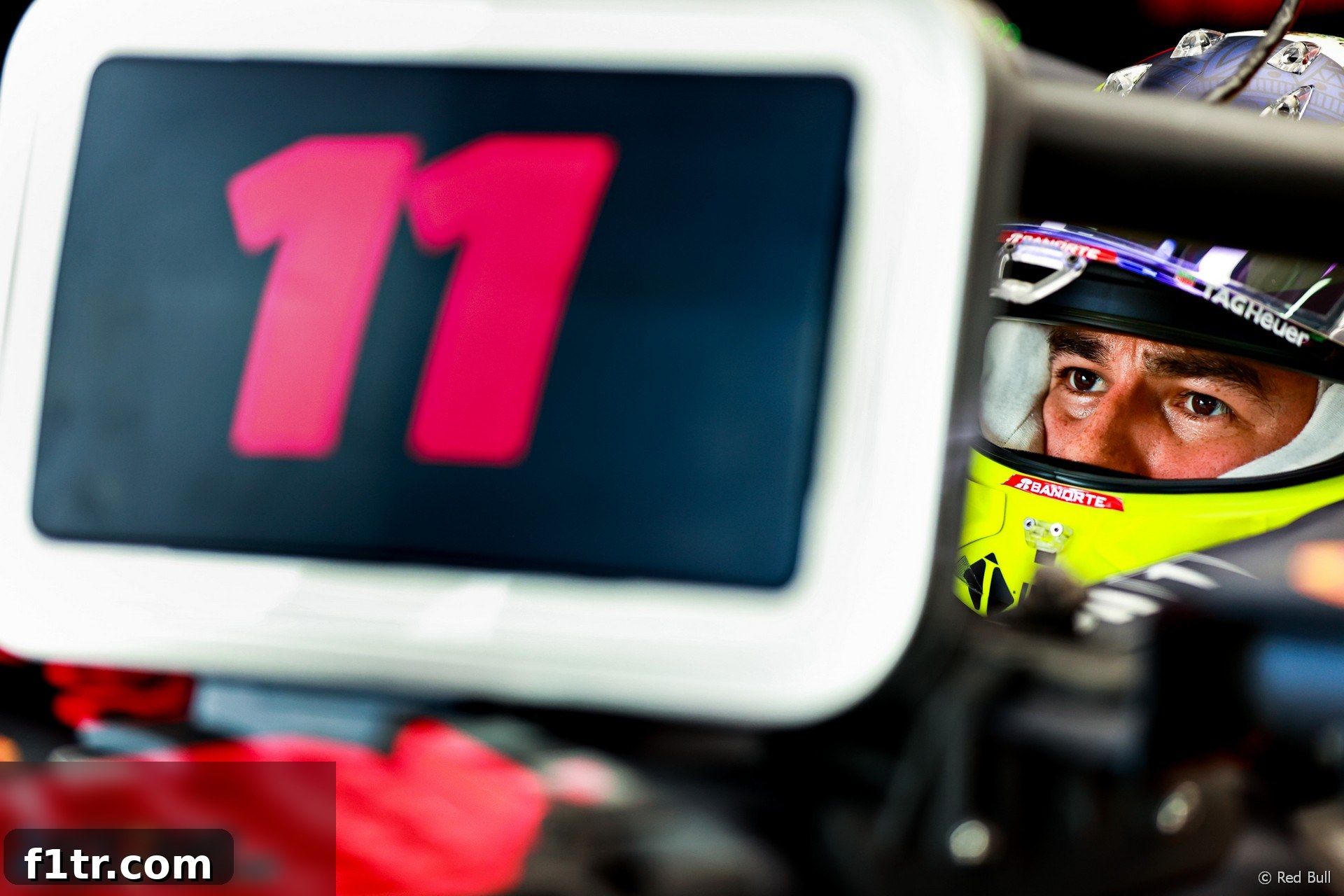
Sergio Perez, in only his second race with Red Bull, secured his first-ever front-row start in Formula 1 during a dramatic qualifying session. Starting alongside pole-sitter Lewis Hamilton, Perez’s achievement is monumental, placing him in a prime position to challenge for victory. However, his choice of Pirelli’s soft compound tyres adds an intriguing layer to Red Bull’s race strategy. The cars immediately flanking him – Hamilton just ahead and his teammate Max Verstappen just behind – will both be on the more durable medium compound, generally considered the tactically superior choice for the start of the race. This difference immediately sets up a strategic chess match at the front of the grid.
Perez, a Grand Prix winner just three races prior in Sakhir, is acutely aware of the significant challenge that lies ahead. “If there is a place that you don’t want to come in your second race with a new team, it’s probably Imola,” he candidly admitted after qualifying, acknowledging the circuit’s notoriously unforgiving nature. Yet, his confidence in the machinery shone through as he added, “I think we have a fantastic car for the race,” hinting at Red Bull’s strong package and his own adaptation to it.
His teammate, Max Verstappen, starting from third on the grid, faces a slightly different set of circumstances. A driveshaft problem on Friday curtailed his long-run practice, leaving him with less comparative data on race pace. Despite this setback, Verstappen remains unfazed. He believes it “will not be a big issue,” drawing confidence from his fierce battle with pole-winner Lewis Hamilton right to the chequered flag at the season-opening Bahrain Grand Prix. The prospect of having two Red Bulls flanking Hamilton presents a strategic advantage, as Verstappen noted, “We have two cars close to Lewis on different tyres. So hopefully that will give some excitement tomorrow.” This multi-pronged attack could prove decisive in disrupting Mercedes’ race plans.
Verstappen’s qualifying performance itself contained an element of frustration. An off-track moment early in his crucial Q3 lap prevented him from maximizing his pace, breaking a long-standing streak of out-qualifying his teammates. This error, as described by Mercedes team principal Toto Wolff, likely cost him pole position, which Wolff believed “would have been solidly on pole without error.” Starting behind two cars that are at least as quick as his, on a track where genuine overtaking opportunities are scarce, adds an extra layer of difficulty for the Dutch driver. However, as Hamilton wisely observed, “we could all go back and look at our data and say we could go faster – at the end of the day, it’s what you do in that one moment that counts.” For Verstappen, that moment meant P3.
Delving into the data from qualifying sessions, it suggests that Hamilton holds a marginal advantage over Verstappen on the medium compound tyre over a single lap. The absence of comprehensive long-run data for Verstappen due to his driveshaft issue in second practice leaves a degree of uncertainty regarding his sustained race pace compared to Hamilton. Meanwhile, Perez’s decision to use soft tyres in Q2, as he wasn’t entirely confident of making it to Q3 on mediums, now dictates his starting compound. This decision, while securing his grid position, introduces a fascinating strategic dilemma for Red Bull. The initial estimations by Pirelli and the teams regarding the performance gap between the soft and medium compounds have evolved throughout the weekend. However, a developing consensus suggests that the more durable medium tyre may not provide an immediate, significant advantage, especially if the race proceeds in cooler conditions, as anticipated.
While the soft tyre might warm up quicker – many drivers required at least two laps to bring the softs into their optimal performance window during qualifying – there is little evidence to suggest it will have a significantly shorter lifespan than the mediums, particularly when expertly managed by a driver with Perez’s renowned tyre-whispering abilities. Perez himself elaborated on the team’s perspective: “We felt as a team that the soft is nowhere near what it was last year. So it’s a good race tyre. It’s just different to the medium, and it was very important and crucial for me to get that learning, that consistency and that progression [by using it in Q2].” Pirelli’s F1 tyre chief, Mario Isola, echoed this sentiment, expecting minimal graining on the soft tyres. He also observed that “the medium is working quite well for Mercedes” on Friday, even with a rear tyre starting pressure of 19psi, which was subsequently raised to 20psi, potentially altering the feel for drivers without necessarily impacting lap times significantly.
For Red Bull, Perez’s position on soft tyres opens up a wealth of strategic possibilities. He doesn’t necessarily need to lead Hamilton in the opening stint. His primary objective could be to maintain pace, gather crucial data on the soft compound’s performance in race conditions, and potentially hold off Hamilton, allowing Verstappen to push from behind. If Red Bull opts for an aggressive two-stop strategy, Perez could enjoy a clear pace advantage by switching back to softs for his final stint, potentially leapfrogging rivals who commit to a one-stop race. This strategic flexibility places significant pressure on Mercedes.
Lewis Hamilton is acutely aware of the strategic advantages Red Bull might wield over Mercedes, especially with his own teammate, Valtteri Bottas, starting disappointingly in sixth after struggling to warm up his soft tyres in Q3. Hamilton understands that Imola presents unique challenges for strategy and overtaking. “I think tomorrow, they have these, I mean if we’re able to get off in order, then they obviously have a bit of a better set of cards in terms of strategy,” he conceded. However, Hamilton, ever the strategist, remained optimistic: “But that doesn’t mean we can’t pull out something unique and do something different.” The prospect of a lone battle against two Red Bulls is a tough one, especially without immediate support from Bottas. “I’m not really sure what happened with Valtteri, it’s very hard to overtake here. So probably won’t have the support of him early on, but nonetheless, maybe he’ll make it through. But otherwise we just got to focus on our job and and try to do absolutely everything and more to keep these guys behind.” This highlights the immense pressure on Hamilton to execute a flawless race from the very first lap.
Further down the grid, the consensus among drivers points towards a predominantly one-stop race, unless adverse weather conditions intervene. Alpine’s Esteban Ocon, starting ninth, expressed that he extracted “the maximum” from his car in qualifying. He anticipates a significant gap forming between his car and those ahead, potentially leading to either a long train of cars behind him or a race-long battle for the lower points positions. Ocon’s candid admission provides a valuable benchmark for top teams like Mercedes and Red Bull, allowing them to time their pit stops strategically to avoid traffic and maintain track position. The midfield battle at Imola is always intense, with cars capable of scoring points needing to be aggressive yet precise. Ferrari’s Carlos Sainz Jnr stands out among those starting on fresh rubber, having failed to reach Q3. His race pace in Bahrain was notably strong, particularly in the latter stages of the Grand Prix, suggesting Ferrari could be a dark horse for a strong points finish. Even if his teammate Charles Leclerc remains cautiously unsure about Ferrari’s true standing in the pecking order at Imola, the potential for Sainz to make up ground is significant, adding another layer of intrigue to the race dynamics. McLaren, with Daniel Ricciardo and Lando Norris, also showcased strong qualifying performances, putting them in contention for solid points and potentially joining the strategic battle at the front if opportunities arise.
Quotes: Dieter Rencken
Advert | Become a RaceFans supporter andgo ad-free
Qualifying times in full
| Driver | Car | Q1 | Q2 (vs Q1) | Q3 (vs Q2) | ||
| 1 | Lewis Hamilton | Mercedes | 1’14.823 | 1’14.817 (-0.006) | 1’14.411 (-0.406) | |
| 2 | Sergio Perez | Red Bull | 1’15.395 | 1’14.716 (-0.679) | 1’14.446 (-0.270) | |
| 3 | Max Verstappen | Red Bull | 1’15.109 | 1’14.884 (-0.225) | 1’14.498 (-0.386) | |
| 4 | Charles Leclerc | Ferrari | 1’15.413 | 1’14.808 (-0.605) | 1’14.740 (-0.068) | |
| 5 | Pierre Gasly | AlphaTauri | 1’15.548 | 1’14.927 (-0.621) | 1’14.790 (-0.137) | |
| 6 | Daniel Ricciardo | McLaren | 1’15.669 | 1’15.033 (-0.636) | 1’14.826 (-0.207) | |
| 7 | Lando Norris | McLaren | 1’15.009 | 1’14.718 (-0.291) | 1’14.875 (+0.157) | |
| 8 | Valtteri Bottas | Mercedes | 1’14.672 | 1’14.905 (+0.233) | 1’14.898 (-0.007) | |
| 9 | Esteban Ocon | Alpine | 1’15.385 | 1’15.117 (-0.268) | 1’15.210 (+0.093) | |
| 10 | Lance Stroll | Aston Martin | 1’15.522 | 1’15.138 (-0.384) | ||
| 11 | Carlos Sainz Jnr | Ferrari | 1’15.406 | 1’15.199 (-0.207) | ||
| 12 | George Russell | Williams | 1’15.826 | 1’15.261 (-0.565) | ||
| 13 | Sebastian Vettel | Aston Martin | 1’15.459 | 1’15.394 (-0.065) | ||
| 14 | Nicholas Latifi | Williams | Mercedes | 1’15.653 | 1’15.593 (-0.060) | |
| 15 | Fernando Alonso | Alpine | 1’15.832 | 1’15.593 (-0.239) | ||
| 16 | Kimi Raikkonen | Alfa Romeo | 1’15.974 | |||
| 17 | Antonio Giovinazzi | Alfa Romeo | 1’16.122 | |||
| 18 | Mick Schumacher | Haas | 1’16.279 | |||
| 19 | Nikita Mazepin | Haas | 1’16.797 |
Sector times
| Driver | Sector 1 | Sector 2 | Sector 3 |
|---|---|---|---|
| Lewis Hamilton | 23.633 (3) | 25.787 (7) | 24.908 (1) |
| Sergio Perez | 23.630 (2) | 25.668 (2) | 25.059 (4) |
| Max Verstappen | 23.730 (4) | 25.617 (1) | 24.965 (2) |
| Charles Leclerc | 23.853 (7) | 25.690 (3) | 25.060 (5) |
| Pierre Gasly | 23.806 (6) | 25.728 (4) | 25.131 (6) |
| Daniel Ricciardo | 23.739 (5) | 25.856 (8) | 25.231 (11) |
| Lando Norris | 23.554 (1) | 25.737 (5) | 25.163 (7) |
| Valtteri Bottas | 23.917 (9) | 25.747 (6) | 25.008 (3) |
| Esteban Ocon | 23.975 (12) | 25.920 (12) | 25.222 (10) |
| Lance Stroll | 23.920 (10) | 25.907 (9) | 25.189 (8) |
| Carlos Sainz Jnr | 23.910 (8) | 25.910 (10) | 25.204 (9) |
| George Russell | 23.937 (11) | 25.914 (11) | 25.410 (15) |
| Sebastian Vettel | 24.115 (15) | 25.932 (13) | 25.307 (12) |
| Nicholas Latifi | 24.143 (16) | 26.013 (14) | 25.307 (12) |
| Fernando Alonso | 24.072 (13) | 26.120 (15) | 25.401 (14) |
| Kimi Raikkonen | 24.090 (14) | 26.172 (16) | 25.603 (18) |
| Antonio Giovinazzi | 24.275 (17) | 26.223 (17) | 25.572 (17) |
| Mick Schumacher | 24.362 (18) | 26.242 (18) | 25.545 (16) |
| Nikita Mazepin | 24.494 (19) | 26.319 (19) | 25.905 (19) |
Speed trap
| Pos | Driver | Car | Engine | Speed (kph/mph) | Gap |
|---|---|---|---|---|---|
| 1 | George Russell | Williams | Mercedes | 295.5 (183.6) | |
| 2 | Nicholas Latifi | Williams | Mercedes | 294.5 (183.0) | -1.0 |
| 3 | Fernando Alonso | Alpine | Renault | 294.2 (182.8) | -1.3 |
| 4 | Lando Norris | McLaren | Mercedes | 293.0 (182.1) | -2.5 |
| 5 | Esteban Ocon | Alpine | Renault | 292.7 (181.9) | -2.8 |
| 6 | Sebastian Vettel | Aston Martin | Mercedes | 292.5 (181.8) | -3.0 |
| 7 | Pierre Gasly | AlphaTauri | Honda | 292.2 (181.6) | -3.3 |
| 8 | Lance Stroll | Aston Martin | Mercedes | 292.1 (181.5) | -3.4 |
| 9 | Max Verstappen | Red Bull | Honda | 291.8 (181.3) | -3.7 |
| 10 | Lewis Hamilton | Mercedes | Mercedes | 291.8 (181.3) | -3.7 |
| 11 | Valtteri Bottas | Mercedes | Mercedes | 291.6 (181.2) | -3.9 |
| 12 | Charles Leclerc | Ferrari | Ferrari | 291.3 (181.0) | -4.2 |
| 13 | Mick Schumacher | Haas | Ferrari | 291.0 (180.8) | -4.5 |
| 14 | Kimi Raikkonen | Alfa Romeo | Ferrari | 290.8 (180.7) | -4.7 |
| 15 | Daniel Ricciardo | McLaren | Mercedes | 290.7 (180.6) | -4.8 |
| 16 | Nikita Mazepin | Haas | Ferrari | 290.6 (180.6) | -4.9 |
| 17 | Sergio Perez | Red Bull | Honda | 290.6 (180.6) | -4.9 |
| 18 | Carlos Sainz Jnr | Ferrari | Ferrari | 289.8 (180.1) | -5.7 |
| 19 | Antonio Giovinazzi | Alfa Romeo | Ferrari | 288.6 (179.3) | -6.9 |
Advert | Become a RaceFans supporter andgo ad-free
Over to you
As the Emilia-Romagna Grand Prix looms, several questions beg for answers. Will Sergio Perez capitalize on his front-row start and challenge Max Verstappen for Red Bull’s first victory of 2021? Is the soft tyre truly as competitive and durable as Red Bull’s strategy suggests, or will the medium compound prove its worth? Can Valtteri Bottas recover from a disappointing Q3 to support Lewis Hamilton, or will Mercedes be forced to get creative? And will any team dare to attempt an audacious two-stop strategy on a track where track position is paramount?
Share your predictions and analysis for the Emilia-Romagna Grand Prix in the comments section below.
2021 Emilia-Romagna Grand Prix
- Poor Imola pace was “100% tyres”, says Bottas
- Bottas says Imola crash is “history” after reading George Russell’s apology
- ‘Lewis and Valtteri are team mates to me as Nicholas is’ says Russell after ‘private’ Wolff talks
- ‘Hamilton didn’t break the rules by reversing’ shouldn’t be a story
- 2021 Emilia-Romagna Grand Prix Star Performers
Browse all 2021 Emilia-Romagna Grand Prix articles