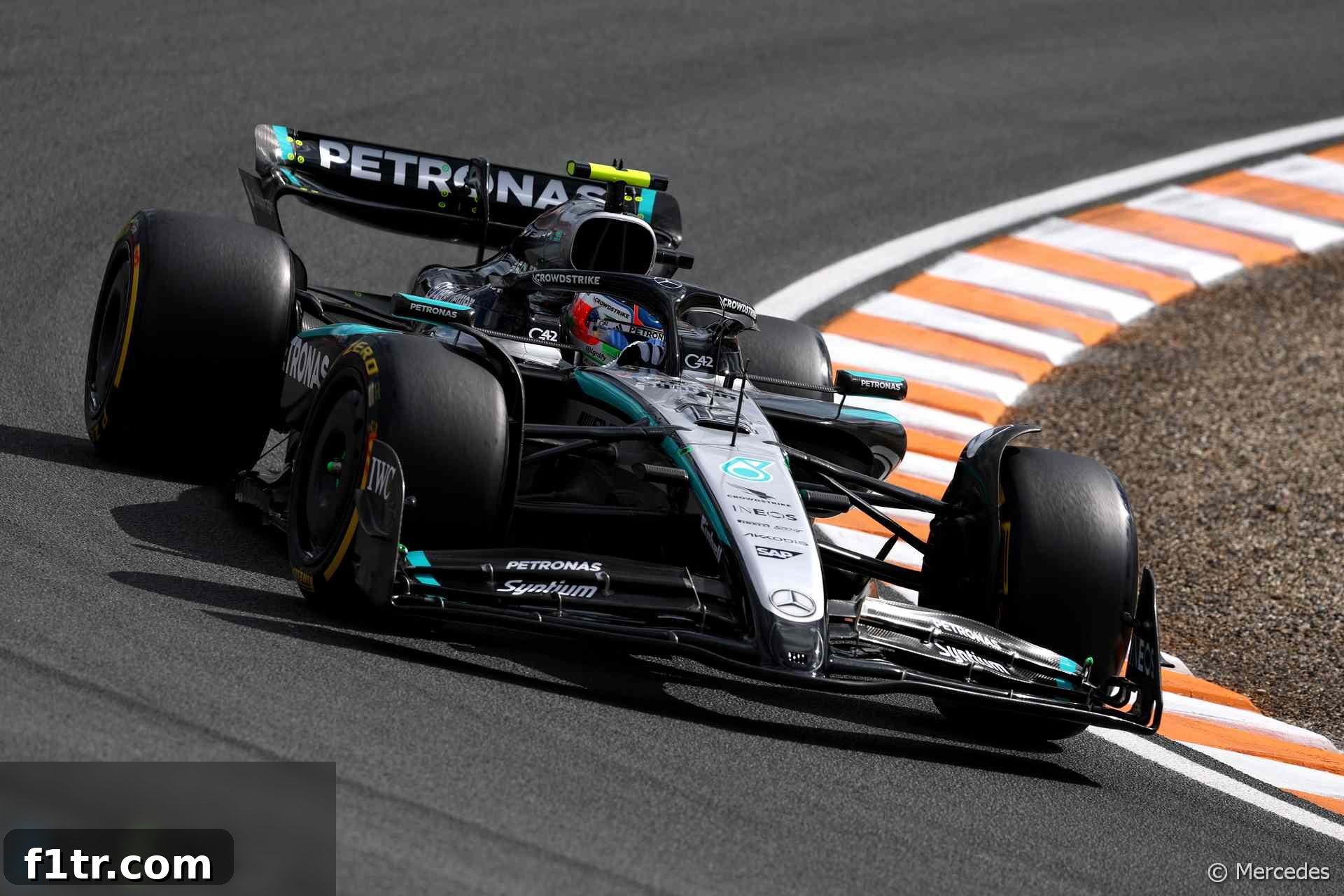
Andrea Kimi Antonelli’s F1 Journey: Mercedes Stands Firm Amidst Rookie Pressures
Mercedes team principal Toto Wolff has unequivocally expressed his lack of concern regarding Andrea Kimi Antonelli’s recent fluctuations in performance. Wolff, a seasoned veteran in Formula 1 management, acknowledges that Antonelli has been navigating the immense and unique challenges of his rookie F1 season under what he terms “maximum pressure.” This unwavering support from the highest echelons of the Mercedes AMG Petronas F1 Team underscores a long-term vision for the young Italian driver, seeing beyond immediate results to focus on his holistic development in the sport’s most demanding environment.
Antonelli’s introduction to Formula 1 was met with considerable anticipation, given his meteoric rise through junior categories. His F1 career began with a commendable streak, where he consistently delivered strong performances, scoring points in an impressive five out of his first six events. This initial surge hinted at the raw talent and adaptability that Mercedes had identified. However, the unforgiving nature of Formula 1, with its relentless schedule and fierce competition, inevitably led to a more challenging period. In the subsequent eight rounds, Antonelli has managed to secure points only twice, although one of these instances was a remarkable and well-deserved podium finish in Canada, a testament to his undeniable potential to perform at the sharp end when opportunities arise. This oscillation between promising highs and understandable lows is a common characteristic of any rookie’s journey in F1, especially one propelled into the spotlight with such high expectations.
The Immense Pressure of a Mercedes F1 Debut
Mercedes took a bold and unconventional step by promoting Antonelli to Formula 1 at the tender age of just 18, following a single, albeit highly successful, season in Formula 2. This decision, announced swiftly after his official F1 practice session debut at the Italian Grand Prix, immediately placed an extraordinary burden of expectation on the young driver. It was during this very session at Monza that Antonelli experienced a minor setback, crashing on his sixth lap, a moment that Wolff now openly reflects upon. The team principal candidly admitted that Antonelli’s immediate elevation to a front-running F1 team, bypassing what might typically be a more gradual progression, undeniably made his debut more challenging and intensified the scrutiny.
Wolff elaborated on the Monza incident, stating, “I think we have put Kimi under maximum pressure, to be honest. Looking at it now, I felt it was a great idea to have him in FP1 in Monza [last year] and present him there. That was maybe a mistake.” His introspection reveals a deep understanding of the psychological demands on a young athlete. The “mistake” was not in Antonelli’s capability – Wolff was quick to clarify this – but rather in the timing and the sheer weight of expectation placed on an 18-year-old in a high-profile session with a top team. “Not because he wasn’t capable of driving the car, because if he had finished that lap without crashing it would have been sensational and it would have built the confidence. That’s why he’s in a Mercedes,” Wolff added, underscoring the team’s belief in his intrinsic ability despite the initial hiccup.
Under the Magnifying Glass: A Rookie in the Spotlight
Joining a team of Mercedes’ calibre inevitably means operating under an intense global spotlight. Antonelli’s every move, every lap, and every result is scrutinized not only by fans and media but also by his highly accomplished teammate, who, as Wolff noted, “is maximising the car.” This creates an environment where Antonelli naturally “feels himself under the magnifying glass.” The pressure is multifaceted: internal expectations from the team, external scrutiny from the media, and the personal drive to perform at the highest level against the world’s best. Unlike rookies who might start their F1 careers with smaller, less competitive teams, Antonelli has been thrust directly into a championship-contending setup, where the benchmark for performance is inherently higher and the margin for error significantly smaller.
This amplified visibility means that every single setback, no matter how minor, tends to be highlighted. For instance, Antonelli recently lost most of a practice session after going off track and getting stuck in a gravel trap. While such incidents are part and parcel of pushing the limits in motorsport, for a driver under such intense scrutiny, they can feel disproportionately significant. However, Wolff was quick to dismiss these one-off setbacks as inconsequential in the grand scheme of Antonelli’s development. The team’s leadership has communicated a clear message: these isolated incidents are not cause for alarm and will not sway their fundamental belief in their young driver.
A Long-Term Investment: Mercedes’ Development Philosophy
Mercedes’ approach to Andrea Kimi Antonelli is firmly rooted in a long-term investment strategy. Toto Wolff’s rhetoric consistently reinforces that the team views Antonelli’s journey not as a sprint, but as a marathon. “The team just continue to believe in him. He needs time,” Wolff asserted, highlighting the crucial element of patience required in nurturing elite talent. This philosophical stance is particularly pertinent in an era where immediate results often overshadow the developmental process. Mercedes, having embarked on this trajectory, is fully committed to seeing it through.
Wolff reflected on the initial decision, acknowledging the inherent risks but standing by the chosen path. “We’ve embarked on this route, so you can say: ‘Was it right to put him under so much pressure by putting him in the team?’ We’ve taken that trajectory, we’ve taken that route, we are fully on the mission, and single race weekends or a session like we had before is not going to change our opinion.” This powerful statement underscores Mercedes’ unwavering conviction and their strategic alignment behind Antonelli. They understand that true talent cultivation involves weathering storms and providing a stable environment for growth, even when performance curves are not consistently upward.
The concept of “long-term investment” extends beyond mere financial backing; it encompasses a holistic development program designed to hone not just Antonelli’s driving skills but also his mental fortitude, racecraft, and ability to work effectively within a high-pressure team environment. Setbacks, such as the recent off in practice, are viewed not as failures but as crucial learning opportunities. “Yes [in the] short-term we’re going to say ‘that’s not good’, but Kimi is a long-term investment,” Wolff concluded, crystallizing the team’s perspective. This patient and supportive approach is vital for any young driver aiming to carve out a successful and enduring career at the pinnacle of motorsport.
Navigating Expectations and Future Prospects
The journey of a Formula 1 rookie is fraught with challenges, and navigating the vast landscape of expectations is one of the most significant. Andrea Kimi Antonelli is not only battling on track but also managing the immense anticipation surrounding his future, particularly given the speculation about his potential role as a successor to Lewis Hamilton at Mercedes. This adds an extra layer of complexity to his development, requiring him to maintain focus and composure amidst constant external noise.
His strong teammate, a benchmark against whom his performances are inevitably measured, serves both as a catalyst for improvement and an additional source of pressure. Learning from an experienced driver is invaluable, offering insights into car setup, race strategy, and tire management. However, the direct comparison also means that any perceived shortcomings become more apparent. For Antonelli, the emphasis must remain on personal growth and gradual progression rather than immediate parity with a seasoned F1 veteran. Resilience and mental strength are paramount, as the ability to rebound from challenging weekends and convert lessons learned into future successes will define his long-term trajectory.
Mercedes’ continued belief in Antonelli signals not just confidence in his raw speed but also in his character and potential to adapt and evolve. The team is investing in a driver they believe has the complete package to become a future star. This comprehensive development path will likely involve meticulous debriefs, simulation work, and consistent coaching aimed at refining every aspect of his performance. While the short-term goal is to see consistent improvement and fewer errors, the overarching objective is to mould Antonelli into a championship-calibre driver capable of leading the team in the coming years. His future in Formula 1 looks bright, predicated on the solid foundation of talent and the unwavering support of a team committed to his success.
Miss nothing from RaceFans
Get a daily email with all our latest stories – and nothing else. No marketing, no ads. Sign up here:
2025 Dutch Grand Prix
- Williams’s Sainz penalty review success “will open the door to more challenges”
- Lawson now accepts Sainz collision was a “racing incident” after stewards’ U-turn
- Stewards’ U-turn over Zandvoort penalty shows ‘how far the FIA have come’ – Sainz
- The FIA’s stewards grabbed the chance to correct their mistake – unlike last time
- Sainz’s Dutch GP penalty points cancelled as stewards accept Williams’ request for review
Browse all 2025 Dutch Grand Prix articles