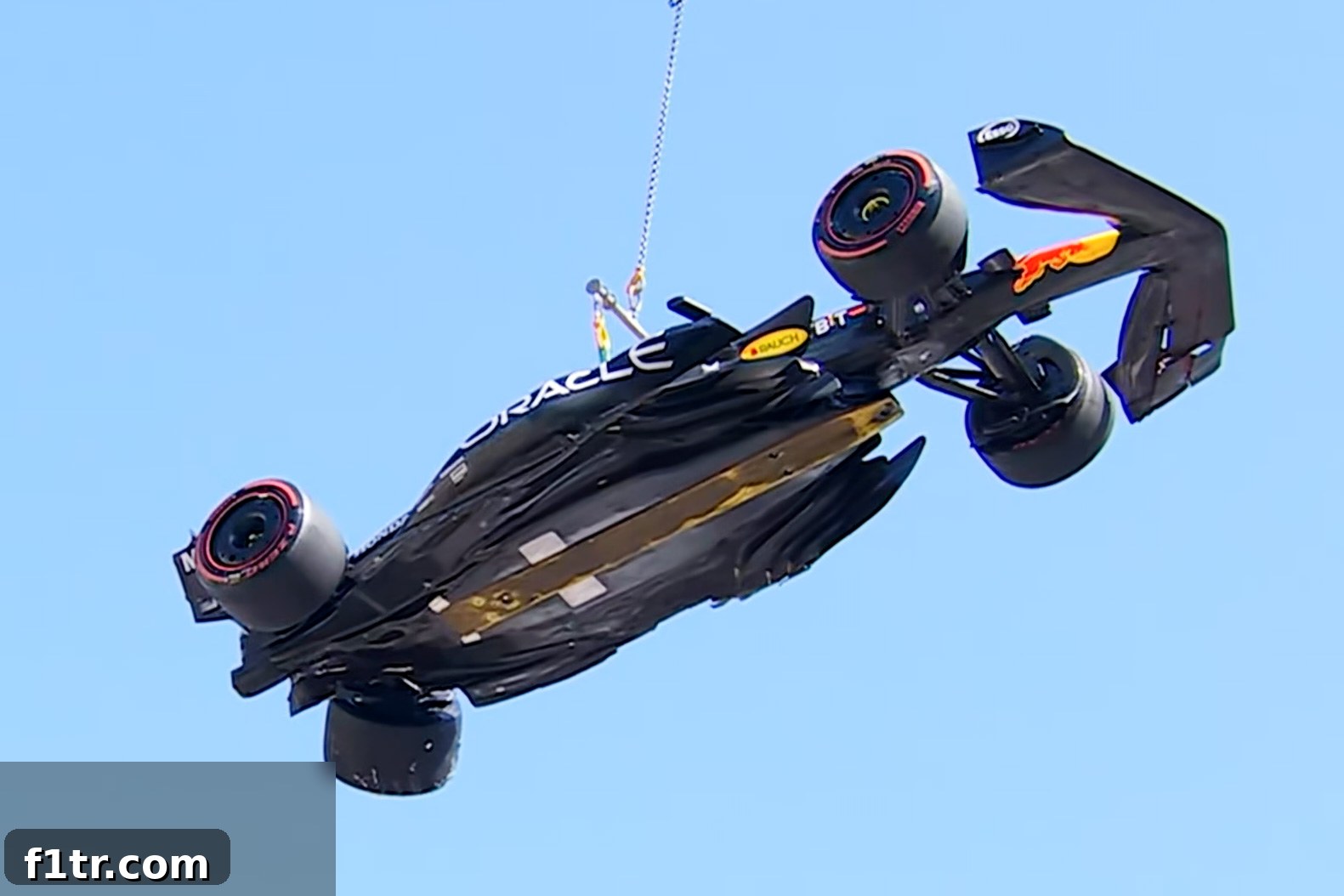
The intense world of Formula 1 racing, where every millisecond counts and every design detail is fiercely guarded, saw an unexpected moment of revelation during the recent Monaco Grand Prix. When Sergio Perez’s Red Bull RB19 was hoisted by a crane after a Q1 crash, rivals were afforded a rare, albeit brief, glimpse beneath the car – specifically, at its critically acclaimed floor. This incident ignited discussions across the paddock regarding competitive intelligence and the sanctity of design secrets, yet Red Bull team principal Christian Horner remained remarkably unfazed.
Red Bull Racing has, in recent seasons, established an almost unshakeable dominance over the F1 grid. Since the middle of the previous season, their RB18 and current RB19 designs have consistently outperformed competitors, culminating in an astonishing record of 16 victories from the last 17 Grands Prix. Much of this unparalleled performance advantage is widely attributed to the intricate and highly innovative aerodynamic design of their car’s underbody, particularly how air is managed beneath the floor to generate immense downforce. This makes any exposure of this area a significant event in the relentless F1 design battle.
Advert | Become a Supporter & go ad-free
A Rare Glimpse: The Monaco Crane Incident
The incident occurred during qualifying for the Monaco Grand Prix when Sergio Perez suffered a crash in Q1. As marshals worked to recover the damaged RB19, a crane lifted the car high into the air, inadvertently exposing its entire underside to the watchful eyes and high-resolution cameras of rival teams and photographers. This fleeting moment provided a rare opportunity for competitors to scrutinize the complex curves, strakes, and tunnels that define Red Bull’s ground-effect philosophy – a design element widely considered the core of their current superiority.
The importance of this event was underscored by a similar occurrence involving Mercedes. Later, Lewis Hamilton also crashed his W14 at Mirabeau during final practice, leading to his car being lifted and its underside revealed. Horner humorously remarked on the irony, stating, “It’s been a bit of a show and tell for all the teams this weekend. Everybody’s been up in the air at some point. So it’s the same for everyone.” This mutual exposure softened the potential blow for any single team, yet the sheer curiosity surrounding Red Bull’s design remained palpable.
Christian Horner’s Calculated Calm: Secrets Already Known?
When questioned about the potential implications of Red Bull’s floor being seen, Christian Horner responded with characteristic wit and a degree of dismissiveness, quipping, “It’s very rude to look up people’s skirts.” Beyond the humor, Horner conveyed a calm confidence, suggesting that this public exposure offered little new intelligence to their rivals. His rationale stems from the well-established practice of competitive intelligence gathering within Formula 1.
“Pictures of floors get taken in and around the paddock,” Horner explained. “They arrive in vans, they work with the cars, the shutters are up. Each team will be employing spy photographers to get pictures of the cars when they’re in parts and pieces. So that’s common practice.” This highlights the clandestine yet accepted nature of F1 espionage, where teams constantly strive to understand and emulate their competitors’ innovations. Horner’s perspective implies that while the crane lift provided a clear, high-angle view, it was likely just another data point in an ongoing intelligence operation, rather than a groundbreaking revelation.
“I wouldn’t have thought it’s the first picture of the floor. It’s probably the first time it’s been suspended from a crane. But all teams are always striving for that intelligence,” he concluded, downplaying the immediate impact of the incident. This viewpoint suggests that the highly sophisticated nature of modern F1 aerodynamics means a single static image, no matter how clear, is unlikely to unlock the full secrets of a dynamic design, which relies on intricate airflows and precise interactions with the track surface.
The Aerodynamic Edge: Why F1 Floors Are the Secret Weapon
To understand the significance of the Red Bull floor revelation, one must appreciate the pivotal role aerodynamics play in contemporary Formula 1. With the advent of new regulations in 2022, which brought back a strong emphasis on ground effect, the design of a car’s floor has become arguably the single most critical performance differentiator. Ground effect technology uses specially shaped underbodies, known as Venturi tunnels, to accelerate airflow beneath the car, creating a low-pressure area that effectively sucks the car to the track. This generates immense downforce without the drag penalty associated with large wings, allowing cars to corner at incredibly high speeds.
Red Bull, under the guidance of engineering mastermind Adrian Newey, has long been renowned for its aerodynamic prowess. Their current RB19 is widely considered to have perfected the art of ground effect, extracting more performance from its floor than any other car on the grid. The subtle curves, precisely sculpted diffusers, and carefully managed vortex structures visible on the underside of the RB19 are the culmination of thousands of hours of computational fluid dynamics (CFD) simulations and wind tunnel testing. It’s a testament to their innovative approach and meticulous attention to detail that their car consistently demonstrates superior stability and grip, particularly through high-speed corners.
Rival Reactions and the Pursuit of Intelligence
While Christian Horner expressed his calm, rival teams certainly viewed the exposed floors with keen interest. Aston Martin’s performance director, Tom McCullough, openly admitted the intense scrutiny the images would receive. “I’m sure the aerodynamicists will be having a good look at all the cars that have been lifted up,” he stated. His relief that Aston Martin’s car avoided such a fate was palpable: “Thankfully ours haven’t been lifted up yet. Let’s try to keep it that way.”
McCullough further elaborated on the extreme secrecy surrounding F1 floors. “The aerodynamicists never want you to share that. You learn a lot from just even how the plank’s wearing, you learn a lot from what’s touching [the ground],” he explained. The wear patterns on the “plank” – a mandatory wooden skid block on the car’s underside – provide crucial data about how close the car is running to the track, indicating how effectively the ground effect is being utilized. This level of detail offers insights into a team’s suspension setup, ride height strategy, and overall aerodynamic philosophy.
His observation that “there’s a lot of very excited aerodynamics up and down the pit lane looking at all those I dare say,” perfectly captures the competitive spirit. Engineers and designers will meticulously pore over every available image and video, attempting to reverse-engineer elements of Red Bull’s floor design. This process involves cross-referencing with their own simulations and data, seeking to identify any novel features or solutions that could be adapted to their own cars.
The Broader Context of F1 Espionage and Innovation
The Monaco incident serves as a vivid reminder of the constant arms race in Formula 1 design and the vital role of competitive intelligence. Teams invest significant resources not only in developing their own innovations but also in analyzing their competitors. This includes everything from overt observations in the pit lane to more discreet methods like the aforementioned “spy photographers” and detailed analysis of on-track performance data.
However, simply seeing a component is only the first step. Reproducing its performance is infinitely more complex. An F1 car’s aerodynamics are a holistic system; each part interacts with others in intricate ways. A specific floor design that works wonders on the Red Bull might not translate perfectly to another chassis due to different suspension kinematics, cooling requirements, or overall vehicle packaging. Understanding the *why* behind a design, rather than just the *what*, is the true challenge.
Furthermore, F1 regulations are highly restrictive, limiting the extent to which teams can directly copy designs. Any attempt to replicate a rival’s innovation must still adhere to the strict technical rules and be integrated seamlessly into the existing car concept. This means the Monaco exposure, while exciting, is more likely to inspire further research and development directions rather than lead to immediate, wholesale replication.
Looking Ahead: The Ongoing Battle for Supremacy
The glimpse beneath the Red Bull RB19 in Monaco was a fleeting moment in a season defined by Red Bull’s dominance. While Christian Horner projects an image of calm, the incident undoubtedly provided valuable visual data for rival teams, fueling their relentless quest for performance. The intricate dance between secrecy and intelligence gathering is a fundamental aspect of Formula 1, pushing the boundaries of engineering and design.
Whether this rare exposure will translate into tangible gains for Red Bull’s competitors remains to be seen. The complexity of modern F1 aerodynamics ensures that true understanding requires far more than a few photographs. Nevertheless, the incident serves as a powerful reminder of how every detail, no matter how small or hidden, contributes to the overall performance of an F1 car and how keenly these details are observed by competitors in the cutthroat world of top-tier motorsport.
Bringing the F1 news from the source
RaceFans strives to bring its readers news directly from the key players in Formula 1. We are able to do this thanks in part to the generous backing of our RaceFans Supporters.
By contributing £1 per month or £12 per year (or the equivalent in other currencies) you can help cover the costs involved in producing original journalism: Travelling, writing, creating, hosting, contacting and developing.
We have been proudly supported by our readers for over 10 years. If you enjoy our independent coverage, please consider becoming a RaceFans Supporter today. As a bonus, all our Supporters can also browse the site ad-free. Sign up or find out more via the links below:
- Become a RaceFans Supporter
- RaceFans Supporter FAQ
Advert | Become a RaceFans supporter andgo ad-free
2023 Monaco Grand Prix: Further Reading
- Mercedes ready to “grind” their way to competitiveness after major W14 update
- Verstappen surpasses Vettel as winner of most races for Red Bull
- How the first team to fit intermediate tyres in Monaco got the call right
- Verstappen’s Monaco pole run was the completion of his 2021 Jeddah lap – Horner
- Haas thrilled as upgrade performance exceeds wind tunnel predictions
Browse all 2023 Monaco Grand Prix articles