This session has concluded. No further live updates will be posted here.
The first practice session for the 2025 Australian Grand Prix proved to be a dynamic and incident-filled affair, offering intriguing glimpses into the season’s early pecking order. As the cars returned to the garage, it was Lando Norris who emerged at the top of the timesheets, signaling a strong start for McLaren. For a full breakdown of the session’s highlights and analysis, our comprehensive report is available here.
2025 Australian Grand Prix: First Practice Analysis – Norris Leads Challenging Session
The Albert Park Circuit in Melbourne, a fan favorite and a demanding street circuit, once again had the honor of hosting the opening practice session for the 2025 Formula 1 season. For the first time since 2019, the Australian Grand Prix commences the championship, a stark reminder of the disrupted 2020 season opener due to the global pandemic. Anticipation was palpable as all twenty cars prepared to hit the track, ready to unveil the real performance hierarchy after weeks of pre-season testing and speculation. This crucial first ninety-minute session promised to offer invaluable data on car performance, tire degradation, and driver acclimatization to the updated machinery.
Early Pacesetters and Initial Impressions
As the green light illuminated the pit lane, signaling the start of FP1, drivers wasted no time venturing onto the iconic circuit. The initial laps saw various teams conducting installation runs and gathering preliminary data. Red Bull’s reigning world champion, Max Verstappen, was among the first to establish a benchmark, setting a 1’19.771. This early time immediately provided a reference point, being 1.2 seconds shy of the best time recorded during the corresponding session last year, which was set by Lando Norris. This early comparison hinted at either conservative initial running or slightly different track conditions. McLaren’s Lando Norris, eager to assert his presence, had an immediate moment as he touched the grass at turn five while attempting to navigate around a slower car. Fortunately, no damage was sustained, and he swiftly recovered without further incident, continuing his run.
Soon after, the competitive nature of the session began to intensify. Charles Leclerc, behind the wheel of his Ferrari, quickly demonstrated strong pace, vaulting to the top with a 1’18.317. The McLaren duo closely followed, indicating their early potential. Notably, only Nico Hulkenberg and Alexander Albon were yet to post representative lap times as the session progressed. Young talent Liam Lawson also experienced an early scare, glancing the wall with the right-hand side of his car on the entry to turn nine, though he managed to continue without significant issues. Leclerc further solidified his position, shaving more time off his best, bringing the top time down to a rapid 1’17.880. This impressive lap was already well under last year’s best time from this very session, and a mere six-tenths of a second off the fastest time from last year’s second practice, underscoring the advancements in car performance. As Leclerc temporarily retreated to the pits, George Russell in the Mercedes ascended to second place, just 0.15 seconds adrift of the Ferrari, showcasing Mercedes’ early competitiveness.
Further down the field, newcomers and rising stars made their presence felt. Andrea Kimi Antonelli, running a unique camber-exaggerating onboard camera, was approximately a second off the pace in 13th, a respectable showing for his first outing. Meanwhile, another promising new name, Isack Hadjar, impressively claimed third position for the team now officially known as Racing Bulls, previously identified by the initials RB. Home hero, Melburnian Oscar Piastri, briefly dropped out of the top 10 as he rejoined the track in his McLaren, seeking to improve his lap times.
Initial Top Times:
- Charles Leclerc: 1’17.880
- George Russell: 1’18.030
- Isack Hadjar: 1’18.218
- Lando Norris: 1’18.253
- Max Verstappen: 1’18.325
First Red Flag and Debris Scare
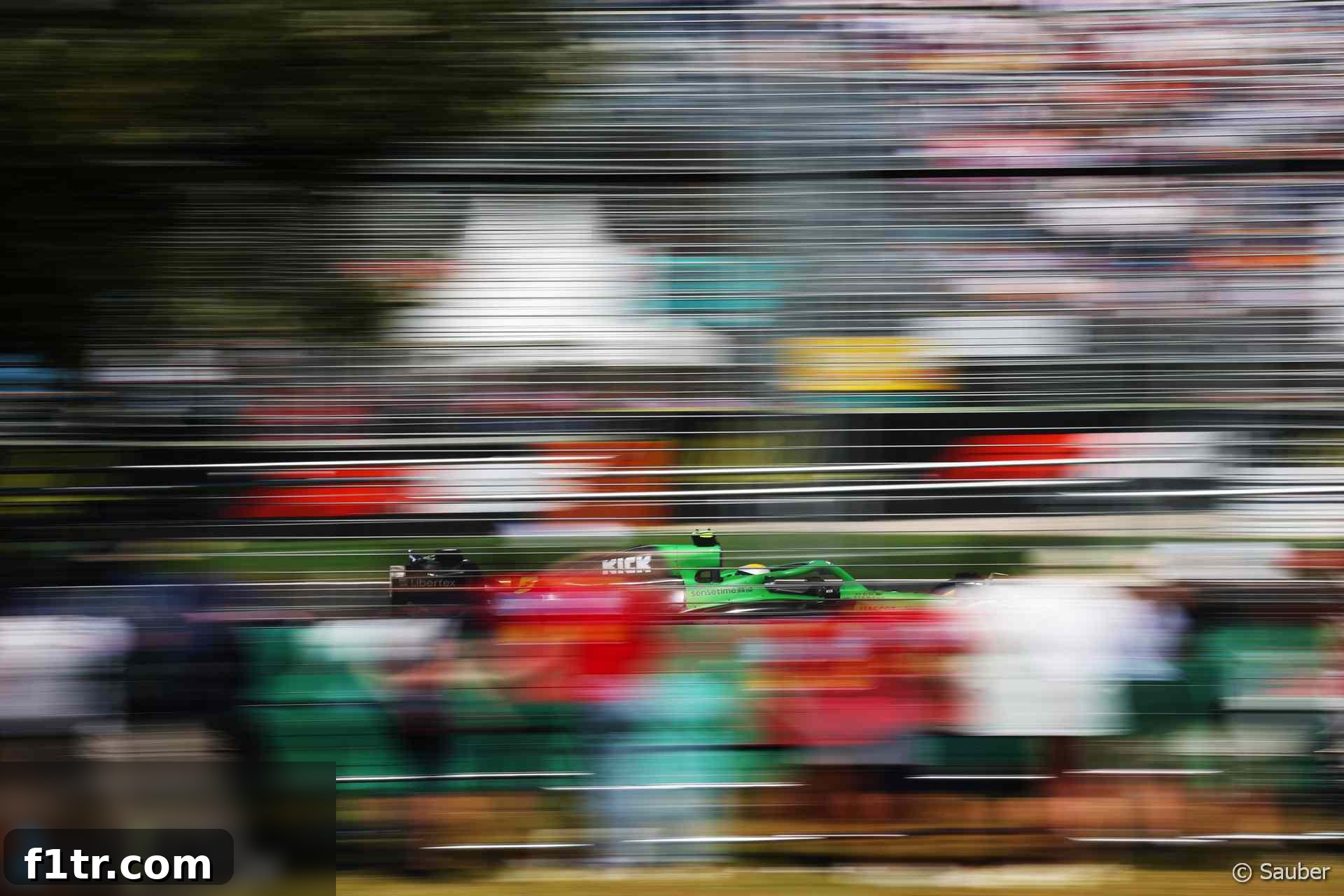
The session was interrupted for the first time by a red flag. The cause was quickly identified as a significant build-up of gravel at turn six, a corner where several drivers, including Jack Doohan and Max Verstappen, had run wide. While a gravel trap is designed to slow cars, excessive accumulation on the track can pose a hazard, potentially causing punctures or further incidents. The FIA confirmed the red flag was indeed for debris, noting, “it seems it came from a car.” This suggested that besides the dislodged gravel, a vehicle might have shed a component that cameras had not initially captured, requiring a full track inspection and cleanup. Fortunately, the delay was brief, and the session was soon cleared to restart. By this point, all twenty cars had logged a timed lap, and it was evident that Sauber appeared to be struggling at the bottom of the pecking order.
A peculiar moment from yesterday’s Supercars support races was also brought to mind, involving ducks on the track. Thankfully, none of the birds were harmed, and the F1 session managed to avoid any similar wildlife interventions.
Mid-Session Dynamics: Tyre Switches and Close Calls
Upon the resumption, a significant shift in strategy became apparent as drivers began swapping their medium tire compounds for the quicker softs, indicating a push for faster times. Max Verstappen, now on the soft compound, immediately improved his lap time to a 1’17.696. This was still four-tenths of a second shy of the best time recorded on Friday last year, showcasing the ever-evolving challenge of setting ultimate pace. George Russell, clearly pushing his Mercedes, was incredibly close behind Verstappen, trailing by a mere two-hundredths of a second. The Mercedes driver had been actively communicating with his engineering team prior to his pit stop, seeking assistance to improve his car’s balance through the high-speed corners, a crucial aspect of performance at Albert Park.
The session also saw a tense moment between two titans of the sport. Earlier, Max Verstappen encountered Carlos Sainz Jnr at turn six, an incident that prompted a stern radio message from Verstappen to his race engineer, Gianpiero Lambiase: “That was dangerous.” Such close calls are not uncommon in practice sessions as drivers explore track limits and push their cars, but Verstappen’s comment highlighted the fine margins involved. Sainz, meanwhile, continued his impressive run on the softs, producing a 1’17.401. This excellent time temporarily elevated him to the top of the leaderboard, a mere tenth of a second off Friday’s best time from last year’s event. His performance was undoubtedly encouraging for Ferrari, demonstrating their potential.
Second Red Flag: Bearman’s Significant Incident
The session was brought to a halt for a second time, this time due to a more serious incident. Young talent Oliver Bearman, driving for Haas, unfortunately crashed into the wall after running wide at the exit of turn 10. The impact appeared to be substantial, severely damaging the left-hand side of his Haas VF-25. Fortunately, Bearman quickly confirmed he was alright and was seen exiting his car, a testament to the safety standards in modern Formula 1. The resulting damage to the car and the need to clear debris led to a significantly longer red flag period compared to the first, as expected given the severity of the crash. The incident curtailed valuable track time for all competitors, emphasizing the unforgiving nature of the Albert Park circuit.
Away from the track action, some significant news emerged regarding Aston Martin. The team announced the commencement of operations in its new, state-of-the-art wind tunnel located at its Silverstone base. This development comes just two weeks after the high-profile recruitment of legendary technical guru Adrian Newey, signaling Aston Martin’s ambitious long-term plans to challenge at the very front of the grid. The new wind tunnel is a critical tool for aerodynamic development, promising to accelerate the team’s progress in designing competitive machinery for future seasons.
Final Sprint and Session Conclusion
With just 12 minutes remaining on the clock, the drivers were finally given the all-clear to head back to the pit exit as the session resumed. The final minutes saw a scramble for improved lap times, with strategic tire choices coming into play. Lewis Hamilton and Lando Norris opted for soft tires, indicating a final performance run. Max Verstappen, however, remained on mediums, suggesting he was either satisfied with his current data or focusing on longer run simulations, so no significant improvement was expected from the world champion in this final segment.
The closing stages were not without their drama. Alexander Albon, pushing hard in the Williams, unfortunately caused some pain to his car’s floor by running wide on the kerb at turn 10. A visible piece appeared to detach from his FW47, indicating potential damage that would require inspection. Earlier, Albon had performed well, moving up to sixth place, half a second off the pace of his Williams teammate, highlighting the team’s surprising early pace. There was also a moment of on-track frustration between Tsunoda and Norris at the final corner, where Tsunoda overtook the McLaren driver as Norris was preparing to begin a flying lap. They subsequently swapped places over the next two corners, an incident that ultimately compromised both drivers’ laps, preventing either from maximizing their potential on that particular run.
Fernando Alonso demonstrated his characteristic determination, switching from mediums to softs and finding an impressive three-tenths of a second, which elevated his Aston Martin to eighth place. Despite the improvement, he appeared to contend with a fair amount of understeer through turn 10, a common challenge at this circuit. Just as the session approached its climax, George Russell experienced a spin off at turn four. This proved to be an unusual location for such an incident, as he swapped ends after touching the grass on entry. Crucially, he seemed to avoid contact with any barriers and was quickly able to rejoin the track, limiting any further impact on his session.
Ultimately, it was Lando Norris who delivered the decisive blow, producing a blistering 1’17.252 in his McLaren. This exceptional lap put an end to Sainz’s temporary reign at the top, making Norris quickest by a comfortable 0.149 seconds. The McLaren driver’s performance cemented his position as the fastest in this lively and eventful first practice session.
Reflections on FP1
The first practice session for the 2025 Australian Grand Prix provided a captivating start to the race weekend. While practice sessions are always to be taken with a grain of salt, Norris topping the charts is a strong statement from McLaren. The close battle between Ferrari, Mercedes, and Red Bull, coupled with surprising pace from Williams and Racing Bulls, suggests a highly competitive season ahead. The two red flags, particularly Bearman’s significant crash, underscore the challenges and risks drivers face at this demanding circuit. Teams will now delve into the vast amounts of data collected, fine-tuning their setups and strategies ahead of FP2 and FP3, with qualifying looming on the horizon. The pecking order remains fluid, but FP1 certainly delivered on its promise of excitement and intrigue.
2025 Australian Grand Prix News:
- F1 rules change to prevent repeat of Verstappen-Bearman Australian GP confusion
- Contact with team mate may have led to Bortoleto’s Australian GP crash
- Hamilton dismisses ‘negativity’ over his radio calls. ‘Other drivers are almost abusive’
- Antonelli “got really scared” when he made “big save” on first lap of Australian GP
- Williams explain role played by car’s systems in Sainz’s race-ending crash
Browse all 2025 Australian Grand Prix articles