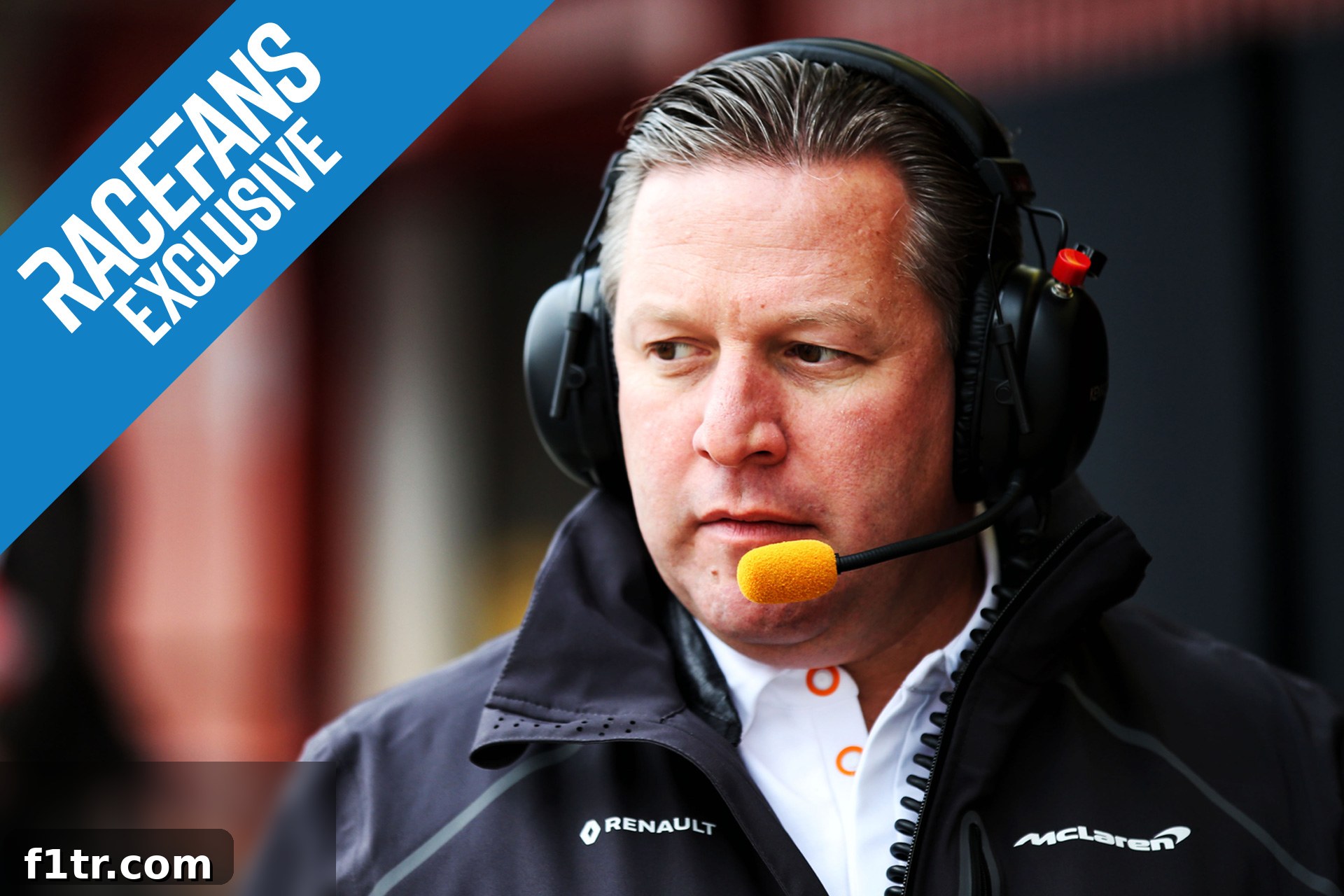
In a candid and exclusive interview, McLaren CEO Zak Brown sheds light on the sweeping organizational changes being implemented at the legendary Formula 1 team. Brown reveals why he is systematically dismantling the controversial ‘matrix management’ structure, a system widely attributed to the team’s struggles in recent years, and outlines his ambitious vision for McLaren’s future.
The Dawn of a New Era: Zak Brown’s Mandate at McLaren
When Zak Brown, renowned for his prowess as a sponsorship acquisition expert in the motorsport world, stepped into the role of McLaren executive director, it coincided with Ron Dennis’s departure after a significant disagreement with the company’s principal shareholders. The common perception within the Formula 1 paddock was that Brown was simply replacing Dennis, the towering figure who had guided the post-Bruce McLaren operation to unparalleled success before its subsequent decline.
However, Brown’s initial appointment was distinctly different. He was tasked with leading the commercial operations of the race team, while Dennis had been the CEO of the broader McLaren Technology Group, which encompassed McLaren Racing, McLaren Advanced Technologies, and various smaller entities. McLaren Automotive, the high-performance road car division, operated as a separate company, albeit with some overlapping shareholders, including Dennis himself. This complex organizational landscape would soon undergo a radical transformation.
Following Dennis’s exit, the shareholders initiated a comprehensive consolidation program, bringing all the disparate entities under a singular corporate umbrella: the McLaren Group. Within this revised structure, Zak Brown was appointed CEO of McLaren Racing, one of the three core operating divisions. One of his immediate and most critical tasks was to orchestrate a complete organizational restructure, aiming to inject clarity and efficiency into a system that had become famously convoluted.
Dismantling the Matrix: A Necessary Overhaul
The restructuring process under Brown has been significant and, at times, turbulent. It saw the departure of numerous key senior personnel, including technical director Tim Goss, racing director Eric Boullier, and engineering director Matt Morris, along with several other influential figures further down the chain of command. These exits paved the way for a fresh influx of talent and a redefinition of crucial roles.
New appointments quickly followed, signaling Brown’s intent to build a streamlined, high-performance team. Indy 500 winner Gil de Ferran, who had a brief management stint with Honda F1 a decade prior, joined McLaren as sporting director. Concurrently, Andrea Stella was promoted to performance director, and Simon Roberts assumed greater responsibilities as Chief Operating Officer (COO). The changes did not cease there; ahead of F1’s summer break, McLaren announced the high-profile recruitment of James Key from Toro Rosso as technical director – a move that reportedly caused considerable friction in Faenza, given Key’s alleged long-term contract.
A crucial aspect underpinning these new appointments is the emphasis on clearly defined job descriptions. This stands in stark contrast to the previous era at McLaren, particularly after Ron Dennis introduced the ‘matrix management’ structure at the turn of the millennium. The fact that McLaren subsequently failed to secure another constructors’ title, despite its illustrious history of eight, is widely considered to be more than mere coincidence. The complexity and inherent ambiguities of the matrix system, Brown argues, directly contributed to this drought.
Understanding Matrix Management: Why It Failed McLaren
Matrix management, a concept that first emerged in the seventies, involves individuals reporting to multiple managers, often indirectly. While such multi-layered structures can prove highly effective in project-based environments, fostering cross-functional collaboration and resource sharing, their application in traditional corporate hierarchies, particularly in the high-stakes world of Formula 1, frequently leads to confusion, a lack of accountability, and blurred lines of authority. These are critical “no-nos” in an F1 team, where rapid decision-making, clear communication, and precise execution are paramount. For McLaren, this organizational quagmire became a significant contributor to its escalating performance dilemma and a clear target for Zak Brown’s revitalization efforts.
An Interview with Intent: Zak Brown’s Unfiltered Perspective
During our monthly team principal interview series, I had the opportunity to sit down with Zak Brown in Hungary, nestled between practice and qualifying sessions, specifically to delve into these structural issues and their profound impact on the team. Initially allocated a mere 15 minutes, Brown graciously extended the session by ten minutes, delaying an eagerly awaited meeting with Carlos Sainz Jr.’s management team, whom I observed waiting patiently in the corridor. The subsequent announcement of Sainz joining McLaren for the following season would confirm the outcome of those discussions.
Upon being escorted to Brown’s office, I was struck by a noticeable change. Over the years, my interviews with various McLaren team bosses had invariably taken place in the spacious right-hand corner office on the first floor of McLaren’s hospitality unit. This time, I was directed to a smaller office on the left. Inquiring about the change and the current occupant of the former corner office, Brown’s response was immediate and telling. “Oh, it’s a team meeting room,” he explained. “That’s more important than my having more space.” The implication was clear: a shift from individual grandeur to collective efficiency and collaboration was underway at Woking, symbolizing the very cultural change Brown was striving to instill.
I wasted no time, diving straight into a somewhat provocative question: From an external perspective, McLaren appeared to be in utter turmoil. What, I pressed, was truly happening within a team that once stood as the unequivocal benchmark against which all others in Formula 1 were measured?
Diagnosing the Decline: Leadership, Stability, and Clarity
After a thoughtful pause, Brown articulated his perspective on McLaren’s trajectory. “If I look back at what got us to where we are today,” he began, “is [that] we’ve had a continuous change of leadership since – pick a year – ’10, ’11, ’12…” He referenced a tumultuous period marked by figures like Ron Dennis and Martin Whitmarsh cycling in and out of power, followed by the brief tenure of Jost Capito. “And then at the highest level, [we’ve] had shareholder changes. So I think the team has lacked leadership. Not any one individual person’s fault, but just because of the turmoil, that’s created a lack of leadership and therefore direction.”
Brown emphasized that this instability would cripple any organization, regardless of its industry. “Whether it’s a Formula 1 team or a water company, I don’t think any entity can be successful having that degree of lack of stability.” This foundational instability, he explained, then cascaded down, creating a critical deficit of clarity and effective leadership within the racing team itself. “So you had racing directors and CEOs; Jost and Eric, you had a structure that wasn’t right…”
I interjected, explicitly mentioning the two “M” words: “matrix management.” Brown confirmed, “Correct. And then because there wasn’t that overarching, consistent leadership, no one was able to recognize the issue. The issue was then probably maxed somewhat by our [Honda] power unit situation,” he conceded. Brown readily acknowledged that while the Honda engine partnership brought significant challenges, it also inadvertently masked deeper organizational flaws within McLaren, making it harder to pinpoint the root causes of their underperformance.
Bracing myself for a familiar tirade of criticism against Honda, I was surprised by Brown’s measured response. “While it definitely wasn’t all [Honda’s] fault, clearly we had tons of issues and penalties and blow-ups, so that made it harder, I think, to then go in and diagnose where are we really, because there’s other factors. And then you make that change, you put in a (Renault) power unit that Red Bull shows what you can do with it, and you have a big wake-up call…” This period served as a stark revelation, underscoring that McLaren’s struggles ran deeper than just engine performance and highlighted the urgent need for comprehensive internal reform.
Brown’s Blueprint for Revival: Structure, Communication, and Focus
Allowing Brown to continue his flow of thought, he elaborated on the multifaceted nature of McLaren’s challenges. “So it’s been structural, it’s been communication, it’s been leadership. It’s not been a person. I think some of the people that moved on were high-quality people. It wasn’t their fault. It was just not a well-run organization from the top, because it didn’t have that focus.” This statement highlighted Brown’s commitment to addressing systemic issues rather than assigning blame to individuals, fostering an environment of collective responsibility and forward momentum.
He continued, “So I think that’s what’s happened over the last five, six years. Now we’ve identified we haven’t had the right people in the right place. We’ve got a lot more right people than I think we appear to have. And so now I’m making changes to address that. I’ve hired a Technical Director…”
“You hope,” I playfully interjected, alluding to the complexities of securing high-profile talent from rival teams. Brown, undeterred, affirmed, “I’ve hired a technical director! Start date TBD.” This ‘TBD’ in ‘Zakspeak’ could signify ‘discussed,’ ‘defined,’ ‘decided,’ or ‘determined,’ reflecting the intricate negotiations involved in such top-tier recruitments.
“I’ve brought in Gil; I’ve got other things happening. I’ve done some restructuring and it’s not all been public, it doesn’t need to be public. I’ve got a plan. I’m head down. It took us five, six years to get us in the situation we’re in. We’re not going to fix it overnight.” Brown drew a parallel with FOM CEO Chase Carey, who inherited years of issues, emphasizing that deep-seated problems require sustained effort, not quick fixes. “So I think I’ve got a plan. People are starting to see it. ‘Ah, a new technical director?’ So they are paying attention.”
“Because everyone thought we need, I mean, I didn’t hire one because everyone thought we needed one, but there’s a reason why everyone else has one. And so I think I don’t want to big up the plan, because I think that’s gotten us into trouble in the past, is making predictions and big statements. So I’ve got a plan, we’ve got a plan, people are starting to see that. It’s not done, it’s not fully matured yet, and it’s going to take some time but I think we’re confident we know what we’re doing. It’s just going to be head down and get on with it and hopefully people will just see us go up the grid.” This statement underscores a pragmatic, results-oriented approach, moving away from overly optimistic pronouncements that have previously disappointed fans and media alike.
The Road Ahead: Timeline for Transformation
While Brown’s transparency was encouraging for McLaren’s legions of loyal fans, I highlighted that it took McLaren approximately four years to fully implement its matrix structure. How long, then, would it take to dismantle it and establish a more traditional, effective hierarchical ‘pyramid’ system? “I think it will take us a year,” he responded swiftly, “to the end of this decade, to really be in a position where…” This suggested a timeframe of another 12 to 18 months from the time of the interview.
“Yeah, to really get ourselves in a situation where I feel like ‘Right, I’ve got all the right people in all the right places with all the right structure, full-throttle.’” We concurred that reversing the organizational structure is far more complex than simply redrawing charts. It necessitates establishing precise job descriptions, clear reporting lines, potential job re-grading, revision of pay scales, and a re-evaluation of benefits – none of which can be accomplished in a matter of days. Furthermore, a fundamental shift in the team’s culture is imperative before McLaren can once again proudly reclaim its identity as a truly formidable Formula 1 racing team.
“Yes, yes,” he nodded in agreement. “By then I think we will be where we need to be, but then things take time to gel, work together. I’ve now got a five-year business plan.” When asked about the commencement of this ambitious plan, Brown unequivocally stated, “Starting right now,” then paused, adding, “Yes, it’ll take time to get the right people, to get the right structure. Everything you’ve mentioned is correct and we’re on it, and it’s just going to take some time. We just want to be head down, focused on it, getting on with the job, and the results will come in due course, and we don’t want to predict when.”
Brown reflected on past missteps in managing expectations. “Hence my statement, which I don’t think was a good soundbite because it wasn’t intended to be the soundbite everyone picked up on of ‘two to 10 years, maybe somewhere in between’.” This earlier comment had generated significant headlines. “Really what I was saying was ‘It’s going to take some time, don’t expect miracles overnight.’ But the ’10 years’ was a great headline.” After another brief pause, Brown refined his stance to “No timeline,” emphasizing, “We’ve got a clear plan, but much as we acknowledge the media interest in what is our plan, what are the steps on the timeline, it’s just not productive for us to get into that in too much detail. So it’s not about us being evasive, it’s just about us being sensible.”
I highlighted that it is precisely the passionate fanbase who craves specific timelines, eager to know how much longer they must wait for McLaren to consistently achieve wins, podiums, and realistic championship aspirations. “Yeah, for sure. I think what the fans need to know is we’re on it, we have a plan, we’re head down, we’re working hard and we’re trying to do it as fast as we can. I think you run a risk of saying ‘We’re going to accomplish this by this date’, because if you don’t, then you lose your fans. I think we’ve made that mistake before and we’re not going to make that mistake again.” This commitment to transparency without making unfulfillable promises marks a significant shift in McLaren’s communication strategy, prioritizing sustainable progress over fleeting optimism.
McLaren’s Future Structure and the Quest for Victory
Probing further, I asked Brown how he envisioned McLaren’s organizational structure five years down the line. “If you look at what we have now: technical director, sporting director, performance director. There’s a certain way to run Formula One teams. I think there’s probably not a big variance up and down the pit lane. So while we’re not done with our restructuring, if you drew it on a piece of paper, or you drew every race team on a piece of paper, everyone’s probably within 90%.” This suggests a convergence towards a standard, proven F1 team structure, emphasizing clarity and functional specialization as key drivers for competitive success.
The conversation then shifted to a deeper question: Could McLaren’s prolonged slide be attributed solely to its matrix structure, or was there an element of “forgetting how to win” at play? After all, the failure to secure a constructors’ championship in the new millennium must have been immensely painful for a team of McLaren’s stature. Brown candidly addressed the historical context. “So clearly we had enough resources in 2012 and before. It’s all before my time, so I think it’s a little hard for me to go back and go ‘Here’s what happened in 2004’ or ‘Why didn’t we do it in ’05 when we had a dominant car?’”
He continued, “So all I’m really doing is focusing on looking forward, and how we got to where we are. I think sitting here today, until the new rules come out in 2021, I don’t see anyone other than Ferrari or Mercedes winning in the next two years. Back then there wasn’t the budget discrepancy, so why we didn’t then, especially we had some dominant cars? I think the car was fast enough and we had great drivers. I don’t remember all the stats, probably some pretty close seconds and thirds. In ’07 we could’ve won [but for Spygate, which knocked the stuffing out of the team].”
Brown acknowledged the current reality of Formula 1, stating, “But sitting here today, I think it would be difficult to win the Constructors’ given the resource and engine situation. I don’t think anyone would beat Ferrari and Mercedes. And [we’re] just very happy that Formula 1 has recognized that and are looking to put in changes in ‘21 that would change that dynamic.” This pragmatic assessment underscores the financial and technical disparities that exist in contemporary F1, and McLaren’s hope for a more level playing field with future regulations to truly test the efficacy of their internal transformation.
Addressing Chassis Performance and “Arrogance”
Still, McLaren’s chassis performance had been notably poor in recent seasons, a fact reflected in their race results. Brown offered an explanation: “A couple of things. One, this year’s chassis is different than last year’s chassis, so… Hard to ultimately know, because when you get more power then the chassis could start doing different things. I think when you have three years of poor performance like we did, I think we took our eye off the ball.” This admission points to internal complacency or distraction during a period of underperformance, where the team might have become overly reliant on external factors or past glories.
I then raised the sensitive question of whether an element of “McLaren arrogance” contributed to their decline. Brown paused, choosing his words carefully. “I think,” he began, “what’s the right way to answer that? I wouldn’t say arrogance, but not enough looking in the mirror and challenging ourselves enough. For instance, last year our pit stops weren’t great. Sauber and Williams had great pit stops, so I think we took our eye off the ball, because pit stops have nothing to do with chassis and they have nothing to do with power unit. So we should still strive to be the best. Launches, things of that nature. So I think if you look, we haven’t been world championship calibre in all the areas that you need to be, the areas under our control.” This humble acknowledgement of shortcomings in controllable areas signifies a crucial shift in the team’s self-assessment, emphasizing a renewed focus on fundamental excellence across all operations, regardless of external circumstances.
The Legacy of Ron Dennis and Future Aspirations Beyond F1
Ron Dennis was famously adept at controlling the ‘controllables,’ yet he seemingly lost some focus when the road car division was established. Brown offered his perspective on this period: “I think at the end of the day the Group grew to a size, and if you look at what Ron had to do – he was road car, he was MAT (McLaren Applied Technologies), he was F1; meanwhile not having a great relationship with the shareholders…” This suggests that the sheer breadth of Dennis’s responsibilities, coupled with internal conflicts and the expansive growth of the McLaren Group, created an untenable situation that inadvertently diluted focus from the core F1 racing operation.
This discussion naturally led to the next pertinent area: McLaren’s burgeoning aspirations in IndyCar and Le Mans, especially while its Formula 1 team was significantly off the pace and undergoing such a profound restructure. Was this not detrimental, potentially spreading already thin resources even further? Brown was emphatic in his reassurance. “So we won’t do those other race series if we feel it compromises F1 in any way, shape or form. So the whole reason why no one’s seen us saying anything other than that we’re reviewing is because all that we’re doing is reviewing,” he clarified.
He elaborated on the strategic thinking behind these potential ventures: “If, when, when, if we decide to into other forms of racing, it will only be because first and foremost it won’t compromise our F1. So do you look at things when the budget cap comes in and we’re going to have extra resources?” Brown pointed to the successful Indy 500 collaboration with Andretti the previous year as an example of how such projects can be managed without detriment to the F1 effort. “There’s maybe some drain on maybe executive leadership time, which we have to protect and laser focus on F1, but if we were to do something in IndyCar or WEC, it wouldn’t be pulling on F1 resources.” This commitment to safeguarding F1 resources is central to his strategy, ensuring that core efforts remain uncompromised.
Driver Line-Up and the Road Ahead
The conversation inevitably turned to prospective driver line-ups, a timely topic given the team awaiting Carlos Sainz Jr.’s management outside. Just two weeks after this interview, McLaren announced Fernando Alonso would not be driving in F1 the following year, subsequently confirming Sainz as his replacement. Stoffel Vandoorne remained an option for the second seat but was under pressure to elevate his performance, while the team’s promising development driver, F2 star Lando Norris, was set to participate in first practice sessions at Spa, signaling his readiness for a potential F1 debut.
Evidently, driver selections, while critical, are currently among the lesser of Zak Brown’s immediate concerns. This allows him ample time and focus to dedicate to the monumental tasks of the team’s restructuring and securing vital sponsorships. Both are immense undertakings, and Brown’s cautious approach to setting public timelines for success is a testament to the sheer scale and complexity of the challenge ahead. McLaren’s revival, under Brown’s leadership, is a multi-year project built on clarity, accountability, and a relentless pursuit of excellence, aiming to restore the iconic team to its rightful place at the pinnacle of motorsport.
Follow Dieter on Twitter: @RacingLines