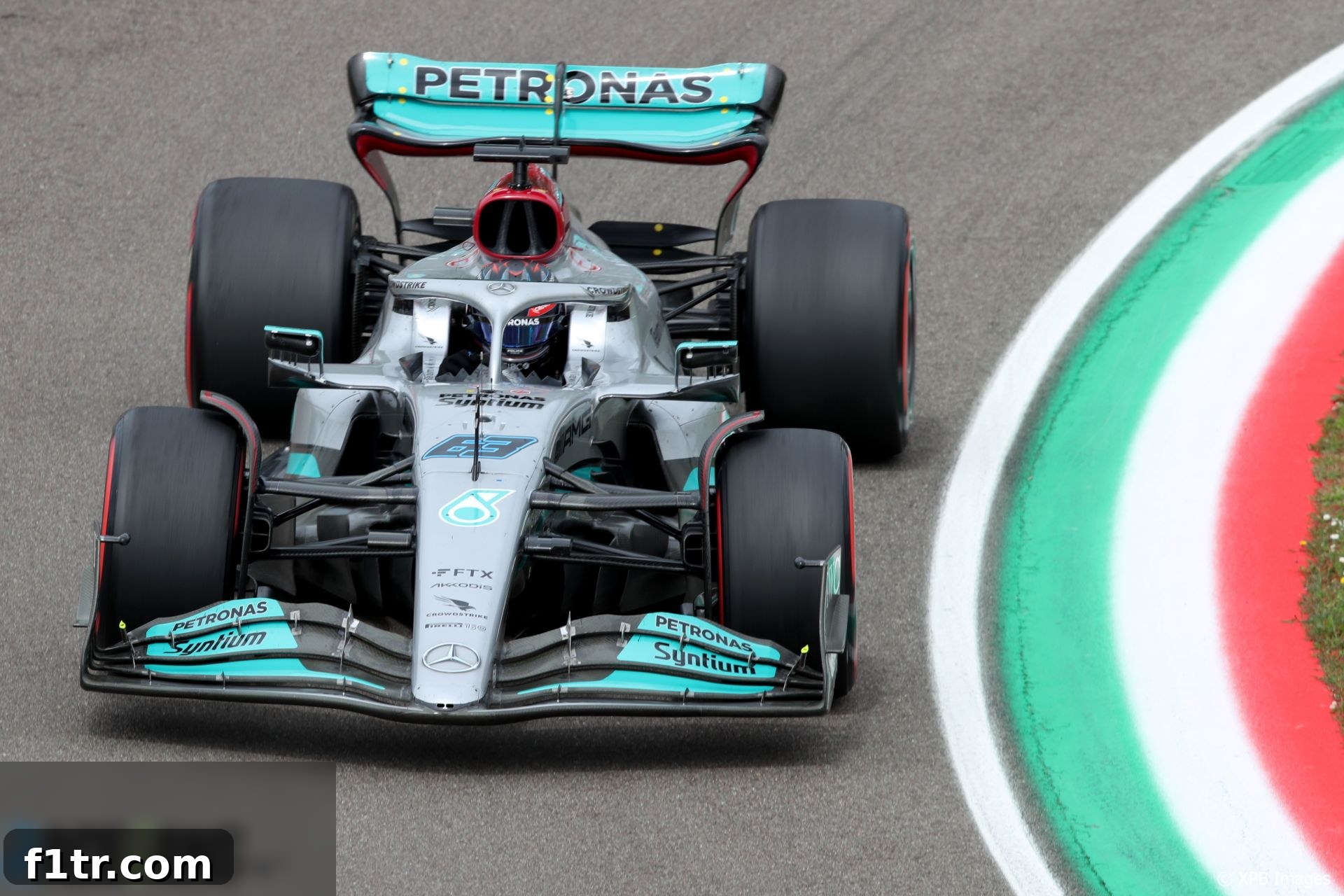
Mercedes-AMG Petronas Formula 1 Team Principal Toto Wolff has confirmed that the reigning constructors’ champions will not abandon their fundamental design philosophy for the 2022 W13 car, despite a challenging start to the season marked by significant performance issues.
The team, which has dominated Formula 1 for the better part of a decade, found itself in an unfamiliar position during the Emilia-Romagna Grand Prix weekend. Both seven-time world champion Lewis Hamilton and his new teammate George Russell were eliminated in Q2 during Friday’s qualifying session and subsequently finished outside the top 10 in Saturday’s sprint race. The primary culprit behind their struggles has been the severe ‘porpoising’ effect, a phenomenon where the car bounces violently at high speeds due, ironically, to the reintroduction of ground effect aerodynamics under the new 2022 regulations. This issue was particularly acute on the demanding Imola circuit.
Wolff emphasized that the team’s immediate attention is laser-focused on understanding and rectifying the floor design of their car, which they believe is the root cause of their current aerodynamic woes. “I think all of the goodness and badness happens mainly on the floor as it stands at the moment,” Wolff stated, highlighting the critical role this component plays in generating downforce and managing airflow under the new technical rules.
He revealed that Mercedes’ engineers are actively exploring novel solutions and innovative concepts to address the problem. “We have interesting ideas and concepts that we are exploring that have to find its way onto the car in the next few races,” Wolff added, suggesting that upgrades are in the pipeline, aiming to unlock the W13’s latent potential.
However, Wolff also cautioned against any knee-jerk reactions or premature radical changes to the car’s overall concept. The seasoned team principal is wary of a complete design overhaul without a thorough understanding of the underlying issues. “I wouldn’t say there is no such thing as a concept being wrong. But is there a part of what we have done that just simply doesn’t work with the regulations, and what is it?” he pondered, underscoring the delicate balance between targeted adjustments and wholesale changes.
The challenge lies in identifying specific problematic areas without discarding elements that might still hold long-term promise. “You don’t need to throw away the goodness, you can keep the goodness, but if there are fundamental areas that don’t allow us to unlock the potential that we believe is in the car, then obviously you need to cut your losses,” Wolff explained. This strategic dilemma encapsulates the high-stakes world of Formula 1 development, where every decision can have profound implications for championship aspirations.
Wolff stressed that it is still too early for the team to consider such a drastic ‘cut your losses’ approach. A fundamental shift in car design would represent a significant setback, essentially restarting a significant portion of their development cycle. For such a monumental decision to be made, a comprehensive and unequivocal understanding of the problem is paramount, which the team currently lacks.
“Cutting the losses is quite defined: you cut the losses,” Wolff reiterated, highlighting the gravity of such a move. “Because it would mean that you say, ‘okay, where’s the baseline now? Is there a new baseline where we can start upon where we believe that we can unlock more potential?’ Well, if we would have thought that, we would have done it five months ago.” This comment reveals the deep-seated conviction within the team that their chosen development direction, initiated well before the 2022 season, is fundamentally sound.
The commitment to their existing architectural concept is strong, making any deviation a meticulously considered and scientifically backed decision. “We believe that this is the development direction that we need to take. So it’s quite a tricky exercise to do. Before we take such a decision, we need to really continue in the science and continue in finding out what it is, because only then you can actually say, ‘okay, cut the losses, switch to next year’,” Wolff articulated. This underscores Mercedes’ methodical approach, prioritizing data-driven insights over emotional responses to their current struggles.
The ability to completely pivot their car’s design mid-season, or even abandon it for future seasons, is contingent on a clear diagnosis of the problem. “If you understand where you got it wrong,” said Wolff, “and at the moment, we simply don’t. Not yet.” This candid admission highlights the complexity of the current aerodynamic challenges under the new F1 regulations, which have significantly altered how teams generate downforce and manage airflow. Mercedes, a team renowned for its engineering prowess and meticulous attention to detail, finds itself grappling with an enigma that requires profound scientific investigation.
Mercedes F1’s Porpoising Predicament and the New Regulations
The 2022 Formula 1 season introduced sweeping regulatory changes, most notably bringing back ground effect aerodynamics. While intended to promote closer racing, these rules have inadvertently created the ‘porpoising’ phenomenon, where cars rapidly oscillate due to aerodynamic stall and reattachment cycles under the floor. Mercedes’ W13 appears to be particularly susceptible to this effect, which not only compromises performance but also significantly impacts driver comfort and confidence. The bouncing prevents the car from running at its optimal ride height, directly affecting the effectiveness of the intricate floor design, which is now the primary source of downforce.
The impact of porpoising at Imola was stark. A circuit known for its bumps and high-speed sections exacerbated the issue, hindering both Hamilton and Russell from extracting maximum performance. This aerodynamic instability limits the team’s ability to fine-tune the car’s setup, leaving them in a difficult position where improving one aspect might worsen another. For a team accustomed to fighting for victories, finishing outside the points is a significant blow, testing their resilience and strategic acumen.
The Dilemma of Design Philosophy in F1
Mercedes’ design philosophy for the W13, characterized by its distinctive ‘zeropod’ sidepod concept, has been a subject of intense scrutiny. While visually unique, it’s intrinsically linked to the car’s overall aerodynamic package, particularly the floor. Abandoning this concept entirely would mean a monumental engineering undertaking, potentially requiring a complete redesign of the car’s chassis and internal components. Such a decision, especially under the sport’s restrictive budget cap, is not taken lightly.
Wolff’s stance reflects the deep commitment and investment already poured into the current design. To simply “cut losses” implies a concession that the fundamental concept is flawed, a conclusion Mercedes is not yet ready to make. Instead, their strategy appears to be one of persistent scientific inquiry and iterative improvement, believing that the underlying performance potential of the W13 can still be unlocked through targeted modifications to the floor and associated aerodynamic elements.
The pressure on Mercedes is immense. After years of unparalleled success, the team faces a formidable challenge from competitors like Ferrari and Red Bull, who have seemingly mastered the new regulations more effectively. The performance gap is not merely a matter of a few tenths; it is substantial enough to keep Mercedes out of contention for race wins. This situation demands a perfect blend of patience, rigorous engineering, and decisive action when the full picture emerges.
Looking Ahead: The Road to Recovery
Mercedes’ journey through the 2022 season will undoubtedly be one of the most closely watched narratives in Formula 1. The team’s ability to diagnose and rectify the W13’s issues, particularly the porpoising linked to the floor, will be crucial. Wolff’s confidence in their “interesting ideas and concepts” suggests that substantial upgrades are on their way, and the next few races will be critical in determining if these developments can translate into tangible performance gains.
The commitment to scientific understanding before radical change is a hallmark of Mercedes’ engineering culture. This approach, while potentially slower in the short term, aims for a comprehensive and sustainable solution rather than a series of temporary fixes. The ultimate goal is not just to alleviate the current problems but to fully unlock the potential they believe is inherent in their W13 design, positioning them to challenge for victories and championships once again. The path ahead is challenging, but Mercedes remains steadfast in its methodical pursuit of excellence.
2022 Emilia-Romagna Grand Prix
- Aston Martin’s first points reward “immense” effort by factory after Melbourne crashes
- Verstappen becomes 14th driver in F1 history to score more than one ‘grand slam’
- Transcript: “I need more power” – Hamilton and Russell’s contrasting fortunes at Imola
- Ferrari backs increase to six sprint races as F1 Commission meets in London
- Ocon blames pit equipment after penalty for near-miss with Hamilton in pits
Browse all 2022 Emilia-Romagna Grand Prix articles