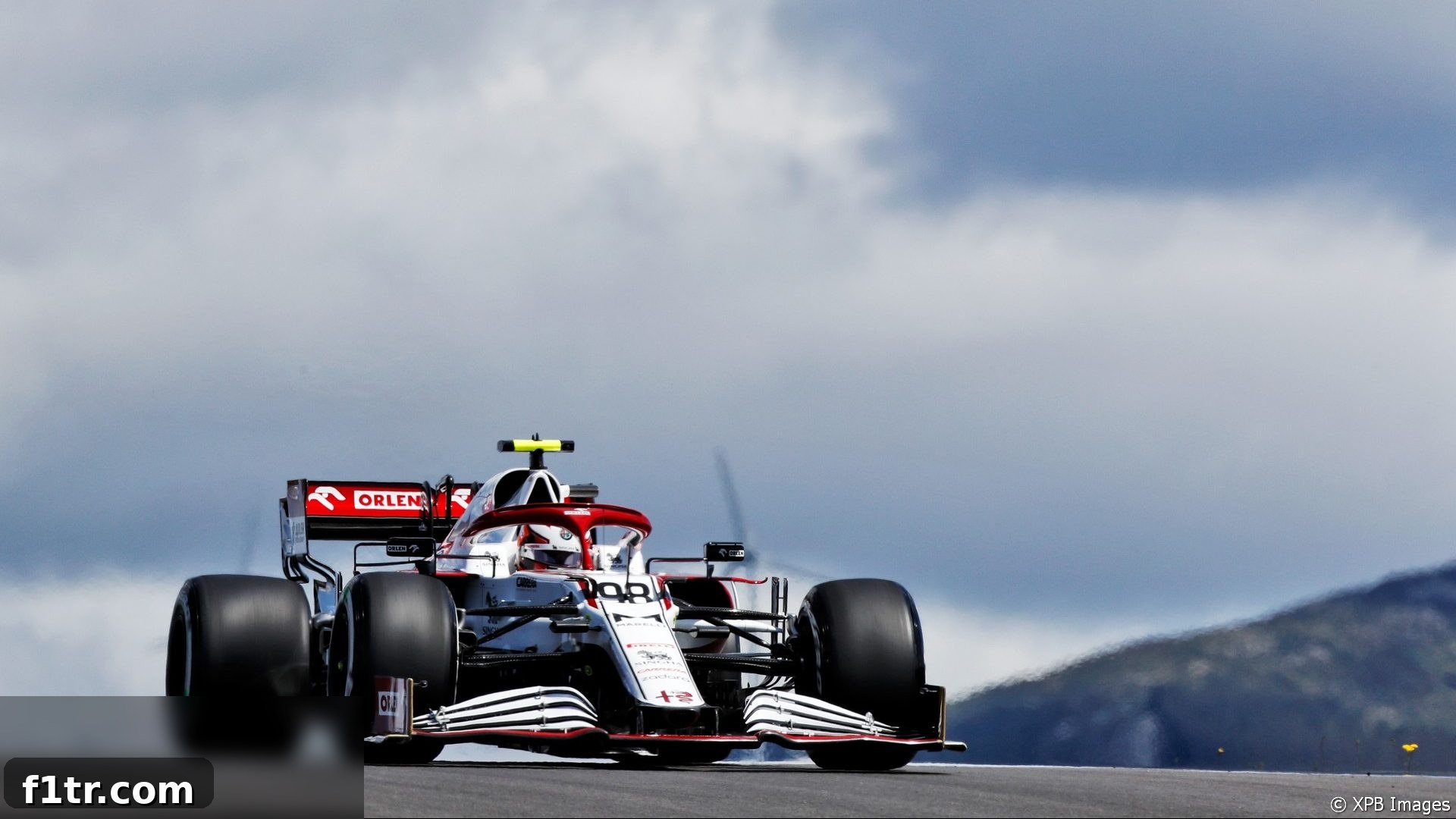
In the high-octane world of Formula 1, every moment on track is a precious opportunity, especially for emerging talent. Callum Ilott, a promising figure in the motorsport landscape, seized his first official F1 practice session at the Portuguese Grand Prix with a mix of cautious optimism and a dose of unexpected aerodynamic drama. Despite grappling with a playfully described “Churchill bulldog” crash helmet, Ilott deemed his outing in the Alfa Romeo Racing C41 a resounding success, yielding invaluable data for both himself and the team.
The Algarve International Circuit, a picturesque yet notoriously challenging venue, presented its usual array of complexities for the drivers. Many, including Ilott, noted the track’s distinctive slippery characteristics, reminiscent of the previous year’s conditions. “I think the track was very similar to last year in the characteristics and some of the difficulties,” Ilott reflected. “On that side, I think it caught us out a little bit in the beginning. Obviously, for me, I was still taking it easy as well, so it was interesting to experience it.” For a young driver making their debut, understanding and adapting to such a unique surface is paramount, and Ilott’s cautious approach allowed him to progressively build confidence and speed.
Navigating the Slippery Slopes of Portimão: A Rookie’s Initiation
The Algarve circuit, with its undulating terrain and often low-grip surface, is a true test of a driver’s skill and an F1 car’s setup. Its sweeping corners and elevation changes demand precision and a delicate touch. For a rookie like Callum Ilott, stepping into an F1 cockpit for the first time in an official capacity on such a track is a baptism of fire. The initial stages of any practice session involve a careful exploration of the track limits, braking points, and optimal lines. The “not so easy to start with” sentiment expressed by Ilott is a common refrain among drivers tackling the Portimão challenge, particularly when the track feels slick.
The inherent low grip meant that finding the limit was a gradual process. Ilott’s methodical approach was evident as he worked through his initial laps, gradually pushing the boundaries of the Alfa Romeo. This measured start is crucial for data gathering, allowing the team to compare the car’s real-world performance with simulator predictions and make initial adjustments. It’s a delicate balance between extracting performance and avoiding costly mistakes, a tightrope walk that young drivers must master under immense pressure.
Chasing the Veteran: Ilott’s Pace Against Kimi Raikkonen
A key metric for any reserve driver or young talent in an F1 practice session is their comparative performance against their established teammate. In Ilott’s case, the benchmark was none other than Kimi Raikkonen, the veteran “Iceman” known for his consistent pace and deep understanding of an F1 car. Ilott’s progress in closing the gap to the experienced Finn was a source of considerable satisfaction.
During his stint on the hard compound tyres, Ilott managed to get within a mere tenth of a second of Raikkonen – an impressive feat given his limited experience in the car. “Once I was up to speed a bit with the tyres, getting used to it, I think I finished the run on the hards one tenth off Kimi, which wasn’t too bad at the time,” he recounted. This close proximity to a world champion speaks volumes about Ilott’s natural talent and quick learning curve.
However, the transition to the softer compound tyres presented a fresh challenge. Soft tyres, while offering significantly more grip, demand a different driving style and a more precise understanding of their operating window. “Then we went to the softs and I completely got caught out at the beginning by how much grip and also getting the tyres in,” Ilott admitted. Adapting to the sudden increase in grip and managing the tyre warm-up process effectively can be tricky, even for seasoned drivers. Yet, true to his adaptable nature, Ilott quickly recalibrated. “But then we came in, rebalanced and I think with the tyre mileage I had, I didn’t do a bad time.” This ability to acknowledge a challenge, adjust, and still deliver a respectable performance is a testament to his burgeoning maturity as a racing driver.
The Intricacies of Setup: Taming the Oversteer
Beyond pure driving, a significant component of any F1 practice session involves refining the car’s setup. Drivers provide crucial feedback to engineers, who then make adjustments to parameters like suspension, aerodynamics, and differential settings. Ilott identified car balance as a primary area of focus during his session. “I was struggling a little bit with the balance, I think it was quite oversteery,” he explained.
Oversteer, where the rear end of the car loses grip before the front, can make a car feel unstable and challenging to drive, particularly through high-speed corners. Correcting an oversteer tendency requires delicate inputs from the driver and precise adjustments from the pit wall. “So obviously I was waiting for the team to give me the information on that side,” Ilott added, highlighting the symbiotic relationship between driver and engineering team. The conditions themselves added another layer of complexity. “We had to make quite a few changes, we tried to keep it as simple as possible, but the conditions were a bit more sketchy in some areas than expected.” This iterative process of feedback, adjustment, and re-evaluation is fundamental to unlocking a car’s full potential and tailoring it to a driver’s preference and the track’s demands.
The “Churchill Bulldog” Helmet Saga: An Unexpected Aerodynamic Challenge
Perhaps the most memorable anecdote from Ilott’s session was the unexpected issue with his crash helmet. Stepping into Antonio Giovinazzi’s car meant inheriting a cockpit setup tailored for another driver’s physique. Ilott, being shorter than Giovinazzi, found himself in a slightly different aerodynamic envelope, leading to significant buffeting at high speeds. “It was a little bit on the wobbly side,” he admitted with a hint of amusement. “Reminded me of the Churchill bulldog.”
This light-hearted comparison belies a serious underlying issue. In Formula 1, even the smallest distraction can have a major impact on performance and safety. A wobbly helmet, particularly at speeds exceeding 300 km/h, can impair vision, concentration, and cause discomfort. “It’s quite hard to get the balance and obviously the helmet is used a lot to redirect the air and maybe the positioning with me is a bit different to Antonio,” Ilott elaborated. The precise interaction between the driver’s helmet and the car’s aerodynamics is critical for optimal airflow and driver comfort. While it was primarily noticeable at top speeds, such an issue necessitates immediate attention, and Ilott confirmed, “I was a bit uncomfortable but we’ll make some changes for next time.” This highlights the meticulous attention to detail required in F1, where even a millimetre can make a difference.
Beyond the Lap Times: A Wealth of Data for Driver and Team
For a young driver’s F1 practice outing, the ultimate measure of success isn’t necessarily a headline-grabbing lap time, but rather the quality and quantity of data gathered. Ilott’s session at Portimão proved immensely valuable in this regard for both him and the Alfa Romeo Racing team. “Overall we were building the consistency and I was very happy with the session, got through all the run plan that we needed to and discovered the limitations that we had as a team and as a driver as well,” he stated.
This “run plan” typically involves a series of specific tests: aero runs, tyre evaluations, brake balance assessments, and setup changes. Every lap provides crucial information that engineers analyze to understand the car’s behaviour, validate simulation models, and identify areas for improvement. For Ilott himself, this track time is indispensable. It allows him to correlate his simulator experience with real-world driving, understand the nuanced feedback of an F1 car, and further hone his skills. “So overall lots learned from my side and I think lots learned from the team.” Such comprehensive data acquisition forms the bedrock of future development, both for the aspiring driver and the competitive F1 team.
The Road to F1: Ilott’s Journey and Missed Opportunities
Callum Ilott’s journey to this official F1 practice session has been one marked by talent, determination, and a touch of unforeseen circumstance. A prominent member of the Ferrari Driver Academy and a formidable competitor in Formula 2, Ilott has long been earmarked as a future F1 prospect. His opportunity to participate in an official Grand Prix weekend session at the Portuguese Grand Prix was particularly significant, given a previous disappointment.
Last year, Ilott was scheduled to make his F1 practice debut at the Eifel Grand Prix at the Nürburgring. However, fate intervened in the form of inclement weather. Persistent low-hanging cloud prevented the medical helicopter from operating safely, leading to the cancellation of the entire practice session before the pit lane even opened. For any young driver, such a missed opportunity is incredibly frustrating, delaying a crucial milestone in their career. Ilott subsequently had to wait until the young driver’s test in Abu Dhabi for another chance to get behind the wheel of an F1 car. Therefore, his unhindered run at Portimão was not just a practice session, but a hard-earned reward and a vital step forward in his aspirations to join the elite ranks of Formula 1.
Looking Ahead: The Future is Bright for Callum Ilott
Callum Ilott’s performance at the Portuguese Grand Prix was a clear demonstration of his potential and adaptability. Despite the inherent challenges of a slippery track, a new car, and even a troublesome helmet, he maintained a professional approach, gathered vital information, and showed encouraging pace against an experienced teammate. His feedback and the data collected will undoubtedly prove invaluable for Alfa Romeo Racing as they continue to develop their car throughout the season.
For Ilott, this official practice session adds another layer of experience to his impressive resume, reinforcing his credentials as a driver ready for the pinnacle of motorsport. It’s these opportunities, these moments of learning and proving oneself under pressure, that pave the way for a future in Formula 1. With his talent, dedication, and now, a solid official F1 practice under his belt, the racing world will be watching Callum Ilott’s journey with keen interest.
2021 Portuguese Grand Prix
- Pirelli’s tyre choice for Portuguese GP wasn’t “too hard”, Hamilton concedes
- Who are the top F1 juniors bidding for a grand prix debut in 2022?
- 2021 Portuguese Grand Prix Star Performers
- Race gains encourage Ricciardo after ‘unacceptable’ qualifying performance
- Sainz says top-five finish was possible after first no-score for Ferrari
Browse all 2021 Portuguese Grand Prix articles