The dawn of the 2019 F1 season brought a stark reality check for the legendary Williams Racing team. From the very first practice sessions, their new challenger, the FW42, found itself firmly rooted at the bottom of the timesheets. The performance deficit was not marginal; the FW42 lagged well over a second and a half behind even the next-slowest competitors, a significant margin in the hyper-competitive world of Formula 1. This immediate underperformance set an ominous tone for what would become one of the team’s most challenging seasons.
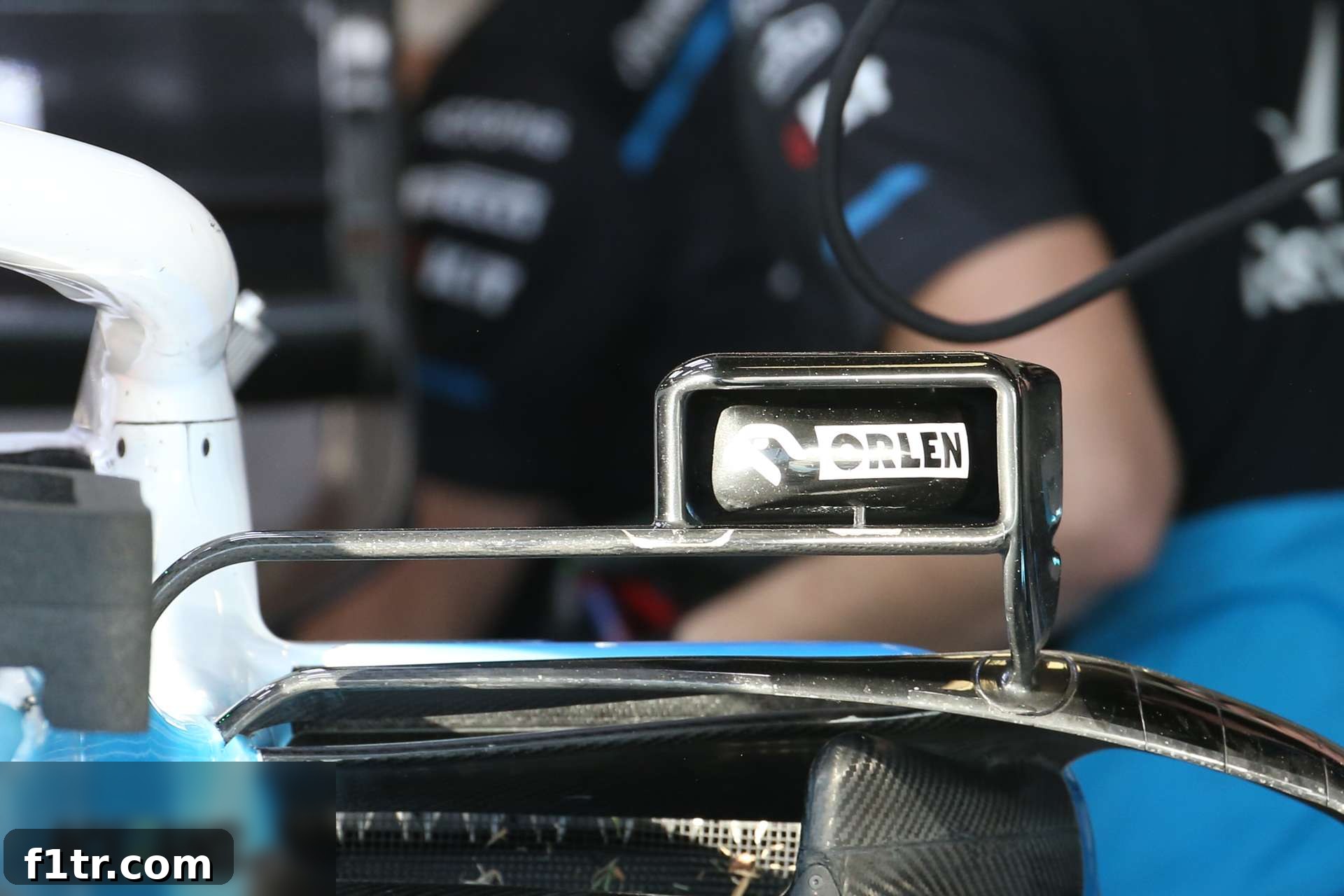
Before the lights even went out for the Australian Grand Prix, Williams faced critical technical scrutiny. The team arrived at the FIA garage for scrutineering with two significant technical modifications to the FW42. These changes were a direct consequence of queries raised by rival teams during pre-season testing, which cast doubts on the legality of specific design elements on the FW42 – specifically, its rear-view mirrors and front suspension. To avoid potential disqualification or further sanctions, Williams opted to replace these controversial designs with more conventional, compliant solutions ahead of the season opener in Melbourne.
Williams FW42: Pushing the Boundaries of F1 Regulations
Despite a turbulent period marked by various crises behind the scenes, Williams’s design philosophy for the 2019 FW42 remained as aggressive as ever. The team, known for its innovative engineering, pushed the envelope with two key aspects of the car’s design. These interpretations took a very liberal approach to the wording of the FIA’s technical regulations, inevitably drawing the attention and scrutiny of both competitors and the governing body regarding their legality.
In Formula 1, the technical regulations are a bible for designers, but also a playground for those seeking competitive advantage through creative interpretation. Teams often invest heavily in finding ‘grey areas’ within the rules, designing components that are technically compliant on paper but fulfill an aerodynamic or performance function unintended by the rulemakers. Williams’s FW42, at its initial presentation, was a prime example of this audacious approach.
The Controversial Rear-View Mirrors
The first area of contention revolved around the FW42’s rear-view mirrors. In recent years, mirrors and their mountings have evolved from simple safety devices into complex aerodynamic elements. Teams have increasingly exploited their design and placement for aerodynamic gain, creating downwash, influencing airflow around the chassis, and even directing air towards critical cooling inlets. Recognizing this trend, several new regulations were introduced for the 2019 season to curb such exploitation. These rules meticulously defined the size and position of the mirror pod – the housing that mounts the mirror itself – and strictly limited it to a maximum of two mountings.
Williams’s initial mirror design was a bold interpretation of these new rules. They reshaped the mirror pod into a distinct vane-shaped structure. This design ingeniously took advantage of the angled mirror surface, which is necessary to provide the driver with a clear rear view due to wider mounting positions. However, the unique merging of the reshaped mirror pod and its mounting created a single, aerodynamically efficient vane. Rivals quickly queried whether this integrated design went beyond the “intention” of the revised regulations, arguing that it primarily served an aerodynamic purpose rather than purely supporting the mirror.
In response to the scrutiny, Williams presented a revised mirror setup at Albert Park for the Australian Grand Prix. This new design was far more conventional, aligning with typical F1 2019 configurations. The mirror pod now adopted a ducted design, reminiscent of Ferrari’s 2018 mirrors, and was mounted with two much simpler, less aerodynamically integrated supports. This revised setup was widely expected to gain the FIA scrutineers’ approval, effectively putting an end to any further debate regarding the legality of this particular component.
The ‘Seventh Member’ Front Suspension Innovation
The second major technical challenge for the FW42 involved its front suspension. During pre-season testing, observers noted an unusual “extra leg” attached to the car’s lower front wishbone. This additional, thinner carbon fibre element trailed behind and slightly below the main lower wishbone. Strategically positioned, this extra part was believed to offer a useful aerodynamic effect. Its design and placement suggested it could generate beneficial downwash, directing airflow towards the bargeboards and the front sections of the sidepods – areas crucial for optimizing overall aerodynamic performance.
However, this “seventh member” immediately raised questions about its compliance with the prevailing rules for suspension components. Formula 1 regulations explicitly limit the number of members allowed to support the wheel. Generally, this allows for just six primary members: two for each wishbone (an upper and a lower), and one each for the pushrod (or pullrod) and the track rod. Furthermore, these members must be symmetrical and restricted in their angle relative to the floor, precisely to minimize any beneficial aerodynamic effect they might inherently possess.
Williams’s inclusion of a seventh member appeared to be a broad interpretation of a specific rule exemption. The regulations state that suspension members carrying brake lines, tethers, or wiring are exempt from the aforementioned geometrical rules regarding symmetry and angle. The team seemingly argued that this additional carbon fibre leg served a purpose related to carrying one of these exempted items, thereby legitimizing its presence and circumventing the six-member limit. However, the primary suspicion remained that its design was fundamentally aerodynamically driven, exploiting the loophole rather than strictly adhering to its spirit.
Faced with such a broad and potentially contentious interpretation of long-established rules, Williams once again chose the pragmatic route. To avoid further dispute and ensure compliance, the team opted to remove the seventh member from the FW42’s front suspension. It is presumed that any brake lines, tethers, or wiring that were previously routed through this part were subsequently re-routed through the main cross-section of the wishbone itself. In this modified format, the legality of the car’s front suspension was no longer in question, but the compromise undoubtedly impacted the team’s initial design philosophy and potential aerodynamic gains.
Implications for Williams and the 2019 Season
These early-season technical controversies and subsequent modifications placed Williams in an even more precarious position. Already struggling with significant financial and organizational issues, having to redesign and adapt critical components before the first race added immense pressure to a team already stretched thin. The time and resources diverted to ensuring legality meant less focus on performance optimization and resolving the FW42’s inherent pace deficit.
The performance challenges of the FW42 throughout the 2019 season were well-documented. The car consistently remained at the back of the grid, often by significant margins, failing to score a single point for much of the season until a solitary point was awarded in Germany due to post-race penalties for other competitors. This inability to extract performance was undoubtedly exacerbated by the technical compromises forced upon them even before the season began. The initial aggressive design, while perhaps aimed at finding a breakthrough, ultimately backfired, highlighting the fine line between innovative interpretation and outright rule-breaking in Formula 1.
The saga of the FW42’s mirrors and suspension underscores the perennial cat-and-mouse game between F1 teams and the FIA. Teams will always seek to maximize performance within the confines of the regulations, and often just beyond the spirit of them. The FIA, in turn, must constantly monitor and clarify rules to maintain a level playing field and prevent designs that could compromise safety or create an unfair advantage. For Williams, the 2019 season, starting with these immediate technical hurdles, became a painful lesson in ambition meeting strict regulatory reality, contributing to one of the most difficult periods in the team’s illustrious history.
F1 technology
- McLaren, Red Bull and Ferrari bring rear corner updates to Imola
- Ferrari, McLaren and Red Bull bring upgrades again for Saudi Arabian Grand Prix
- McLaren introduce major floor upgrade for Norris’ car at Mexican Grand Prix
- McLaren, Mercedes and Red Bull detail upgrade packages for United States GP
- Red Bull remove engine cover ‘cannons’ in major RB20 update – but they may return
Browse all F1 technology articles