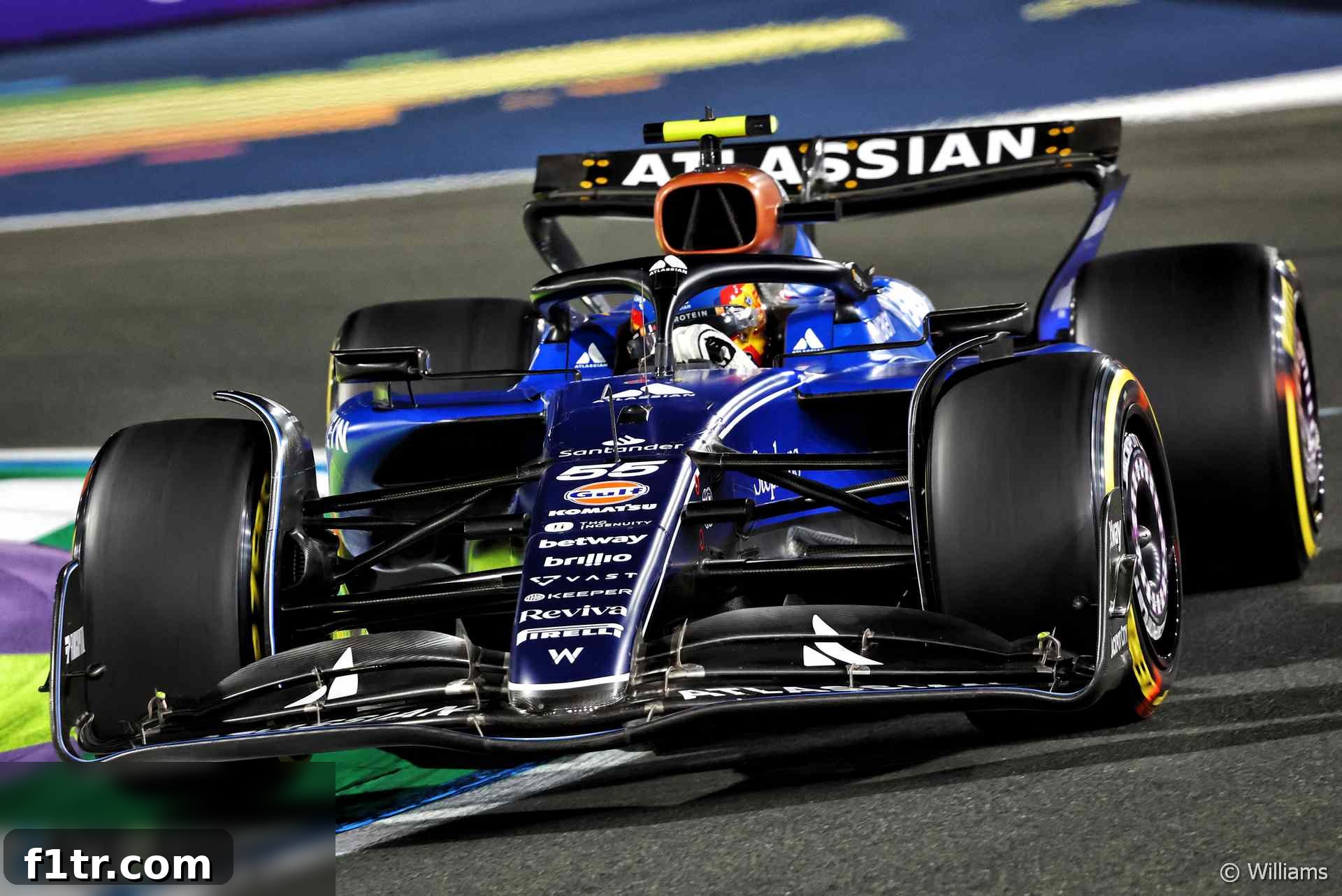
Carlos Sainz Jr., currently driving for Ferrari, found himself in a familiar and strategically challenging position leading into the Saudi Arabian Grand Prix. For the second consecutive race weekend, Sainz had impressively qualified one spot ahead of Lewis Hamilton, the Mercedes driver set to take his place at Ferrari in the upcoming season. However, Williams Team Principal James Vowles issued a clear warning, emphasizing that Sainz must not squander precious time or tyre life attempting to hold off significantly faster cars like Hamilton’s during the race.
Advert | Become a Supporter & go ad-free
Strategic Prudence: Carlos Sainz Urged to Prioritize Points Over Battles with Lewis Hamilton in Saudi Arabian Grand Prix
The exhilarating world of Formula 1 is a delicate balance of raw speed, unwavering skill, and shrewd strategic decision-making. As the F1 season progresses, every point gained, or lost, can significantly impact a team’s championship aspirations and a driver’s standing. In this high-stakes environment, particularly for teams in the competitive midfield, knowing when to fight and when to conserve is paramount. This strategic dilemma was at the forefront of discussions surrounding Carlos Sainz Jr.’s approach to the Saudi Arabian Grand Prix, with seasoned F1 figures offering valuable insights.
The Nuance of Midfield Racing: James Vowles’ Perspective on Sainz’s Performance
James Vowles, a veteran of Formula 1 with a keen strategic mind, observed Sainz’s performance with a discerning eye. Vowles, currently leading Williams Racing, acknowledged Sainz’s exceptional qualifying prowess. “I’m really proud of the steps Carlos is making,” Vowles shared with the official Formula 1 channel. He highlighted Sainz’s impressive control during the session, noting, “He was really in control. It was great to hear him on the radio, in control of what was going on in the session and just working with the team on the best run plan to get him up as high as possible.” This praise underscored not just Sainz’s raw talent but also his methodical approach and strong communication with his team, critical attributes for any top-tier F1 driver.
Vowles specifically lauded Sainz’s qualifying lap in Jeddah. “And it was a brilliant lap. They really made some good time up in turn one, two, three and just held on to it.” Such a performance, securing a grid position ahead of a multiple world champion like Lewis Hamilton, speaks volumes about Sainz’s current form and ability to extract maximum performance from his Ferrari package. However, Vowles’ commendation came with an important strategic caveat, one that forms the crux of the advice he imparted.
Learning from Bahrain: A Costly Overtake Battle
The previous race in Bahrain served as a stark lesson in strategic prudence. In that Grand Prix, Carlos Sainz found himself locked in an intense battle with Lewis Hamilton during the opening stint. While such head-to-head racing is thrilling for spectators, Vowles pointed out that it came at a significant cost for Sainz and, by extension, Ferrari. The aggressive defense against a quicker car led to excessive tyre degradation, compromising Sainz’s race pace and overall strategy later in the event. This tactical misstep ultimately cost him a more favourable points position.
“Carlos said this himself, but we have to take a little bit of care with Lewis,” Vowles explained, drawing directly from the Bahrain experience. “We can qualify there, but we’re not quite on that race pace yet.” This statement succinctly captures the gap in performance between the cars at this stage of the season. While Sainz’s Ferrari could sometimes match or even briefly outpace the Mercedes in a single qualifying lap, maintaining that advantage over a full race distance, especially when pushing hard against a faster rival, proved unsustainable. “So I think one of the reflections from Bahrain is it was great to race the Ferrari, it looked great, but it did cost us a points position. So it’s making sure we race correctly for where the car is tomorrow,” Vowles reiterated, emphasizing the critical importance of realistic race management for securing valuable championship points.
Carlos Sainz Jr.’s Evolving Race Craft: A Realistic Approach to Competition
Crucially, Carlos Sainz Jr. himself echoed Vowles’ sentiments, demonstrating a mature understanding of his current position and the strategic demands of Formula 1. Before the Saudi Arabian Grand Prix commenced, Sainz openly admitted his need to adjust his approach. He stated that he realized he needed to “pick my fights a bit better” than he did in Bahrain, a clear sign of his self-awareness and commitment to continuous improvement.
Sainz elaborated on the shifting dynamics of competition, especially when facing the top-tier teams like Ferrari (his own team, interestingly), Mercedes, and Red Bull. “Unfortunately this year I think with the Ferrari, the Mercedes and the Red Bulls I need to, if I’m ahead of them, last year I was fighting them hard but maybe this year I need to be a bit more realistic and let them go,” he acknowledged. This represents a significant strategic shift, recognizing that while his car might offer formidable qualifying pace, its race-day performance, especially against the absolute front-runners, might necessitate a different philosophy.
The strategic nuance extends to track characteristics. Sainz wisely differentiated between circuits where aggressive defensive driving can pay off versus those where it’s a losing battle. “Especially on a track like Bahrain, where overtaking in the end is easy and they’re going to pass you. Other tracks, not so much. Maybe Suzuka or other tracks like Monaco, you definitely fight it out.” This insight highlights the importance of adapting strategy not just to the car’s performance but also to the unique layout and overtaking opportunities presented by each circuit on the F1 calendar. For tracks with ample overtaking zones, like Bahrain and potentially the high-speed Jeddah Corniche Circuit, expending valuable tyre life in a futile defense against a clearly quicker car is a suboptimal strategy. Instead, focusing on one’s own race, preserving tyres, and ensuring a strong finish within the points becomes the priority. “But in tracks like Bahrain, maybe pick a bit better the fights and commit to make sure you’re finishing in the points,” Sainz concluded, underscoring his refined strategic mindset.
Don’t Miss a Moment from Formula 1!
Stay updated with all the latest stories, analyses, and exclusive content directly in your inbox. No marketing, no ads – just pure F1 insights. Sign up here:
Advert | Become a RaceFans supporter andgo ad-free
The Unpredictability of Jeddah: Opportunities Amidst Chaos
Beyond individual driver strategy and car performance, the nature of the Jeddah Corniche Circuit itself adds another layer of complexity and opportunity to the Saudi Arabian Grand Prix. Vowles aptly noted the inherently unpredictable character of the race in Jeddah. “Points are on the table, that’s where the car’s been all weekend. But, and it’s always a big but here, it’s never a normal race. We’ve always had red flag [or] Safety Cars that dominate it. So it’s just a question of where that falls.”
The Jeddah circuit, known for its high-speed corners and close proximity to walls, has a history of dramatic incidents. This often leads to extended Safety Car periods, Virtual Safety Cars, or even red flags, which can completely reset race strategies, create unexpected pit stop windows, and shuffle the running order. For a team like Williams, and for a driver like Sainz who is strategically astute, these chaotic elements present a unique chance to capitalize. While sheer pace might dictate performance in a clean race, the intervention of safety cars can level the playing field, allowing teams to gain positions through smart timing and opportunistic decisions rather than raw speed alone. This unpredictability means that even if a car is not among the absolute quickest, maintaining a clean race, staying out of trouble, and being ready to react to sudden changes can be the key to securing valuable championship points.
Williams’ Strategic Imperative: Maximizing Every Opportunity
For James Vowles and Williams Racing, every point is a treasure. The team is on a journey of rebuilding and improvement, and maximizing results from every Grand Prix is vital for their long-term aspirations. Vowles’ advice to Sainz, while directed at a competitor, implicitly reflects the strategic mindset Williams aims to instill in its own drivers. It’s about racing intelligently, understanding the car’s limitations relative to the competition, and focusing on the achievable. In a championship where the midfield is incredibly tight, avoiding unnecessary battles that deplete resources like tyres, fuel, or even risk damage, is a fundamental aspect of race management.
The goal is always to bring the car home in the highest possible position, converting strong qualifying performances into tangible points. This conservative yet opportunistic approach, advocated by Vowles and acknowledged by Sainz, is not a sign of weakness but rather a demonstration of strategic intelligence. It recognizes the pecking order while remaining alert to the ever-present possibilities that F1 races, especially on challenging circuits like Jeddah, often provide.
The Broader F1 Landscape: Sainz’s Future and Impact
Carlos Sainz Jr.’s situation at Ferrari, coupled with the announcement of Lewis Hamilton taking his seat next season, adds another layer of intrigue to his strategic decisions. As a driver currently performing at a very high level, yet without a confirmed seat for the following year, every race becomes an audition. His ability to consistently deliver strong results, manage races intelligently, and demonstrate mature decision-making is crucial for his future in Formula 1.
His willingness to reflect on his past strategies, like the Bahrain incident, and openly discuss adjusting his approach for different track types, reinforces his reputation as a thoughtful and adaptable driver. This kind of self-awareness and strategic discipline makes him an attractive prospect for any team looking for a consistent points-scorer and a strong team player. The dynamic between him and Hamilton, both on track and in the narrative of their respective team moves, further heightens the spotlight on Sainz’s performances. His ability to navigate these challenges with strategic clarity will undoubtedly define much of his 2024 season and shape perceptions of his long-term value in the sport.
Conclusion: The Evolving Art of F1 Race Strategy
The advice from James Vowles to Carlos Sainz Jr. concerning the Saudi Arabian Grand Prix perfectly encapsulates the evolving art of Formula 1 race strategy. It’s no longer just about who has the fastest car or the bravest driver; it’s about a sophisticated understanding of tyre degradation, circuit characteristics, the relative pace of competitors, and the unpredictable nature of the race itself. Sainz’s self-reflection and willingness to adapt demonstrate a maturity that is essential for success at the pinnacle of motorsport.
As the F1 season unfolds, drivers and teams will continuously grapple with these strategic choices. For Sainz, the imperative to prioritize points, manage resources wisely, and pick his battles judiciously will be key to a successful season, solidifying his reputation as one of F1’s most intelligent and consistent performers, even in the face of significant competitive pressures. The Jeddah Corniche Circuit offered another chapter in this ongoing strategic saga, where prudence often triumphs over aggressive ambition.
2025 Saudi Arabian Grand Prix Related Articles
- Red Bull made tactical decision not to avoid a penalty in Jeddah, Horner confirms
- Norris’s starts were far poorer than Verstappen’s but the balance is shifting
- McLaren’s rivals “just one upgrade away from being the lead car” – Brown
- Russell told race control what he thought of Verstappen’s first lap corner cut
- Doohan’s final corner pass on bortoleto was F1’s closest fight for last place in seven years
Browse all 2025 Saudi Arabian Grand Prix articles