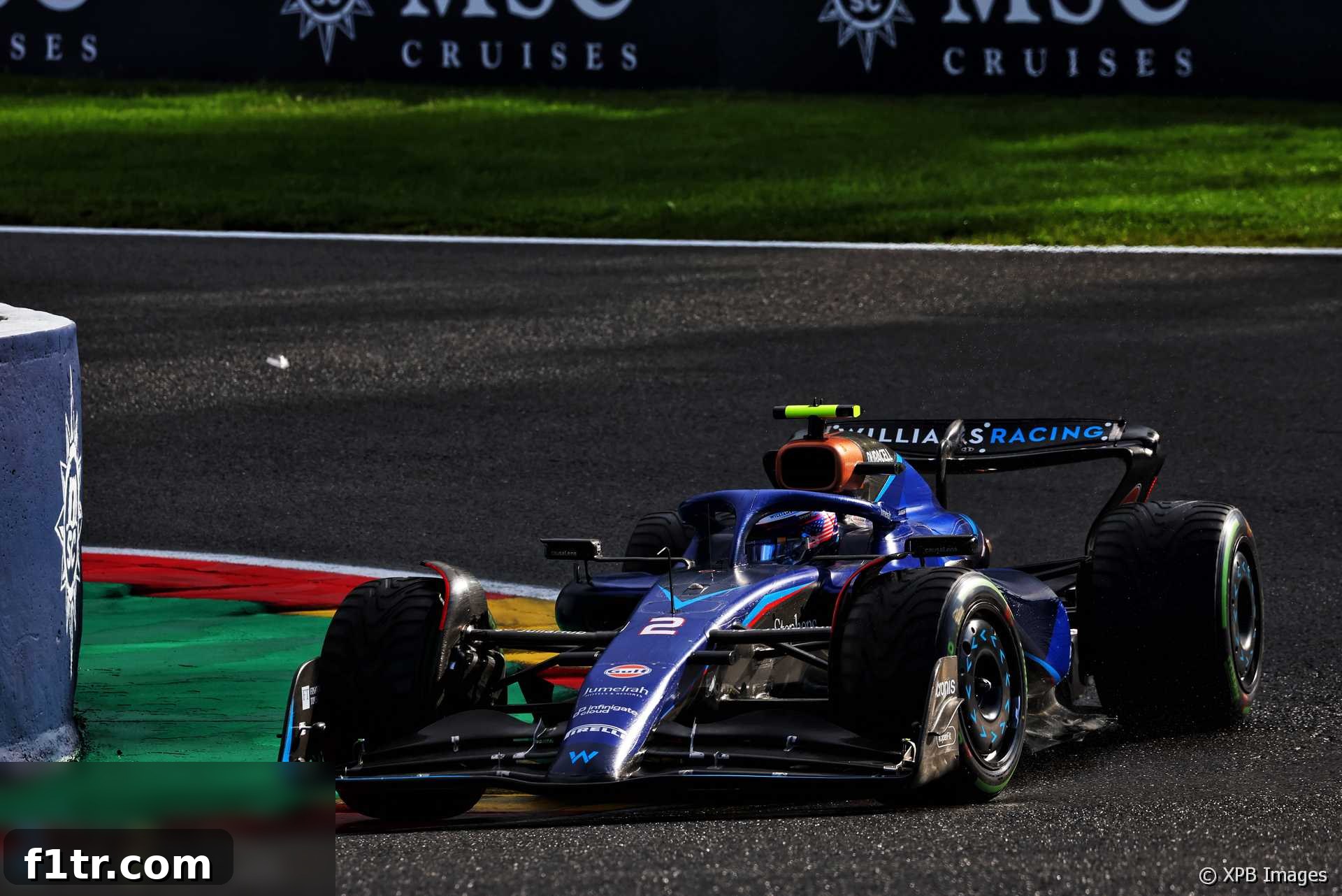
Williams F1’s Unforeseen Tyre Degradation Nightmare at the Belgian Grand Prix
The highly anticipated Belgian Grand Prix at Spa-Francorchamps presented an unexpected and formidable challenge for Williams Racing. Their drivers, Alexander Albon and Logan Sargeant, were taken by surprise by an alarming rate of rear tyre degradation, a critical issue that fundamentally derailed their race strategy and compromised their overall performance. This unforeseen struggle forced the team into an atypical three-stop strategy, a stark contrast to most of their rivals who largely opted for more conventional one or two-stop approaches.
A Challenging Weekend Unfolds at Spa-Francorchamps
The weekend started with glimmers of hope but quickly descended into a battle against the clock and, more critically, against rapidly deteriorating Pirelli rubber. While both Williams drivers initially failed to advance past Q1 in Friday’s main qualifying session, they managed to reach Q2 during Saturday’s sprint shootout, demonstrating flashes of potential. However, the true test came in the main race on Sunday, where their persistent tyre issues proved insurmountable. Albon finished 14th, and Sargeant, after incurring a penalty in the sprint, ended up 17th on Sunday, both positions far from their and the team’s aspirations.
Logan Sargeant’s Battle: “A Really Difficult Car to Drive”
Rookie driver Logan Sargeant articulated the team’s profound struggles, highlighting the FW45’s challenging behaviour during the Grand Prix. “It didn’t go our way, for sure. As a team, we struggled a lot with rear degradation, in particular on that medium tyre,” Sargeant lamented. His comments underscored a widespread issue within the team rather than an isolated incident.
The American driver elaborated on the frustrating experience from behind the wheel: “It was just a really difficult car to drive today. Maybe it’s to do with the low downforce set-up that we went for; we just struggled to keep the tyres alive.” This revelation points towards a potential mismatch between the car’s aerodynamic configuration, specifically tailored for Spa’s long straights, and its impact on tyre longevity. While Albon and Sargeant displayed promising pace in the initial laps, their strategy quickly unravelled. “I could see Alex ahead, we both had a really, really good first six, seven laps. But I think we left that first stop too late,” Sargeant noted, reflecting on the crucial early stages of the race.
Beyond strategy missteps, the underlying lack of pace was a bitter pill to swallow. “That aside, we didn’t have the pace today. It was a frustrating day, and we weren’t expecting that level of degradation. We came in quite positive, and it hasn’t panned out the way we wanted it to,” Sargeant concluded, emphasizing the stark difference between pre-race expectations and on-track reality. He stressed the immediate need for the team to “definitely regroup, see what happened, and try and come back better” – a sentiment that resonates with any team facing an unexpected performance setback.
Alexander Albon’s Gritty Fight Against Degradation
Alexander Albon, known for his ability to extract performance from the Williams car, also found himself locked in a relentless struggle against tyre wear. Starting from 15th on the grid, Albon demonstrated his typical fighting spirit, making an impressive climb to seventh within the first five laps. However, this early gain proved unsustainable as the severe degradation set in. “I knew the start was good,” Albon recounted, “but I was almost surprised that I fell out of the points around the mid stint.”
Albon’s race unfolded as a series of defensive manoeuvres that inadvertently exacerbated his tyre woes. He pitted on lap seven, re-emerging in 10th place after the initial round of pit stops, and maintained a similar position after the second round. Yet, the relentless tyre wear meant he continuously lost ground. “At the end of the stint there, just struggling with deg. It was a tricky race the whole race,” Albon explained, pinpointing the low-downforce setup as a double-edged sword. “Running that low downforce, which is great fun in some ways and in other ways, especially when you go through like Sector Two, it’s not that fun anymore. And it’s just degrading the tyres so much.”
The Low Downforce Dilemma: A Spa Specialisation Backfiring
The choice of a low-downforce setup for Spa-Francorchamps is a common strategy amongst teams aiming to maximise speed on the circuit’s notoriously long straights, such as the run through Eau Rouge and Raidillon and the Kemmel Straight. While this configuration reduces aerodynamic drag, leading to higher top speeds, it also reduces grip through corners, particularly in the twisty middle sector (Sector 2) of the track. This decreased grip means drivers often have to slide the car more, putting increased strain on the tyres, especially the rears. For Williams, this trade-off, intended to play to their strengths on straights, appears to have backfired severely, leading to a vicious cycle of sliding, overheating, and rapid degradation.
Albon confirmed this observation, stating, “We saw it already on the wet tyres, we predicted a lot of deg for us. But it was a bit of a wake-up call just how much deg we did have today, particularly on that medium tyre.” The severity of the issue, even after pre-race predictions, underscores the unexpected scale of the problem they encountered.
The challenge was compounded by the intense on-track battles. “To race the cars around me, I was basically having to over-push in Sector Two because as soon as I backed off one corner, as soon as I tried to manage the tyre in the places you need to – Turn 10, Turn 11, Turn 12 – I was immediately under fire. I almost immediately got overtaken by the car behind,” Albon revealed. This constant pressure forced him into a detrimental feedback loop: “So I had to almost over-push the tyre to stay in front. And then it’s a vicious cycle because you then degrade more, and you’re already trying to save the tyre but you’re not allowed to, you don’t have the freedom.”
Strategic Headaches: The Unforeseen Three-Stop Gamble
In a race where most competitors gravitated towards a two-stop strategy, and a select few even managed a single stop, Williams found themselves almost uniquely committing to three pit stops. While Lewis Hamilton also stopped three times, his final visit to the pits was a calculated move to secure the fastest lap bonus point, not a necessity driven by tyre wear. For Williams, the extra stop was a clear indicator of their fundamental problem.
“We had to make that call to go to the three-stop, just with the level of degradation we had,” Sargeant confirmed, highlighting the lack of viable alternatives. Despite the additional time lost in the pit lane, he believed it ultimately offered a better outcome: “It ended up giving us a better end result, I think.” This difficult strategic decision underscores the profound impact of their tyre woes, forcing them away from optimal race strategy and into damage limitation mode.
Unraveling the Mystery: Why Such Degradation?
The perplexing nature of the tyre degradation left both drivers and, presumably, the team’s engineers scratching their heads. “I can’t really explain why we had that level of degradation. I’m not sure any of us can. So we’re going to have to dig into it and see why,” Sargeant admitted. This admission signals a critical period of analysis for Williams as they seek to understand the root causes. Was it a specific characteristic of the FW45 on this particular track? Was it a sensitivity to the medium compound tyre under specific conditions? Or was it an inherent flaw in their setup philosophy for low-downforce circuits? The answers will be crucial for their development moving forward.
Looking Ahead to Monza: A Repeat Performance Risk?
The lessons learned from Spa-Francorchamps take on added significance as Formula 1 looks towards Monza, often dubbed the “Temple of Speed.” Monza is another circuit that demands a very low-downforce setup, similar in principle to Spa, which Williams typically predicts would suit their car. Albon expressed his initial optimism for Spa, believing Williams “would do better” there, making the unexpected struggles even more concerning for the Italian Grand Prix.
Understanding their unexpected degradation issues from Spa will be paramount for Monza. “That’s really going to be our next best chance to score points,” Albon stated, underlining the importance of rectifying these problems before arriving at the iconic Italian circuit. The team will need to meticulously analyse data from Belgium, correlating it with simulations for Monza, to prevent a recurrence of their tyre nightmare.
A Silver Lining: Rain’s Unexpected Intervention
Amidst the relentless struggle, a brief shower of rain during the race offered a temporary, unexpected reprieve for Albon. “When it started to rain, it cooled my tyres down, and it gave me more grip than I had in the dry,” he explained. This meteorological interlude provided a momentary boost, allowing him to regain some lost ground. “So I actually caught [drivers who passed me] back up again, and actually had a resurgence of pace, which just shows you how much overheating we were doing.” This observation starkly illustrates the extent to which Albon’s tyres were suffering from overheating, a primary factor in degradation, and how even a slight drop in temperature could significantly improve their performance.
Performance Data Insights: Albon Lap Times Comparison
The raw performance data further illuminated Williams’ struggles. A comparison of Alexander Albon’s lap times with those of Esteban Ocon, a driver he was battling when the rain began, would reveal key insights. Typically, such a chart would show Albon’s lap times being consistently slower or rapidly degrading compared to Ocon’s in dry conditions, particularly in the sectors most affected by the low-downforce setup and tyre wear. The brief period of rain, however, would likely show Albon’s times narrowing the gap or even temporarily surpassing Ocon’s, supporting Albon’s claim of finding unexpected pace as his tyres cooled. This data would visually underscore the dramatic impact of tyre temperature and degradation on Williams’ race performance at Spa.
Conclusion: A Critical Review for Williams
The 2023 Belgian Grand Prix served as a critical wake-up call for Williams Racing. What began with optimistic hopes for points quickly transformed into a challenging exercise in managing severe and unexpected tyre degradation. Both Alexander Albon and Logan Sargeant fought valiantly, but the inherent issues with the car’s interaction with the Pirelli tyres, exacerbated by the chosen low-downforce setup, proved too significant to overcome. The team’s forced adoption of a three-stop strategy, a rarity for most of their competitors, speaks volumes about the extent of their struggles.
As the Formula 1 season progresses, Williams faces the crucial task of dissecting the data from Spa-Francorchamps. Understanding the precise mechanisms behind this unprecedented degradation will be vital, not only for improving their performance on future low-downforce circuits like Monza but also for informing the development of their future challengers. The ability to manage tyre performance is often the differentiator in modern Formula 1, and Williams’ capacity to address this unexpected Achilles’ heel will be a key determinant of their success for the remainder of the season and beyond.
Supporting Independent Motorsport Journalism
Providing insightful and in-depth coverage of Formula 1 requires dedication and resources. Our commitment to delivering original journalism, directly from the heart of the paddock, is made possible through the valued support of our readers. Your contributions help cover the essential costs involved in creating high-quality, independent motorsport content, including travel, reporting, analysis, and development.
We pride ourselves on over a decade of reader-backed journalism. If you appreciate our unbiased and comprehensive reporting, please consider supporting independent motorsport journalism. Your support ensures we can continue to bring you closer to the action and deeper into the stories that matter in Formula 1.
- Learn More About Supporting Our Journalism
- Frequently Asked Questions About Support
2023 Belgian Grand Prix Further Reading
- Haas drivers fear losing battle for seventh after “grim weekend” in Spa
- Mercedes optimistic they’re “in the right place for winter” with development plan
- Ferrari not convinced by call to equalise engines: ‘Renault is not so far away’
- Ferrari staying “calm” amid swings in performance from race to race
- Pirelli proposes new “super-intermediate” to address wet weather tyre problems
Browse all 2023 Belgian Grand Prix articles