Lewis Hamilton’s Precarious Pole: Navigating the Russian Grand Prix Challenge
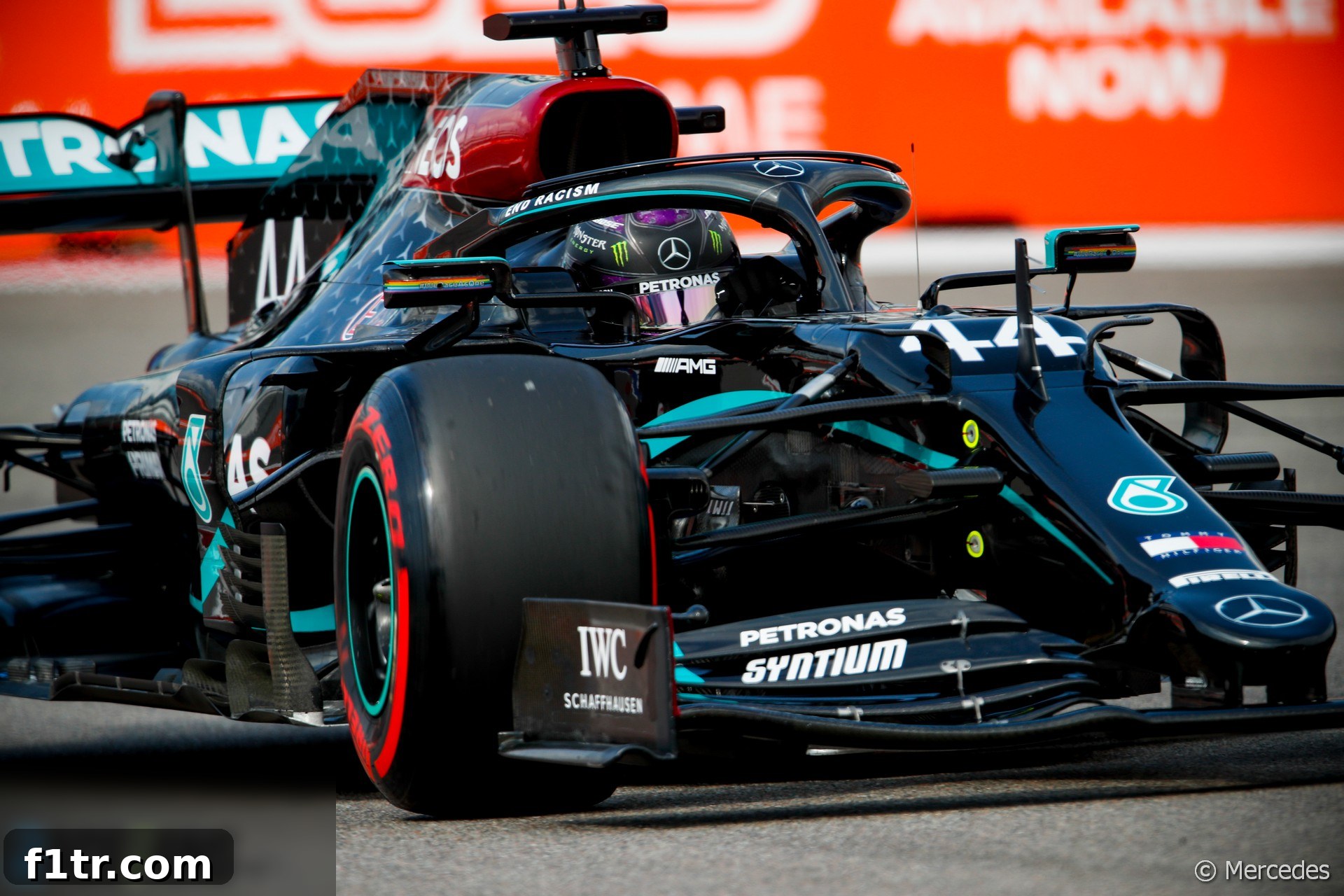
As the engines roar to life for Sunday’s Russian Grand Prix, all eyes are on Lewis Hamilton. Despite clinching a remarkable pole position, his starting situation appears far more vulnerable than typical for a driver of his caliber at the front of the grid. A confluence of factors – a less-than-ideal tire compound choice, the unique characteristics of the Sochi Autodrom, and the critical cleanliness of the starting grid – have conspired to create a high-stakes scenario that could define his race from the very first lap.
The Tire Conundrum: Soft vs. Medium at Sochi
One of the most significant talking points following qualifying centered on Hamilton’s tire choice. Unlike his closest championship rivals, he was unable to secure a Q2 time on the preferred medium compound tires due to unforeseen setbacks during the session. This forces him to start the race on the softer compound, a strategic compromise that Mercedes team principal Toto Wolff openly acknowledged was “clearly not the optimum strategy.”
Wolff articulated the inherent risks: “Because after some laps, the soft is clearly going to suffer. That means it compromises your whole race because you probably need to pit into traffic. And then obviously it’s not a great situation.” The concern is that the soft tires, while offering superior initial grip, tend to degrade faster than the mediums, potentially forcing Hamilton into an earlier pit stop. This early stop could drop him into the thick of the mid-pack traffic, making overtaking difficult and disrupting his race rhythm. The pressure to manage these tires effectively will be immense, turning what should be a straightforward race from pole into a delicate balancing act of pace and preservation.
Conversely, his primary competitors, including Max Verstappen, who demonstrated shrewd racecraft to secure a front-row start, and teammate Valtteri Bottas, starting P3, will both launch on the more durable medium rubber. This strategic advantage allows them greater flexibility in their pit stop windows, potentially enabling them to run longer first stints and giving them clearer air to manage their pace without the immediate pressure of severe tire degradation.
Experience F1 Ad-Free for just £1 per month>> Discover more and sign up today
A Silver Lining for the Softs?
Despite the prevailing concerns from Mercedes, not everyone views the soft tire choice as a definitive disadvantage. Renault’s sporting director, Alan Permane, offered a more optimistic assessment, suggesting that the soft compound might perform better than anticipated at Sochi. Permane predicted that drivers starting on softs could comfortably manage “15, 20 or so laps” in their opening stint, which, in a 53-lap race, is far from catastrophic.
“It’s not as bad as we’ve seen certainly before here in previous years on an even stiffer compound,” Permane noted. “I think when we had the thicker gauge tires, the C4 we had here one year was awful. This tyre’s behaving pretty well for a soft tyre.” He further bolstered his argument by observing practice sessions: “Some people were running reasonably long stints on it yesterday afternoon. We saw people I think this morning running multiple laps on it and going faster. So no, we’re not worried about it.”
Permane’s insights suggest that while the top teams might prefer mediums for their strategic comfort, the performance delta between the two compounds might not be as vast as feared, particularly in race conditions. The initial grip offered by the soft tires could even be a secret weapon for Hamilton, providing a crucial launch advantage on the notoriously long run to Turn 2.
The Sochi Start: Long Run, Dirty Side, and Slipstream Dynamics
Sochi is unique for its exceptionally long run from pole position to the first significant braking zone at Turn 2, stretching over 800 meters. This distance inherently allows for a substantial slipstream or ‘tow’ effect, granting cars behind the pole-sitter an opportunity to gain significant speed and challenge for the lead. Hamilton, starting from pole, will inevitably be “serving up a generous tow to his pursuers,” a situation amplified if a headwind is present.
Adding another layer of complexity is the grid itself. Concerns have been raised about the varying grip levels on either side of the starting grid. Carlos Sainz Jnr articulated these worries: “There is a dirty side, particularly this year off-line it looks very dirty.” He elaborated, “Today in the out-laps whenever I was trying to overtake a car or get out of line, the dirty side or off-line it was particularly dirty. A lot of stones, a lot of dust coming out of the car in front.”
This “dirty side” phenomenon is critical because two of Hamilton’s quickest starting rivals, teammate Valtteri Bottas in third and Daniel Ricciardo’s Renault in fifth – a car known for its great getaways lately – have landed on what is perceived to be the cleaner side of the grid. This could hand them an immediate traction advantage off the line, allowing them to capitalize on the tow and challenge Hamilton even before Turn 2. For Hamilton, starting from pole on the potentially dirtier side, maximizing the soft tire’s initial grip becomes paramount to negate any traction deficit.
Hamilton’s Resilience and Strategic Balancing Act
Lewis Hamilton’s career is replete with examples of him overcoming adversity, and the Russian Grand Prix presents another such test. While his post-qualifying comments revealed his preference for the medium tire – “I did plead to have the medium tyre but they weren’t having it,” he explained – he also showed his trademark resolve: “It doesn’t matter now, it’s happened so we will just make do with what we have.” This adaptability and determination will be crucial as he faces a complex race scenario.
The interplay of these factors creates a fascinating strategic chess match. Hamilton’s soft tires could provide a sensational launch, potentially giving him a few vital extra meters over Bottas and Verstappen on the long dash to Turn 2. This initial burst of grip might just be enough to break the tow effect or at least place him in a stronger defensive position. In this sense, one ‘disadvantage’ – the soft tire – could, ironically, cancel out another – the vulnerability of pole position on Sochi’s long straight. The early laps will be critical, demanding precise execution from Hamilton to establish a lead and manage his tires against rivals with a potentially more robust strategy.
Quotes: Dieter Rencken
Qualifying Times in Full
| Driver | Car | Q1 | Q2 (vs Q1) | Q3 (vs Q2) | |
| 1 | Lewis Hamilton | Mercedes | 1’32.983 | 1’32.835 (-0.148) | 1’31.304 (-1.531) |
| 2 | Max Verstappen | Red Bull | 1’33.630 | 1’33.157 (-0.473) | 1’31.867 (-1.290) |
| 3 | Valtteri Bottas | Mercedes | 1’32.656 | 1’32.405 (-0.251) | 1’31.956 (-0.449) |
| 4 | Sergio Perez | Racing Point | 1’33.704 | 1’33.038 (-0.666) | 1’32.317 (-0.721) |
| 5 | Daniel Ricciardo | Renault | 1’33.650 | 1’32.218 (-1.432) | 1’32.364 (+0.146) |
| 6 | Carlos Sainz Jnr | McLaren | 1’33.967 | 1’32.757 (-1.210) | 1’32.550 (-0.207) |
| 7 | Esteban Ocon | Renault | 1’33.557 | 1’33.196 (-0.361) | 1’32.624 (-0.572) |
| 8 | Lando Norris | McLaren | 1’33.804 | 1’33.081 (-0.723) | 1’32.847 (-0.234) |
| 9 | Pierre Gasly | Toro Rosso | 1’33.734 | 1’33.139 (-0.595) | 1’33.000 (-0.139) |
| 10 | Alexander Albon | Red Bull | 1’33.919 | 1’33.153 (-0.766) | 1’33.008 (-0.145) |
| 11 | Charles Leclerc | Ferrari | 1’34.071 | 1’33.239 (-0.832) | |
| 12 | Daniil Kvyat | Toro Rosso | 1’33.511 | 1’33.249 (-0.262) | |
| 13 | Lance Stroll | Racing Point | 1’33.852 | 1’33.364 (-0.488) | |
| 14 | George Russell | Williams | 1’34.020 | 1’33.583 (-0.437) | |
| 15 | Sebastian Vettel | Ferrari | 1’34.134 | 1’33.609 (-0.525) | |
| 16 | Romain Grosjean | Haas | 1’34.592 | ||
| 17 | Antonio Giovinazzi | Alfa Romeo | 1’34.594 | ||
| 18 | Kevin Magnussen | Haas | 1’34.681 | ||
| 19 | Nicholas Latifi | Williams | 1’35.066 | ||
| 20 | Kimi Raikkonen | Alfa Romeo | 1’35.267 |
Sector Times Overview
| Driver | Sector 1 | Sector 2 | Sector 3 |
|---|---|---|---|
| Lewis Hamilton | 33.361 (2) | 31.330 (1) | 26.544 (1) |
| Max Verstappen | 33.513 (3) | 31.613 (3) | 26.741 (3) |
| Valtteri Bottas | 33.337 (1) | 31.459 (2) | 26.844 (6) |
| Sergio Perez | 33.884 (7) | 31.696 (6) | 26.635 (2) |
| Daniel Ricciardo | 33.631 (4) | 31.691 (5) | 26.827 (5) |
| Carlos Sainz Jnr | 33.908 (9) | 31.690 (4) | 26.888 (8) |
| Esteban Ocon | 33.904 (8) | 31.894 (8) | 26.818 (4) |
| Lando Norris | 34.017 (13) | 31.889 (7) | 26.860 (7) |
| Pierre Gasly | 34.029 (14) | 31.984 (9) | 26.987 (11) |
| Alexander Albon | 33.940 (11) | 32.086 (10) | 26.966 (10) |
| Charles Leclerc | 33.967 (12) | 32.254 (13) | 27.018 (12) |
| Daniil Kvyat | 33.939 (10) | 32.204 (12) | 26.952 (9) |
| Lance Stroll | 33.870 (5) | 32.194 (11) | 27.300 (15) |
| George Russell | 33.870 (5) | 32.358 (15) | 27.355 (16) |
| Sebastian Vettel | 34.152 (15) | 32.338 (14) | 27.079 (13) |
| Romain Grosjean | 34.611 (20) | 32.728 (17) | 27.253 (14) |
| Antonio Giovinazzi | 34.358 (16) | 32.817 (18) | 27.419 (18) |
| Kevin Magnussen | 34.433 (18) | 32.719 (16) | 27.380 (17) |
| Nicholas Latifi | 34.396 (17) | 32.927 (19) | 27.743 (20) |
| Kimi Raikkonen | 34.501 (19) | 33.098 (20) | 27.668 (19) |
Support RaceFans and enjoy an ad-free experience
Over to you, RaceFans!
The stage is set for a thrilling Russian Grand Prix. Will Max Verstappen leverage his medium tires and the slipstream to challenge the Mercedes drivers from the outset? Or will Valtteri Bottas, starting on the clean side of the grid, be Lewis Hamilton’s most immediate threat? More importantly, can Hamilton transform his perceived tire disadvantage into a tactical masterpiece at the start?
Share your predictions, analyses, and hopes for the Russian Grand Prix in the comments section below. We want to hear your views!
Further Reading: 2020 Russian Grand Prix Insights
- Despite F1 drivers’ concerns, stewards don’t give penalty points for “minor infringements”
- 2020 Russian Grand Prix Star Performers
- “Slower” Ferrari only beat us because of Q3 tyre rule – Tost
- “I may not always get it right” says Hamilton after penalty criticism
- Why did the stewards make their second U-turn this year on a Hamilton penalty call?
Browse all 2020 Russian Grand Prix articles