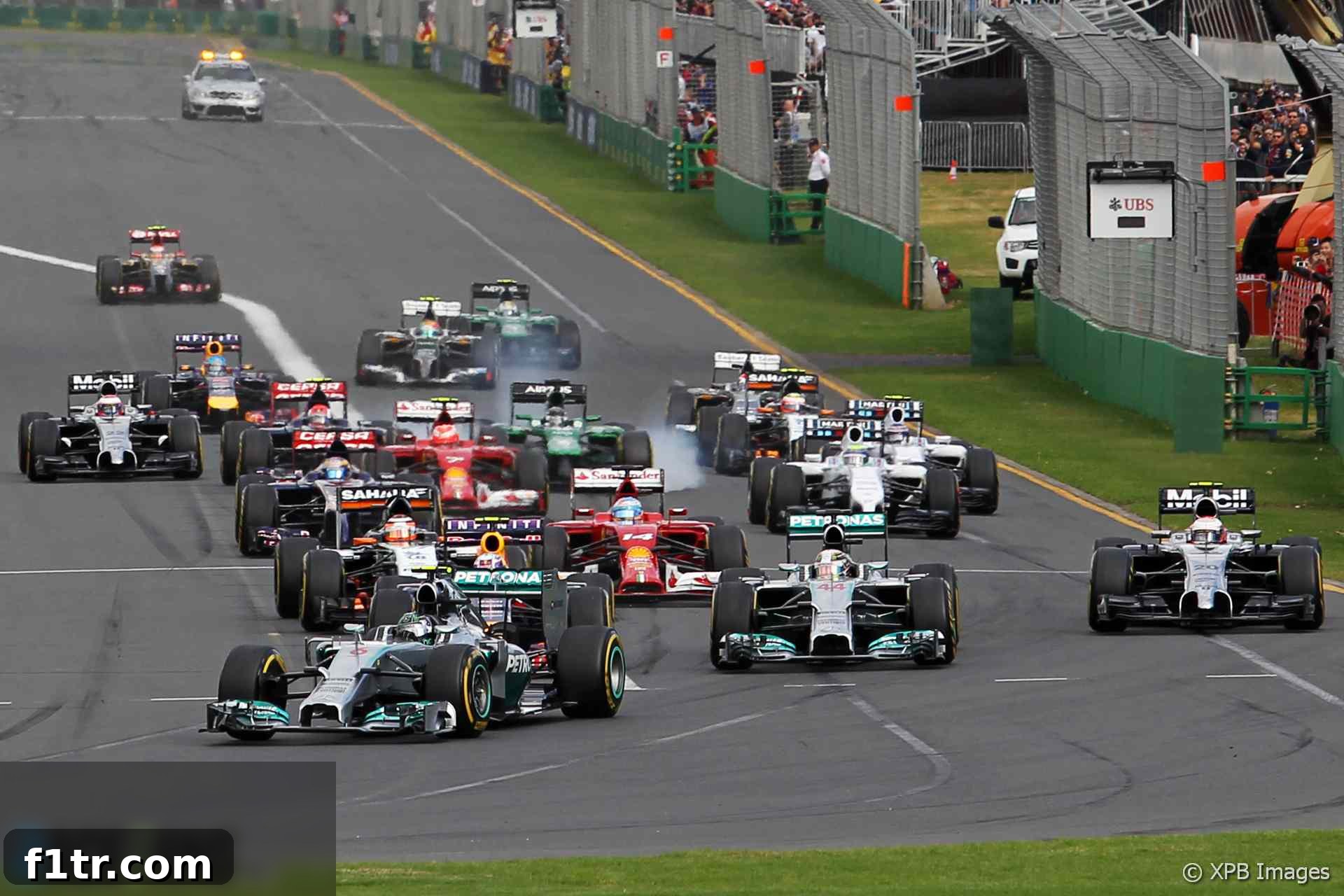
Formula 1 fans first saw the new generation of V6 hybrid turbo cars ten years ago today.
Advert | Become a Supporter & go ad-free
Force India were the first team to officially share an image of their new car, but they were cautious — releasing only a profile rendering of the VJM07. The team kept the unusual nose shape hidden, a design feature driven by the new regulations that many teams adopted.
Those odd nose designs were later addressed by rule tweaks, but another controversial change, at the opposite end of the car, remained. After eight years with one engine formula, Formula 1 adopted another: the V6 hybrid turbo power unit. FIA president Jean Todt, who had taken charge in 2010, pushed for engines designed around hybrid energy recovery from the outset. Although F1 first used hybrid systems in 2009, the 2014 power units incorporated two advanced recovery systems — the MGU-K and the MGU-H — as core components.
The switch from V8s to V6 hybrid turbos had vocal opponents, notably F1 CEO Bernie Ecclestone, who repeatedly criticised the change. His main complaint was the reduced engine noise, and his frustration grew when Mercedes produced a dominant power unit and matched it to a chassis that maximised its advantage. Ecclestone warned promoters and broadcasters that they risked losing audiences.
Ten years on, Ecclestone is gone and the V6 hybrid turbos remain. By the time they are replaced in the future, these rules will have governed the sport for a dozen years and overseen more than 250 grands prix. That longevity raises questions: did the change prove correct, and how have hybrid power units reshaped Formula 1 over the last decade?
Advert | Become a RaceFans supporter andgo ad-free
Reliability
The complexity of the new power units fuelled concerns about reliability when they debuted. Testing in late January 2014 highlighted those worries: not all teams were ready and many completed only a handful of laps. On the opening day at Jerez, only eight cars ran and collective mileage was under 100 laps.
Despite early teething problems, the season opener proved the fears of mass retirements unfounded: of 22 starters, 16 finished. Some manufacturers struggled more than others — Renault and Honda faced persistent issues, with Honda’s partnership with McLaren in 2015 particularly difficult at the start.
To control costs, regulations limited how many power unit components a team could use during a season. Initially, exceeding those limits could mean time penalties during a race; this was later softened to grid penalties, sometimes of absurd magnitude — notably Jenson Button’s 70-place grid drop at the 2015 Mexican Grand Prix.
By 2023, with development frozen for two seasons and teams allowed an extra power unit during a shortened campaign, reliability had become less of a concern. New cycles of rules and calendar changes will continue to test teams in the years ahead.
Advert | Become a RaceFans supporter andgo ad-free
Performance
Initially the V6 hybrid turbos represented a step back in outright performance, but Formula 1’s development pace quickly closed the gap. By 2016 lap times at Silverstone had returned to V8-era levels. Subsequent aerodynamic rule changes — first in 2017 and then again in 2022 — had larger impacts on lap times and handling than the engine change alone.
Competitiveness
Did the V6 hybrid era stifle competition or simply usher in a new form of dominance? The pre-2014 period had its own streaks of supremacy — Red Bull won nine consecutive races to close 2013 — but the first years under the new formula were marked by Mercedes supremacy. They began the era with overwhelming victories, and one senior Mercedes engineer later admitted the team intentionally detuned engines in qualifying to avoid drawing regulatory scrutiny.
Even at the height of Mercedes’ early dominance, title battles still produced close contests: Rosberg and Lewis Hamilton fought for the championship to the final race in 2014 and again later. Rule changes in 2017 narrowed the gap, allowing Ferrari and others to challenge briefly, though Ferrari ultimately failed to capitalise on several opportunities. A contentious private settlement over Ferrari’s power unit subsequently saw them drop back for two seasons.
Honda’s resurgence as an effective engine supplier revived Red Bull, and by 2021 and 2022 another intense title battle unfolded between Max Verstappen and Lewis Hamilton, ending with a controversial finale. Liberty Media’s stewardship, ownership changes, and further aerodynamic reforms in 2022 aimed to promote closer racing. Those changes yielded mixed results: overtaking and close racing improved in places, but Red Bull’s recent dominance has been as pronounced as Mercedes’ earlier era.
Competitors
The early hybrid years consolidated success among the “big three” — Mercedes, Ferrari and Red Bull — while other teams struggled to break through. For six seasons no team outside that trio won a race. The engine rules and the way prize money was distributed contributed to this gap. Liberty Media later adjusted prize money distribution, introduced budget caps and permitted greater development opportunities for lower-ranked teams to help level the field.
The increased costs of hybrid power units squeezed smaller teams. Of the three new teams that entered F1 in 2010, only two made it into the hybrid era. Caterham ran out of money during the first hybrid season and appeared at the finale only after a fundraising drive. Marussia endured the tragic loss of Jules Bianchi at Suzuka; the team continued, helped by Bianchi’s Monaco points that secured ninth in the championship and vital prize money.
Later entrants and team transformations reshaped the grid: Manor (formerly Marussia) fell to the back and eventually exited, while newcomers Haas arrived in 2016. Several teams changed owners and names — Sauber briefly became Alfa Romeo and is on course to become Audi, Force India transformed into Aston Martin, Lotus rebranded as Alpine, and Williams changed ownership but retained its historic name.
One criticism of the hybrid era has been the limited number of engine manufacturers involved. Cosworth exited when hybrids began, leaving Mercedes, Ferrari and Renault as the main suppliers. Honda joined in 2015 and, after early struggles, became competitive before temporarily departing. Looking ahead, the engine landscape is shifting again for the 2026 regulations, which remove the MGU-H and strengthen the electric component. That change, paired with F1’s growing popularity, has attracted interest from several major manufacturers: Honda, Audi, Ford (with Red Bull), and potential entrants such as Porsche and Cadillac in later years.
On to the second era
The arrival of V6 hybrid turbos coincided with a broader shift toward electrification in motorsport. Formula E launched the same year, and many racing series have since explored hybrid or electric technologies. Some argue the 2014 power unit rules were ahead of their time, which may have deterred manufacturers; others note the sport itself was in a different commercial and political environment then.
Bernie Ecclestone’s public objections did little to reassure potential newcomers, whereas current leadership has taken a more positive promotional approach. The confirmed manufacturer commitments for 2026 and expressions of interest from others suggest the power unit direction has been vindicated and that Liberty Media’s efforts to grow the sport have been effective.
Advert | Become a RaceFans supporter andgo ad-free
Formula 1
- Poll: Has the time finally come for Hamilton to hang up his helmet?
- Grosjean felt Renault ‘told everyone I wasn’t good enough for F1’ before return
- There’s one 2026 change Verstappen will approve of: Zero penalty points
- Which F1 drivers have made the strongest start to 2026 against their team mates?
- “Not correct” to say Ferrari should have discovered Antonelli instead of Mercedes
Browse all Formula 1 articles